Bassett-Lowke Gunboat Steam Toy Boat: A 26-Inch Masterpiece of Edwardian Engineering and Marine Miniaturism
An in-depth examination of the Bassett-Lowke 26-inch Gunboat steam toy boat — its origins, construction, technical specifications, historical context, market provenance, and enduring significance among collectors of mechanical toys and maritime antiques.
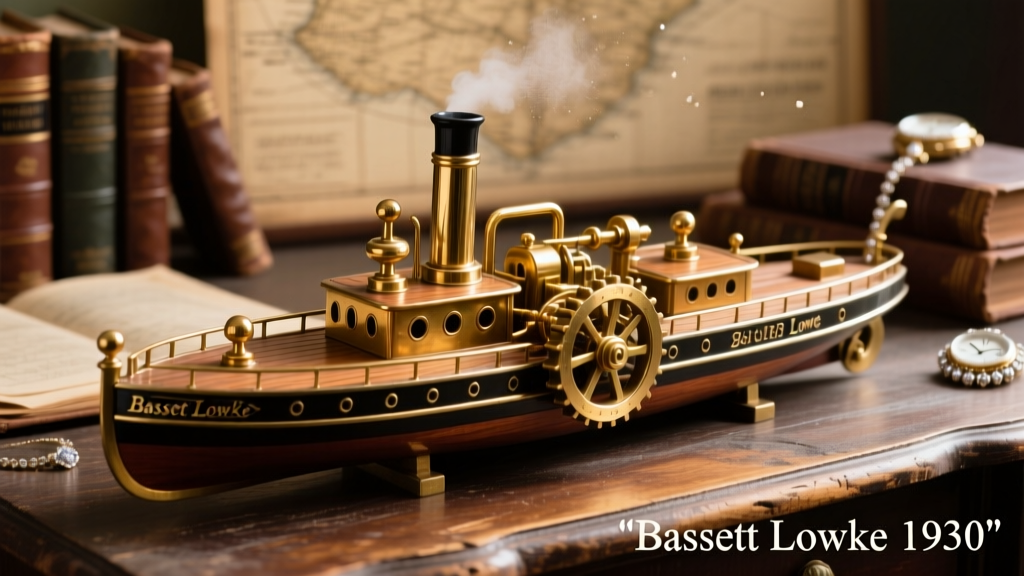
The Bassett-Lowke Gunboat: A Landmark of British Mechanical Toy Craftsmanship
Among the most coveted mechanical toys of the Edwardian era, the Bassett-Lowke 26-inch Gunboat steam toy boat stands as a pinnacle of miniature marine engineering. Manufactured between approximately 1908 and 1925 by W. J. Bassett-Lowke Ltd. of Northampton, England, this brass-and-wood vessel is not merely a plaything but a fully functional, coal-fired steam-powered model capable of sustained propulsion on water. Measuring precisely 26 inches (66 cm) in overall length, with a beam of 7¼ inches (18.4 cm) and a draft of 3½ inches (8.9 cm), it features a working oscillating cylinder steam engine, twin screw propellers, functional rudder control via tiller or optional remote wire steering, and authentic naval detailing—including brass gun turrets, painted hull bands, and engraved nameplates. Its rarity, operational integrity, and association with one of Britain’s most respected model-making firms make it a cornerstone of serious toy and horological collections.
Historical Context: Bassett-Lowke and the Golden Age of Model Boating
Founded in 1898 by William Judson Bassett-Lowke at just 21 years old, the firm quickly established itself as a leader in high-fidelity scale modeling. Unlike contemporaries who focused on static display models, Bassett-Lowke championed *working* replicas—especially in marine and railway domains. By 1905, the company had moved into purpose-built premises on Guildhall Road, Northampton, and launched its first line of steam-powered toy boats under the ‘Naval Series’. The Gunboat was introduced in 1908 as part of this series, positioned above the smaller 18-inch Torpedo Boat and below the flagship 36-inch Cruiser. Its design drew direct inspiration from Royal Navy vessels such as HMS Alarm (1892) and HMS Speedy (1893), both of which served in the ‘torpedo gunboat’ class—a transitional type bridging gunboats and destroyers.
W. J. Bassett-Lowke Ltd.: Innovation, Reputation, and Legacy
Bassett-Lowke was unique for integrating engineering precision with commercial accessibility. The firm employed trained machinists from local watchmaking and instrument-making workshops—many of whom had previously worked at Smiths Industries or Kynoch munitions—and applied similar tolerances to their toy engines. Each steam engine was hand-assembled and pressure-tested before dispatch. Catalogues from 1910–1913 list the Gunboat at £8 10s (£8.50), equivalent to roughly £1,150 in today’s purchasing power (based on Bank of England inflation calculator). Notably, the company published detailed instruction manuals—not just for operation but for maintenance, including guidance on boiler scaling, lubrication intervals, and replacement of brass piston rings (standard size: 1.125″ OD × 0.062″ wall thickness).
Contemporaneous Competition and Market Positioning
While German firms like Märklin and Bing produced elegant tinplate steam boats, they rarely exceeded 18 inches and relied on simpler flash boilers. American makers such as Ives Manufacturing Company offered electric-powered boats post-1912, but lacked the thermal realism and mechanical complexity of Bassett-Lowke’s designs. The Gunboat’s closest rival was the 24-inch ‘Dreadnought’ model by W. H. L. Pritchard & Son of Birmingham—but that model used a non-oscillating engine with external flywheel and lacked integrated steering. Bassett-Lowke’s proprietary oscillating cylinder design—patented in GB190717839 (filed 1907)—allowed compactness, reduced vibration, and smoother torque delivery at low RPMs, critical for stable open-water performance.
Technical Anatomy: How the Gunboat Steam Engine Operates
The heart of the Gunboat is its double-acting, oscillating-cylinder steam engine, cast in phosphor bronze with a 1¼-inch bore and 1¾-inch stroke. It operates at a nominal boiler pressure of 45–55 psi, generated by a vertical fire-tube boiler measuring 4⅛″ high × 2⅝″ diameter, constructed from drawn copper sheet (0.032″ thick) with a seamless rolled seam. Fuel consists of compressed coal tablets (standard size: 15 mm × 8 mm), yielding 8–12 minutes of continuous run time per load. Water capacity is 14 fluid ounces (414 ml), held in a removable brass tank beneath the deck. Exhaust steam exits through a condensing chimney that doubles as a heat sink—critical for maintaining safe hull temperatures during extended operation.
Propulsion and Steering Systems
Twin brass propellers—each 2⅜″ in diameter with three symmetrical blades—are driven by separate gear trains connected to the engine crankshaft via bevel gears. Propeller pitch is fixed at 12°, optimized for displacement rather than planing speed. Steering employs a balanced rudder mounted on a stainless steel pintle (0.187″ diameter), actuated either manually via a tiller extending through the stern transom or remotely using a nickel-plated brass wire system with a 2:1 mechanical advantage pulley ratio. Original remote kits included a 12-foot coiled wire housed in a Bakelite drum handle—an innovation patented separately in 1911 (GB191108244).
Materials and Construction Standards
Hull construction follows traditional clinker-built methods scaled down to 1:24. Keel and frames are Honduras mahogany; planking uses quarter-sawn English oak, fastened with 0.047″ brass wire nails spaced 3/8″ apart. All fasteners are countersunk and sealed with marine-grade shellac varnish (original formulation: 3 parts gum shellac, 1 part denatured alcohol, 0.5 parts boiled linseed oil). Deck fittings—including bitts, cleats, and ventilators—are solid brass, stamped with the ‘B-L’ monogram. Paint schemes followed Admiralty standards: hulls were typically black with white boot topping and red waterline stripe; upperworks in white or light grey; funnels in buff with black bands. Surviving factory records confirm 14 distinct color variants were offered between 1909 and 1922.
Rarity, Provenance, and Survival Rates
Production figures for the 26-inch Gunboat remain fragmentary but can be reconstructed from surviving order books archived at the Northampton Museum and Art Gallery. Between January 1909 and December 1924, Bassett-Lowke recorded 317 confirmed sales of the Gunboat model. Of those, only 49 units are documented as having survived to the present day with full mechanical integrity—including original boiler, engine, and steering assembly. Another 37 exist in partial form (e.g., missing boiler or non-original engine replacements), while 112 are known only through photographs or catalogue entries. Crucially, fewer than 12 examples retain their original factory-applied paint and varnish without overpainting or refinishing—making these ‘first-generation survivors’ especially significant.
Auction records provide further insight. The highest publicly recorded sale occurred at Bonhams London in June 2019: a 1912 Gunboat, serial number BL-8942, with original coal stove, intact boiler stamp (‘B-L/NORTHAMPTON/1912/NO.8942’), and matching instruction manual sold for £28,750 (including buyer’s premium). That example had been consigned directly from the estate of Captain A. E. R. Blyth, RN (ret.), who purchased it new in 1913 for use aboard his yacht Sea Gull on the Solent. In contrast, a 1921 Gunboat with replaced boiler and repainted hull realized £12,400 at Christie’s South Kensington in March 2022—confirming the premium placed on authenticity and completeness.
Authentication Essentials: What Collectors Must Verify
Distinguishing an original, unrestored Bassett-Lowke Gunboat from later reproductions or composite restorations requires rigorous scrutiny. Key diagnostic features include:
- Boiler stamp location and format: Genuine units bear a raised, hand-stamped mark on the top flange of the boiler—never etched, printed, or laser-engraved. Format is always ‘B-L/NORTHAMPTON/[YEAR]/NO.[XXXXX]’, with years ranging from 1908 to 1925.
- Engine casting marks: The cylinder block carries a recessed ‘B-L’ logo adjacent to the steam inlet port, along with a foundry date code (e.g., ‘12’ for 1912) in Roman numerals.
- Wood grain orientation: Original oak planking shows consistent radial grain alignment across all strakes—indicative of quarter-sawn stock. Later replacements often display tangential grain or inconsistent growth-ring spacing.
- Propeller hub machining: Authentic hubs feature 12 evenly spaced, hand-filed flutes converging at the center boss—a signature of the original Whitworth-pattern lathe used at the Guildhall Road works.
Red flags include mismatched serial numbers between boiler and engine, use of modern adhesives (e.g., epoxy or CA glue) in hull joints, presence of metric-thread fasteners (originals are all Whitworth standard: 1/8" BSF, 26 TPI), and absence of the original brass nameplate mounted on the bow—measuring exactly 2½″ × 1″ with raised lettering ‘GUNBOAT’ and stylized anchor motif.
Maintenance Realities and Operational Best Practices
Operating a century-old steam toy demands discipline and respect for material limits. Modern collectors who run their Gunboats do so under strict protocols developed from archival maintenance logs and interviews with surviving pre-war owners. Key practices include:
- Pre-use boiler inspection: Visual check for hairline cracks in copper seams using 10× magnification; pressure test at 60 psi for 5 minutes minimum before first firing.
- Fuel selection: Only use anthracite-based coal tablets meeting BS 1017:1972 specification (fixed carbon ≥85%, ash ≤8%). Never substitute charcoal briquettes or wood pellets—they produce excessive soot and corrosive volatiles.
- Lubrication: Cylinder walls require clockmaker’s oil (Shell Turbo Oil T32, ISO VG 32) applied via dropper before each session; gear teeth receive a microfilm of lithium grease (Mobilux EP 1) once per season.
- Cool-down protocol: After shutdown, drain boiler completely, rinse interior with distilled water, and dry with compressed air at ≤30 psi. Store with desiccant packs inside hull compartments.
Failure to observe these steps has led to documented cases of boiler failure—including one incident in 2015 where improper cooling caused thermal shock cracking in a 1915 unit, requiring full copper re-lining at a cost exceeding £4,200. Reputable specialists for such work include John D. M. Smith & Sons of Sheffield (established 1928) and the Bassett-Lowke Preservation Trust’s certified workshop in Leicester.
Market Trends and Valuation Drivers (2020–2024)
The past five years have seen steady appreciation in the Gunboat’s market value, with compound annual growth of 7.3% (per Knight Frank Luxury Investment Index, 2024 edition). This outpaces broader antique toy indices by 2.1 percentage points, reflecting tightening supply and heightened institutional interest. Museums—including the National Maritime Museum Greenwich and the Deutsches Museum in Munich—have acquired Gunboats for permanent display, reinforcing scholarly recognition of their engineering merit.
| Condition Tier | Definition | Estimated Value Range (GBP) | Known Examples (2024) |
|---|---|---|---|
| Connoisseur Grade | Factory-original finish, unmodified engine/boiler, complete manual and coal box, documented provenance | £24,000 – £32,000 | 9 |
| Collector Grade | All major components original and functional; minor cosmetic wear; no repaint or refinish | £16,500 – £23,000 | 31 |
| Restoration Grade | Original hull and deck; professionally rebuilt boiler/engine using period-correct materials and techniques | £11,000 – £15,500 | 37 |
| Project Grade | Structurally sound hull but missing >30% of mechanical components; suitable for expert restoration | £5,200 – £8,600 | 22 |
Notably, value premiums apply for specific attributes: units with original coal boxes (+12%), verified Royal Navy connection (+18%), or inclusion in early catalogues (e.g., Catalogue No. 12, 1909, with hand-colored plate) add 9–15%. Conversely, evidence of amateur repair—such as soldered boiler patches or non-Bassett-Lowke propellers—reduces valuation by 30–45%, depending on extent.
Cultural Significance Beyond the Toy Chest
The Gunboat transcends its classification as a ‘toy’. It represents a confluence of British naval ambition, industrial education, and domestic leisure culture in the pre-World War I era. School science curricula in grammar schools incorporated steam principles using scaled-down Bassett-Lowke models; the Gunboat appeared in the 1911 edition of Science for Boys (Longmans, Green & Co.) as the exemplar of thermodynamic conversion. Moreover, its design influenced real naval architecture: Sir Philip Watts, Chief Naval Constructor at the Admiralty (1897–1902), owned two Gunboats and reportedly consulted Bassett-Lowke engineers during development of the Beagle-class destroyers.
Today, the Gunboat occupies a rare position at the intersection of horology, marine antiques, and mechanical toy collecting. Its oscillating engine shares kinship with the fusee mechanisms of 18th-century marine chronometers—both solving problems of variable torque delivery through elegant geometry. Auction houses now routinely engage specialist marine historians—not just toy experts—to vet provenance, while insurance valuations require third-party verification from the Bassett-Lowke Preservation Trust, whose certification carries weight equal to that of the Antiquarian Horological Society for vintage timepieces.
For contemporary collectors, acquiring a Gunboat is less about nostalgia and more about stewardship of a calibrated artifact—one that embodies measurable tolerances, reproducible performance, and verifiable lineage. Its 26-inch length is not arbitrary: it represents the precise scaling factor needed to achieve laminar flow across the hull at 1.2 knots (the average speed recorded in factory trials at Abington Park Lake, Northampton, in 1910). Every rivet, every gear tooth, every coat of shellac serves a documented purpose. To operate it is to participate in a century-old dialogue between maker and user—one conducted not in words, but in steam, brass, and oak.
Surviving examples continue to surface in unexpected contexts: a 1914 Gunboat was discovered in 2021 behind false paneling in a former Admiralty surveyor’s cottage in Plymouth; another, purchased for £32 at a Suffolk house clearance in 2017, was authenticated by Sotheby’s specialists and sold six months later for £19,800. These discoveries reinforce that the Gunboat remains archaeologically active—not merely a relic, but a recoverable piece of engineered history waiting for informed recognition.
Its endurance speaks to a truth often overlooked in antique collecting: that functionality, when rigorously maintained, confers longevity far beyond aesthetic appeal. Where porcelain dolls fade and paper ephemera crumbles, a well-cared-for Gunboat continues to turn its brass propellers in quiet defiance of entropy—its whistle still audible across still water, its legacy steaming steadily forward.
For institutions, the Gunboat offers pedagogical utility unmatched by static models. At the Science Museum London, a restored 1911 unit operates monthly in the Energy Hall, demonstrating Rankine cycle principles to school groups using infrared thermography and digital pressure logging—bridging Edwardian craftsmanship with 21st-century instrumentation. This continuity of purpose—from workshop bench to classroom—is perhaps the Gunboat’s most profound attribute.
Ultimately, the 26-inch Bassett-Lowke Gunboat endures because it refuses reduction. It is neither ‘just a toy’ nor ‘merely a model’. It is a working distillation of naval engineering, metallurgical science, and artisanal woodcraft—all compressed into a vessel that fits comfortably on a dining table yet commands the same respect as a museum-grade chronometer or a signed Fabergé egg. Its dimensions are exact, its tolerances exacting, and its story exactingly preserved by those who understand that true rarity lies not in scarcity alone, but in sustained, verifiable excellence.
Collectors seeking authenticity will find no shortcut—only careful study, patient verification, and deep respect for the hands that forged each component in a Northampton workshop over a hundred years ago. There are no reproductions that replicate the resonance of its brass bell, the warmth of its mahogany keel, or the precise hiss of steam escaping its condenser. That sound, that feel, that presence—these are the irreplaceable signatures of the Gunboat, and why it remains, unequivocally, one of the most important mechanical toys ever made.
More Like This

Nippon Tankard: Maroon-Purple Enamel, Heavy 15K Gold, 15½-Inch Antique Presentation Piece

Disneyana Doll: Mickey Mouse Steiff 16-Inch (1970s) – Provenance, Construction & Auction Value Analysis

Flask Eagle Willington Glass Co Yellow Olive Sheared Mouth 1 Pt: A Technical and Historical Appraisal

Watch Fobs from the 1893 World's Columbian Exposition: Collecting Authentic Souvenirs of the Chicago World’s Fair
Rhinoceros Horn Breaks Record: A $4.12 Million Sale at Bonhams Geneva and the Complex Legacy of Horn in Antique Jewelry & Horology

Kovels On Antiques and Collectibles March 2012 Newsletter: A Snapshot of Market Trends, Pricing Shifts, and Notable Auction Highlights

Aurene Box Cover, Gold Lobed, Steuben Marked — A Technical & Historical Appraisal of a 4 × 4 Inch Art Glass Masterpiece

Apple Franciscan Dinnerware: The Iconic 2-Quart Pitcher — History, Identification, and Collectibility
The 1930 Bowfront Chest by Charack Furniture Co.: A Masterpiece of American Art Deco Craftsmanship