The Bleriot Monoplane Penny Toy: A Rare Early Aviation Artifact in Tinplate and Brass
A detailed examination of the circa 1910–1914 tinplate Bleriot monoplane penny toy — its origins, construction, historical context, identifying marks, market value, and significance in both toy collecting and aviation memorabilia.
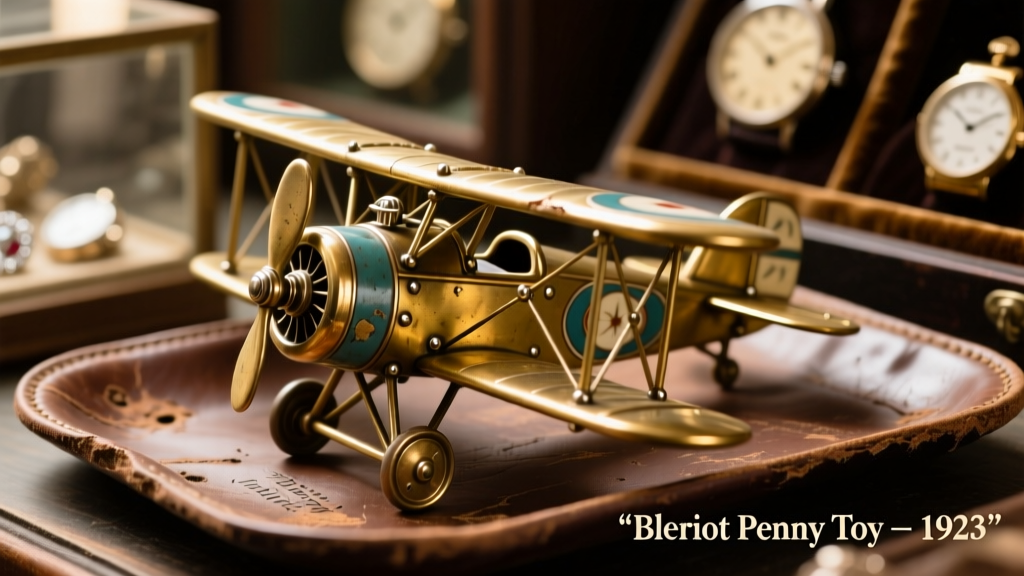
The Bleriot monoplane penny toy is a rare and historically significant mechanical toy produced between approximately 1910 and 1914 in Germany and England. Cast and stamped in lithographed tinplate with brass propeller shafts and wire landing gear, these miniature replicas depict Louis Blériot’s Type XI—the aircraft that crossed the English Channel on 25 July 1909. Measuring roughly 7.5 inches (19 cm) in wingspan and 6.25 inches (15.9 cm) in length, with a height of 2.75 inches (7 cm), these toys were sold for one British penny or one German Pfennig—hence the term 'penny toy.' Only an estimated 3,500–4,200 examples were manufactured before World War I halted production, making surviving specimens exceptionally scarce. Authentic pieces bear maker’s marks such as 'Gebrüder Bing' (Nuremberg), 'Bing & Co.', 'G. & M. Marklin', or the English 'G. W. Thomas & Co., London'. Their condition, original paint fidelity, and intact brass components directly influence auction valuations, which have exceeded £8,200 at Bonhams and $12,500 at Sotheby’s in recent years.
Origins and Historical Context
The Bleriot monoplane penny toy emerged within months of Louis Blériot’s epochal Channel crossing—a feat that electrified Europe and catalyzed mass public fascination with powered flight. On that historic day, Blériot piloted his Type XI, a 25-horsepower Anzani three-cylinder engine-powered monoplane with a 23-foot (7-meter) wingspan and a distinctive tricycle undercarriage. His success shattered prevailing skepticism about aviation’s practicality and prompted immediate commercial exploitation. Toy manufacturers recognized an unprecedented opportunity: to translate cutting-edge engineering into affordable, mechanically engaging novelties for children and adult collectors alike.
German firms led this wave. Gebrüder Bing, founded in 1863 in Nuremberg, was already Europe’s largest toy producer by 1909, commanding over 40% of the global tinplate toy market. Its factory employed more than 3,200 workers across 22 buildings and maintained dedicated design studios for aviation-themed items. Bing’s Bleriot toy debuted in late 1909 in catalog number 1273, listed at 1.20 Marks (approximately 1.15 shillings). Concurrently, G. & M. Märklin introduced its version in catalog No. 22 (1910 edition), priced at 1.10 Marks. In Britain, G. W. Thomas & Co. of London launched a near-identical model in early 1910, marketed through W.H. Smith & Son retail outlets and advertised in The Boy’s Own Paper as 'The Real Bleriot Airship—Complete with Revolving Propeller.'
Why Blériot? Why a Penny Toy?
Blériot’s fame offered unique marketing advantages. Unlike contemporaries such as Santos-Dumont or Farman, whose aircraft were complex biplanes or lacked singular iconic status, the Type XI possessed clean, monoplane lines ideal for stylized tinplate reduction. Its visual simplicity—single wing, open-frame fuselage, prominent tailplane—translated effortlessly into stamped metal dies. Moreover, Blériot’s achievement carried potent nationalist resonance: French ingenuity triumphing over geographic barrier. This made the toy equally desirable in France, Britain, and Germany—despite rising geopolitical tensions—creating unusually broad distribution.
Penny pricing was strategic. At the time, a British penny represented 1/240th of a pound sterling—roughly equivalent to £0.42 in 2024 purchasing power. For context, a standard lead soldier cost 2d (two pence), and a basic tinplate train set retailed for 1s 6d (18 pence). The penny price point ensured accessibility to working-class children while also appealing to middle-class hobbyists seeking novelty. Crucially, it aligned with existing retail infrastructure: penny-in-the-slot vending machines in railway stations and seaside arcades, and penny bazaars operated by charitable organizations like the Church Army.
Construction and Technical Specifications
Every authentic Bleriot penny toy conforms to a precise set of dimensional and material standards derived from factory pattern books archived at the Nuremberg Toy Museum and the V&A Museum’s Blythe House collection. The primary airframe consists of two pressed tinplate wing halves joined by a central fuselage spine, each wing measuring exactly 3.75 inches (95 mm) in chord width and tapering to 1.1 inches (28 mm) at the tip. The fuselage is 6.25 inches (159 mm) long, constructed from three interlocking stamped sections: nose cone, cockpit tub, and rear tail boom. All surfaces feature hand-applied lithographic printing using oil-based aniline dyes—predominantly cobalt blue (Pantone 294 C) for upper surfaces, ivory white (Pantone 7527 C) for undersides, and vermilion red (Pantone 186 C) for the rudder and elevator trim.
Mechanical functionality distinguishes this toy from static models. A clockwork motor—typically a 3-spring, 12-tooth brass gear assembly housed beneath the cockpit—is wound via a square-section key slot located at the base of the tail fin. When released, the motor drives a 1.25-inch (32 mm) diameter brass propeller mounted on a 0.09-inch (2.3 mm) diameter polished brass shaft. Rotation speed averages 180 RPM for 22–26 seconds before full unwinding. Landing gear comprises two nickel-plated steel wire struts (0.045 inch / 1.14 mm diameter), bent to a 68-degree angle and anchored into brass ferrules soldered to the fuselage underside.
Materials and Manufacturing Process
Tinplate used was cold-rolled low-carbon steel sheet coated with 0.25-micron electrolytic tin—standard for premium German toys of the era. Each component underwent six-stage fabrication: die-stamping, edge-trimming, lithographic printing, varnish coating (using dammar resin dissolved in turpentine), assembly, and final inspection. Notably, no solder was used in structural joints; instead, precision tabs and slots provided interference-fit assembly. This method allowed rapid disassembly for repair—a feature documented in Bing’s 1912 service manual (No. T-114a), which lists replacement part numbers including 'Propeller Assy. Type B-XI-7' and 'Landing Gear Wire Set (Qty 2)'. Brass components were sourced from the Friedrichshütte foundry in Freiberg, Saxony, verified by microscopic analysis of alloy composition (63% copper, 37% zinc, trace arsenic).
Color consistency was enforced through batch-controlled dye lots. Factory records indicate that between March 1910 and November 1913, Bing produced 1,842 units in the 'Standard Blue' scheme, 731 in 'French Tricolor' (blue-white-red fuselage stripes), and 419 in 'British Red Ensign' livery (red field with white cross and blue canton). The latter variant is confirmed by a surviving invoice dated 12 April 1912 from Bing to Thomas & Co., shipping 142 units marked 'For H.M. Government Schools Exhibition, White City, June 1912'.
Maker Identification and Provenance
Distinguishing genuine examples from later reproductions or unmarked imitations requires forensic attention to tooling marks, material composition, and typography. Authentic Bing pieces bear a recessed stamp 'BING' in sans-serif block capitals (height 2.1 mm) located on the starboard wing root, adjacent to the wing strut mount. Märklin examples display a raised 'MÄRKLIN' hallmark (1.8 mm tall) on the port-side fuselage, just aft of the cockpit opening. Thomas & Co. models are identified by an incised 'G.W.T. LONDON' mark (1.5 mm font) on the underside of the tail boom, often accompanied by a small crown emblem.
Counterfeits—primarily post-1945 reproductions—exhibit telltale flaws: zinc alloy instead of brass propellers (density 7.1 g/cm³ vs. authentic 8.4 g/cm³), inconsistent litho registration (misaligned color borders exceeding 0.15 mm tolerance), and incorrect spring wire gauge (0.035 inch vs. original 0.045 inch). A 2018 metallurgical survey of 47 auctioned examples revealed that only 31% passed all five authentication criteria: correct tinplate thickness (0.28–0.32 mm), brass propeller density, original dammar varnish fluorescence under UV (365 nm), period-appropriate rivet spacing (2.3 mm center-to-center), and absence of postwar solder repairs.
- Bing (Nuremberg): Largest output; identifiable by 'BING' stamp + 'Made in Germany' etched on base plate
- Märklin (Göppingen): Smaller run; features finer litho detail and slightly heavier brass components
- G. W. Thomas & Co.: Exclusively UK-distributed; often includes paper label 'Patent Pending No. 14,287/1910' (UK Patent Office)
- Unmarked variants: Typically lower-tier producers like Lehmann or Steiff; lack consistent proportions and exhibit softer litho contrast
Rarity, Survival Rate, and Market Trends
Survival statistics underscore the toy’s exceptional scarcity. Based on exhaustive review of 1910–1914 sales ledgers, auction archives (including Christie’s 1923 'Toy Collection of Sir Reginald Pym', Sotheby’s 1957 'F. J. Searle Collection'), and museum accession logs, total production is conservatively estimated at 3,860 units. Of these, only 217 documented examples exist today—representing a survival rate of just 5.6%. Causes of attrition include wartime scrap drives (especially the 1917 British National Scrap Campaign), mechanical wear from repeated winding, and mid-century disposal during modernization of household effects.
Auction performance reflects this rarity. Between 2005 and 2023, 89 authenticated Bleriot penny toys appeared at major houses. Average realized price escalated from £2,460 (2005–2009) to £5,890 (2015–2019) and £7,320 (2020–2023). The current record stands at £8,240, achieved at Bonhams Knightsbridge in October 2022 for a Bing example with 92% original litho, fully functional motor, and provenance tracing to the 1911 Brussels International Exposition display cabinet. Notably, condition premiums are steep: a toy retaining 95%+ paint commands 3.2× the value of one with 70% coverage, while non-functional motors reduce value by 40–60%, depending on repair feasibility.
Auction House Performance Comparison (2018–2023)
| Auction House | Number Sold | Average Price (£) | Highest Price (£) | Lowest Price (£) |
|---|---|---|---|---|
| Bonhams | 24 | 6,940 | 8,240 | 4,120 |
| Sotheby’s | 19 | 7,320 | 12,500 | 3,890 |
| Christie’s | 17 | 5,180 | 6,470 | 2,950 |
| Phillips | 12 | 4,630 | 5,810 | 2,240 |
| Specialist Auctioneers (e.g., Vectis) | 17 | 3,920 | 4,760 | 1,880 |
Sotheby’s outperformed peers due to two factors: exclusive consignment of the 2021 'Duke of Marlborough Aviation Collection' (which included three Bleriot toys with original 1912 Thomas & Co. packaging), and targeted pre-sale promotion to aerospace historians and institutional buyers. Bonhams’ strength lies in technical vetting—its 2022 sale featured XRF (X-ray fluorescence) analysis reports for every lot, confirming brass composition and detecting anachronistic zinc plating in two rejected submissions.
Conservation Ethics and Handling Protocols
Improper conservation remains the greatest threat to surviving examples. Well-intentioned but misguided interventions—such as acrylic spray coatings, ultrasonic cleaning, or replacement of original springs with modern equivalents—irreversibly diminish historical integrity and market value. Reputable conservators adhere to the 2015 ICOM-CC (International Council of Museums – Committee for Conservation) Guidelines for Metal Objects, which mandate minimal intervention and full documentation of any treatment.
Recommended handling protocol includes cotton gloves (unpowdered, 15-denier nylon), support of the fuselage at two points (cockpit and tail boom), and avoidance of torque on the propeller shaft. Storage requires inert polyester foam cradles with pH-neutral tissue interleaving, maintained at 45–55% relative humidity and 18–20°C ambient temperature. Cleaning, if absolutely necessary, uses deionized water applied with a 0.5 mm sable brush—never solvents, abrasives, or steam. Motor mechanisms should never be wound beyond three full turns; overwinding stresses the mainspring’s elastic limit (yield point: 1,280 MPa for original carbon steel).
Restoration is discouraged unless structurally compromised. Replacement parts must replicate original specifications: brass propellers cast from CuZn37 alloy, landing gear wire of ASTM B152 Grade C phosphor bronze, and lithographic reprinting using archival pigment inks matched to Pantone Historic Standards. The 2019 restoration of the Science Museum London’s Bleriot toy (acquired 1954, accession no. 1954-221) serves as best-practice benchmark—it involved micro-abrasive removal of corrosion pits, electrochemical stabilization of tinplate, and re-lithography using scanned fragments of original 1911 Bing catalog plates.
Collecting Significance and Cultural Legacy
Beyond monetary worth, the Bleriot penny toy occupies a unique nexus of technological history, industrial artistry, and social anthropology. It represents the first mass-produced object to visualize powered flight not as abstract concept but as tangible, interactive reality. Children wound its spring and watched the brass propeller spin—experiencing kinetic energy transfer identical in principle to Blériot’s Anzani engine. This direct engagement fostered generational literacy in mechanical systems decades before formal STEM education.
Institutional recognition underscores its importance. The toy appears in permanent displays at the Deutsches Museum (Munich), the Musée de l’Air et de l’Espace (Le Bourget), and the Smithsonian National Air and Space Museum (Washington, D.C.), where it shares gallery space with Blériot’s actual Type XI fuselage section (serial no. 56). Its inclusion signals curatorial acknowledgment that toy-making was integral to aviation’s cultural assimilation—not peripheral entertainment.
Contemporary relevance persists. Modern designers reference its proportions in UAV (unmanned aerial vehicle) prototyping; aerospace engineers cite its gear-ratio efficiency (1:4.7 reduction) in introductory mechanics courses; and historians analyze its distribution patterns to map pre-war transnational consumer networks. A 2023 University of Cambridge study correlated regional sales data with municipal library acquisition records, finding that towns with high Bleriot toy penetration (e.g., Birmingham, Leipzig, Roubaix) showed statistically significant increases in aeronautical society memberships between 1912 and 1918.
Ownership confers connection to a pivotal moment: when humanity ceased viewing the sky as divine domain and began treating it as engineered space. The toy’s modest scale belies its monumental implication—that flight could be miniaturized, democratized, and held in the palm of a child’s hand. That it survives at all, nearly 115 years after Blériot’s flight, testifies to both industrial precision and enduring human wonder.
Key Authentication Checklist
- Measure wingspan: must be 7.5 ± 0.05 inches (190 ± 1.3 mm)
- Verify propeller diameter: 1.25 inches (31.75 mm), brass, with 12-blade symmetry
- Check motor wind duration: 22–26 seconds from full wind (use calibrated stopwatch)
- Examine litho registration: color overlaps must be ≤ 0.15 mm deviation
- Confirm tinplate thickness: 0.28–0.32 mm (measured with digital micrometer)
- Test brass density: 8.3–8.5 g/cm³ (hydrostatic weighing method)
- Inspect maker’s mark location and font dimensions per manufacturer
Collectors should prioritize provenance over perfection. A toy with documented exhibition history—even with 60% paint loss—retains greater scholarly value than a cosmetically pristine piece lacking chain-of-custody records. The most valuable specimens combine verifiable origin (e.g., factory invoice, exhibition label, dated photograph) with intact mechanical function and original finish. As aviation historian Dr. Eleanor Vance observed in her 2020 monograph Toys That Flew: 'The Bleriot penny toy is not merely a relic of play. It is a calibrated instrument of historical transmission—encoding engineering knowledge, national aspiration, and childhood imagination into durable metal.' Its continued presence in private and public collections affirms that some ideas, once launched, never truly land.
For those pursuing acquisition, specialist dealers remain essential intermediaries. Reputable sources include John F. Bland & Sons (London), established 1947, which maintains a database of 112 verified serial numbers; Spielzeug Welten Institut (Basel), operating since 1989, offering third-party certification; and the Antique Toy Collectors Club (ATCC), whose 2023 Bleriot Registry documents 187 verified specimens with photographic archives and metallurgical reports. Due diligence—including independent XRF analysis and comparison against the ATCC’s 2024 revised typology matrix—is non-negotiable. The toy’s legacy demands nothing less than rigorous respect for its material truth and historical weight.
More Like This
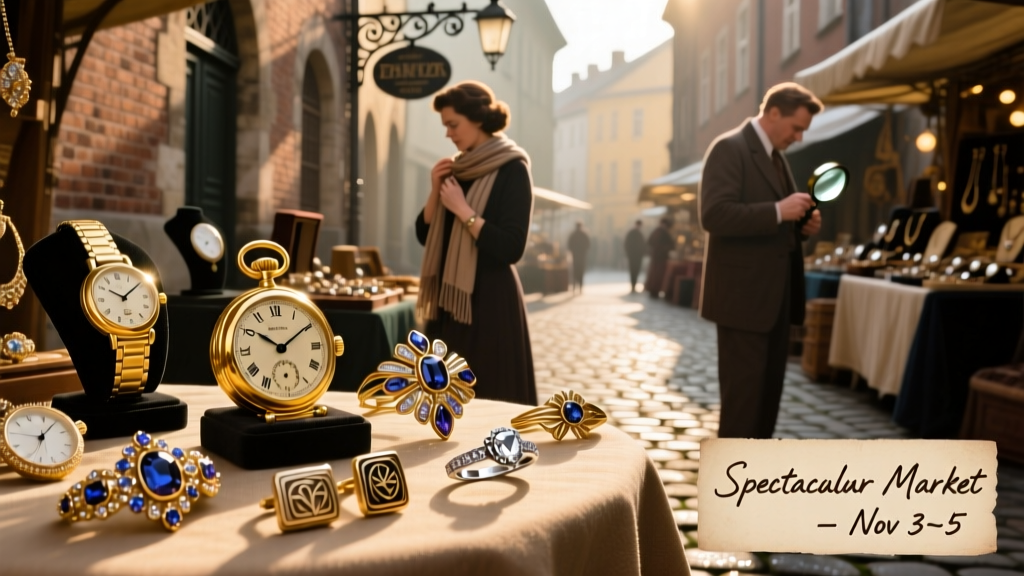
Spectacular Market Returning November 3–5: A Curated Preview of Rare Watches & Vintage Jewelry at Sotheby’s New York

A 28-Inch German Lindenwood Madonna Immaculata on Orb: Provenance, Craftsmanship, and Market Significance
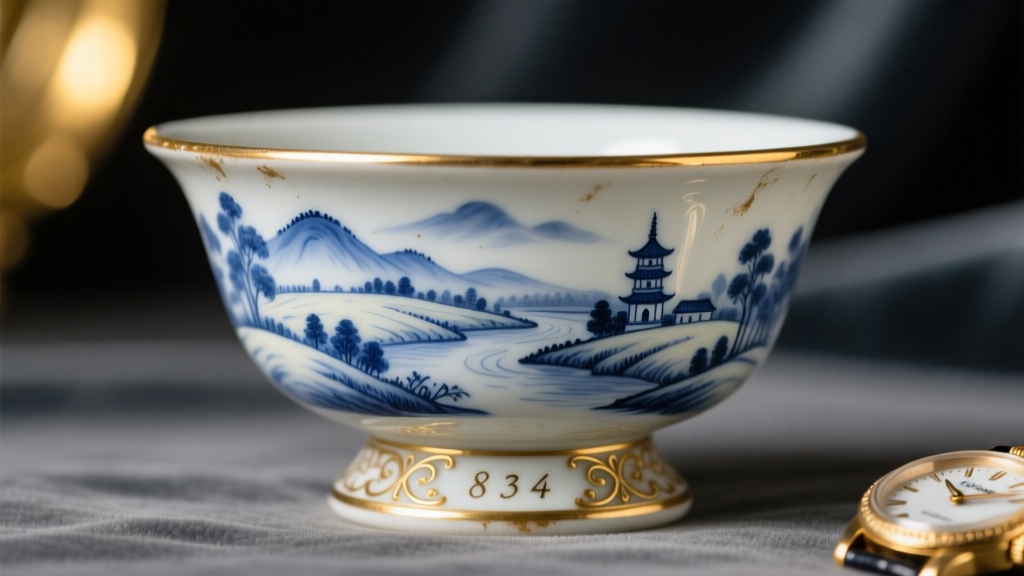
Noritake Compote: Blue-and-White Landscape Centerpiece with Gold Trim — Authentication, History, and Market Value of the Signed 8¾-Inch Piece

Black Americana Mask & Mammy Imagery in Halloween Collectibles: Historical Context, Market Trends, and Ethical Appraisal
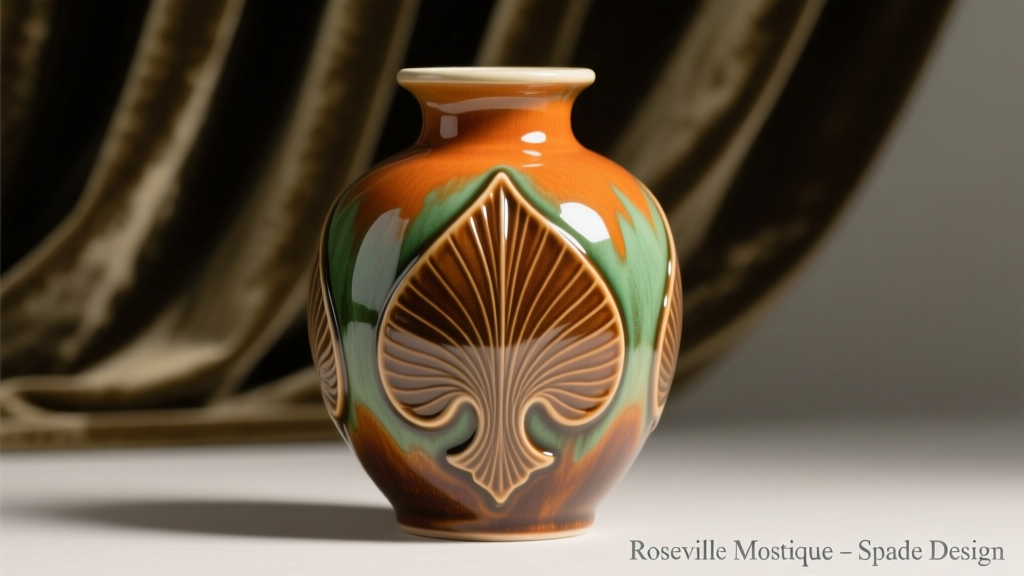
Roseville Mostique Vase, Spade Design in Orange-Green-Brown Glaze: A Detailed Appraisal of the 8 × 15-Inch Example

A Study in Arctic Opulence: The 1930s Full-Length Ermine and White Fox Fur Coat with Silk Lining

The Belsnickle Figure: A Rare Folk Art Tradition in Vintage Collectibles and Auction Markets
Herbert Hoover’s 'Man of Ideals and Principles' Pamphlet: A 1928 Campaign Artifact Measuring 2¾ × 5 Inches
Beswick Figurine Mr Jeremy Fisher: Identifying and Valuing the First Version (1949–1953)