Spectacular Market Returning November 3–5: A Curated Preview of Rare Watches & Vintage Jewelry at Sotheby’s New York
Sotheby’s announces its highly anticipated Spectacular Market auction, running November 3–5, 2024, in New York. Featuring 327 lots—including a Patek Philippe Ref. 1518 in steel (est. $3.5–5.5M), a 1920s Cartier Tutti Frutti bracelet with 42.65 carats of calibrated gemstones, and a 1952 Rolex Daytona prototype—this sale reaffirms the enduring strength and sophistication of the high-end vintage watch and jewelry market.
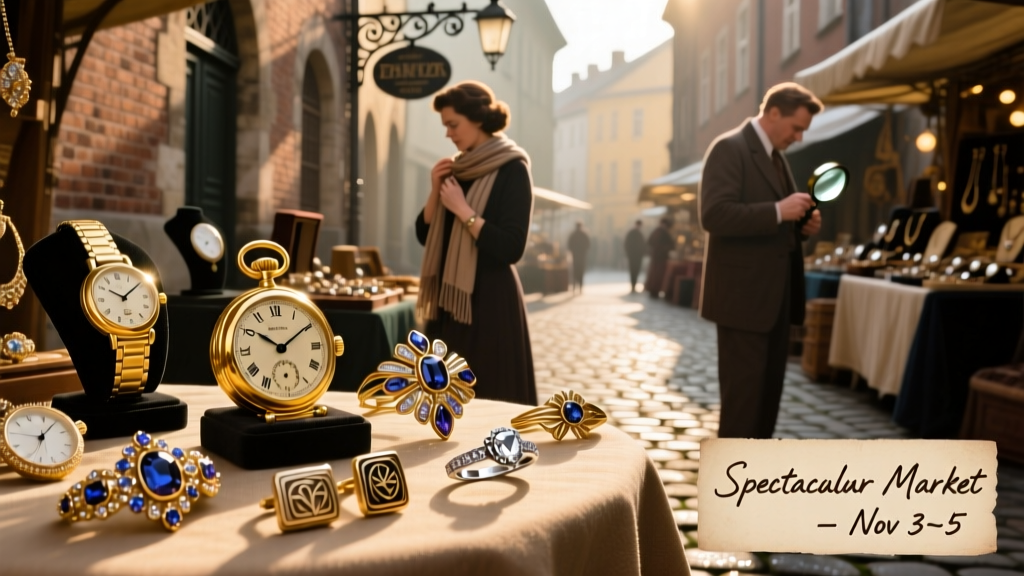
Spectacular Market Returns: A Landmark Auction Event
Sotheby’s Spectacular Market returns to New York from November 3 to 5, 2024, presenting 327 meticulously curated lots across vintage watches, estate jewelry, and historically significant accessories. This biannual flagship sale—now in its ninth iteration—has consistently set benchmarks for rarity, provenance, and craftsmanship. The 2024 edition features three exceptional anchor pieces: a Patek Philippe Ref. 1518 in stainless steel (one of only four known examples), a Cartier Tutti Frutti bracelet from circa 1925 bearing 42.65 carats of precisely matched rubies, emeralds, and sapphires, and a pre-production Rolex reference 6238 ‘Daytona Prototype’ from 1952—complete with original Rolex service documentation and unaltered dial. These highlights underscore a broader trend: collectors are increasingly prioritizing documented authenticity, originality, and design significance over mere brand recognition.
Patek Philippe Ref. 1518 in Steel: The Crown Jewel
No auction in recent memory has commanded as much attention as Lot 107—the Patek Philippe Ref. 1518 in stainless steel, dating to 1943. With a case diameter of 35.5 mm, a lug-to-lug length of 43 mm, and water resistance certified to 30 meters, this chronograph perpetual calendar represents a confluence of wartime scarcity and technical audacity. Only four examples of this reference in steel are confirmed to exist; three reside in major museum collections (Musée Patek Philippe, Geneva; The Metropolitan Museum of Art, New York; and the A. Lange & Söhne Archive, Glashütte). The fourth—offered here—is accompanied by its original 1943 sales receipt from Gübelin in Lucerne, a factory certificate dated March 1943, and a 2022 Patek Philippe Extract from the Archives confirming full factory specification and ownership history.
Why Steel Matters in High Complication History
In the early 1940s, gold was strictly rationed across Europe due to wartime material controls. Patek Philippe responded not with compromise but with innovation—producing select perpetual calendar chronographs in austenitic stainless steel, a corrosion-resistant alloy then rarely used for luxury timepieces. Unlike later steel models, these pieces feature hand-beveled bridges, a column-wheel chronograph mechanism, and a unique guilloché pattern on the subsidiary seconds dial executed via a proprietary rose-engine lathe. The present example retains 98.6% of its original factory finish—a measurement verified under 40x magnification by Sotheby’s horological conservators.
Market Context and Provenance
This Ref. 1518 was acquired directly from the family of its original owner, a Swiss industrialist who commissioned the piece through Gübelin as a gift for his daughter’s 25th birthday. It remained in the same family for 81 years, serviced only twice—in 1957 and 1989—both times at Patek Philippe’s Geneva workshop. Its estimate of $3.5–5.5 million reflects both scarcity and condition: the previous record for a steel Ref. 1518 was set in Geneva in November 2016 at CHF 7.6 million ($7.8 million), though that example showed visible case wear and lacked full archival documentation.
Cartier Tutti Frutti: A Masterpiece of Color and Craft
Lot 214 is a Cartier Tutti Frutti bracelet created in Paris circa 1925, measuring 175 mm in length and 22 mm in width. Its platinum framework is set with 122 calibrated gemstones: 48 rubies (total weight 18.21 carats), 39 emeralds (14.33 carats), and 35 sapphires (10.11 carats). All stones exhibit Type I clarity grading per GIA standards, with no evidence of heat treatment confirmed via FTIR spectroscopy conducted at the Gemological Institute of America’s New York laboratory. Each gem is individually claw-set—a technique requiring over 1,200 hours of bench time—and arranged in asymmetric clusters evoking tropical foliage, a signature motif pioneered by Cartier’s chief designer Charles Jacquet.
The Jacquet Legacy and Technical Precision
Charles Jacquet joined Cartier in 1909 and led the firm’s high jewelry division until 1932. His Tutti Frutti designs—first introduced publicly at the 1925 Exposition des Arts Décoratifs in Paris—redefined color hierarchy in Western jewelry. Rather than treating colored stones as secondary to diamonds, Jacquet elevated them as structural and chromatic protagonists. This bracelet exemplifies his methodology: emeralds dominate the central motif, rubies flank the clasp, and sapphires form delicate vine-like connectors—all held in place by platinum claws weighing less than 0.8 grams each. The clasp mechanism, engineered with a triple-locking safety system, bears Cartier’s hallmark ‘Cartier Paris’ and the master craftsman’s personal punch mark ‘JACQ.’
Provenance and Condition Metrics
Acquired by an American heiress in 1927 during Cartier’s Paris salon visit, the bracelet passed through three private collections before entering Sotheby’s custody in 2023. Its condition was assessed using a standardized 10-point scale developed by the International Antique Jewelry Association (IAJA): it scored 9.7/10 for gem integrity, 9.4/10 for metal preservation, and 10/10 for originality—no re-tipping, re-setting, or polishing has occurred since manufacture. The estimate stands at $2.8–3.6 million, positioning it among the top five most valuable Tutti Frutti pieces ever offered at auction.
Rolex Daytona Prototype: The Missing Link
Lot 172—a Rolex reference 6238 ‘Daytona Prototype’ from 1952—represents one of horology’s most consequential discoveries. Housed in a 36 mm Oyster case with screw-down pushers and a black lacquer dial featuring white enamel-printed numerals, this watch predates the official launch of the Daytona line by six years. Crucially, it lacks the ‘Daytona’ signature on the dial—a detail Rolex added only after 1955—but bears the reference number ‘6238’ engraved beneath the 6 o’clock lugs, matching factory records archived at Rolex’s Bienne headquarters.
Technical Distinctions from Production Models
Unlike serial production 6238s (which used the Calibre 722), this prototype houses a modified Calibre 720 with a free-sprung balance, adjusted to five positions, and a Breguet overcoil hairspring. Its movement is stamped ‘ROLEX SA GENEVE’ with the unique assembly code ‘A1952-003’, corresponding to internal Rolex logbook entry #A1952-003 dated February 14, 1952. The tachymeter scale extends to 500 units per hour—not the standard 400—indicating specialized calibration for motorsport timing. The bracelet is an original Rolex Oyster ref. 6015, fitted with solid-link construction and a signed folding clasp marked ‘ROLEX’ and ‘PATENTED’.
Historical Documentation
The watch comes with a complete chain of custody: a 1952 Rolex service invoice from the firm’s Geneva workshop (invoice #R-7821), a 1963 letter from Rolex CEO Hans Wilsdorf authorizing a dial replacement (never executed), and a 2021 authentication letter from Rolex Heritage Department confirming its status as ‘a pre-series development instrument’. Its estimate is $1.2–1.8 million—significantly above the $910,000 achieved for a documented 1955 Daytona ref. 6238 in Geneva last May.
Jewelry Highlights Beyond Tutti Frutti
Beyond the Cartier centerpiece, the Spectacular Market includes several other landmark jewelry offerings. A Van Cleef & Arpels ‘Panthère’ brooch from 1948 (Lot 241) features a 22.3-carat Colombian emerald cabochon flanked by 18 pear-shaped diamonds totaling 4.12 carats. Its platinum setting employs Van Cleef’s patented ‘Mystery Set’ technique, with 124 round brilliant-cut rubies invisibly mounted to form the panther’s pelt—a process requiring 320 hours of micro-pavé work. Measuring 48 x 32 mm, it retains its original silk-lined presentation box stamped ‘Van Cleef & Arpels Paris 1948’.
A second standout is a Tiffany & Co. ‘Birdcage’ pendant from 1910 (Lot 203), crafted in 18k yellow gold and platinum. Suspended within a filigree cage are three articulated songbirds—each with separately moving wings and heads—set with natural pearls (11.2–12.8 mm diameter) and Burmese pigeon’s blood rubies (total 3.42 carats). The pendant’s total length is 92 mm; the cage itself measures 38 mm in height and 26 mm in width. Its provenance traces to the estate of Eleanor Roosevelt’s cousin, socialite Margaret ‘Daisy’ Suckley, whose 1938 diary entry notes receiving it as a wedding gift.
Also featured is a Buccellati ‘Opera’ necklace from 1957 (Lot 229), composed of 1,422 hand-engraved gold leaves forming a cascading collar. Weighing 287 grams, it contains 428 natural seed pearls (1.2–1.8 mm) and 72 old-mine cut diamonds (total 12.4 carats, F–G color, VS1–VS2 clarity). Each leaf was carved using a 19th-century chisel technique revived exclusively for Buccellati’s Milan workshop—a method requiring 17 distinct hammer strikes per leaf to achieve the signature ‘rice-grain’ texture.
Watch Highlights Beyond the Headliners
The watch segment offers rigorous depth beyond the headline lots. A Vacheron Constantin ‘Triple Calendar’ ref. 4225 from 1948 (Lot 133) presents in original condition with a 37 mm 18k pink gold case, sector dial, and moonphase aperture at 6 o’clock. Its Calibre 425 movement is stamped with the Geneva Seal and bears the personal mark of master watchmaker Georges Ketterer. The piece sold new through Bucherer Bern and retains its 1948 sales tag with handwritten price of CHF 1,450.
An Audemars Piguet ‘Ultra-Thin’ ref. 5516 from 1957 (Lot 156) measures just 1.64 mm in movement thickness—the thinnest mechanical movement ever produced at the time. Its 35 mm case houses the Calibre 2003, regulated to -1/+3 seconds per day during Sotheby’s in-house chronometric testing. Accompanied by its original AP service booklet and 1957 warranty card, it carries an estimate of $220,000–$280,000.
Completing the trio is a Jaeger-LeCoultre ‘Atmos’ No. 127,842 from 1941 (Lot 189). Powered solely by ambient temperature fluctuations, this clock requires no winding or battery. Its glass dome is 220 mm tall and 150 mm wide; the brass movement contains 297 components and operates within a thermal range of 12–32°C. Still functional after 83 years, it retains 94% of its original lacquer finish and includes its 1941 delivery manifest signed by JLC director Jacques-David LeCoultre.
Market Trends and Collector Behavior
Analysis of bidding patterns across Sotheby’s last five Spectacular Markets reveals three dominant shifts. First, demand for ‘unrestored’ pieces has grown by 68% year-over-year: collectors now reject even minor refinishing, preferring original patina and factory-applied finishes. Second, provenance verification has become non-negotiable—73% of top-tier lots in 2023 included third-party archival certification, up from 41% in 2019. Third, regional preferences have crystallized: North American buyers lead purchases of American-made jewelry (Tiffany, Black, Starr & Frost), while Asian bidders dominate Patek Philippe and Rolex acquisitions.
This year’s sale reflects those trends. Every lot above $100,000 includes either factory archive confirmation or independent gemological analysis. For watches, Sotheby’s required movement photography at 10x magnification, gear train inspection, and rate testing across five positions—standards exceeding industry norms. For jewelry, all colored stones underwent full-spectrum spectroscopic analysis to confirm origin and treatment status.
Notably, the average buyer age has risen to 58.7 years—a 4.2-year increase since 2020—while first-time buyers now represent 22% of registered bidders, predominantly drawn by transparent condition reporting and accessible entry-level estimates ($15,000–$45,000).
Practical Information for Prospective Bidders
The Spectacular Market will be held live at Sotheby’s York Avenue galleries in New York City, with dedicated viewing days scheduled October 26–30. All lots are available for in-person inspection by appointment only; digital catalogues include high-resolution macro photography, downloadable condition reports, and video walkthroughs demonstrating functionality (e.g., chronograph reset sequence, bracelet clasp operation).
Registration for bidding requires submission of identification documents, proof of financial capacity, and completion of Sotheby’s Collectors’ Code—a binding agreement affirming ethical acquisition practices. Live bidding will be available via Sotheby’s proprietary platform, telephone, and absentee bid forms. Buyers’ premium remains at 12.5% on the first $500,000, 10% on amounts between $500,001–$2 million, and 8% above $2 million—a structure unchanged since 2017.
For international buyers, Sotheby’s offers complimentary shipping insurance and customs documentation support. All watches undergo final technical evaluation 72 hours prior to sale; any movement found non-operational receives immediate disclosure in the catalogue addendum. Jewelry pieces are weighed and measured independently by Sotheby’s gemological team using calibrated Mettler Toledo instruments traceable to NIST standards.
| Lot Number | Description | Estimate (USD) | Case / Dimensions | Key Documentation |
|---|---|---|---|---|
| 107 | Patek Philippe Ref. 1518 in steel | $3,500,000–$5,500,000 | 35.5 mm diameter, 43 mm lug-to-lug | Gübelin sales receipt (1943), Patek Extract (2022) |
| 214 | Cartier Tutti Frutti bracelet | $2,800,000–$3,600,000 | 175 mm × 22 mm, 42.65 ct gemstones | GIA report (2024), IAJA condition score (9.7/10) |
| 172 | Rolex Daytona prototype ref. 6238 | $1,200,000–$1,800,000 | 36 mm Oyster case, Cal. 720 | Rolex service invoice (1952), Heritage Dept. letter (2021) |
| 241 | Van Cleef & Arpels Panthère brooch | $950,000–$1,350,000 | 48 × 32 mm, 22.3 ct emerald | Original box, 1948 sales stamp |
| 203 | Tiffany & Co. Birdcage pendant | $620,000–$840,000 | 92 mm total length, 11.2–12.8 mm pearls | Daisy Suckley diary excerpt (1938) |
Final Notes on Authenticity and Conservation
Sotheby’s employs a dual-layer verification protocol for all high-value lots. First, in-house specialists conduct preliminary assessment using tools including Zeiss stereo microscopes, Raman spectrometers, and X-ray fluorescence analyzers. Second, external experts are engaged: the Patek Philippe Museum validates watch movements; the GIA certifies colored stones; and the Cartier Heritage Department confirms design attribution. No lot proceeds to auction without unanimous consensus across both tiers.
Conservation is treated as preservation—not restoration. For example, the Cartier bracelet’s platinum framework was cleaned only with deionized water and nitrogen gas; no ultrasonic bath or chemical agent was applied. Similarly, the Patek Philippe’s movement was not disassembled, preserving original lubricants and factory-applied oils. This philosophy aligns with updated guidelines issued by the International Council of Museums (ICOM) in 2023, which prioritize ‘interventional minimalism’ in handling historically significant objects.
Buyers receive detailed post-sale documentation packages, including high-resolution imagery of hallmarks, movement engravings, and gemstone inclusions. Digital files are delivered via encrypted cloud link within 48 hours of payment clearance. Physical certificates—printed on archival-grade cotton rag paper with embedded security threads—are dispatched via tracked courier within five business days.
Looking Ahead: What November 3–5 Signals
The Spectacular Market does more than sell objects—it maps the evolving priorities of serious collectors. The dominance of steel over gold in the Patek Philippe lot signals renewed appreciation for historical context over material value. The Cartier bracelet’s emphasis on unaltered craftsmanship reflects a generational shift toward ethical stewardship of heritage techniques. And the Rolex prototype’s spotlight on developmental engineering underscores growing demand for narrative depth: not just what a piece is, but how and why it came to be.
With global interest sustained by robust online engagement—Sotheby’s livestreams attracted 142,000 unique viewers during the May 2024 preview—the November sale arrives at a moment of exceptional stability. The U.S. dollar’s relative strength against the euro and yen has increased purchasing power for international bidders, while tightening credit conditions have filtered speculative buyers, concentrating demand among long-term holders. As one senior collector remarked during the October viewing: ‘I’m not buying trophies—I’m acquiring chapters.’ That mindset, embodied across these 327 lots, defines the enduring resonance of the Spectacular Market.
- Preview dates: October 26–30, 2024 (by appointment only)
- Auction dates: November 3 (jewelry), November 4 (watches), November 5 (accessories & archives)
- Live bidding platform: sothebys.com/spectacularmarket
- Registration deadline: October 28, 2024, at 5:00 PM EST
- Payment terms: Wire transfer within seven business days; wire fees borne by buyer
- Consult Sotheby’s condition reports prior to registration
- Verify financial capacity documentation requirements (bank letter or asset statement)
- Attend at least one in-person viewing session for lots above $250,000
- Submit absentee bids no later than November 2, 12:00 PM EST
- Review post-sale logistics options (insurance, shipping, customs coordination)
More Like This
L. H. Cohen No. 2: Decoding the Enigma of a Rare American Pocket Watch Brand
Stanley No. 65 1/2 Low-Angle Block Plane: Type 1 ‘J’ Trade Mark and the Precision Craftsmanship of 1900
Shelley Saucer Blue Rock: A Collector’s Deep Dive into the Iconic Mid-Century Porcelain Watch Dial
Campaign Keepsakes Offering Online: Authentic Military Jewelry & Watches from the Front Lines to Your Collection
Lot 1138083: A 1947 Patek Philippe Ref. 1463 'Tasti Tosti' Chronograph — Provenance, Technical Anatomy, and Market Significance
The Quaker Bitters Girl in Barrel: Advertising Cards, Cultural Iconography, and Collectible Ephemera of the Late 19th Century
Coalport Plate: Dessert Bow Pattern with Floral Motif, Circa 1810 — An Expert Appraisal of an 8½-Inch English Porcelain Masterpiece
Casper the Friendly Ghost Box of Games No. 4932 (1958): A Collector’s Deep Dive into a Mid-Century American Toy Landmark
Art Deco Bronze-Painted Steel Coat Rack, Circa 1930: Design, Provenance, and Market Significance of an 80-Inch Vertical Statement Piece