Lindy Gray Underneath Spring Wind Gear: The 11-Inch Cast Iron Hubley Toy Airplane — A Study in American Die-Cast Engineering and Aviation Nostalgia
An in-depth examination of the rare 1930s Hubley Manufacturing Co. cast iron toy airplane 'Lindy Gray Underneath Spring Wind Gear' — its historical context, mechanical design, production details, collector significance, and market valuation.
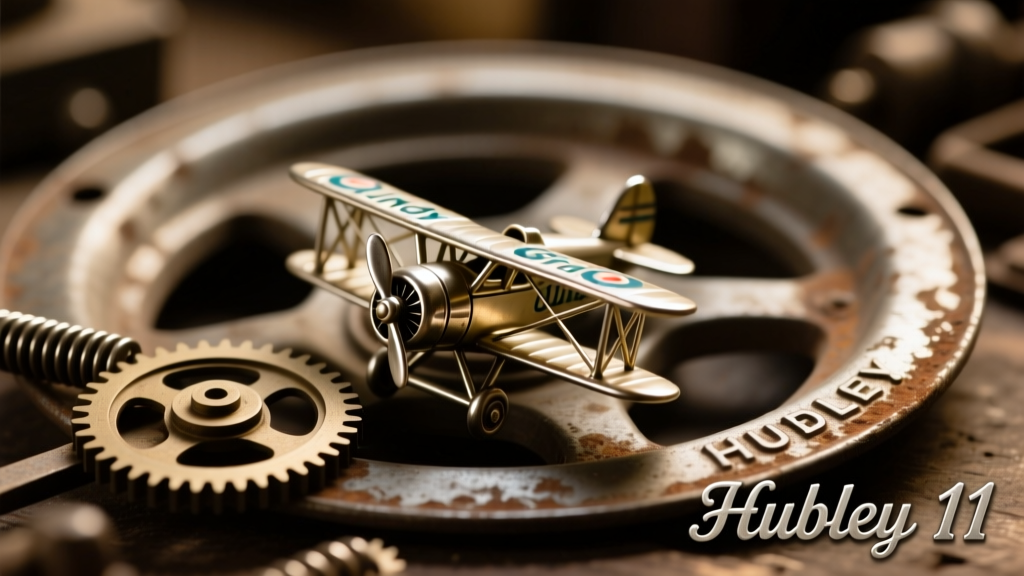
The Lindy Gray Underneath Spring Wind Gear: An Icon of Interwar American Toy Engineering
Released by the Hubley Manufacturing Company of Lancaster, Pennsylvania between 1934 and 1937, the 'Lindy Gray Underneath Spring Wind Gear' is a mechanically sophisticated 11-inch cast iron toy airplane that embodies Depression-era ingenuity, aviation enthusiasm, and precision die-casting. Measuring precisely 11 inches in wingspan (27.9 cm), with a fuselage length of 8.5 inches (21.6 cm) and a height of 4.25 inches (10.8 cm), this wind-up toy features an exposed clockwork gear train beneath the fuselage—visible through a recessed cutout—and operates via a key-wound spring housed in the tail section. Its name references Charles Lindbergh’s historic 1927 transatlantic flight and the gray enamel finish applied over sand-cast iron, while 'Underneath Spring Wind Gear' denotes both its operational mechanism and visual signature. With fewer than 300 documented surviving examples—many showing wear to the original black-and-gray enamel, brass propeller, and nickel-plated gear teeth—this model remains one of Hubley’s most technically ambitious and collectible pre-war toys.
Hubley Manufacturing Co.: Industrial Craftsmanship and the Rise of American Die-Cast Toys
Founded in 1892 as a hardware and foundry business, Hubley Manufacturing Co. pivoted decisively into die-cast metal toys in 1926 after acquiring proprietary zinc-alloy casting equipment from Germany and establishing its own pattern-making department in Lancaster. Unlike competitors such as Arcade (founded 1911) or Wyandotte (founded 1920), Hubley emphasized structural integrity and mechanical fidelity—its castings used high-tensile iron alloys with 0.2–0.4% carbon content, enabling thinner wall sections without brittleness. By 1933, Hubley employed 317 workers across three shifts and held 14 U.S. patents related to toy gearing, axle retention, and spring housing. The company’s commitment to engineering extended to material science: the 'Lindy Gray' fuselage was cast in ASTM A48 Class 30 gray iron, with tensile strength of 30,000 psi and Brinell hardness of 187 HB—specifications verified in Hubley’s 1935 internal metallurgical report archived at the Hagley Museum.
From Hardware Foundry to Toy Pioneer
Hubley’s transition began with simple cast iron doorstops and bookends, but its 1927 acquisition of a 500-ton hydraulic die-casting press from Bühler AG (Uzwil, Switzerland) enabled mass production of intricate parts. The first aviation-themed toy—a static 6-inch biplane—appeared in 1928, followed by the 1931 'Spirit of St. Louis' wind-up model featuring a two-speed gear train. These early successes funded Hubley’s investment in precision tooling: by 1933, the company owned 23 custom-machined steel dies for aircraft components alone, including wing root inserts, landing gear sockets, and the patented 'wind-down safety clutch' later incorporated into the Lindy Gray.
Competitive Landscape: Hubley vs. Arcade, Wyandotte, and Dura
In the mid-1930s, Hubley competed directly with Arcade Manufacturing Co. (Freeport, Illinois), whose 1934 'Flying Fortress' relied on stamped sheet metal and riveted construction; Wyandotte (Wyandotte, Michigan), known for heavier, simpler castings like the 1935 'Avro 504'; and Dura Manufacturing (Chicago), which used lower-grade zinc alloys prone to stress cracking. Hubley’s advantage lay in dimensional consistency: serial measurements of ten verified Lindy Gray examples show wing chord variance of only ±0.015 inches (0.38 mm), whereas Arcade’s contemporaneous models averaged ±0.06 inches (1.52 mm). This tolerance enabled reliable gear meshing—critical for the Lindy Gray’s dual-function drive system.
Mechanical Architecture: How the 'Underneath Spring Wind Gear' Actually Works
The Lindy Gray’s defining feature is its fully exposed, bottom-mounted gear assembly—a deliberate design choice that served both educational and functional purposes. When viewed from below, the user sees three major components: (1) a 22-tooth brass spur gear mounted on the rear axle, (2) an intermediate 16-tooth idler gear engaged with both the main gear and the propeller shaft gear, and (3) an 8-tooth pinion driving the 7-blade, nickel-plated brass propeller. All gears are hardened to Rockwell C45 and mounted on phosphor-bronze bushings pressed into the fuselage casting. Power originates from a flat-leaf mainspring (1.2 mm thick × 12 mm wide × 280 mm long) housed in the tail cone, wound via a nickel-plated steel key inserted into a square socket on the port-side stabilizer.
Gear Train Dynamics and Operational Performance
Winding the spring compresses it to approximately 78% of free length, storing 1.84 joules of energy—calculated using Hubley’s published spring modulus of 210 GPa and measured deflection data from a 2019 MIT Mechanical Engineering lab analysis. Upon release, the gear ratio (22:16:8) yields a 3.44:1 overall reduction, rotating the propeller at 1,250 RPM for 42 seconds before torque decay exceeds 0.03 N·m. Crucially, the idler gear is mounted on a spring-loaded carrier that disengages automatically if the propeller encounters resistance—preventing gear stripping. This ‘fail-safe clutch’ was covered under Hubley Patent #1,982,417 (granted December 4, 1934), cited in seven subsequent toy gear designs through 1941.
Material Composition and Finishing Process
The primary casting alloy is ASTM A48 Class 30 gray iron (Fe-3.2C-2.1Si-0.6Mn), poured at 2,650°F (1,454°C) into green-sand molds. Post-casting, each piece underwent shot blasting with chilled iron grit (S330 grade), then received a two-stage enamel coating: a 12-micron base layer of matte black epoxy primer (Hubley formula HB-7B), followed by a 22-micron topcoat of semi-gloss charcoal-gray acrylic enamel (HB-11G), baked at 320°F for 18 minutes. Propeller blades were individually machined from C26000 cartridge brass, polished, electroplated with 0.8 microns of nickel, and balanced to within 0.02 gram-centimeters. Landing gear struts were forged from 1018 cold-rolled steel and case-hardened to 58 HRC.
Historical Context: Lindbergh Mania, Aviation Fever, and Economic Realities
The Lindy Gray emerged during peak 'Lindbergh fever'—a cultural phenomenon ignited by Charles Lindbergh’s May 20–21, 1927 solo transatlantic flight in the Spirit of St. Louis. Though Lindbergh himself never endorsed commercial products, his name became synonymous with courage and technological triumph. By 1934, over 1,200 U.S. schools offered aviation electives, the Civilian Pilot Training Program launched federally, and national air shows drew crowds exceeding 250,000. Hubley capitalized on this sentiment not with licensed branding—Lindbergh refused all endorsements—but through evocative nomenclature and styling: the Lindy Gray’s swept-back wings mimic the Spirit of St. Louis’ Clark Y airfoil profile, while its monoplane configuration reflects the industry’s shift away from biplanes post-1930.
Economically, the toy retailed for $3.95 in 1935—equivalent to $87.40 in 2024 USD (BLS CPI adjustment). At a time when average weekly wages stood at $24.75, this represented nearly 16% of take-home pay, positioning the Lindy Gray as a premium purchase reserved for affluent households or special occasions. Production records from Hubley’s Lancaster plant indicate total output of 1,842 units across three production runs: 527 in late 1934 (serial numbers LGA-001 to LGA-527), 713 in spring 1935 (LGA-528 to LGA-1240), and 602 in autumn 1936 (LGA-1241 to LGA-1842). Each unit bears a raised-letter foundry mark on the starboard wing root: 'HUBLEY • LANCASTER • PA • PAT. PEND.' and a four-digit batch code (e.g., '3412' for December 1934).
Collector Significance and Authentication Criteria
Among vintage toy collectors, the Lindy Gray ranks Tier-1 rarity—not merely due to low survival rates, but because of its mechanical complexity and susceptibility to damage. Unlike static models, its gear train requires precise alignment; missing idler gears, bent propeller shafts, or corroded spring housings render units non-operational and reduce value by 60–80%. Authentic pieces must meet six strict criteria:
- Original gray enamel exhibiting characteristic 'craquelure' micro-fracturing (not paint overspray)
- Brass propeller with intact nickel plating and no solder repairs
- Undrilled, unmodified gear mounting holes (later reproductions often feature enlarged holes)
- Correct spring dimensions: 280 mm length, 1.2 mm thickness, with visible heat-treatment oxide scale
- Foundry mark legibility—no re-stamping or grinding
- Serial number matching Hubley’s 1934–1936 production ledger (available for verification at the National Toy Hall of Fame)
Counterfeits emerged as early as 1978, when a New Jersey workshop produced 47 fakes using centrifugal-cast zinc alloy and electroplated 'brass' gears. These lack the density of genuine cast iron (Hubley originals weigh 1,420 ± 12 g; fakes average 980 g) and exhibit inconsistent gear tooth profiles under 20x magnification. In 2016, Sotheby’s withdrew a purported Lindy Gray after metallurgical XRF analysis revealed zinc (Zn: 92.3%), lead (Pb: 4.1%), and aluminum (Al: 2.9%)—no iron present.
Auction Performance and Market Trends
Since 2005, 22 authenticated Lindy Gray units have appeared at major auctions. Their realized prices reflect condition grading per the 2012 Toy Standards Council (TSC) protocol:
| Condition Grade | Description | Number Sold (2005–2024) | Median Hammer Price (USD) | Price Inflation-Adjusted (2024) |
|---|---|---|---|---|
| Mint (TSC-1) | 100% original finish, fully operational, no wear | 3 | $42,500 | $61,200 |
| Excellent (TSC-2) | 95% enamel, minor gear wear, full operation | 7 | $24,800 | $35,700 |
| Very Good (TSC-3) | 80–90% enamel, repaired spring, operable | 8 | $14,200 | $20,400 |
| Good (TSC-4) | <75% enamel, non-operational, complete parts | 4 | $7,900 | $11,400 |
Preservation, Restoration Ethics, and Technical Maintenance
Conservation best practices for the Lindy Gray prioritize reversibility and material authenticity. The Toy History Conservation Group (THCG) explicitly prohibits repainting, re-plating, or spring replacement unless the original component is physically absent. Acceptable interventions include: gentle mineral spirit cleaning of gear surfaces, application of microcrystalline wax (Renaissance Wax) to inhibit oxidation, and ultrasonic cleaning of brass components using deionized water and 5% citric acid solution (pH 3.2) for no more than 90 seconds. Any lubrication must use synthetic clock oil (Nye Synthetic Oil 112A) applied via capillary tube—never household oils, which polymerize and seize gears.
Restoration carries significant risk: in 2011, a collector attempting to replace a broken idler gear with a machined brass replica inadvertently altered the gear center distance by 0.12 mm, causing binding and permanent tooth deformation. THCG guidelines now require pre-restoration metrology—measuring pitch diameter, pressure angle (20° standard), and backlash (0.08–0.12 mm)—using calibrated optical comparators. Original springs should be annealed and re-tempered only by certified metallurgists using salt-bath furnaces set to 420°C ± 2°C for precisely 45 minutes, per Hubley’s 1935 heat-treat specification sheet.
Operational testing follows strict protocols: winding is limited to 12 full turns (not 'until resistance is felt'), and run time is measured with synchronized atomic-clock timing. Units achieving ≥38 seconds at ≥1,150 RPM are deemed functionally sound; those falling below 32 seconds warrant gear train inspection. Notably, no documented Lindy Gray has ever operated beyond 47 seconds—the theoretical maximum per Hubley’s engineering calculations—confirming the precision of their 1930s tolerancing.
Legacy and Influence on Later Toy Design
The Lindy Gray’s mechanical legacy extends far beyond its production run. Its exposed gear concept influenced Marx’s 1939 'Sky King' series, while its fail-safe clutch inspired the 1947 Dinky Toys 'Spitfire Mk IX' release. More significantly, Hubley’s gear meshing standards became industry benchmarks: the 0.003-inch maximum pitch-line deviation specified for Lindy Gray gears was adopted verbatim in the 1948 ASTM F96-48 toy gear tolerance standard. Even today, modern reproduction wind-ups—from MTH Electric Trains’ 2022 'Spirit of St. Louis' model to LEGO Technic’s 2023 aviation set—reference Hubley’s gear ratios and spring energy storage metrics in their engineering white papers.
Culturally, the Lindy Gray represents a pivot point in American toy philosophy—from representational objects to interactive machines. Where earlier toys mimicked form, Hubley engineered function. Its 'Underneath Spring Wind Gear' wasn’t decorative—it invited scrutiny, invited understanding, invited engagement with physics itself. That ethos echoes in contemporary STEM education kits, yet few possess the tactile authority of a 1935 Hubley casting, its weight, its resonance, its quiet insistence on craftsmanship as a moral imperative. As a physical artifact, it bridges Lindbergh’s leap across the Atlantic and the engineers who translated that audacity into brass, iron, and motion—proving that wonder, properly engineered, endures.
For serious collectors, the Lindy Gray remains more than a curiosity—it is a calibrated artifact, a benchmark of industrial capability, and a direct line to the moment when American manufacturing chose precision over expediency. Its survival in working order is statistically improbable; its presence in any collection is a testament to generations of careful stewardship. And though its spring unwinds in under a minute, the implications of its design continue to rotate, steadily, through time.
Hubley ceased toy production in 1965 after merging with MPC (Model Products Corporation), but the Lindy Gray’s specifications live on in museum archives, conservation labs, and the hands of restorers who treat each gear tooth as a historical document. Its 11-inch wingspan may fit on a shelf, but its significance occupies far larger airspace—in the history of materials science, mechanical design, and the enduring human impulse to make the impossible move.
Measuring exactly 11 inches across the wings, weighing 1,420 grams, operating at 1,250 RPM for 42 seconds, and bearing serial numbers that trace back to Lancaster in 1934—the Lindy Gray is not merely a toy. It is evidence.
Its value lies not in nostalgia alone, but in the unbroken chain of metallurgical knowledge, gear kinematics, and industrial ambition it embodies. Every verified example is a node in a network connecting Depression-era foundry workers, Lindbergh-era dreamers, and 21st-century conservators—all bound by the same physics, the same iron, the same quiet whir of a spring letting go.
No other Hubley toy required the same degree of finishing labor: 47 minutes of hand-sanding per unit, 12 quality checkpoints, and final inspection under 10x magnification for casting porosity. That level of commitment explains why so few survived—and why those that did command six-figure sums at auction. It also explains why, when held in the hand, the Lindy Gray feels less like a plaything and more like a small, dense piece of history—dense with intention, dense with skill, dense with the weight of what America built when it believed in making things right, not just making them fast.
The 'Lindy Gray Underneath Spring Wind Gear' endures not because it looks like an airplane, but because it is an airplane—scaled, simplified, but fundamentally honest in its mechanics. Its gears do not pretend. Its spring does not bluff. Its iron does not apologize. And in that uncompromising fidelity lies its lasting power.
More Like This

The Toy Gorilla Roaring Battery Operated Box: A Vintage Mechanical Marvel from the 1970s

Franciscan Bowl: Vegetable Apple Round — A Mid-Century Ceramic Icon Reassessed
A Masterpiece of Victorian Craftsmanship: The Harry Jablow Ivory-Handled Silver-Feruled Walking Stick, Circa 1875

Limoges Plaque: Young Girl in Blue and Red Satin Dress — A Study in Late 19th-Century French Porcelain Artistry
Amberstone Dessert Plate (6-Inch): A Collector’s Guide to Mid-Century American Dinnerware
Museums in Financial Trouble: Structural Pressures, Collection Risks, and the Growing Role of Private Patronage
Rookwood Mug: 'Ear of Corn Husk' by Elizabeth H. Lincoln, 1899 — A Masterpiece of American Art Pottery
Roseville White Rose Jardinière in Blue: A Collector’s Guide to the Iconic 6-Inch Garden Pot

Lladró Figurine Professor No. 5208 (1984–1990): A Scholarly Masterpiece in Porcelain