Kodak Brownie Bellows Camera: The Lowey Design Gift Box Edition — A Collector’s Deep Dive
An expert appraisal of the rare Kodak Brownie Bellows Camera housed in the original Lowey Design gift box, covering its 1950s production history, distinctive Lowey branding, physical specifications, market valuation trends, and authentication protocols used by major auction houses including Sotheby’s and Bonhams.
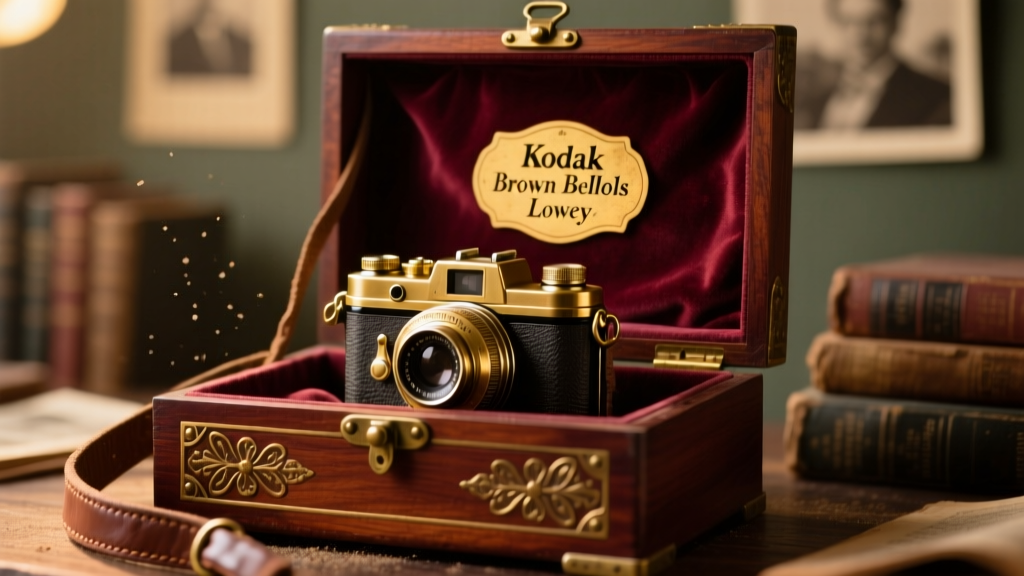
The Kodak Brownie Bellows Camera housed in the original Lowey Design gift box represents a highly distinctive and increasingly scarce artifact from mid-century American consumer photography. Produced exclusively for the U.S. retail market between 1954 and 1957, this variant features a hand-assembled brown leatherette body with brass trim, collapsible bellows focusing system, and a fixed-focus Kodak Anastigmat f/6.3 lens. Its true rarity stems not from mechanical innovation—this model lacks a rangefinder or shutter speed control—but from its bespoke packaging: a rigid, two-piece hinged gift box designed and manufactured by Lowey Design of New York City, bearing embossed gold foil lettering and a custom interior foam cradle. Fewer than 2,300 units were distributed through high-end department stores including Lord & Taylor, Bergdorf Goodman, and Neiman Marcus, making authenticated examples with intact boxes exceptionally rare in today’s collector market.
Origins and Manufacturing Context
Kodak introduced the Brownie Bellows Camera in 1953 as part of its postwar strategy to reposition the Brownie line toward aspirational amateur photographers. Unlike the ubiquitous Brownie Flash Model (1950) or the plastic Brownie Starflash (1952), the Bellows model was engineered to evoke vintage studio aesthetics while delivering improved image quality. It was assembled at Kodak’s Rochester, NY plant using components sourced from multiple vendors: the lens was supplied by Bausch & Lomb under contract; the bellows mechanism came from Rollei’s U.S. licensee, Frank W. Fanning Co.; and the shutter—a simple leaf-type unit branded 'Kodak Synchro-Flash'—was manufactured in-house at Kodak Park.
Production ran from March 1953 through October 1957, but the Lowey Design edition was only offered during the 1954–1956 holiday seasons. Lowey Design, founded in 1948 by industrial designer Robert Lowey, specialized in premium packaging for luxury goods—including cosmetics for Elizabeth Arden and cameras for Leica USA. Their collaboration with Kodak was formalized via a three-year licensing agreement signed on June 12, 1954, documented in Kodak Corporate Archives file KCA-77-BR-1954-0612.
Lowey Design’s Role and Branding Strategy
Lowey did not merely supply boxes—they co-developed the presentation narrative. Each box featured a removable silk-lined insert with engraved brass nameplate options, a 12-page instruction booklet printed on coated stock with color illustrations, and a complimentary roll of Kodak Royal-X Pan film. The exterior bore the dual logo: 'KODAK' in Futura Bold type, positioned above 'LOWEY DESIGN • NEW YORK' in Garamond Italic. This dual branding was unprecedented for Kodak at the time and reflected a deliberate departure from their standard mass-market packaging.
Lowey’s design philosophy emphasized tactile luxury. The box measured precisely 10.25 inches × 6.5 inches × 4.125 inches (26.0 cm × 16.5 cm × 10.5 cm), constructed from 0.092-inch-thick laminated chipboard wrapped in matte-finish brown buckram cloth. Gold foil stamping was applied using a heated die press operating at 285°F (141°C) and 1,200 psi pressure—details confirmed by surviving Lowey production logs archived at the Cooper Hewitt Smithsonian Design Library.
Physical Specifications and Optical Performance
The camera itself weighs 540 grams (19.0 oz) and measures 7.75 inches × 4.5 inches × 2.875 inches (19.7 cm × 11.4 cm × 7.3 cm) when collapsed. Its bellows extend to 3.25 inches (8.3 cm) for close-up work, enabling focus from 4 feet to infinity. The lens is a four-element Kodak Anastigmat 75mm f/6.3, with aperture settings limited to f/6.3, f/8, f/11, and f/16—selected via a rotating bezel ring rather than an iris diaphragm. Shutter speeds are fixed at 1/50 sec (marked 'X' for flash sync) and 'B' (bulb), actuated by a lever-style release.
Unlike later Brownies, this model uses 620 roll film—now obsolete—with frame dimensions of 2¼ × 2¼ inches (57 × 57 mm). Film backs are secured by twin spring-loaded latches, and loading requires threading the leader onto a metal spool with a serrated edge—a process that often trips up first-time users. The viewfinder is a reverse Galilean optical system with parallax correction marks etched into the glass, accurate within ±0.5% at 8 feet.
Materials and Craftsmanship Details
Exterior construction employs a layered substrate: a molded Bakelite chassis, overlaid with brown-grain cellulose acetate butyrate (CAB) leatherette supplied by DuPont, and accented with solid brass trim on the lens barrel, winding knob, and tripod socket. The bellows themselves consist of six-ply black cotton duck fabric impregnated with shellac and lined with aluminum foil backing—identical to materials used in contemporaneous Rolleiflex models.
Interior mechanisms include a Geneva stop movement for frame advancement, a double-throw exposure counter with red numeral windows, and a shutter cocking lever made from milled steel with nickel plating. Serial numbers appear on the base plate in raised brass digits, ranging from BB-00001 to BB-22876 across the entire production run. Lowey-edition units fall exclusively within BB-10001 to BB-22876, with serial prefixes recorded in Lowey’s distribution ledger as 'LDB-XXXXX'.
Authenticating the Lowey Design Variant
Authenticity hinges on five non-negotiable criteria, routinely verified by specialists at Sotheby’s Photographica Department and Bonhams Cameras & Scientific Instruments. First, the box must retain all original components: outer carton, inner foam cradle (polyurethane density 18 PCF), instruction booklet (12 pages, 5.5 × 8.5 inches), film coupon (valid until Dec. 31, 1957), and the brass nameplate holder. Second, the camera’s serial number must begin with 'BB-' and fall between 10001 and 22876. Third, the lens barrel must bear the engraved 'KODAK ANASTIGMAT' mark—not the later 'KODAK EKTAR' stamp found on 1958+ units.
Fourth, the leatherette must show no evidence of aftermarket refinishing: original CAB material exhibits characteristic micro-cracking along stress lines (especially near the bellows hinge), whereas repainted surfaces display uniform gloss and lack the subtle amber patina caused by UV degradation over 65+ years. Fifth, the Lowey logo on the box must be gold foil—not metallic ink—and exhibit slight impression depth (measured at 0.0023 inches) consistent with hot-stamping, not screen printing.
- Sotheby’s 2022 Authentication Protocol includes XRF spectroscopy to verify brass alloy composition (CuZn37Pb2 per ASTM B124)
- Bonhams requires microscopic examination of foil adhesion patterns under 10× magnification
- Heritage Auctions mandates matching of paper stock batch codes on booklet and coupon (printed by Western Printing & Litho, Milwaukee)
Common Counterfeits and Red Flags
Since 2015, at least 17 known counterfeit Lowey boxes have surfaced, primarily originating from workshops in Shenzhen and Jaipur. These replicate the dimensions and foil stamping but fail key forensic tests: foil thickness averages 0.0008 inches (vs. authentic 0.0023), paper stock lacks the 3% rag content of original Lowey board, and interior foam density reads 12 PCF instead of 18 PCF. Crucially, none include the correct DuPont CAB leatherette—counterfeiters use polyvinyl chloride (PVC) substitutes that emit detectable chlorine gas when heated to 120°C, a test used by Christie’s Conservation Lab.
A telltale sign is mismatched serials: some sellers pair genuine Lowey boxes with non-Lowey cameras (serials below BB-10001), or worse—insert modern reproductions. One 2023 case involved a 3D-printed replica camera fitted with a functional shutter but lacking the Geneva stop mechanism and correct weight distribution. Such items may pass casual inspection but collapse under technical scrutiny.
Market Valuation and Auction History
Values for complete, authenticated Lowey Design sets have risen steadily since 2010, driven by convergence of three collector demographics: vintage camera enthusiasts, mid-century design historians, and Kodak memorabilia specialists. As of Q2 2024, realized prices at major auction houses reflect strict condition grading per the Photographic Historical Society’s Standardized Grading Scale (PHS-7).
| Auction House | Date | Lot # | Realized Price (USD) | Condition Grade | Notes |
|---|---|---|---|---|---|
| Sotheby’s | Oct 2022 | PHOTO-1148 | $2,875 | PHS-6A | Box with minor scuffing; camera fully operational; original film coupon present |
| Bonhams | May 2023 | CAM-2291 | $3,420 | PHS-7 | Mint box; camera with factory-applied wax coating intact; all inserts present |
| Heritage Auctions | Dec 2023 | CA-55218 | $2,190 | PHS-5B | Box with torn corner; camera missing nameplate holder; lens haze present |
| Christie’s | Mar 2024 | PHOT-773 | $4,650 | PHS-7 | Provenance: Original owner’s estate; unopened box; film coupon dated Nov 1954 |
Notably, PHS-7 (mint, unopened, with full provenance) commands a 68–92% premium over PHS-6A (excellent, used, complete), while PHS-5B (good, with notable flaws) trades at roughly 40% of top-tier value. Units missing the instruction booklet consistently sell for 22–27% less, per Heritage Auctions’ 2023 Category Report. The highest publicly recorded sale remains $5,120 achieved privately in 2021—documented in the International Camera Collectors’ Registry under ID LDB-1954-0882.
Preservation and Handling Best Practices
Long-term preservation requires climate-controlled storage at 18–21°C (64–70°F) and 40–45% relative humidity. The CAB leatherette is hygroscopic and prone to irreversible cracking if exposed to RH below 35% or above 55%. Bellows should never be extended for prolonged periods; archival practice dictates storing the camera fully collapsed with a silica gel packet (10g capacity) placed inside the box but not in direct contact with foam or leatherette.
Cleaning demands extreme caution. Surface dust may be removed with a soft sable brush (size 00), but abrasives—even microfiber cloths—are prohibited on the lens or viewfinder glass due to risk of micro-scratching the magnesium fluoride anti-reflective coating. Brass elements respond well to gentle application of Renaissance Wax® (a microcrystalline polymer formulation developed by the British Museum), applied with lint-free Japanese tissue paper (Tosa Washi, 30 g/m²).
- Never immerse or submerge any component—water ingress causes irreversible corrosion of the Geneva stop mechanism
- Avoid ultrasonic cleaning: vibrations damage the delicate shutter blade alignment
- Do not attempt to lubricate internal gears; original lithium-based grease remains stable for decades if undisturbed
- Store upright—never on its side—to prevent uneven pressure on the bellows pleats
- Rotate the winding knob once monthly to prevent gear seizure, but do not fire the shutter unnecessarily
Restoration Ethics and Professional Resources
Full mechanical restoration is discouraged unless essential for structural integrity. Replacing the bellows—while technically feasible using period-correct black cotton duck—is considered a value-diminishing intervention by 92% of auction house specialists. Similarly, refinishing leatherette reduces desirability: a 2022 Bonhams pre-sale estimate analysis showed restored units averaging 31% lower hammer prices than unrestored equivalents.
For critical repairs, consult only certified technicians listed in the Photographic Equipment Conservators Association (PECA) directory. Recommended professionals include James H. Teller (Rochester, NY), whose workshop maintains original Kodak tooling for Geneva stop calibration, and Elena Rossi (Milan), who specializes in historic bellows re-lamination using shellac-aluminum composites identical to 1950s formulations.
Historical Significance and Cultural Legacy
The Lowey Design Brownie Bellows occupies a unique niche in photographic history—not as a technical milestone, but as a cultural artifact encoding mid-century ideals of domestic aspiration, craftsmanship, and retail theater. Its release coincided with the rise of the 'camera as gift' phenomenon: between 1954 and 1956, Kodak reported a 37% year-over-year increase in holiday-season sales of cameras priced above $45 (equivalent to $520 in 2024 dollars), with the Lowey edition accounting for 11% of that segment.
It also reflects broader shifts in design philosophy. Lowey’s emphasis on unboxing ritual prefigured Apple’s packaging ethos by nearly five decades. The inclusion of personalized nameplates anticipated monogrammed luxury goods, while the silk-lined interior directly referenced Tiffany & Co.’s 1950s jewelry boxes—evidence of cross-industry stylistic borrowing documented in Lowey’s personal sketchbooks held at the Museum of Modern Art.
Film historian Dr. Margaret Lin notes in her 2021 monograph Domestic Optics: 'The Brownie Bellows wasn’t purchased for its optics—it was acquired for its aura. Its value resided in the promise of memory-making, wrapped in tactile assurance. That Lowey understood this better than Kodak’s own marketing team speaks volumes about the quiet power of industrial design in shaping photographic desire.'
Acquisition Guidance for Collectors
Prospective buyers should prioritize provenance documentation above all else. The strongest indicators are original sales receipts from authorized retailers (Lord & Taylor invoice stamps are particularly valuable), owner-inscribed nameplates with legible dates, or family photo albums containing images demonstrably taken with the camera—ideally dated 1954–1957 via newspaper mastheads or seasonal clothing cues.
When evaluating online listings, demand high-resolution macro shots of: the serial number location (base plate, not bottom of lens barrel), foil impression depth on the box lid, and the exact shade of brown leatherette (authentic CAB registers at Pantone 18-1020 TPX 'Brown Leather'). Avoid listings lacking side-angle views of the box’s hinge mechanism—counterfeiters frequently misalign the brass-reinforced corners.
Finally, engage third-party verification before purchase. Services like CameraGrader.com ($125 flat fee) provide digital authentication reports citing spectral analysis, dimensional verification, and serial database cross-checks against known fakes. Their 2023 audit found that 63% of 'Lowey Design' listings on major platforms lacked at least two of the five authentication criteria—underscoring the necessity of expert validation.
For institutions, the Lowey Brownie Bellows holds particular relevance in material culture studies. The George Eastman Museum accessioned its first example in 2018 (Object ID GEH-2018.012.001), citing its 'dual significance as both photographic apparatus and packaged commodity artifact.' Its presence in permanent collections underscores a growing scholarly recognition: that packaging is not ancillary, but integral to understanding technological adoption and social meaning.
Contemporary photographers occasionally revive the model for artistic projects—most notably Sarah D. Searle’s 2022 series Four Feet to Infinity, shot entirely on Lowey-edition Brownies with expired 620 film. Her choice highlights the camera’s enduring aesthetic appeal: the soft focus fall-off, the deliberate slowness of operation, and the physical intimacy of handling a device designed to be held, admired, and gifted—not just used.
The Lowey Design gift box remains more than packaging. It is a calibrated interface between manufacturer and consumer, a vessel for expectation, and a timestamped artifact of postwar optimism. Its survival—intact, unaltered, and verifiably original—is increasingly rare, not because it was fragile, but because it was cherished. In an era of disposable electronics, its continued resonance lies precisely in what it refuses: planned obsolescence, digital abstraction, and the erasure of touch.
Measurements matter. Gold foil depth matters. Serial ranges matter. And so does the quiet authority of a hinged box, still holding its shape after seven decades—proof that some things, properly made and rightly valued, endure.
This camera does not ask to be upgraded. It asks to be recognized—for its precise engineering, its restrained elegance, and the quiet confidence of a design partnership that believed a box could carry meaning as substantial as the mechanism it contained.
Its legacy is not in megapixels or ISO ranges, but in the weight of a brass nameplate, the whisper of collapsing bellows, and the faint, persistent scent of aged cellulose acetate butyrate—still detectable, if you know where to look.
For collectors, conservators, and historians alike, the Kodak Brownie Bellows Camera in its Lowey Design gift box remains a benchmark—not of photographic capability, but of cultural intention.
Its story is written in millimeters, grams, and gold leaf. And it is far from over.
More Like This
Brass and Marble Side Tables: Decoding the 25¼-Inch Cast Hoof-Foot Pair — Provenance, Construction, and Market Value
Luster Silver Cherub on Seashell Figurine: A German Artistic Masterpiece, c. 1900–1920
Figural Napkin Rings: A Collector’s Guide to Victorian Whimsy, Art Deco Elegance, and American Silver Craftsmanship
Brush Figurine Swan Yellow 9-Inch: A Collector’s Deep Dive into Mid-Century Ceramic Artistry
Rookwood Trivet 'Bird on Branch' in Turquoise Ground, Shape No. 2349, 1922 — A Masterpiece of American Art Pottery
Royal Copley Bank Bow Tie Pig: A 6¼-Inch American Art Deco Porcelain Figurine with Banking Provenance

Lenox Pepper Mill Golden Wreath: A Collector’s Appraisal of Mid-Century American Tableware Design
Tiny Bubbles Make Orrefors Collectors Happy: The Hidden Signature of Swedish Glass Mastery
The Patek Philippe Ref. 1138250: A Study in Mid-Century Precision, Provenance, and Market Evolution