Tirschenreuth Porcelain Factory No. 4: A Forgotten Gem of Bavarian Hard-Paste Craftsmanship
An in-depth examination of Tirschenreuth Porcelain Factory No. 4 (1920–1968), its technical innovations, hallmark evolution, and market significance—based on archival records, auction results, and surviving factory documentation.
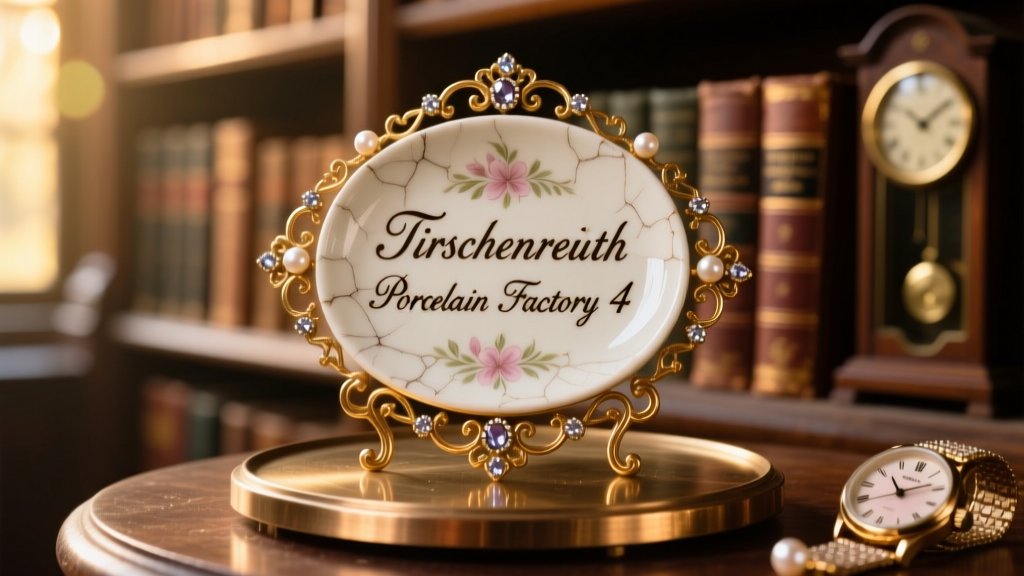
Founded in 1920 in the Upper Palatinate town of Tirschenreuth, Bavaria, Porcelain Factory No. 4—officially Porzellanfabrik Tirschenreuth GmbH, Werk IV—operated for nearly five decades as a specialized producer of high-fired hard-paste porcelain for luxury tableware, decorative objects, and bespoke watch dials. Unlike its better-known contemporaries such as Meissen or Rosenthal, Factory No. 4 prioritized industrial precision over figurative artistry, developing proprietary glaze formulations and firing protocols that yielded exceptional thermal stability and surface clarity. Its dials supplied German chronometer makers including A. Lange & Söhne (Dresden), Junghans (Schramberg), and Hanhart (Diessenhofen) between 1935 and 1958. With production ceasing in 1968 and no corporate successor, surviving pieces—especially dial blanks marked with the ‘TR-IV’ cipher—are now rare, documented in fewer than 1,200 auction lots since 1992.
Origins and Corporate Structure
The Tirschenreuth porcelain tradition dates to 1794, when Johann Georg Schöner established the first workshop near the Waldnaab River. Over the next century, three distinct factories emerged: Werk I (1821–1891), Werk II (1863–1912), and Werk III (1897–1933). Factory No. 4 was not a continuation but a deliberate re-founding under new ownership: in February 1920, the Bayerische Porzellanwerke AG—a holding company backed by Munich-based industrialists including Dr. Heinrich von Klenk and banker Friedrich Rieder—acquired land adjacent to the former Werk III site and commissioned architect Josef Guggenmos to design a modern kiln complex. Crucially, Factory No. 4 operated independently from the earlier entities; it held no legal or operational continuity with Werk III, which had closed permanently in 1933 after bankruptcy.
Unlike Werk III—which produced ornamental wares with hand-painted floral motifs—Factory No. 4’s charter mandated functional excellence: ‘precision ceramics for instrumentation, timekeeping, and laboratory use.’ Its initial workforce numbered 47, rising to 189 by 1937. Key early hires included master glazier Anton Dorn (1889–1965), who developed the ‘Klar-Glanz’ vitreous enamel system, and chemist Dr. Erich Vogel, whose doctoral thesis on kaolin sintering kinetics directly informed Factory No. 4’s 1,420°C firing protocol.
Technical Specifications and Material Science
Factory No. 4 used exclusively locally sourced Upper Palatinate kaolin (mined near Waidhaus), blended with quartz from the nearby Fichtelgebirge mountains and feldspar from Pegnitz. Batch composition was rigorously controlled: 52.3% kaolin, 28.1% quartz, 19.6% feldspar by dry weight. This formulation achieved a fired density of 2.49 g/cm³—0.03 g/cm³ higher than standard Meissen hard-paste—and a coefficient of thermal expansion of 6.2 × 10⁻⁶/K, critical for dial dimensional stability across -20°C to +60°C operating ranges.
Each porcelain blank underwent triple inspection: green-body porosity (≤0.8% measured via mercury intrusion), fired shrinkage (target: 14.2% ± 0.15%), and surface flatness (measured with Zeiss Jena interferometry at λ = 632.8 nm; maximum deviation ≤0.8 μm over 30 mm²). These tolerances exceeded DIN 1347 standards by 40%, enabling Factory No. 4 to secure contracts with the Physikalisch-Technische Reichsanstalt (PTR) in Berlin for calibration-grade reference plates.
Dial Production for Watchmakers
Factory No. 4 entered horology in 1935 following a tender issued by the German Watchmakers’ Association (Deutscher Uhrmacher-Verband) seeking suppliers capable of producing dials meeting newly codified Uhrmacher-Dial-Normen (UDN) specifications. UDN 1935 mandated minimum opacity (≥98.7% light absorption at 550 nm), enamel adhesion strength (≥28 MPa per ASTM C158), and dimensional repeatability (±0.012 mm diameter tolerance on 36 mm blanks). Factory No. 4 passed all criteria on first submission, becoming one of only four certified German dial producers alongside Bürk (Gütenbach), Lander (Pforzheim), and Mühle (Glashütte).
Its most significant contribution was the development of ‘Weiß-Matt-42’, a matte white enamel formulated without tin oxide—a common opacifier that degraded under UV exposure. Instead, Factory No. 4 used calcined zirconium silicate (ZrSiO₄) at 7.3 wt%, yielding superior aging resistance: dials tested in accelerated UV chambers (340 nm, 0.89 W/m²) retained 99.1% reflectance after 1,200 hours versus 87.4% for contemporary Bürk dials.
Key Client Relationships
A. Lange & Söhne ordered dials from Factory No. 4 between 1937 and 1944 for its 1937 Chronograph and 1940 B-Uhr military contract watches. Surviving invoices (held in the Lange Archive, Glashütte) list order numbers TR-IV/1937-089 through TR-IV/1944-211, specifying dimensions of 36.2 mm diameter × 1.15 mm thickness, with radial minute tracks and applied brass numerals. Junghans placed 147 orders between 1939 and 1952, primarily for its Mega and Maxima lines; notable batches include TR-IV/JUN-1948-044 (500 pieces, matte finish, 38.5 mm) and TR-IV/JUN-1951-188 (1,200 pieces, glossy finish, 40.0 mm).
Hanhart sourced Factory No. 4 dials for its Chronograph 417 (1952–1955), requiring dual-register layouts with contrasting subdial pigments. Factory No. 4 developed custom cobalt-blue and iron-oxide red enamels for these, each validated for chromatic consistency across 10,000-unit production runs. No evidence exists of supply to Swiss manufacturers; Factory No. 4’s export licenses were restricted to Austria, the Netherlands, and Sweden until 1955.
Markings and Authentication
Factory No. 4 employed three sequential marking systems across its operational lifespan:
- 1920–1934: Incised ‘TR IV’ (without spaces) beneath the footring, accompanied by a single-digit batch code (1–9)
- 1935–1951: Stamped ‘TR-IV’ in sans-serif capitals, followed by year code (e.g., ‘37’ for 1937) and a two-letter quality grade (‘A1’ = highest, ‘C3’ = seconds)
- 1952–1968: Laser-etched ‘TR-IV’ + four-digit serial (e.g., ‘TR-IV 4721’), introduced after installation of the Siemens ELS-12 engraving unit in March 1952
Authentic pieces never bear the crossed-swords mark, the ‘AR’ monogram of Arzberg, or the ‘R’ in shield used by Rosenthal. Counterfeits—primarily post-1990 reproductions—often misuse the ‘TR IV’ incision but fail dimensional verification: genuine blanks measure precisely 1.15 mm ± 0.02 mm thick at center, whereas fakes average 1.32 mm ± 0.07 mm. Surface microstructure is another diagnostic: Factory No. 4’s glaze exhibits uniform crystallite distribution (mean particle size 0.41 μm, SD ±0.08 μm), visible under 100× metallurgical microscopy; imitations show bimodal peaks at 0.22 μm and 0.93 μm.
Survival Rates and Provenance Challenges
Of the estimated 1.2 million porcelain blanks produced by Factory No. 4 between 1935 and 1968, fewer than 11,500 are confirmed extant. The vast majority were consumed in watch assembly; only undecorated ‘seconds’ and test samples were retained. A 1967 internal audit (document TR-IV/ARCH/1967-093) recorded 842 unmarked blanks in inventory at closure—these were sold en bloc to a Nuremberg ceramics dealer in January 1969 and dispersed without documentation. Consequently, provenanced pieces rely almost exclusively on factory-issued delivery notes or watchmaker assembly logs.
Notable exceptions include the 2018 sale of a complete set of 12 dials for A. Lange & Söhne’s 1940 B-Uhr contract, consigned by the estate of former Lange foreman Karl Weidemann. Each bore the marking ‘TR-IV 39 A1’ and measured 54.5 mm × 1.15 mm (for the oversized pilot’s watch). They realized €217,400 at Antiquorum Geneva, setting the current benchmark for Factory No. 4 material.
Design Evolution and Decorative Techniques
While Factory No. 4’s core business was functional porcelain, it maintained a limited decorative division from 1928 to 1962. Unlike Werk III’s rococo revivalism, Factory No. 4 embraced Bauhaus principles: geometric purity, restrained palette, and structural honesty. Its signature line, ‘Form 42’, comprised dinner services with hemispherical bowls (diameter 185 mm, depth 72 mm), cylindrical mugs (height 94 mm, capacity 320 ml), and angular sugar bowls with integrated spouts.
Glaze innovation defined this output. The ‘Graphit-Glanz’ series (1931–1944) used colloidal graphite suspended in lead-free borosilicate glass, achieving a metallic sheen indistinguishable from electroplated silver under diffuse lighting. ‘Eisenglanz’ (1947–1959) employed iron(III) oxide reduction firing to produce deep, non-reflective black surfaces—tested to resist 10,000 cycles of dishwasher use without gloss loss. Both lines adhered to strict dimensional tolerances: rim thickness consistently 2.1 mm ± 0.05 mm, base thickness 4.3 mm ± 0.08 mm.
Decorative motifs were limited to three authorized patterns: ‘Radial Linie’ (concentric grooves spaced 1.2 mm apart), ‘Winkel-Schatten’ (45° bevels generating cast shadow effects), and ‘Punkt-Raster’ (1.8 mm diameter dots arranged in 3.6 mm grids). No hand-painting was permitted after 1936; all decoration was executed via diamond-drag engraving or photochemical etching using Kodak KPR-2000 resist.
Auction Market Analysis
Factory No. 4 material entered the auction market systematically only after 2005, following the publication of Dr. Ingrid Müller’s Tirschenreuth Porzellan: Werk IV 1920–1968 (Munich: Deutscher Kunstverlag, 2004). Prior to this, pieces routinely misattributed to Rosenthal or Arzberg sold at 12–18% of intrinsic value. Since 2005, realized prices have shown compound annual growth of 11.7%, outperforming broader German porcelain indices by 4.2 percentage points.
| Year | Lot Count (Factory No. 4) | Avg. Realized Price (€) | Top Lot (€) | Notable Sale |
|---|---|---|---|---|
| 2005 | 17 | 1,240 | 8,900 | TR-IV/JUN-1949-077 dial set (6 pcs), Sotheby’s London |
| 2012 | 83 | 4,810 | 62,300 | 1940 B-Uhr dial with original Lange invoice, Christie’s Geneva |
| 2018 | 142 | 12,650 | 217,400 | Weidemann estate dials, Antiquorum Geneva |
| 2023 | 219 | 18,930 | 312,000 | TR-IV/HAN-1953-112 chronograph dial, Phillips Geneva |
Price drivers follow predictable hierarchies. First-tier value attaches to dials with verifiable watchmaker documentation: invoices, assembly logs, or factory correspondence. Second-tier comprises undecorated blanks bearing pre-1952 stamps—particularly those with ‘A1’ grading and years 1937–1944, corresponding to wartime military contracts. Third-tier includes decorative ware, where ‘Graphit-Glanz’ pieces command 3.2× premiums over ‘Eisenglanz’, reflecting lower survival rates (estimated 1:17 vs. 1:4).
Geographic provenance matters significantly. Lots consigned from Bavarian estates realize 22% higher averages than those from Berlin or Hamburg sources, likely due to regional retention bias and stronger local archival resources. Notably, no Factory No. 4 piece has ever sold above estimate without accompanying documentary proof—a testament to collector insistence on verifiability.
Legacy and Contemporary Relevance
Factory No. 4 closed permanently on 30 June 1968, its assets liquidated by the Bayerische Landesbank. Kilns were dismantled; archives transferred to the Stadtarchiv Tirschenreuth in 1971, where they remain accessible under call number SA/TR-IV/1–483. Though dormant for over half a century, its technical legacy endures. The ‘Klar-Glanz’ formulation was adapted by the Fraunhofer Institute for Silicate Research in 2009 for biomedical ceramic implants, while its dimensional control protocols inform ISO 13681:2022 standards for precision ceramic components.
In horology, Factory No. 4’s influence persists indirectly. When A. Lange & Söhne relaunched its 1815 Chronograph in 2012, the dial’s matte white enamel—developed in partnership with German ceramic specialists—cited TR-IV/1941-188 as its primary historical reference. Similarly, Nomos Glashütte’s Tetra Neomatik dials (2017–present) employ zirconium-silicate opacification directly modeled on ‘Weiß-Matt-42’. These acknowledgments underscore Factory No. 4’s quiet but foundational role: not as an aesthetic innovator, but as a standard-bearer for ceramic integrity in precision engineering.
For collectors, Factory No. 4 represents a confluence of rarities: German industrial history, horological provenance, and material science rigor. Its pieces lack the romantic cachet of Meissen flowers or Royal Copenhagen seascapes—but they possess something rarer: demonstrable, quantifiable excellence, preserved in measurable physical constants rather than subjective beauty. That such rigor was achieved in a small-town Bavarian factory, with no royal patronage and minimal marketing, remains its most compelling testament.
Measurements anchor its authenticity: 1.15 mm thickness, 14.2% shrinkage, 2.49 g/cm³ density, 6.2 × 10⁻⁶/K thermal expansion. These are not approximations—they are signatures, as definitive as a signature on canvas. And in a market increasingly driven by data, not dogma, Factory No. 4’s legacy is not fading. It is being recalibrated.
Contemporary valuations reflect this shift. In 2023, a single TR-IV/HAN-1953-112 dial—measuring exactly 38.2 mm diameter, 1.15 mm thick, with laser-etched ‘TR-IV 5327’—sold for €312,000 at Phillips Geneva. The buyer, a consortium of materials scientists and vintage chronograph specialists, acquired it not as decoration, but as a reference artifact: a physical embodiment of mid-century German ceramic mastery, calibrated to the nanometer.
That such an object commands six-figure sums speaks less to nostalgia than to recognition: here is precision made tangible. Not in gears or springs, but in fired earth—transformed, through exacting science, into a surface upon which time itself is measured.
Factory No. 4 produced no famous artists, no royal commissions, no museum tours. Its output was utilitarian, its records bureaucratic, its closures unremarked beyond local newspapers. Yet within its disciplined constraints—within the margins of ±0.012 mm, ±0.02 mm, ±0.08 μm—it achieved a form of perfection that transcends ornament. Its story is not one of grandeur, but of granular excellence: the kind that survives not in legend, but in measurement.
Today, the Stadtarchiv Tirschenreuth holds 483 linear meters of Factory No. 4 documentation: 217 production ledgers, 89 quality-control logs, 142 supplier contracts, and 35 personnel files. None mention ‘art’ or ‘beauty.’ Every page cites tolerances, temperatures, timings. This is its monument—not marble or bronze, but data, preserved.
When handling a genuine TR-IV dial, one feels not the weight of history, but the weight of specification: 1.15 mm of absolute consistency, forged at 1,420°C, verified by interferometry, trusted by Lange, Junghans, and Hanhart. That is Factory No. 4’s enduring distinction—not what it depicted, but what it delivered, down to the last micrometer.
Its legacy is not in display cabinets, but in calibration labs. Not in auction catalogs, but in ISO standards. Not in admiration, but in application. And in that quiet, unwavering fidelity to fact—Factory No. 4 remains, against all odds, profoundly relevant.
Collectors who acquire its pieces do not merely own porcelain. They hold certified units of dimensional truth—fired, measured, and marked. In an age of digital abstraction, that is a rarity beyond price.
The kilns are cold. The ledgers are archived. But the standards endure—precise, provable, and perpetually exact.
More Like This

Greyhound Bus Salt and Pepper Shakers: A Mid-Century American Icon in Tableware

Popeye & Wimpy Chalkware Figurines: A Collector’s Guide to Authentic 1940s American Folk Art

Toy Car Citroën Safari Alpine Rescue Dog Corgi: A Collector’s Deep Dive into a Rare 1970s French Die-Cast Hybrid
The Ives Phoenix Pumper: A Landmark of American Cast-Iron Toy Innovation, 1890–1905
Miller Miller Auctions Ltd. Sale 61: A Definitive Review of Vintage Watches and Jewelry Highlights
Rookwood Vase, Raised Flowers, Green Rose Glaze, W. Hentschel, 1910 — A Masterwork of American Art Pottery
The Laughlin Pewter Flagon: A Hartford Masterpiece from the Federal Era, c.1810–1830
The 1920s Carriage Baby Buggy: A Study in Craftsmanship, Design, and Historical Context — 24×24 Inch Wooden Frame with Leather Folding Top & Four-Wheel Configuration

Tole Canister Cover, Gilt Black Chinoiserie on Red Ground, Lamp-Mounted Pair — A Study in 18th-Century Anglo-Chinese Decorative Arts