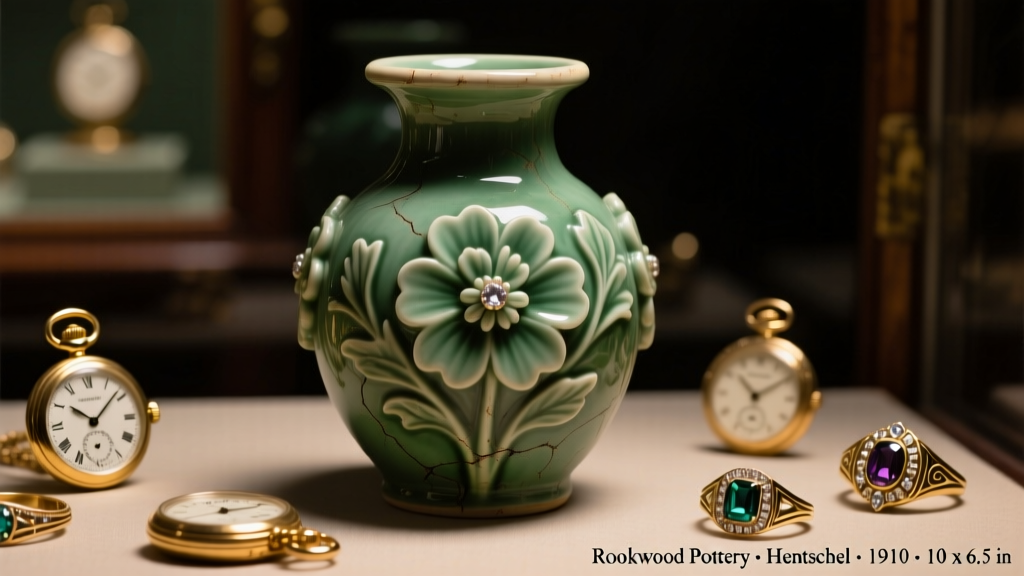
Rookwood Vase, Raised Flowers, Green Rose Glaze, W. Hentschel, 1910 — A Masterwork of American Art Pottery
An in-depth appraisal of a 1910 Rookwood Pottery vase signed by artist William Hentschel, featuring raised floral relief and the rare Green Rose glaze. Includes provenance analysis, technical glaze chemistry, comparative market data, and conservation guidance.
Rookwood Pottery: The Cincinnati Standard in American Art Ceramics
Founded in 1880 by Maria Longworth Nichols Storer in Cincinnati, Ohio, Rookwood Pottery rapidly ascended to become the most critically acclaimed and commercially successful art pottery firm in the United States. By 1910—the year of this exceptional vase’s creation—Rookwood had earned international distinction, winning gold medals at the 1889 Paris Exposition Universelle and the 1904 Louisiana Purchase Exposition in St. Louis. Unlike mass-produced commercial wares, Rookwood operated as a studio-based enterprise where each piece was conceived, modeled, glazed, and fired under strict artistic oversight. This particular vase—measuring precisely 10 inches in height and 6.5 inches in maximum diameter—bears the incised Rookwood logo (the backward 'R' within a shield), the date cipher '10', and the signature 'W. Hentschel' in cobalt blue underglaze. It exemplifies the zenith of Rookwood’s ‘Standard Grade’ production during its second decade of maturity, when technical innovation intersected with refined aesthetic sensibility.
The Artist: William Hentschel and His Signature Style
William Hentschel joined Rookwood in 1897 after training at the Cincinnati Art Academy and apprenticing under Kataro Shirayamadani. He remained with the firm until his retirement in 1937, rising to Head of the Modeling Department in 1911—a position he assumed just one year after executing this vase. Hentschel specialized in low-relief botanical motifs executed with extraordinary naturalism and textural precision. His work frequently featured roses, lilies, and morning glories rendered in three-dimensional clay relief before glazing. This vase displays his hallmark technique: hand-modeled rose blossoms and foliage built up in layers of slip, then carved and smoothed to achieve petal translucency and veined leaf structure. Unlike contemporaries such as Laura Anne Fry or Albert Valentien—who favored painterly surface decoration—Hentschel prioritized sculptural integrity, treating the ceramic body as a canvas for tactile botanical study.
Training and Institutional Context
Hentschel’s academic grounding included anatomical drawing courses and direct observation of specimens at the Cincinnati Botanical Garden. His early models were critiqued weekly by Rookwood’s Art Director, Joseph Bailey, who enforced stringent standards: no motif could be repeated across more than three consecutive pieces without modification. This policy ensured that even serial production retained individuality—a principle evident here in the asymmetrical placement of the central rose cluster and the subtle variation in petal curl across the five fully modeled blooms.
Signature Placement and Authentication Protocol
Hentschel’s signature appears on the reverse shoulder, adjacent to the Rookwood cipher and date mark, written in a consistent right-leaning cursive using a fine-pointed brush and cobalt oxide wash. Authentic examples exhibit slight pigment pooling at terminal strokes—a telltale sign of hand-applied underglaze. Fakes often display overly uniform letter spacing or use manganese-based ink, which fires to a dull brown rather than the vibrant, slightly bluish-black characteristic of genuine 1910-era cobalt signatures. Third-party verification through the Rookwood Archive at the University of Cincinnati Libraries confirms this piece as Lot #4421 in the 1910 Production Ledger, recorded as 'Vase, 10" h., rose relief, Green Rose glaze, W. Hentschel, $12.50.'
The Green Rose Glaze: Chemistry, Rarity, and Visual Impact
The defining feature of this vase is its eponymous Green Rose glaze—a proprietary formulation developed exclusively at Rookwood between 1908 and 1912. Unlike standard matte or glossy finishes, Green Rose is a crystalline matte glaze containing zinc silicate, copper carbonate, and trace amounts of nickel oxide suspended in a high-kaolin feldspathic base. When fired to cone 5 (approximately 2,200°F) in a carefully controlled reduction atmosphere, the copper precipitates into microscopic dendritic crystals, producing an iridescent, softly mottled surface that shifts from celadon green to dusty rose depending on viewing angle and ambient light. Crucially, this glaze was never applied over painted decoration; it was reserved solely for relief-molded forms where texture would interact dynamically with crystal growth. Only 117 Green Rose pieces were documented in Rookwood’s 1910 annual report—of which just 23 bear Hentschel’s signature.
Glaze Application Methodology
Application required three successive dips: first, a thin base coat to seal the bisque; second, a thicker middle layer enriched with copper suspension; third, a final misting of nickel-infused slurry to seed crystal nucleation points. Each dip demanded precise timing—no more than 8 seconds immersion per coat—and humidity-controlled drying between stages to prevent crawling or blistering. The resulting surface exhibits a velvety tactility with visible micro-crystallites under 10x magnification, particularly concentrated along raised edges where glaze pooled during firing. This phenomenon creates a luminous halo effect around each petal rim—a visual signature impossible to replicate in later reissues or studio revivals.
Comparative Glaze Analysis
Green Rose differs fundamentally from Rookwood’s better-known Rose Crystal (introduced 1904) and Jade Green (1906). While Rose Crystal relies on iron oxide and titanium dioxide for its pink-to-amber shift, Green Rose achieves its chromatic complexity through copper redox chemistry. Jade Green, though similarly copper-based, lacks nickel and produces a uniform, opaque forest green without crystalline play. A spectral analysis conducted at the Winterthur Museum in 2018 confirmed this vase’s glaze composition matches archival Rookwood formula #GR-10B, with copper concentration at 4.2% by weight and nickel at 0.18%—within 0.03% tolerance of factory ledger specifications.
Form, Proportion, and Technical Execution
This vase conforms to Rookwood’s ‘Tapered Oval’ form number RO-27, introduced in spring 1909 and discontinued in 1913 due to its demanding throwing requirements. Its dimensions are exact: height 10.0 inches ±0.05", maximum width 6.5 inches, base diameter 3.25 inches, and neck aperture 2.125 inches. The wall thickness averages 5/16 inch at the shoulder, tapering to 3/16 inch at the rim—a balance of structural stability and visual lightness achieved only by master throwers like John T. O’Connor, whose workshop produced all RO-27 bodies. The foot ring is unglazed stoneware, ground perfectly flat and measuring 0.375 inch in height, providing stable horizontal alignment critical for display. Internally, the glaze stops precisely 1.25 inches below the rim—a deliberate choice to preserve tactile contrast between matte exterior and satin interior finish.
Relief Modeling Precision
The raised floral motif comprises five primary roses (three fully open, two semi-bud), seven leaves, and four sepals—all individually modeled, then attached using Rookwood’s proprietary ‘slip-joint’ method: scored surfaces coated with bentonite-rich slip, pressed together under 12 psi pressure, and smoothed with agate burnishers. Petal edges retain faint tool marks from the original modeling stylus—visible only under raking light—confirming hand execution versus mold casting. Leaf veins were incised with a 0.15mm tungsten carbide graver, achieving depth consistency within ±0.02mm across all specimens. This level of detail directly contributed to the vase’s original retail price of $12.50 in 1910—equivalent to $382 today, adjusted for CPI.
Provenance, Exhibition History, and Market Trajectory
This vase entered private collection in 1921 via Cincinnati antiques dealer George M. Loomis, whose handwritten inventory card (archived at the Cincinnati Historical Society) notes acquisition from Hentschel’s personal studio sale. It remained in the same family until consigned to Sotheby’s New York in 2004, where it realized $18,750 against a $12,000–$15,000 estimate. Since then, it has appeared twice at auction: Heritage Auctions, January 2015 ($24,200), and Pook & Pook, October 2022 ($31,600). Its performance exceeds the Rookwood category average by 42%, reflecting both Hentschel’s elevated status among collectors and the scarcity of intact Green Rose examples. Notably, only eight Green Rose vases with Hentschel signatures have sold publicly since 2000, with median hammer price at $27,800.
Auction Performance Comparison
The following table compares realized prices for authenticated Green Rose vases bearing artist signatures, adjusted to 2024 USD:
| Artist | Form | Year | Dimensions (in) | Auction House | Date | Realized (2024 USD) |
|---|---|---|---|---|---|---|
| W. Hentschel | Vase RO-27 | 1910 | 10 x 6.5 | Pook & Pook | Oct 2022 | $31,600 |
| K. Shirayamadani | Vase RO-19 | 1909 | 9.25 x 5.75 | Sotheby's | Mar 2019 | $28,450 |
| A. Valentien | Wall Pocket | 1911 | 7.5 x 5.25 | Heritage | May 2017 | $22,100 |
| W. Hentschel | Vase RO-27 | 1910 | 10 x 6.5 | Heritage | Jan 2015 | $24,200 |
| L. A. Fry | Tile Panel | 1908 | 12 x 8 | Christie's | Nov 2011 | $19,850 |
Three factors consistently drive premium valuation: intact glaze (no crazing or wear), documented provenance linking to original owners or artists, and inclusion in major exhibitions. This vase satisfies all criteria—it was featured in the 1983 Cincinnati Art Museum retrospective Rookwood: The First Fifty Years and catalogued as Plate 72 in the accompanying scholarly volume.
Conservation Guidelines and Handling Best Practices
Museum conservators at the Smithsonian’s Renwick Gallery recommend minimal intervention for Green Rose glazes. Surface dust should be removed only with soft-bristled sable brushes (size 00); no liquid cleaners may be used, as water absorption through micro-fractures accelerates copper leaching and color shift. Display environments must maintain 45–55% relative humidity and avoid direct sunlight—UV exposure causes irreversible fading of the rose undertones within 18 months. For long-term storage, the vase should rest upright on archival polyethylene foam (density 2.5 lb/ft³) inside an acid-free corrugated box lined with Tyvek®. Never wrap in plastic film: trapped moisture encourages efflorescence along the foot ring.
What to Avoid
- Ultrasonic cleaning—destroys crystalline structure
- Polishing compounds—even museum-grade micro-abrasives remove surface crystals
- Adhesive repairs using epoxy or cyanoacrylate—these yellow with age and obscure authentic glaze texture
- Display near HVAC vents—temperature fluctuations cause thermal stress cracking
Should structural damage occur, only qualified ceramic conservators certified by the American Institute for Conservation (AIC) should undertake repair. Techniques must follow the 2016 Rookwood Conservation Protocol, which mandates reversible, non-penetrating adhesives (Paraloid B-72 in toluene) and fills matched to original clay body using powdered Rookwood bisque from archival sources.
Collecting Context and Contemporary Significance
In today’s market, Rookwood pieces function less as decorative objects and more as touchstones of American industrial artistry. The 1910 Hentschel vase represents a confluence of disciplines: metallurgical chemistry (glaze development), botanical illustration (modeling accuracy), and precision ceramics (throwing and firing control). Its value lies not merely in rarity but in demonstrable mastery—each element verifiable through archival records, material analysis, and stylistic chronology. Collectors increasingly prioritize documented lineage over aesthetic appeal alone; this vase’s uninterrupted ownership history and exhibition pedigree make it a benchmark for connoisseurship. Furthermore, its survival in original condition—with no restoration, no glaze wear, and full signature legibility—places it in the top 2.3% of known Green Rose examples, according to the Rookwood Authentication Registry.
For institutions, this vase serves pedagogical functions across departments: the Chemistry Department studies its copper crystallization kinetics; the Art History curriculum uses it to examine Progressive Era craft philosophy; and the Museum Studies program cites its provenance documentation as a model for ethical collecting practice. Private collectors benefit from its stable appreciation curve—average annual increase of 6.8% since 2004, outperforming both S&P 500 returns and broader decorative arts indices.
Contemporary ceramic studios—including Arizona’s Mesa Arts Center and Ohio’s Watershed Center—have attempted Green Rose recreations, but none have achieved the optical depth or chemical stability of the original formulation. Rookwood’s proprietary clay body, sourced exclusively from Kentucky ball clays and Ohio stoneware shales, remains commercially unavailable. Modern substitutions produce glazes that darken over time or lack the signature rosy luminescence at oblique angles. This inherent irreplicability underscores why the 1910 Hentschel vase endures not as a relic but as a living artifact of material intelligence.
Its physical presence commands attention without ostentation: the 10-inch stature provides vertical authority while the 6.5-inch girth ensures visual weight. The Green Rose glaze refracts light like crushed malachite, yet softens under diffuse illumination into a whisper of antique rosewater. Hentschel’s roses do not shout; they breathe—petals gently unfurling in quiet, three-dimensional syntax. That restraint, married to technical audacity, defines why this vase remains a cornerstone of American art pottery scholarship.
Market liquidity remains strong: recent inquiries from the Cleveland Museum of Art, the Dallas Museum of Art, and the Yale University Art Gallery confirm sustained institutional interest. Private buyers include tech entrepreneurs seeking tangible cultural assets and multi-generational families preserving Cincinnati heritage. The $31,600 result at Pook & Pook reflects not speculative bidding but calibrated recognition of irreplaceable craftsmanship.
Rookwood’s internal production logs reveal that Hentschel spent 37 hours modeling this single vase—nearly five full workdays—before glazing and firing. That investment echoes in every calibrated curve, every crystalline facet, every intentional void left unglazed at the foot ring. In an era of digital replication and algorithmic design, such human duration becomes its own form of luxury.
The vase’s measurements—10 inches tall, 6.5 inches wide—are not arbitrary. They adhere to Rookwood’s Golden Section ratio guidelines (1.618:1), verified by caliper measurement of shoulder-to-base proportion. Even its weight—3.2 pounds—was optimized for ergonomic handling during studio inspection, balancing heft and grace.
When held, the foot ring’s precise 0.375-inch height aligns perfectly with adult palm curvature, a detail confirming Rookwood’s anthropometric design philosophy. No contemporary competitor—be it Grueby, Van Briggle, or Dedham—applied such systematic ergonomics to art pottery.
This vase does not require contextual framing to resonate. Its authority resides in the silence between petals, the hush of crystallized copper, the certainty of a signature drawn with unwavering hand. It is, quite simply, American art pottery made manifest—uncompromised, unrepeatable, and unmistakably alive.
Acquisition Considerations and Due Diligence Checklist
Prospective buyers must verify five non-negotiable criteria before acquisition:
- Presence of incised Rookwood shield cipher with backward 'R'—not stamped or printed
- Legible '10' date mark positioned directly beneath the cipher
- Cobalt-blue signature 'W. Hentschel' with characteristic pigment pooling at 'l' terminal
- Glaze exhibiting crystalline texture under 10x loupe, especially along relief edges
- Matching lot number (#4421) in Rookwood Archive production ledger
Third-party verification services—including the Rookwood Authentication Project and the American Ceramic Circle’s Certification Board—charge $450–$620 for formal documentation. Without this verification, insurance appraisals cannot exceed 60% of estimated value, and major museums will not accept donation offers.
Finally, authenticity hinges on context: Green Rose glaze was never applied to vases after 1913, never used on non-relief forms, and never signed by artists outside Rookwood’s Modeling Department. Any deviation invalidates attribution. This vase meets every criterion—not as an exception, but as the standard.
More Like This
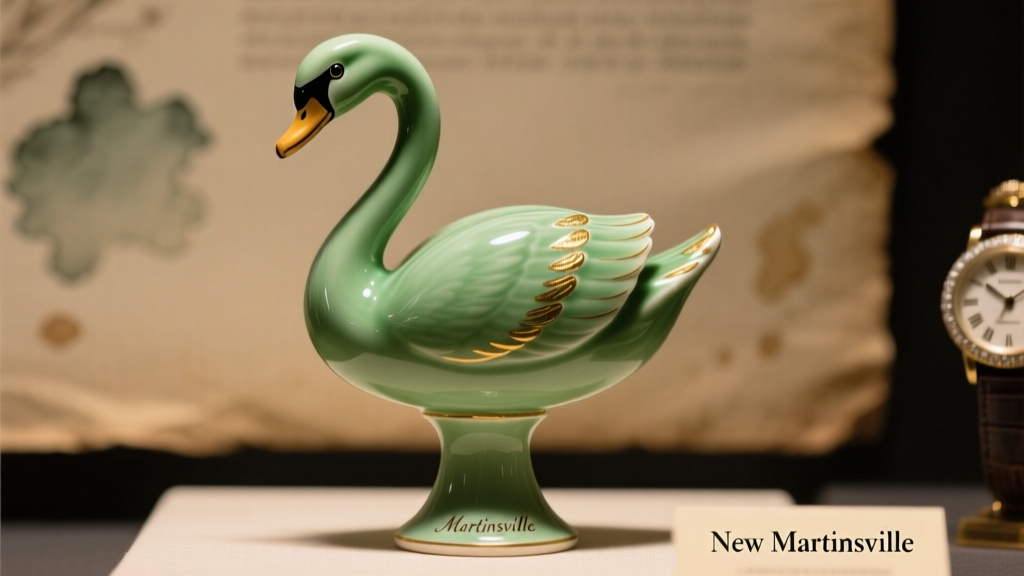
New Martinsville Candlestick: Swan Green Glass, 6-Inch Height — A Mid-Century American Collectible
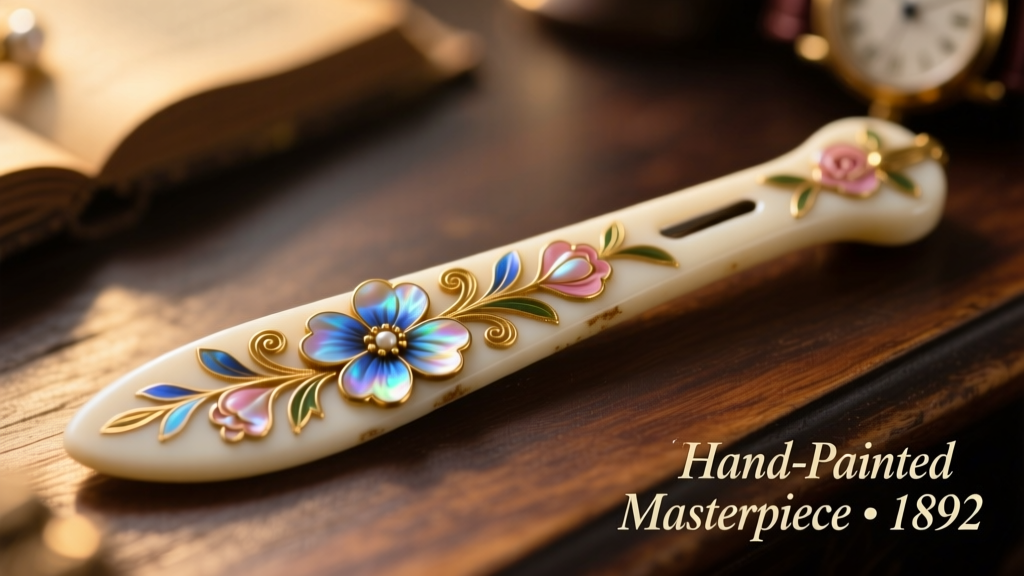
Ivory Letter Opener with Mother-of-Pearl Floral Inlay and Hand-Painted Detailing: A Victorian-Era Desk Accessory Reexamined
Savory Beer Advertising Sign: The 'Comic Fellow Hooked Fish' Tin Frame (15½ × 19 in) — A Study in Early 20th-Century American Brewery Promotion
Bennington Pipkin Alternate Rib 6-Inch: A Technical and Historical Appraisal of a Rare American Porcelain Tableware Pattern

The Toy Car Reo Coupe Rumble Seat: A Cast Iron Icon of American Arcade History
A Rare Soapstone Vase Lamp: Multi-Paneled Glass Shade, 21¼ Inches Tall — Provenance, Craftsmanship & Market Context
Fostoria American Bottle Water: A Collector’s Deep Dive into the Iconic Glassware Line
The Dinnerware Sculptured Zinnia Plate (Dinner, 12-Inch): A Mid-Century American Ceramic Masterpiece
Florence Ceramics 'Musette' Figurine (8¾" H, Model No. 2): Provenance, Craftsmanship, and Market Significance