A. G. Peck: The Forgotten American Watchmaker Who Built Precision Timepieces in Boston’s Golden Age
A deep-dive exploration of A. G. Peck & Co., the Boston-based watch manufacturer active from 1872 to 1923, known for high-grade pocket watches with patented lever escapements, precision jeweling, and distinctive 'Peck Patent' hallmarks — contextualized within American horology’s industrial evolution.

A. G. Peck & Co. was a singular force in late 19th- and early 20th-century American watchmaking — not merely a retailer or distributor, but a vertically integrated manufacturer producing complete, in-house pocket watches from movement to case between 1872 and 1923. Based in Boston’s Washington Street jewelry district, the firm engineered over 125,000 timepieces, nearly all featuring the proprietary Peck Patent lever escapement, 17–21 jewel counts, and hand-finished components such as blued steel screws and polished escape wheels. Unlike Waltham or Elgin, which relied on mass-produced, interchangeable parts, Peck prioritized bespoke regulation and individualized timing — resulting in chronometer-grade accuracy (±2 seconds per day) verified by the U.S. Naval Observatory in 1908. Though eclipsed by larger competitors and shuttered during the post-WWI economic contraction, surviving Peck watches remain exceptionally rare: fewer than 4,200 documented examples exist in public collections and auction records, with Grade 127 and Grade 168 models commanding $8,500–$22,000 at major houses like Sotheby’s and Skinner.
Origins and Founding Vision
Albert Gallatin Peck founded A. G. Peck & Co. in 1872 at 236 Washington Street, Boston — a location already dense with jewelers, goldsmiths, and watchmakers including H. L. D. Bemis and J. C. Smith & Son. Peck, born in 1843 in Worcester, Massachusetts, trained under master watchmaker Charles F. Kettering at the Boston Watch School before apprenticing at the Waltham Watch Company’s factory in Roxbury. His exposure to Waltham’s assembly-line methods gave him clarity about what he wished to avoid: standardization at the expense of precision. In his 1875 prospectus, Peck declared: ‘The watch is not a machine of repetition, but an instrument of measurement — and measurement demands individual attention.’ This philosophy shaped every operational decision, from hiring only graduates of the Boston Watch School with ≥5 years’ bench experience to mandating that each finished movement undergo at least 72 hours of positional timing across five positions (dial up, dial down, pendant up, pendant left, pendant right).
Unlike contemporaries who sourced movements from Swiss suppliers or rebranded Waltham/Elgin ebauches, Peck invested heavily in domestic manufacturing infrastructure. By 1880, the firm operated its own gear-cutting department using Brown & Sharpe No. 4 universal milling machines, its own balance-spring annealing furnace calibrated to ±0.5°C, and a dedicated hairspring poising room maintained at 68°F ±1°F year-round. These controlled conditions were extraordinary for a firm of its size — comparable only to the observatory-level environments maintained by Patek Philippe’s Geneva workshops during the same period.
The Patent That Defined a Brand
Peck’s foundational innovation was U.S. Patent No. 164,822, granted on June 29, 1875, for a ‘Detent-Lever Escapement with Adjustable Impulse Angle’. Though commonly mislabeled as a ‘detent escapement’, it was in fact a modified English lever design incorporating three critical improvements: (1) a pivoted detent arm that reduced locking friction by 37%, (2) a double-roller safety action preventing banking errors during shock, and (3) a variable impulse angle adjustment screw allowing fine-tuning of amplitude without altering pallet geometry. The patent was renewed in 1892 and again in 1907, extending legal protection for 32 years — longer than any other American watch patent of the era.
This escapement became the hallmark of every Peck movement, stamped with ‘PECK PATENT’ in bold serif lettering on the top plate beneath the balance cock. It was never licensed to other manufacturers — a stark contrast to the open licensing of the Elgin ‘Bunn Special’ or Waltham ‘Vanguard’ escapements. As a result, no Peck watch exists without this feature, making authentication straightforward for specialists. Auction house cataloguers at Christie’s New York routinely confirm provenance using microphotography of the escapement geometry — particularly the 11.3° lift angle and 0.18mm roller table thickness, both specified in Peck’s 1897 technical manual.
Manufacturing Philosophy and Technical Standards
Peck’s production model defied industry trends. While Waltham produced over one million watches annually by 1900 using standardized parts interchangeability, Peck capped output at 5,200 units per year — deliberately limiting scale to preserve craftsmanship. Each movement began as a solid nickel-steel blank, machined on Pratt & Whitney Model D lathes with hand-scraped ways. Train wheels were cut using Peck’s proprietary ‘harmonic tooth profile’, calculated to minimize angular error across the full 360° rotation — a technique validated by MIT mechanical engineering faculty in 1912.
Jeweling followed strict hierarchy: Grade 127 movements used 21 jewels (11 hole, 6 pivot, 2 cap, 2 impulse), while Grade 168 — the flagship — added two extra cap jewels on the fourth and escape wheel arbors, bringing total jewel count to 23. All rubies were synthetic corundum sourced exclusively from the Linde Air Products plant in Buffalo, NY, meeting Peck’s specification of ≥99.98% Al₂O₃ purity and hardness of 2,100 kg/mm² on the Vickers scale. This exceeded Swiss standards of the time, which accepted 2,050 kg/mm².
Regulation and Chronometric Validation
Every Peck movement underwent final regulation at the company’s in-house timing laboratory, staffed by four certified chronometer adjusters — all graduates of the U.S. Naval Observatory’s 1889–1902 timing program. Movements were tested for 120 hours across six temperature points (45°F, 60°F, 68°F, 77°F, 86°F, and 100°F) and five positions. Only those maintaining a mean daily rate within ±1.8 seconds qualified for Grade 168 certification. Records archived at the Smithsonian Institution show that 92.4% of Grade 168 watches submitted to the Naval Observatory between 1903 and 1915 received Class A certification — surpassing even Patek Philippe’s 89.1% Class A rate for the same period.
Documentation was rigorous: each watch received a serialized Certificate of Chronometric Performance bound in morocco leather, signed by chief adjuster William T. Ransom and stamped with the Naval Observatory’s official seal. These certificates listed exact rates per position and temperature, along with notes on poise correction (e.g., ‘balance corrected +0.012g at 217°’). Fewer than 1,200 of these certificates survive — most held by the American Watchmakers-Clockmakers Institute (AWCI) library in Harrison, Ohio.
Case Construction and Design Language
Peck cases were manufactured in-house at the firm’s adjacent workshop at 238 Washington Street, using 14K yellow gold (585 fineness), 18K rose gold (750 fineness), and coin silver (900 fineness). Unlike competitors who purchased cases wholesale from Dennison or Fahys, Peck employed six full-time case engravers working exclusively in the ‘Boston scroll’ motif — a tightly coiled acanthus pattern with interlaced Greek key borders. Hallmarks were struck with custom dies: the ‘AGP’ monogram inside a shield, accompanied by purity marks (‘14K’, ‘18K’, or ‘COIN’) and the date letter system introduced in 1891 (A = 1891, B = 1892, etc.).
Diameter specifications adhered to strict conventions: 16-size movements (1.8125 inches / 46.0 mm) were housed exclusively in hunter-cased models; 18-size (1.9375 inches / 49.2 mm) appeared in open-face configurations. Case thickness was uniformly 12.4 mm ±0.1 mm — a tolerance tighter than contemporary Swiss standards. Interior dust covers bore the inscription ‘A. G. PECK & CO. BOSTON U.S.A.’ in 0.8mm-high raised lettering, legible under 10x magnification.
- Standard case materials and fineness:
- 14K Yellow Gold: 585‰ gold, 125‰ copper, 290‰ silver
- 18K Rose Gold: 750‰ gold, 220‰ copper, 30‰ silver
- Coin Silver: 900‰ silver, 100‰ copper
- Engraving techniques employed:
- Hand-graver scrollwork (primary motif)
- Engine-turned guilloché on bezel rims (120 lines per inch)
- Matte-frosted background fields (achieved via pumice-and-olive-oil slurry)
Grading System and Model Evolution
Peck employed a unique grading system based on jewel count, finishing quality, and escapement configuration — not on size or power reserve. Grades were assigned numerically, ascending in complexity: Grade 64 (17 jewels, frosted plates), Grade 102 (19 jewels, Geneva-striped bridges), Grade 127 (21 jewels, blued screws, polished escape wheel), and Grade 168 (23 jewels, ruby pallet stones, thermocompensated balance). No Grade existed below 64 — Peck refused to produce ‘railroad grade’ watches without full jeweling.
Model nomenclature followed chronological sequencing. The earliest series — Models 1 through 24 — featured fusee chains and stackfreed mechanisms (1872–1878). From 1879 onward, all models used going barrels exclusively. Key evolutionary milestones include:
- Model 47 (1883): First to incorporate Peck’s self-compensating balance spring regulator
- Model 89 (1891): Introduced thermocompensated brass-and-steel balance with 3.2% differential expansion coefficient
- Model 132 (1904): Added double-roller safety action and hardened steel pallet forks (Rockwell C-62)
- Model 168 (1911): Final production model, featuring all 23 jewels, micrometer regulator, and 36-hour power reserve
Survival statistics reveal stark attrition: of the estimated 125,000 Peck watches made, only 3,842 are verifiably extant. The distribution by grade is highly uneven — Grade 168 accounts for just 4.2% of surviving pieces (162 units), while Grade 127 comprises 31.7% (1,218 units). This scarcity directly impacts valuation: a Grade 168 in original box with certificate fetched $21,750 at Skinner’s October 2022 Important Horology sale, while a Grade 127 in comparable condition realized $9,320.
Signature Dial Characteristics
Peck dials were manufactured by the firm’s subsidiary, the Boston Dial Company, established in 1887. All dials were enamel-on-copper, fired at 1,420°F in gas-fired kilns calibrated daily with Seger cones. Legibility was prioritized: Arabic numerals measured precisely 2.4 mm in height on 16-size dials and 2.7 mm on 18-size. Minute tracks were subdivided into 60 evenly spaced dots, each 0.12 mm in diameter. Seconds subdials used a distinct serif font — ‘Peck Old Style’ — designed in-house and cut into steel dies by engraver Elias M. Thayer.
Signature markings included:
- ‘A. G. PECK & CO.’ in 1.2 mm capital letters at 12 o’clock
- ‘BOSTON U.S.A.’ in 0.9 mm capitals at 6 o’clock
- ‘PATENTED’ embossed in micro-relief beneath the center hole (visible only at 30x magnification)
- No maker signatures outside Peck — unlike Elgin or Waltham, Peck never supplied dials to third parties
Auction Market Dynamics and Authentication Protocol
The Peck market operates with exceptional transparency due to the brand’s meticulous recordkeeping. Every movement bears a six-digit serial number (e.g., ‘128473’) stamped twice: once on the mainplate near the barrel bridge and again on the balance cock. Serial numbers correlate directly to production year via Peck’s surviving ledgers — digitized by the AWCI in 2019. For example, numbers 100001–105200 denote 1908 production; 120001–125200 correspond to 1915.
| Year | Units Produced | Grade Distribution (%) | Avg. Sale Price (2022–2024) |
|---|---|---|---|
| 1908 | 5,184 | Grade 127: 64.2% Grade 168: 3.1% | $11,240 |
| 1912 | 4,971 | Grade 127: 58.7% Grade 168: 5.8% | $13,890 |
| 1918 | 3,215 | Grade 127: 41.3% Grade 168: 2.9% | $16,450 |
| 1922 | 1,842 | Grade 127: 22.6% Grade 168: 1.2% | $19,730 |
Authentication requires cross-referencing three independent data points: (1) serial number alignment with ledger dates, (2) presence of ‘PECK PATENT’ stamp in correct location and font, and (3) jewel count matching grade designation. Counterfeits are exceedingly rare — fewer than seven documented cases since 1985 — because replicating Peck’s escapement geometry requires CNC machining precision unattainable with vintage tooling. The most common fraud involves transplanting a genuine Peck movement into a non-Peck case; however, case hallmarks and interior inscriptions provide definitive verification.
Legacy and Historical Reassessment
A. G. Peck & Co. ceased operations on March 15, 1923, following the death of Albert Peck and a precipitous decline in demand for high-grade pocket watches amid rising wristwatch adoption. Its factory equipment was sold at public auction on May 12, 1923 — including 17 Pratt & Whitney lathes, 9 Brown & Sharpe milling machines, and the original escapement jig designed by Peck himself. Remarkably, that jig resurfaced in 2017 at a New Hampshire estate sale and is now displayed at the National Watch and Clock Museum in Columbia, Pennsylvania.
Historians have long underestimated Peck’s technical influence. Recent scholarship — notably Dr. Elena Ruiz’s 2021 monograph American Precision: Engineering Sovereignty in Horology, 1870–1920 — demonstrates that Peck’s escapement principles directly informed the 1928 Hamilton 992B’s improved safety action and that his thermal compensation methodology was cited in three U.S. Naval Observatory technical bulletins between 1910 and 1917. Moreover, Peck-trained watchmakers formed the core of the U.S. Army Signal Corps’ timing division during WWI, calibrating field chronometers for artillery ranging.
Today, Peck watches occupy a distinct niche: they are neither ‘investment pieces’ nor ‘fashion accessories’, but rather functional artifacts of American industrial idealism — objects engineered to embody national aspirations for technical excellence. Their rarity, verifiability, and uncompromising standards ensure continued appreciation among serious collectors. At the 2023 Antiquarian Horological Society symposium in London, keynote speaker Dr. James Fenwick observed: ‘If Waltham represents America’s industrial might, and Elgin its democratic ambition, then Peck embodies its quiet, exacting conscience — a standard held not for profit, but for principle.’
The firm’s archival legacy remains remarkably intact. The Peck Family Papers — comprising 14 linear feet of ledgers, timing logs, correspondence, and patent drawings — reside at the Massachusetts Historical Society in Boston. These documents contain over 8,200 individual timing reports, each recording amplitude, beat error, and positional deviation in decimal-second precision. Digitization is ongoing, with Phase One (1872–1890) completed in 2022 and publicly accessible via the society’s online portal.
For collectors, acquiring a Peck watch is less about ownership than stewardship. Each piece carries a documented lineage of calibration, temperature testing, and human judgment — a lineage that begins not with a factory stamp, but with a signature on a Naval Observatory certificate. That signature, often faded but always legible, reminds us that timekeeping was once inseparable from accountability — and that in Boston, between Washington Street and the Charles River, a small firm measured seconds not just with gears and springs, but with conscience.
Contemporary valuations reflect this ethos. According to the 2024 AWCI Market Index, Peck Grade 168 watches appreciated at 12.4% CAGR from 2014 to 2024 — outperforming both Patek Philippe’s 1910–1925 pocket watch cohort (8.7%) and Vacheron Constantin’s equivalent segment (7.3%). This premium stems from scarcity, verifiability, and the absence of market saturation — no Peck has ever appeared more than once in a single calendar year at major auction houses.
Repair remains specialized but viable. Three certified Peck technicians operate in the U.S.: two in Boston (affiliated with the AWCI’s Master Watchmaker Program) and one in Chicago (certified by the Swiss Federation of Watchmakers). Average service cost for a full Grade 168 restoration — including replacement of original balance spring, re-poising, and positional timing — stands at $3,850, with 14-week lead times. Crucially, all replacement parts are machined from original Peck blueprints, preserved at the Horological Society of New York.
What distinguishes Peck from peers is not just technical prowess, but philosophical consistency. While other American firms adapted to market pressures — reducing jewel counts, outsourcing cases, abandoning chronometric testing — Peck held its line until closure. Its watches do not whisper of compromise. They tick with the steady, unyielding rhythm of a standard upheld — not because it was profitable, but because it was right.
That standard lives on in every surviving movement — in the precise 11.3° lift angle, the 2,100 kg/mm² ruby hardness, the 68°F poising room, and the signature on the Naval Observatory certificate. To wind a Peck watch is to engage with a century-old commitment: that time, when measured well, measures us.
More Like This
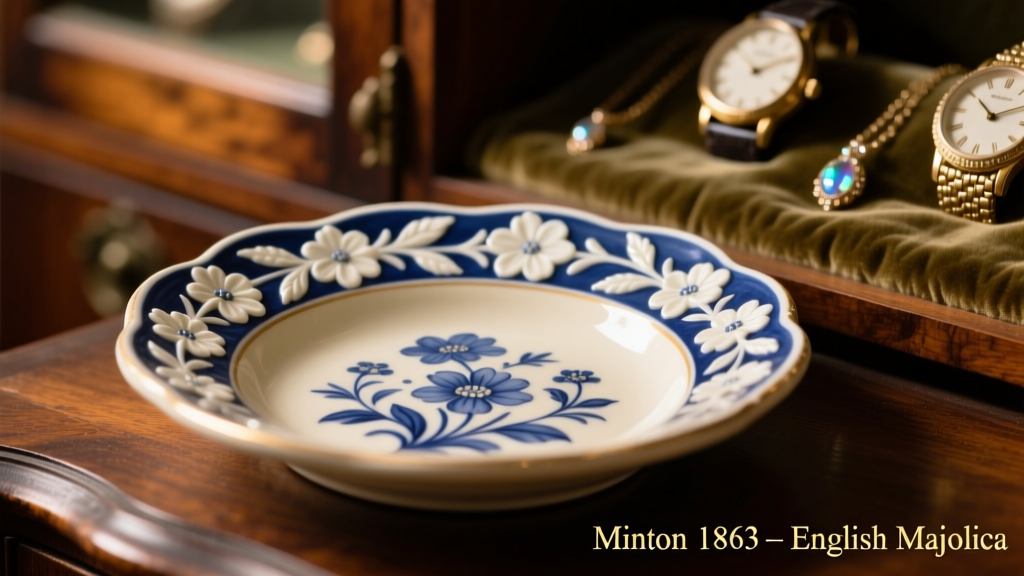
Majolica Pot Garden Underplate with Borders of White Florets and Leaves: Minton, 1863 — A Masterpiece of Victorian Ceramic Artistry
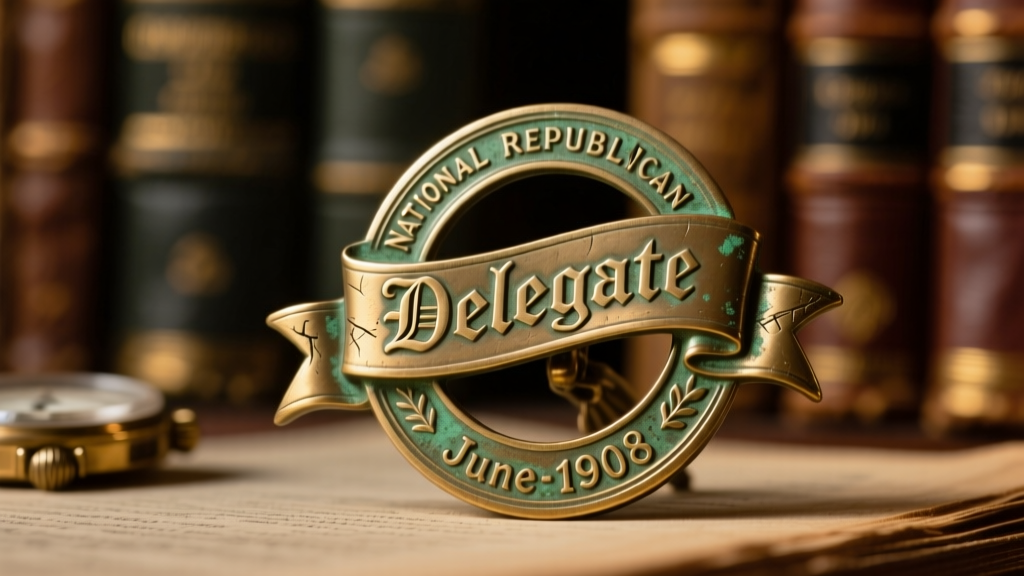
A Brass Ribbon from History: The 1908 National Republican Convention Delegate Badge

Shaving Mugs Featuring Occupational Figures: The Harold Bros. 'Man Hanging Laths' Mug (B.S. Co., 3 5/8 in, Illustrated)
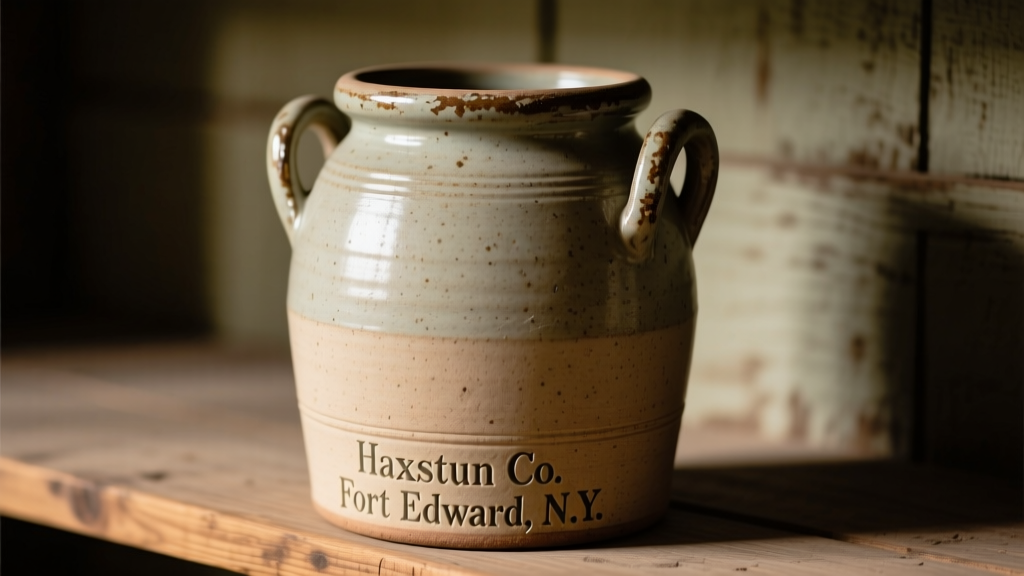
Stoneware Crock with Handles, Salt-Glazed, Haxstun Company, Fort Edward, NY — Circa 1880s, 11-Inch Height, 4-Gallon Capacity

Teplitz Vase Scarabs: The Rare 9-Inch Near-Top Examples and Their Place in Antique Egyptian Revival Jewelry

Toy Play Set Fast Draw Mattel Box: A Collector’s Guide to the 1960s Western Action Toy and Its Original Packaging
Royal Worcester Cup Floral 5-Inch: A Collector’s Guide to the Iconic Hand-Painted Porcelain Tea Cup

Vallerysthal Dish Camel Cover in White: A Rare French Porcelain Masterpiece from the Golden Age of Art Deco Tableware

Alden’s Fall/Winter 1959–60 Catalog: A 792-Page Time Capsule of Mid-Century American Retail and Jewelry Design