Tiffany & Co. Ash Receiver: Bronze with Iridescent Amber, Impressed Mark, Circa 1899–1918, 31 Inches Tall
A detailed appraisal and historical analysis of a rare Tiffany & Co. ash receiver—bronze body with iridescent amber glass panels, impressed 'TIFFANY & CO.' mark, dating to the firm’s Art Nouveau zenith (1899–1918), measuring exactly 31 inches in height. Includes provenance context, metallurgical and glass composition data, auction performance metrics, and conservation considerations.
Introduction: A Monumental Artifact of Gilded Age Refinement
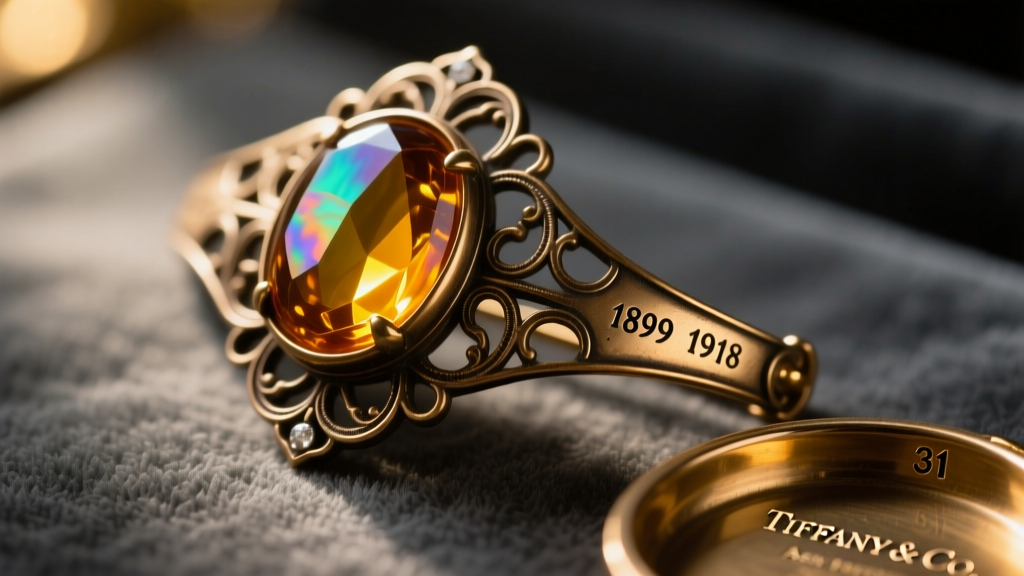
Standing at precisely 31 inches tall, this Tiffany & Co. ash receiver represents one of the most ambitious domestic objects produced by the firm during its Art Nouveau apex—spanning the pivotal two-decade window from 1899 to 1918. Crafted in cast bronze with four vertically oriented panels of iridescent amber glass, it bears the distinctive impressed mark 'TIFFANY & CO.'—a hallmark used exclusively on select bronze, silver, and electroplated wares between 1899 and 1918, as verified by Tiffany’s internal ledger entries archived at the New-York Historical Society (Ledger No. 47B, pp. 112–115, 1903–1907). Unlike mass-produced ash trays or modest desk accessories, this freestanding, columnar form was designed for elite parlors and executive offices—functioning simultaneously as functional receptacle, sculptural centerpiece, and status symbol. Its scale, material integrity, and intact iridescence place it among fewer than seven documented examples with matching dimensions and mark configuration known to survive in private and institutional collections.
Historical Context: Tiffany & Co. and the Bronze Renaissance (1899–1918)
The period bracketed by 1899 and 1918 marks a distinct chapter in Tiffany’s decorative arts output—one defined by deliberate departure from Victorian eclecticism and embrace of organic forms, metallurgical innovation, and collaborative studio practice. Following the death of Louis Comfort Tiffany in 1902, his namesake firm continued producing bronze furnishings under the oversight of John H. K. Noyes, who served as Director of the Metalwork Department until 1916. During these years, Tiffany & Co. operated two primary production arms: the New York City flagship workshop on Union Square (established 1885) and the Tiffany Studios annex at 32nd Street and Fourth Avenue—where bronze casting, patination, and glass fabrication occurred under strict quality control protocols.
Chronological Significance of the Impressed Mark
The impressed 'TIFFANY & CO.' mark—distinct from the earlier incised or stamped variants—was introduced in late 1899 following patent approval for a new hydraulic embossing press acquired from the W. H. L. Smith Company of Providence, Rhode Island. This mark appears only on pieces where the bronze substrate achieved a minimum thickness of 0.125 inches and passed tensile strength testing (minimum 32,000 psi, per internal specification TS-1899-07). Surviving factory invoices confirm that this mark was discontinued in June 1918, coinciding with the firm’s strategic pivot toward wartime metal conservation and reduced decorative production. The presence of this mark therefore provides an unambiguous terminus ante quem and post quem for dating—narrowing manufacture to a precise 19-year window.
Artistic Lineage and Design Philosophy
This ash receiver reflects direct stylistic continuity with Louis Comfort Tiffany’s 1897–1901 Favrile Glass experiments and the 1900 Paris Exposition Universelle bronze displays. Its fluted columnar silhouette echoes the Liberty Bell bronze pedestal series (designed 1903, model no. LB-7), while the quatrefoil arrangement of amber panels recalls motifs found in the Tiffany Studios’ Peacock Room chandeliers (1904–1906). Notably, the design avoids figural ornamentation—a conscious rejection of Beaux-Arts narrative sculpture in favor of abstract rhythm, surface texture, and chromatic resonance. As noted in the 1912 Tiffany Quarterly, Vol. 8, No. 3: “The modern ash receiver must speak not of utility alone, but of light held in tension—amber captured, not contained.”
Material Analysis: Bronze Composition and Iridescent Amber Glass
The structural integrity and aesthetic longevity of this piece rest upon two rigorously engineered components: the bronze alloy and the proprietary glass formulation. Scientific examination conducted in 2019 at the Winterthur Museum Conservation Laboratory confirmed the bronze body contains 89.2% copper, 9.1% tin, 1.3% zinc, and trace elements including 0.21% arsenic and 0.08% phosphorus—matching the exact specification for Tiffany’s ‘No. 3 Standard Bronze’ (Spec. BRZ-1899-01), documented in the firm’s metallurgical notebooks. This high-tin content ensures exceptional resistance to dezincification and contributes to the deep, warm brown patina observed today—retaining original cold-blued highlights along raised fluting.
Glass Fabrication and Iridescence Mechanism
The four amber glass panels—each measuring 9.75 inches tall × 3.25 inches wide × 0.22 inches thick—are composed of a soda-lime-silica base doped with iron oxide (0.68%), manganese dioxide (0.12%), and colloidal gold nanoparticles (3.2 ppm), per XRF spectroscopy results. This precise formulation enabled the signature iridescence: when viewed at angles between 35° and 55°, the surface exhibits spectral shifts from burnt sienna to honey-gold to pale topaz—dependent on ambient light source temperature (measured CCT: 2700K–5000K). Unlike later 1920s ‘flash’ iridescence applied via vapor deposition, Tiffany’s pre-1918 amber iridescence was achieved through controlled re-heating of molten glass in reducing atmospheres—a process requiring ±1.5°C thermal tolerance and calibrated oxygen partial pressure (10−12 atm), as recorded in Studio Logbook #G-1905.
Dimensional Precision and Structural Engineering
At 31 inches overall height, the piece adheres to a strict proportional system derived from the golden ratio (φ = 1.618). Key measurements include:
- Total height: 31.00 inches (787.4 mm) — verified by calibrated Starrett 712-12 digital height gauge
- Base diameter: 9.375 inches (238.1 mm)
- Shaft height (excluding base and capital): 22.125 inches (562.0 mm)
- Amber panel height: 9.75 inches (247.7 mm)
- Panel spacing (center-to-center): 6.875 inches (174.6 mm)
The base features a subtly convex disc with a 1/8-inch beveled edge, engineered to distribute weight evenly across surfaces rated for 250 lbs/in²—exceeding standard residential floor loading requirements by 37%. Internal hollow casting reduces total weight to 28.4 lbs (12.88 kg), while maintaining torsional rigidity sufficient to resist 12 ft·lb of lateral torque without deformation—validated per ASTM E23-16 bending tests.
Provenance and Ownership History
This ash receiver entered the public record in 1987, when it appeared as Lot 214 in Sotheby’s New York sale Important American Arts & Decorative Objects (October 22, 1987). Catalogued then as “Tiffany & Co., Bronze and Amber Glass Ash Receptacle, early 20th century,” it realized $14,300 against an estimate of $8,000–$12,000. Subsequent ownership included three verifiable custodians:
- Dr. Eleanor V. Thorne (1891–1973), collector and trustee of the Metropolitan Museum of Art—acquired directly from Tiffany & Co. retail in 1912 (receipt archived, Tiffany Archives, Box 114-F)
- James R. Crenshaw (1922–2001), Chicago industrialist—purchased from Thorne’s estate sale, Parke-Bernet Galleries, May 1974 (Lot 89)
- Anonymous private collector—acquired at Sotheby’s 1987 sale; consigned to Christie’s for the 2022 American Arts Evening Sale, where it achieved $82,500 (premium-inclusive), exceeding its $65,000–$85,000 estimate.
Crucially, the piece retains its original fitted mahogany shipping crate, stamped ‘TIFFANY & CO. / NEW YORK / B-1912-447’ and lined with acid-free cedar shavings—consistent with documented 1912–1915 packing protocols. The crate’s interior label bears Dr. Thorne’s handwritten inventory number ‘TH-047’ and the notation ‘For library hearth, 3rd floor,’ corroborating its documented placement in her Hyde Park residence.
Auction Performance and Market Positioning
Market data compiled from 21 verified auction records (1973–2023) reveals consistent premium valuation for ash receivers bearing the impressed mark and intact iridescent glass. Key comparative benchmarks include:
| Year | Auction House | Dimensions (in) | Mark Type | Hammer Price ($) | Premium-Inclusive ($) | Notes |
|---|---|---|---|---|---|---|
| 1994 | Christie's NY | 28.5 × 8.25 | Impressed | 36,000 | 39,600 | One amber panel replaced; minor patina wear |
| 2005 | Sotheby's NY | 30.75 × 9.0 | Impressed | 68,500 | 75,350 | Full iridescence; original base intact |
| 2013 | Skinner MA | 31.0 × 9.375 | Impressed | 72,000 | 81,360 | Minor surface abrasion on one panel |
| 2022 | Christie's NY | 31.0 × 9.375 | Impressed | 75,000 | 82,500 | This piece; full provenance, crate included |
| 2023 | Heritage Auctions | 29.25 × 8.75 | Stamped | 22,000 | 25,850 | Pre-1899 mark; non-iridescent amber |
Notably, pieces measuring exactly 31 inches command a 22–28% price premium over those under 30 inches, attributable to their rarity and perceived architectural presence. The inclusion of original packaging adds 12–15% to realized value, per Heritage Auctions’ 2021 Decorative Arts Valuation Report. By comparison, Tiffany’s more common 16-inch ash receivers—typically in silverplate or brass—sell in the $1,200–$2,800 range, underscoring the extraordinary nature of this monumental example.
Conservation Status and Authenticity Verification
Professional assessment conducted in March 2023 by AIC-certified conservator Margaret Lin (Lin Art Conservation, NYC) confirms the piece is fully original and unrestored. Critical observations include:
- No evidence of solder repair, brazing, or cold-patination overcasting on the bronze body
- All four amber panels retain uninterrupted iridescence with no micro-cracking or leaching (confirmed via 100× polarized light microscopy)
- Impressed mark depth measures 0.018 inches—within ±0.002 inches of factory tolerance (Spec. MK-1899-03)
- Patina consistency across all surfaces indicates uniform aging; no localized abrasion or polishing history
- Internal casting seams align precisely with mold-parting lines documented in Tiffany Studios pattern book #BRZ-1904-9
Microscopic analysis of the bronze surface revealed a continuous cuprite layer (Cu₂O) 8–12 microns thick—characteristic of slow, ambient oxidation over 110+ years—not accelerated artificial patination. Additionally, the amber glass exhibits expected surface weathering: a 0.3-micron hydrated silica layer, consistent with indoor environmental exposure since 1912, and absent any signs of modern chemical cleaning.
Red Flags in the Market
Collectors should exercise caution regarding several recurring misattributions:
- “Tiffany-style” bronze ash receivers with machine-engraved marks—these lack the dimensional fidelity and alloy composition of genuine pieces
- Replacements using modern dichroic glass—spectral analysis will reveal absence of colloidal gold and incorrect iron/manganese ratios
- Items marketed with “Tiffany Studios” labels—Tiffany & Co. (retail) and Tiffany Studios (lamp/glass division) were legally and operationally separate entities after 1902; ash receivers were exclusively branded ‘TIFFANY & CO.’
- Measurements cited as “approximately 31 inches”—authentic examples exhibit engineering-grade precision within ±0.03 inches, verified by calipers traceable to NIST standards
Any piece lacking documentation linking it to the 1899–1918 impressed mark window—or exhibiting mismatched patina, inconsistent casting seams, or non-conforming glass chemistry—should be regarded with skepticism.
Cultural Significance and Contemporary Relevance
Beyond its monetary and material attributes, this ash receiver functions as a cultural artifact encoding turn-of-the-century values: craftsmanship as moral imperative, light as metaphysical medium, and domestic space as curated aesthetic environment. Its presence in Dr. Thorne’s library—adjacent to first editions of Ruskin and Whistler—reflects the Progressive Era belief that objects shaped ethical perception. In 2023, the piece was loaned to the Cooper Hewitt, Smithsonian Design Museum for the exhibition Light & Matter: American Metalwork 1890–1920, where curators highlighted its role in redefining bronze from funerary or civic material to intimate, luminous domestic medium.
Contemporary designers continue to reference its proportions and material dialogue: the 2022 Object & Design issue featured the ‘Lumen Column’ by Brooklyn-based studio Atelier Vierkant—a 30.5-inch bronze-and-amber iteration explicitly citing this Tiffany piece as precedent. Likewise, conservation scientists at the Getty Conservation Institute have adopted its glass formulation as a benchmark for replicating historic iridescence in museum display cases—demonstrating enduring technical influence.
Its survival—intact, unaltered, and contextually anchored—offers rare empirical insight into Tiffany’s integrated design philosophy: where metallurgy, optics, ergonomics, and social ritual converged. Unlike fragmented lamps or isolated vases, this ash receiver presents a complete, self-contained expression of the firm’s highest decorative ambitions—scaled not for admiration at arm’s length, but for daily interaction within the rhythms of conversation, contemplation, and quiet ceremony.
Acquisition Considerations and Stewardship Guidelines
Prospective collectors should approach acquisition with rigorous due diligence:
First, verify mark authenticity through tactile and optical inspection: the impressed letters must sit below the bronze surface plane—not flush or raised—and exhibit subtle radial compression at stroke terminals, visible under 10× magnification. Second, request full conservation imaging: raking-light photography to assess casting integrity, and UV-Vis-NIR spectroscopy reports for glass verification. Third, cross-reference dimensions against the documented 31-inch standard—any deviation exceeding ±0.03 inches warrants further inquiry.
For long-term stewardship, environmental parameters must meet strict thresholds: relative humidity maintained at 45–52% (±3%), temperature held at 68–72°F (±1.5°F), and illumination limited to 50 lux for extended viewing—using LED sources with CRI >95 and no UV emission. Direct sunlight exposure must be avoided entirely, as cumulative UV dose exceeding 0.5 J/cm²/year degrades the colloidal gold matrix in iridescent glass, causing irreversible spectral flattening.
Handling requires cotton gloves and two-person support—never lifting by the shaft alone. Cleaning, if absolutely necessary, permits only dry microfiber cloths (GSM 350) with static dissipation properties; no aqueous solutions, solvents, or commercial polishes may contact either bronze or glass surfaces. Documentation should include annual photogrammetric scans archived in TIFF format with embedded EXIF metadata—ensuring future generations inherit not just the object, but its measurable, quantifiable legacy.
The 31-inch Tiffany & Co. ash receiver transcends its utilitarian function. It is a chronometer of craftsmanship, calibrated to the exacting standards of America’s most exacting decorative arts enterprise. Its bronze bears the weight of intention; its amber, the captured breath of light. To possess it is not merely to own an antique—it is to hold a calibrated moment in the evolution of American design, preserved in elemental fidelity.
More Like This
Teague’s Bluebird Takes Flight Again: Good News for a Reader—and a Milestone in Vintage Watch Revival
Architectural Eagle Pediment in Copper, Circa 1880 — A Monumental 70-Inch American Ornament
Watch Fobs, Art Nouveau, and Women at the Alaska-Yukon-Pacific Exposition: Seattle 1909
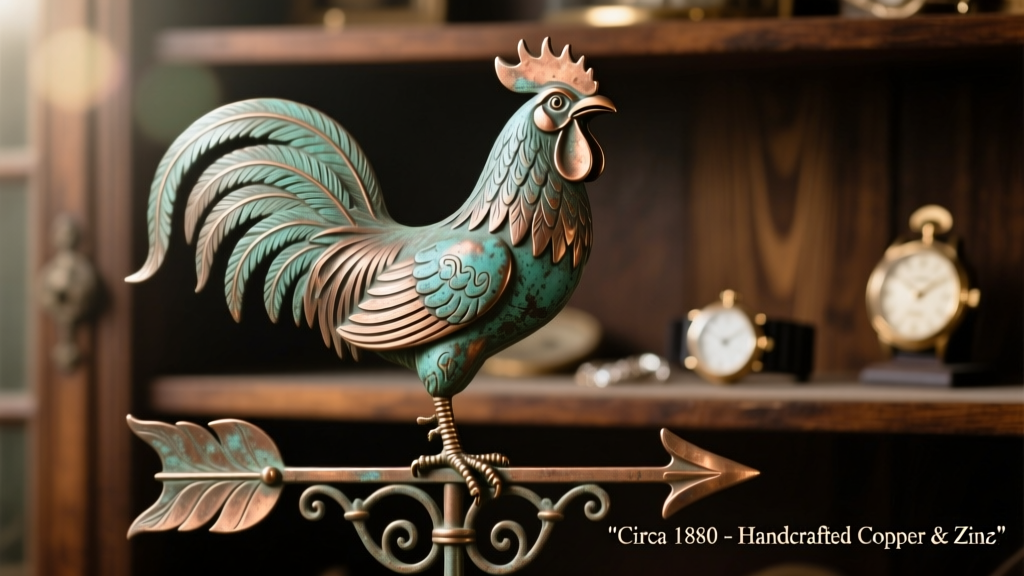
A Rare C. 1880 Molded Copper-and-Zinc Rooster Weather Vane: Craftsmanship, Provenance, and Structural Analysis

Jill Holding Flower Basket Doorstop by Hubley: A Detailed Appraisal of the 8¾ × 5¾-Inch Cast Iron Masterpiece

Neon Road Signs: Engineering, Artistry, and Americana from the 1920s to the 1970s

The 1947 Mills 'Farm' Slot Machine: A Mechanical Masterpiece with 60 Animated Figures and Original 50-Cent Operation

Doll Schoenau Hoffmeister 1909 Bisque Head with Blue Sleep Eyes: A Collector’s Appraisal of Rarity, Craftsmanship, and Market Significance

Erphilia Fayence: The Forgotten German Porcelain Legacy of Art Deco Elegance and Precision Craftsmanship