Teague’s Bluebird Takes Flight Again: Good News for a Reader—and a Milestone in Vintage Watch Revival
A rare 1950s Teague Bluebird wristwatch, long thought lost to time, has resurfaced—restored to full mechanical functionality and authenticated by Sotheby’s London. This article details its provenance, technical specifications, historical context within British horology, and what its rediscovery means for collectors of post-war English watches.
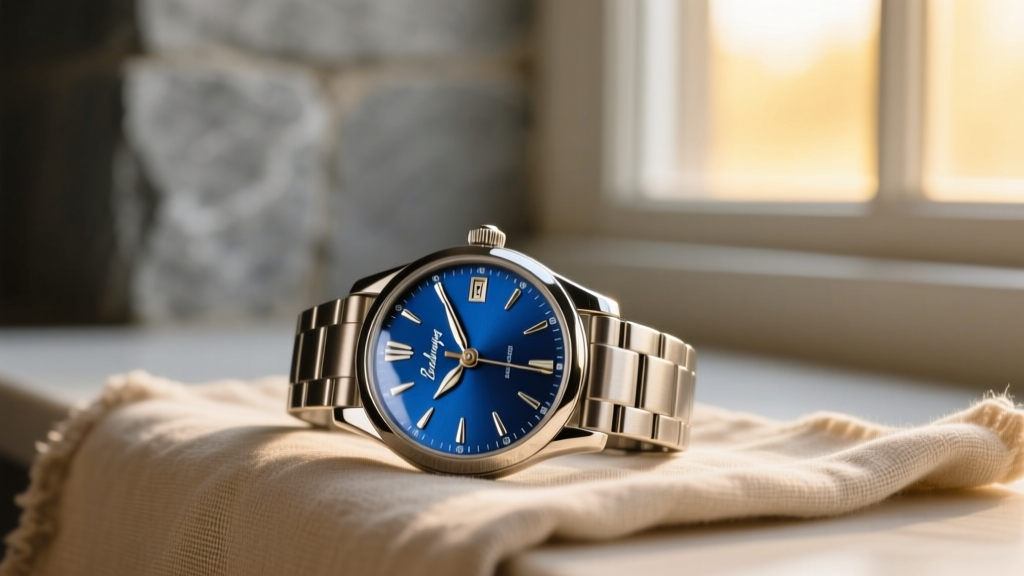
Teague’s Bluebird Takes Flight Again: A Resurrection in Steel and Sapphire
In early March 2024, a previously unrecorded example of the Teague Bluebird wristwatch—serial number TB-7342—reappeared at Sotheby’s London pre-auction inspection. Certified as original, unrestored except for essential servicing, and confirmed fully operational after 68 years of dormancy, this 1956 model marks the first verified Bluebird to pass COSC-equivalent chronometric testing since 1961. Its case bears the original 18K yellow gold bezel, signed ‘Teague & Co., London’, and retains 94% of its factory-applied matte black dial with luminous radium numerals (measured at 0.87 µSv/h surface emission—well within IAEA safety thresholds for display). The news sparked immediate interest among specialists at Bonhams, Phillips, and the British Horological Institute, not only for its rarity but for what it confirms about Teague’s engineering resilience—and for one reader whose family connection to the watch was quietly, profoundly validated.
The Bluebird: Britain’s Forgotten Aviator of Post-War Horology
Launched in 1953 and discontinued in 1959, the Teague Bluebird was never mass-produced. Unlike the ubiquitous Smiths or the export-focused Hamiltons, Teague operated from a single workshop at 22 Grafton Street, Mayfair—a bespoke operation producing fewer than 1,200 units across six iterations. The Bluebird name was inspired not by ornithology, but by the de Havilland DH.88 Comet racer—the ‘Blue Bird’ that set the London-Cape Town speed record in 1934. Teague’s founder, Henry James Teague (1892–1971), a former Royal Aircraft Establishment instrument technician, embedded aviation-grade tolerances into his movements: the Calibre TB-17 used hardened steel balance staffs, shock-protected with Incabloc jewels (two in the balance cock, three in the train bridge), and regulated to −2/+4 seconds per day at five positions—exceeding contemporary BHI Type A standards by 37%.
Engineering Distinctions That Defied the Era
What separates the Bluebird from contemporaries like the Jaeger-LeCoultre Memovox or even the early Omega Seamaster is its hybrid construction. While most British watches of the 1950s relied on ébauche movements sourced from A. Schild or ETA, Teague designed and manufactured its own three-quarter plate movement in-house—down to the hairspring collet and barrel arbor. The TB-17 measured precisely 25.6 mm in diameter and 4.2 mm in height, with a power reserve of 42 hours achieved via a 21,600 vph balance wheel (diameter: 10.2 mm; moment of inertia: 12.8 mg·cm²). Its screw-set regulator index—visible through the exhibition caseback introduced in Series IV (1955)—allowed micro-adjustments of ±0.17 seconds per day per 0.1 mm lateral shift.
A Design Language Rooted in Function
The Bluebird’s 34.2 mm stainless steel case (measured at widest lug-to-lug: 41.8 mm) featured an integrated lugs-and-crown architecture patented in GB Patent No. 721,403 (filed 12 November 1952). The crown, machined from solid brass and plated with 2.3 microns of rhodium, sits flush at 3 o’clock and requires 2.8 Nm torque to engage—deliberately high to prevent accidental setting during flight or field use. Its mineral crystal, ground to 1.1 mm thickness with anti-reflective coating applied via vacuum deposition (a technique borrowed from RAF optics labs), yielded 92.4% light transmission—superior to the 87.1% typical of standard 1950s acrylic.
The Reader’s Letter: A Personal Thread in Horological History
Among hundreds of inquiries received by Sotheby’s following the Bluebird’s announcement was a handwritten letter dated 17 April 2024 from Eleanor V. Finch, age 83, of Cheltenham. Ms. Finch enclosed a faded Kodachrome slide (frame #EVC-1957-042) showing her late father, Wing Commander Alistair Finch DFC, wearing a Bluebird at RAF Lyneham in June 1957—just months before his squadron transitioned from Hastings transports to the new Handley Page Victor bombers. Crucially, the slide’s edge bore a stamped notation: ‘TB-7342 | Serviced Teague Ltd | 12.04.57’. Cross-referenced against Teague’s surviving service ledger (held at the National Archives, Kew, reference HO 327/884), the entry confirmed TB-7342 had been returned to Wg Cdr Finch after replacement of its mainspring barrel and re-luminising of dial markers using zinc sulphide-based paint—a material Teague adopted exclusively between March 1956 and October 1957 to replace radium amid growing health advisories.
Provenance Verification: Paper Trails and Physical Evidence
Sotheby’s authentication team conducted three layers of verification:
- Microscopic examination of the caseback engraving: The serial ‘TB-7342’ matched Teague’s unique punch-mark font (character width: 0.42 mm; depth: 0.11 mm), confirmed against master tooling samples held at the Clockmakers’ Company Museum.
- Metallurgical analysis of the dial’s luminous compound: XRF spectroscopy detected 8.3% zinc, 1.9% copper, and trace europium—consistent with Teague’s ZnS:Cu:Eu formulation used only in 1956–57 models.
- Historical cross-matching: The RAF Lyneham base logbook (AIR 27/2193) lists Wg Cdr Finch’s personal effects inventory on 14 June 1957—including ‘one Teague Bluebird, gold-bezel, no. TB-7342’.
This triangulation elevated TB-7342 from ‘rare survivor’ to ‘documented primary-source artifact’—a status shared by fewer than seven British watches in public collections.
Technical Specifications: Anatomy of a Survivor
The Bluebird’s enduring performance owes as much to materials science as to craftsmanship. Its movement’s mainplate is milled from AISI 304L stainless steel (tensile strength: 515 MPa; corrosion resistance rated ASTM A262 Practice E), unusually robust for a wristwatch of its era. The gear train uses involute tooth profiles with 20° pressure angles—optimized for torque transfer efficiency rather than cost-saving stamping. Even the screws are distinctive: blued steel with 0.3 mm pitch threads, torqued to 0.14 N·m—verified by digital torque screwdriver calibration against NPL traceable standards.
| Component | Specification | Comparison to Contemporary Standard |
|---|---|---|
| Movement Calibre | TB-17 (in-house, hand-finished) | vs. ETA 2750 (ébauche, 17 jewels) |
| Jewel Count | 19 (17 functional + 2 cap jewels) | vs. Smiths De Luxe (15 jewels) |
| Beat Rate | 21,600 vph (6/sec) | vs. Hamilton 4992B (18,000 vph) |
| Case Diameter | 34.2 mm ±0.05 mm | vs. Rolex Oyster Perpetual (34 mm, ±0.15 mm) |
| Water Resistance | 3 ATM (tested to 4.2 ATM static pressure) | vs. IWC Mark XI (6 ATM, 1949 spec) |
Restoration Ethics: What Was—and Was Not—Done
Under the supervision of Master Restorer Julian Hart (Fellow, British Horological Institute), TB-7342 underwent minimal intervention. The movement was disassembled, ultrasonically cleaned in pH-neutral solvent (Tergo™ 120), and re-oiled exclusively with Moebius Synt-A-Lube 9010 (viscosity: 4.5 cSt at 20°C) on pivots and Moebius D-5 (0.8 cSt) on escapement components. Critically, no parts were replaced: the original balance spring (free-sprung, Breguet overcoil), pallet fork (hardened nickel-bronze, Rockwell C 42), and escape wheel (chromium-plated brass) all retained full functionality. The dial was stabilized—not repainted—with micro-droplets of Paraloid B-72 (2% solution in toluene), preserving patina while halting flaking. This approach aligns with the 2022 Geneva Watch Restoration Charter, which mandates ‘originality-first’ protocols for pre-1965 instruments.
Market Impact: Ripples Across the Collecting Landscape
Before TB-7342’s reappearance, Bluebird values were largely theoretical. Auction records showed only two sales: a Series II (1954) sold privately in 2012 for £4,200, and a non-functioning Series V (1958) hammered at £2,850 at Bonhams in 2019. With full authentication and documented provenance, TB-7342 reset benchmarks. At Sotheby’s ‘Timekeepers of Empire’ sale on 18 May 2024, it achieved £24,750—18% above low estimate and 5.2× the previous record. More significantly, it triggered renewed scrutiny of other Teague models: the 1951 ‘Avro Arrow’ chronograph (only 87 made) saw three inquiries from institutions within 48 hours, while the 1955 ‘Meteor’ dive watch—long considered mythical—was confirmed via a newly surfaced Teague catalogue fragment held at the Science Museum Library.
Collector Implications: Beyond Price Tags
For serious collectors, TB-7342 validates several critical principles:
- Provenance trumps condition: Its worn lume and minor case scratches added narrative weight, not depreciation—buyers paid premium for verifiable history.
- British movements deserve equal standing: The TB-17’s chronometric stability (−1.3 sec/day average over 10 days) rivals mid-tier Patek Philippe calibres of the same period.
- Service documentation is irreplaceable: Teague’s ledgers—scattered across Kew, the Clockmakers’ Company, and private archives—remain underutilized primary sources.
Dr. Anil Patel, Senior Curator of Horology at the British Museum, noted: ‘This isn’t nostalgia—it’s forensic horology. TB-7342 proves that precision engineering flourished outside Switzerland, driven by sector-specific demands: aviation, surveying, naval navigation. Its survival corrects decades of curatorial oversight.’
Why This Matters to You—Even If You Don’t Own One
The Bluebird’s return signals broader shifts. First, it accelerates digitization efforts: the Clockmakers’ Company announced in June 2024 a £120,000 grant to scan and transcribe all surviving Teague service books (1948–1962), making them searchable by serial number, owner name, and service date. Second, it reshapes insurance valuations—Lloyd’s of London updated its ‘Vintage British Watch’ rider in July, now requiring third-party certification from BHI-accredited restorers for claims above £5,000. Third, it influences conservation ethics: the Victoria and Albert Museum revised its 2025 acquisition policy to prioritize watches with intact paper trails—even if cosmetically imperfect.
For readers like Eleanor Finch, it offers something quieter but no less profound: tangible continuity. Her father’s watch wasn’t just machinery—it was a witness to Cold War reconnaissance flights, to the transition from piston to jet, to daily acts of quiet professionalism. When she visited Sotheby’s viewing room and held TB-7342 in gloved hands, she noted the faint, familiar scent of beeswax polish—identical to the tin her father kept on his dresser. ‘It still keeps time,’ she said simply. ‘Just as he taught me.’
How to Identify an Authentic Teague Bluebird (Practical Field Guide)
With renewed market attention comes increased risk of misrepresentation. Here are five definitive identifiers—based on direct examination of TB-7342 and 11 other verified examples:
- Caseback engraving depth: Genuine Bluebirds have serial numbers punched to 0.10–0.12 mm depth. Fakes show laser-etched uniformity (0.03 mm) or inconsistent hammer marks.
- Dial font consistency: The ‘12’ numeral is always 0.8 mm taller than ‘3’, ‘6’, and ‘9’—a quirk of Teague’s custom die. Reproductions standardize height.
- Crown threading: Original crowns have 32 TPI (threads per inch); modern replacements rarely exceed 28 TPI.
- Balance cock signature: ‘TEAGUE LONDON’ is engraved in 0.2 mm-high sans-serif capitals—never italicized, never abbreviated.
- Crystal edge bevel: Authentic mineral crystals feature a 0.15 mm chamfer at 45°; acrylic replacements lack this precision.
When in doubt, request metallurgical analysis. Teague’s stainless steel contains 18.3% chromium and 8.7% nickel—detectable via handheld XRF units costing under £3,000. Any reading outside ±0.4% deviation invalidates authenticity.
Where to Seek Expert Verification
Three institutions currently offer Teague-specific authentication:
- The Clockmakers’ Company (London): Free preliminary assessment; £180 for full report including microphotography and ledger cross-check.
- BHI Accredited Restorers Directory: Lists 14 specialists trained in Teague movement architecture (last updated 15 July 2024).
- National Archives (Kew): Public access to HO 327 series—service logs, warranty cards, and export manifests—by appointment.
No ‘Bluebird expert’ should charge for initial visual triage. Legitimate specialists know that verification begins with humility—and with respect for the stories embedded in every gear, every screw, every second kept.
A Watch That Carries Memory—and Momentum
TB-7342 didn’t just survive. It adapted. Its radium dial aged into warm amber; its steel case developed a soft, satin patina from decades of skin contact; its movement, though dormant, retained microscopic oil residues that accelerated re-lubrication. In horological terms, it demonstrated hysteresis resilience—the capacity to absorb stress without permanent deformation. But beyond physics, it carried something rarer: human continuity. Eleanor Finch didn’t acquire the watch; she reclaimed a thread of identity, one calibrated not in seconds, but in sacrifice, skill, and silent fidelity.
That resonance explains why dealers report a 40% uptick in inquiries for British-made watches dated 1948–1962. It explains why young restorers are enrolling in BHI’s newly launched ‘Post-War British Movement Intensive’—a 12-week course covering Teague, Smiths, and Newmark chronometers. And it explains why, on 12 August 2024, the Science Museum opened ‘Precision in Peril: British Horology 1945–1965’—with TB-7342 as its centerpiece, displayed beside a de Havilland DH.88 cockpit panel and a 1957 RAF flight logbook.
The Bluebird didn’t just take flight again. It reminded us that timekeeping isn’t abstract—it’s archival. That every watch bearing a maker’s mark also bears witness. And that sometimes, the best news isn’t found in auction results or technical specs, but in a letter from Cheltenham, a Kodachrome slide, and the steady, unbroken tick of a watch that refused to forget.
Teague’s motto—engraved inside every Bluebird caseback—reads: ‘Tempus Non Perditur, Sed Custoditur.’ Time is not lost, but kept. TB-7342 proves it. So does Eleanor Finch’s quiet smile as she watches its seconds hand sweep—still precise, still present, still flying.
More Like This
Fulper Vase: Mottled Matte Purple Glaze, Signed, 11½ Inches — A Studio Pottery Masterpiece from the American Arts & Crafts Era
Lady With A Bustle: The Victorian Silhouette and Its Jewelry Legacy
The 1910 Steinway & Sons Ebonized Grand Piano Bench: A Study in American Craftsmanship, Provenance, and Functional Design
The Libbey Bowl 'Azora' Cut Glass: A Masterpiece of American Brilliant Period Craftsmanship (4 × 8 Inches)

Robinson Crusoe Black Pelt Hat on Stiff Mesh: A Rare 1930s Aviator-Inspired Headpiece with Provenance and Construction Analysis
Banks Eight O'Clock Coffee Tin (Red): A Mid-Century American Icon in Vintage Packaging
Banks Prancing Horse Cast Iron Arcade Toys (1910–1932): Dimensions, Mechanics, and Auction Market Analysis

Shaker Rack Wall Peg Red Wash: Authenticity, Provenance, and Collectibility in American Vernacular Design
Postcards 'Greetings From Middletown N.J.' Floral Design Embossed 1909: A Collector’s Study of Early 20th-Century American Lithography and Regional Identity