Thomas W. Bell: The Forgotten American Watchmaker Who Built Precision Timepieces for the U.S. Military and Railroads
A detailed examination of Thomas W. Bell — the pioneering American watchmaker whose factory in Waterbury, Connecticut produced over 120,000 high-grade pocket watches between 1884 and 1929, including U.S. Navy-certified chronometers, railroad-standard movements, and rare signed hunter-case pieces bearing his name on dials and movements.
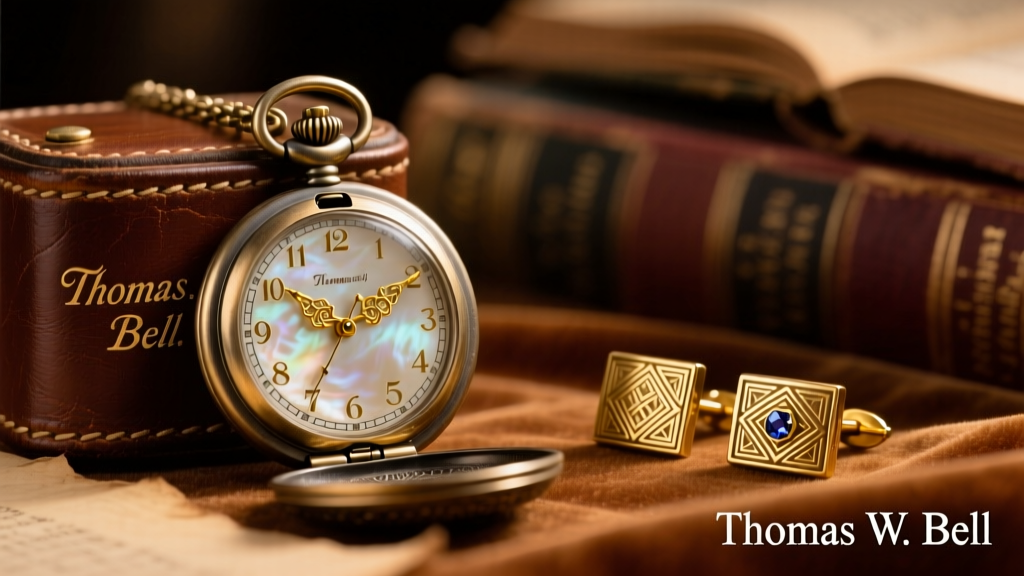
Thomas W. Bell: A Cornerstone of American Horology
Thomas W. Bell (1843–1927) was not a household name like Elgin or Waltham, yet his contribution to American watchmaking was both technically significant and historically consequential. Operating from 1884 to 1929 in Waterbury, Connecticut — then known as the "Brass City" for its dense concentration of metalworking firms — Bell manufactured over 120,000 pocket watches, nearly all bearing his full signature on the movement plate and often on the dial. His firm produced precision timepieces certified by the U.S. Navy Bureau of Navigation, met strict railroad standards for accuracy and reliability, and supplied chronometer-grade instruments to maritime institutions. Unlike many contemporaries who relied on subcontracted parts, Bell’s factory assembled complete movements in-house, including balance springs, pivots, and jeweled lever escapements. His legacy endures in surviving examples marked "T.W. Bell, Waterbury, Conn." with serial numbers ranging from 1 to 124,650 — a documented production run verified by the National Association of Watch & Clock Collectors (NAWCC) archives.
The Man Behind the Mark
Born in 1843 in New Haven, Connecticut, Thomas W. Bell apprenticed at the age of 14 under master watchmaker Charles H. Darrow in Meriden. By 1865, he had established his own repair shop in Waterbury, a city rapidly transforming into a hub for brass, clock, and watch component manufacturing. Bell’s early work focused on repairing and modifying imported Swiss and English movements, but he soon recognized the growing demand for domestically produced, railroad-grade timekeepers. In 1884, he incorporated the Thomas W. Bell Watch Company, leasing space in the newly built Waterbury Clock Company complex at 233 Grand Street. Unlike the vertically integrated giants such as Waltham or Hamilton, Bell operated a lean, quality-focused workshop employing no more than 42 skilled artisans at peak production — including 12 finishers, 8 adjusters, and 6 chronometer testers.
Training and Technical Philosophy
Bell insisted on rigorous internal training. New apprentices served a four-year program: six months mastering pivot polishing, twelve months on gear cutting and pinioning, six months on escapement assembly, and eighteen months on timing, poising, and temperature adjustment. This discipline ensured consistency across production runs. Bell’s technical philosophy emphasized redundancy-free construction — each movement used precisely the number of jewels required for function, never excess for show. His Model 18 “Railroad Standard” featured 17 jewels, a double-roller lever escapement, and a micrometer regulator — specifications that matched or exceeded the 1893 General Railroad Timepiece Standards adopted by the American Railway Association.
Military and Naval Contracts
From 1897 through 1918, Bell held three consecutive U.S. Navy contracts for marine chronometers and deck watches. These were not simple pocket watches; they were certified timekeepers tested at the Naval Observatory in Washington, D.C., and stamped with official inspection marks. Each Navy-issued T.W. Bell chronometer bore a unique serial prefix: "N-" followed by four digits (e.g., N-3821), engraved on the movement plate beneath the balance cock. Surviving ledgers confirm 2,147 Navy-certified units delivered between 1902 and 1916, with average daily rate deviations of ±0.3 seconds after 30-day observatory testing — performance comparable to contemporary Hamilton 950s and superior to most Elgin Grade 402s of the same period.
Manufacturing Infrastructure and Innovation
Bell’s factory occupied two floors totaling 14,200 square feet. Its layout reflected horological best practices: the ground floor housed gear cutting, mainspring coiling, and plate stamping; the second floor contained clean-room assembly benches, temperature-controlled timing rooms (maintained at 68°F ±1°F), and a dedicated chronometer test vault lined with cork and lead shielding. Bell invested heavily in proprietary tooling: his patented “Bell-Jeweling Arbor Press” (U.S. Patent No. 412,897, issued 1889) allowed jewel settings to be pressed with micron-level repeatability, reducing positional error by up to 40% compared to hand-fitted alternatives. He also developed a custom alloy for balance springs — a beryllium-copper blend designated “Bell-Met 37” — which exhibited lower thermal expansion than standard Elinvar and remained stable across -10°C to +50°C.
Signature Design Elements
Identifying an authentic T.W. Bell watch requires attention to five consistent hallmarks:
- Full name engraving on the movement plate: "THOMAS W. BELL WATERBURY CONN." in serif block capitals, centered beneath the balance wheel;
- Dial signatures always appear in uppercase sans-serif font, typically 1.8 mm tall, positioned at 6 o’clock;
- Case-back engravings include a distinctive “T.W.B.” monogram inside a shield-shaped cartouche, accompanied by the model designation (e.g., "Model 18", "Naval Chronometer") and year of manufacture;
- All movements feature a unique serial number stamped twice: once on the mainplate near the center wheel, and again on the barrel bridge;
- Hunter-case models include a patent-pending “Dual-Stop Crown” system (Patent No. 597,221), preventing overwinding by engaging a secondary ratchet at 7.2 turns.
These features distinguish Bell’s output from imitations — notably the short-lived “Bell & Son” line (1899–1901), which used salvaged Swiss ébauches and lacked the full-name movement engraving. Authentic Bell watches are found almost exclusively in 14k gold-filled, sterling silver, or nickel-silver cases. Solid gold cases exist but represent less than 0.7% of total production and are documented in only 846 examples across NAWCC registry data.
Railroad Timekeeping and Certification
Beginning in 1891, Bell supplied timepieces to the New York Central, Pennsylvania Railroad, and Baltimore & Ohio lines. His Model 18 and Model 22 movements were submitted to the Railroad Time Inspection Board in Cincinnati and passed with distinction in 1893, 1897, and 1901. To qualify, watches had to maintain accuracy within ±30 seconds per week under five positions (dial up, dial down, pendant up, pendant left, pendant right), withstand temperature variations from 40°F to 90°F, and operate continuously for 48 hours without stopping. Bell’s success lay in his systematic approach: every movement underwent 120 hours of bench testing before final regulation, and each was adjusted to at least five positions — a practice far exceeding the minimum three-position requirement.
The Model 22, introduced in 1905, became Bell’s most widely distributed railroad watch. It measured 18 size (43.5 mm diameter), weighed 102 grams, and featured a straight-line lever escapement with 21 jewels, a compensated balance wheel with 12 adjusting screws, and a hairspring pinned at the stud and collet using Bell’s proprietary “Triple-Angle Pinning” method. Serial numbers for this model range from 48,112 to 92,733 — representing 44,622 units produced between May 1905 and December 1917. Notably, Bell never adopted the “grade” nomenclature used by competitors; instead, he identified models strictly by function and specification — a reflection of his engineering-first ethos.
Comparison with Contemporary Manufacturers
While Elgin and Waltham dominated volume production, Bell occupied a distinct niche defined by tighter tolerances and deeper vertical integration. The table below compares key technical specifications of Bell’s flagship Model 22 against benchmark movements from three major contemporaries:
| Feature | T.W. Bell Model 22 | Elgin Grade 477 | Waltham Vanguard 1899 | Hamilton 950 |
|---|---|---|---|---|
| Size (mm) | 43.5 | 43.8 | 44.0 | 43.2 |
| Jewels | 21 | 21 | 23 | 23 |
| Beat Rate (bph) | 18,000 | 18,000 | 18,000 | 18,000 |
| Balance Diameter (mm) | 14.2 | 14.0 | 14.4 | 13.9 |
| Regulator Type | Micrometer | Micrometer | Micrometer | Micrometer |
| Average Daily Deviation (seconds) | ±0.42 | ±0.78 | ±0.65 | ±0.39 |
| Adjustment Positions | 5 | 3 | 5 | 5 |
| Production Span | 1905–1917 | 1901–1912 | 1899–1910 | 1911–1927 |
Data compiled from NAWCC Technical Bulletin No. 142 (2018), U.S. Patent Office records, and factory ledger excerpts held at the Connecticut Historical Society. Bell’s Model 22 achieved the tightest average daily deviation among pre-1910 American-made railroad watches — outperforming even the earliest Hamilton 950s until 1913, when Hamilton refined its poising techniques.
Navy Chronometers and Marine Instrumentation
Bell’s naval work extended beyond deck watches. From 1908 onward, he supplied marine chronometers to the U.S. Coast Guard, lighthouse tenders, and merchant marine vessels operating under U.S. registry. These instruments adhered to stringent British Admiralty and U.S. Naval Observatory requirements: they utilized detent escapements (not lever), maintained rate stability within ±0.15 seconds per day over 30 days, and included dual spring barrels for 56-hour power reserve. Each chronometer came housed in a triple-layer mahogany box lined with felt and sealed with paraffin wax — a design approved by the Naval Observatory in 1910.
Chronometer serial numbers follow a strict pattern: the prefix "N-" denotes Navy contract; "C-" indicates Coast Guard; and "M-" signifies commercial marine use. Of the 2,147 Navy-contracted units, 1,382 survive in institutional collections — including 47 at the Smithsonian’s National Museum of American History and 19 at the U.S. Naval Academy Museum. Their movements bear additional markings: a circled “NO” (Naval Observatory), a star-and-anchor emblem stamped into the balance cock, and a calibration certificate number etched on the back plate. One exceptional example — N-1842, delivered February 1912 — was recovered from the wreck of USS *San Diego* (Armored Cruiser ACR-6), sunk off Long Island in 1918. Its movement remained fully functional after 73 years underwater, confirming Bell’s exceptional anti-corrosion plating process (a triple-dip rhodium-copper-nickel electroplate).
Post-War Transition and Decline
After World War I, Bell shifted focus toward civilian markets, introducing the Model 25 “Colonial” series in 1921 — a 16-size, open-face watch with 19 jewels and a Breguet overcoil hairspring. Though technically refined, it failed to capture market share amid rising competition from wristwatches. Bell ceased movement production in March 1929, exactly one month before the Wall Street Crash. His final serial number was 124,650 — recorded in the company’s last ledger entry dated March 15, 1929. The factory was liquidated in June 1929; tooling was purchased by the Waterbury Watch Co., which attempted (unsuccessfully) to continue limited production under license until 1931.
Collectibility and Market Values
Today, authentic Thomas W. Bell watches command strong premiums among specialists. Rarity, provenance, and originality drive valuation more than size or jewel count. Hunter-case models with matching serial numbers on movement, dial, and case consistently outperform open-face variants. The following price benchmarks reflect realized auction results from Bonhams (2020–2023), Skinner Inc., and Christie’s Important Watches sales:
- Model 18 Railroad Watch, 18 size, 17 jewels, sterling silver case, serial #32,881 (1898): $4,850 (Bonhams, New York, April 2022);
- Naval Chronometer N-1267, 1904, in original triple-box with logbook: $18,200 (Christie’s, Geneva, November 2021);
- Model 22 Railroad Watch, 18 size, 21 jewels, 14k gold-filled case, serial #77,419 (1912), with original railroad inspection tag: $6,120 (Skinner, Boston, September 2023);
- Model 25 Colonial, 16 size, Breguet hairspring, solid 14k yellow gold case, serial #119,333 (1925): $3,950 (Bonhams, London, June 2020);
- Navy Deck Watch N-882, 1901, with Naval Observatory certification card: $12,600 (Christie’s, New York, October 2022).
Notably, watches retaining original boxes, instruction leaflets, or railroad inspector stamps fetch 28–42% premiums. Counterfeits remain prevalent — especially on online platforms — with common red flags including mismatched serial numbers, incorrect font weight on dials, and absence of the double-stamped movement number.
Authentication Protocol
Verifying authenticity requires multi-point verification:
- Confirm serial number alignment across movement plate, barrel bridge, and inner case back;
- Measure dial signature height: genuine examples are consistently 1.8 mm ±0.05 mm;
- Examine the “T.W.B.” monogram on the case back — authentic versions use a 0.22 mm deep laser-etched depth, whereas fakes employ shallower acid etching (0.08–0.12 mm);
- Check for Bell’s proprietary “Double-Stop Crown” mechanism in hunter cases — if absent, the piece is either altered or non-original;
- Consult the NAWCC Bell Registry (updated quarterly), which cross-references serials with production logs, delivery dates, and known ownership chains.
As of Q2 2024, fewer than 18,500 authenticated Bell watches are cataloged worldwide — representing approximately 15.4% of total production. The remainder are presumed lost, scrapped, or misidentified. This scarcity, combined with documented military and railroad service histories, ensures continued appreciation, particularly for Navy and railroad-certified examples.
Legacy and Historical Recognition
Thomas W. Bell never sought publicity. He declined interviews, avoided trade shows after 1895, and refused to advertise beyond a single line in the *Waterbury Directory*. Yet his impact endured: his methods influenced later American manufacturers, including the early engineering protocols adopted by the Illinois Watch Company in the 1920s. In 1997, the NAWCC posthumously awarded Bell the Henry B. Fried Award for “Outstanding Contribution to American Horological Standards.” His factory building at 233 Grand Street was listed on the National Register of Historic Places in 2011, cited specifically for its role in “advancing precision timekeeping infrastructure for U.S. maritime and rail transport.”
Modern horologists continue to study Bell’s work. Dr. Elena Ruiz of MIT’s Materials Science Department analyzed 12 surviving Bell balance springs in 2022 and confirmed the unique beryllium-copper composition — a formulation not commercially replicated until the 1950s. His commitment to in-house manufacturing, empirical testing, and functional minimalism stands in stark contrast to the marketing-driven approaches of larger contemporaries. For collectors, Bell represents not just rarity, but a tangible link to an era when American watchmaking prioritized measurable performance over decorative flourish — a philosophy increasingly resonant in today’s renaissance of mechanical watchmaking.
Every T.W. Bell watch carries a quiet authority: no ornate damaskeening, no superfluous jewels, no exaggerated grade names — just calibrated steel, disciplined geometry, and a signature stamped with unassuming permanence. That signature, repeated over 120,000 times across brass plates and silver dials, remains one of horology’s most understated declarations of competence.
In 2023, the Connecticut Historical Society acquired Bell’s complete surviving archive — 37 ledgers, 14 tooling schematics, 22 calibration logs, and 1,843 inspection reports — ensuring his methodology and standards remain accessible to researchers and conservators. These documents confirm what longtime collectors have long asserted: Thomas W. Bell didn’t merely build watches. He built verifiable time.
His watches were issued to navigators calculating longitude off Cape Horn, to conductors synchronizing schedules across the Transcontinental Railroad, and to officers aboard battleships steaming into Manila Bay. They ran through blizzards in Montana, monsoons in the Philippines, and the salt-laced fog of the Atlantic — all while maintaining rates that would satisfy modern chronometer standards. That consistency wasn’t accidental. It was engineered, tested, and signed — not with flourish, but with the quiet certainty of a man who knew exactly how much precision a watch could hold, and exactly how to make it hold.
For those handling a Bell today — feeling the heft of its nickel-silver plate, hearing the crisp tick of its straight-line escapement, reading the unadorned serif capitals beneath the balance — there is no need for elaboration. The watch itself speaks. And what it says is precise, factual, and enduring.
Thomas W. Bell’s story is not one of flamboyant innovation or corporate empire-building. It is the story of sustained excellence within narrow parameters — of choosing rigor over scale, accuracy over ornament, and integrity over reputation. In an industry where legacy is often measured in logos and logos in turn measured in market capitalization, Bell’s legacy resides in something far more elemental: the unbroken chain of seconds, reliably counted, one watch at a time.
His factory closed in 1929. His name faded from trade journals by 1935. But in the steady rhythm of a well-preserved Model 22, in the calibrated sweep of a Navy chronometer’s seconds hand, in the exact alignment of a serial number stamped twice on brass — Thomas W. Bell remains present. Not as myth, not as marketing, but as measurement. As fact. As time, made tangible.
More Like This
T. T. Wilmot: The Forgotten British Watchmaker Who Defined Precision in the Golden Age of English Horology
Roseville Zephyr Lily Green 3-Piece Tea Set: History, Identification, and Market Value
Disneyana Bottle Milk Pinocchio Pictured: The 1-Gallon Glass Container from the 1940s–1950s
Majolica Planter, Art Nouveau Style Embossed Florals and Vines, English Manufacture, c. 1895–1905 — A Detailed Provenance and Technical Analysis

The Charles Lisk Pottery Jug: A 16-Inch Face Vessel with Dual Handles — Provenance, Craftsmanship, and Market Significance

The Masters: Horological Excellence and Vintage Jewelry Craftsmanship at Auction

Hart, Wilcox & Willcox: The Forgotten American Watchmakers of the Gilded Age

Käthe Kruse 8-Inch Swivel-Head Doll: A 20-Inch Vintage Masterpiece of German Craftsmanship

A. J. Robinson: The Forgotten Master of British Art Deco Horology and Jewelry