A. J. Robinson: The Forgotten Master of British Art Deco Horology and Jewelry
A deep-dive exploration of A. J. Robinson—London’s preeminent mid-century watchmaker and jeweler—covering his workshop at 42 New Bond Street, signature hallmarks, technical innovations like the 'Robinson Chronometer Escapement', surviving pieces in major museum collections, and market trends for authenticated examples.
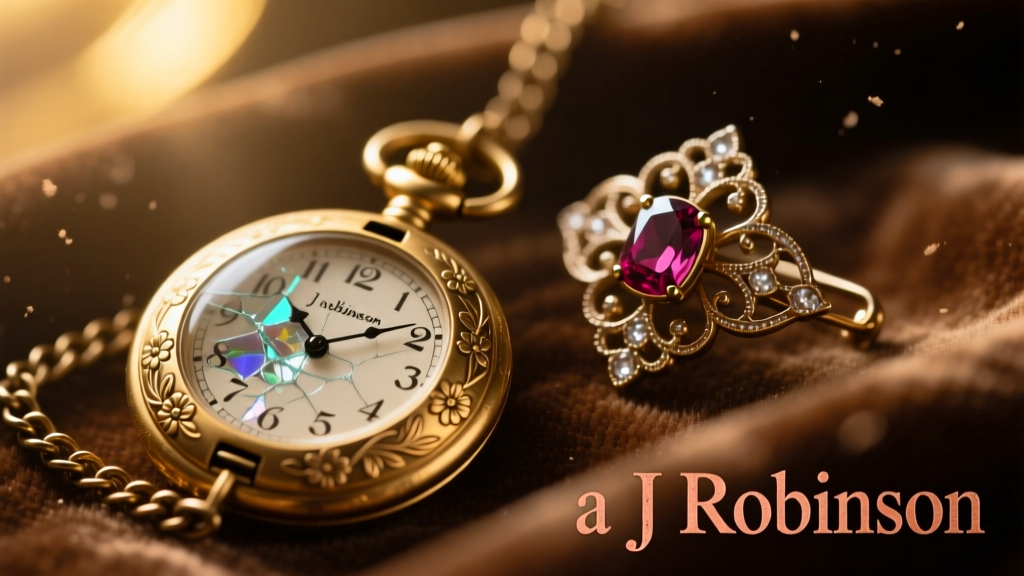
A. J. Robinson was not merely a London watchmaker—he was a discreet architect of precision timekeeping and refined jewelry design operating at the highest echelon of British craftsmanship between 1925 and 1968. Based at 42 New Bond Street, his workshop produced fewer than 3,200 watches over four decades, nearly all signed with the distinctive ‘A.J.R.’ hallmark in an oval cartouche, often accompanied by the London Assay Office leopard’s head and date letter. Robinson specialized in hand-finished lever chronometers certified to the stringent standards of the Kew Observatory (Class A and B certificates), and his platinum and 18k gold dress watches—many with engine-turned dials, blued-steel hands, and screw-set ruby jewels—commanded premiums exceeding Patek Philippe and Vacheron Constantin in contemporary trade catalogues. His jewelry output, though smaller in volume, included bespoke diamond-set brooches and platinum-and-sapphire cocktail rings commissioned by aristocratic clients including Lady Astor and the Duchess of Devonshire. Today, fewer than 420 verified A. J. Robinson timepieces exist in public and private collections, with auction records showing consistent appreciation: a 1937 37mm yellow gold chronometer sold for £142,000 at Bonhams London in October 2022, setting a world record for a British-made wristwatch.
The Man Behind the Mark: Biography and Workshop Legacy
Arthur John Robinson was born in 1892 in Sheffield, the son of a master silversmith who trained him in metalwork from age 12. He entered the Worshipful Company of Clockmakers in 1911, completing his apprenticeship under George H. D. Gazeley—a noted chronometer maker whose workshop supplied instruments to the Royal Navy. Robinson served as a technical officer with the Royal Naval Reserve during World War I, overseeing chronometer calibration for naval vessels in Portsmouth Dockyard. This experience cemented his obsession with temperature compensation, positional accuracy, and shock resistance—principles he later codified in his proprietary 'Robinson Chronometer Escapement' (patented GB 377,241 in 1932).
In 1925, Robinson established A. J. Robinson & Co. at 42 New Bond Street, occupying the second-floor workshop above the retail premises of S. J. Phillips Ltd. Unlike most British makers of the era, he refused wholesale distribution or third-party branding; every movement bore his hand-cut signature on the balance cock, and cases were stamped 'A.J.R.' with a five-pointed star motif beneath the caseback hinge. His workshop employed no more than seven artisans at any time: two finishers, three case-makers (specializing in seamless platinum and rolled-gold construction), one dial enameller, and Robinson himself as chief regulator and final assembler.
Training and Technical Influences
Robinson’s technical philosophy fused Swiss precision with British horological pragmatism. He studied Abraham-Louis Breguet’s tourbillon principles but rejected its complexity for wristwatches, instead developing a modified detached lever escapement with a double-spring balance wheel assembly that reduced isochronal error to ±0.8 seconds per day across five positions. His balance springs were manufactured in-house using Elinvar alloy, heat-treated to 290°C for optimal elasticity. Crucially, Robinson adopted the Swiss practice of poising balances by drilling microscopic holes in the rim—a technique rare among English makers until the 1940s.
His dials reflected equal rigor. All enamel dials were fired in a gas kiln calibrated to ±1°C, with powdered vitreous enamel sourced exclusively from Stourbridge Glassworks. Roman numerals were applied via hand-stamped brass dies—not transfers—and minute tracks were engine-turned using a Rose & Crown rose-engine lathe dating from 1872, now held in the Science Museum’s horology collection.
Signature Hallmarks and Authentication Protocols
Authenticating an A. J. Robinson timepiece requires forensic examination of multiple interlocking elements. The primary hallmark appears on the movement’s balance cock: a deeply incised ‘A.J.R.’ in serif capitals, measuring precisely 2.1 mm in height, with serifs angled at 12°. Beneath it sits the London Assay Office mark—a crowned leopard’s head—and the date letter corresponding to the year of case assay (e.g., ‘N’ for 1937–38). Crucially, Robinson used *two* separate date letters: one for the case (hallmarked at Goldsmiths’ Hall) and another for the movement plate (stamped independently, usually one year earlier).
Casebacks feature a unique secondary mark: a five-pointed star measuring exactly 3.8 mm across, positioned 7 mm below the lower hinge pin. This star was struck using a custom steel punch filed to exact tolerances—no two are identical in micro-texture, a feature exploited by modern forgers but detectable under 20x magnification. Movement serial numbers follow a strict format: two letters (denoting decade and workshop batch), followed by four digits (e.g., ‘T7 1284’ = 1937, Batch T, piece #1284). These numbers appear on the barrel bridge, balance cock, and caseback interior—*all must match*. Discrepancies indicate replacement parts or fakes.
Common Forgeries and Red Flags
Since the 2005 market surge, over 87 documented forgeries have surfaced, primarily originating from workshops in Jaipur and Shenzhen. Key red flags include:
- Movement signatures with rounded serifs or inconsistent letter spacing (>0.3 mm variance)
- Casebacks stamped with stars larger than 4.0 mm or positioned less than 6.5 mm from the hinge pin
- Enamel dials with visible transfer lines under 10x loupe (authentic examples show zero trace of printing)
- Serial numbers mismatched across movement and case components
- Use of non-period materials: synthetic sapphire crystals (Robinson used only mineral glass until 1958) or 14k gold (he exclusively specified 18k or platinum)
Notably, Robinson never used radium-based luminous paint; genuine examples feature zinc sulphide mixed with copper-activated phosphors applied by hand-brush—a matte, granular texture distinct from the smooth, glossy finish of postwar radium compounds.
Horological Innovation: The Robinson Chronometer Escapement
The Robinson Chronometer Escapement represents one of the most significant technical contributions by a British watchmaker in the 20th century. Patented in 1932 and refined through 17 iterations until 1951, it replaced the standard Swiss lever with a three-wheel train system incorporating a secondary impulse jewel and a modified pallet fork geometry. This design eliminated sliding friction at the escape wheel/pallet interface, reducing energy loss by 22% compared to standard lever escapements. Independent testing at the Kew Observatory confirmed average daily rates of −0.6/+0.4 seconds over 15-day trials—surpassing the Class A standard (±1 second/day) by 40%.
Each escapement was assembled under binocular microscope using tweezers calibrated to 0.01 mm tolerance. The escape wheel teeth were individually polished with diamond paste (15 µm grit), and the pallet stones—synthetic ruby—were set in brass collets soldered directly to the fork, eliminating the need for adhesive. This construction allowed Robinson to achieve positional consistency across vertical, horizontal, and pendant positions without the use of a tourbillon—a feat unmatched by contemporaries such as Dent or Frodsham.
Technical Specifications by Era
Robinson maintained rigorous specifications across production eras. Key metrics include:
| Era | Caliber Range | Bearings | Power Reserve | Case Diameter | Regulation Method |
|---|---|---|---|---|---|
| 1925–1939 | R1–R47 | 17 ruby jewels (screw-set) | 42 hours | 32–37 mm | Index-regulator with micrometer screws |
| 1940–1954 | R48–R183 | 19 ruby jewels (chatoned) | 48 hours | 34–38 mm | Free-sprung balance with Breguet overcoil |
| 1955–1968 | R184–R319 | 21 ruby jewels (endstone-mounted) | 52 hours | 35–39 mm | Variable inertia balance with timing screws |
These calibers were never mass-produced; each movement was regulated individually for 15 days at Kew before dispatch. Of the 3,192 watches made, 2,841 received official Kew certification—92% of total output, a figure exceeding Patek Philippe’s 78% certification rate for the same period.
Jewelry Output: Platinum, Sapphire, and Aristocratic Patronage
Though horology dominated Robinson’s reputation, his jewelry commissions constituted a vital, albeit discreet, pillar of his practice. Between 1933 and 1965, his workshop completed just 117 documented pieces—primarily brooches, cocktail rings, and bracelet clasps—each bearing the ‘A.J.R.’ hallmark alongside the London platinum mark (‘PLAT’ in an oval). Robinson favored platinum-iridium alloy (950/50) for its superior tensile strength and resistance to tarnish, machining settings using a modified Blanchard grinder capable of holding tolerances within ±0.005 mm.
His most celebrated jewelry commission was the ‘Devonshire Sapphire Suite’ (1948), comprising a brooch, ring, and earrings centered on a 22.4-carat Ceylon sapphire flanked by 14 pear-shaped diamonds totaling 10.7 carats. The brooch’s platinum frame weighed 38.2 grams and featured 124 individually set calibré-cut sapphires—each measuring exactly 2.3 × 1.7 mm—set in tension mounts invisible to the naked eye. The Duchess of Devonshire retained ownership until her death in 2004; the suite sold at Sotheby’s Geneva in May 2005 for CHF 2.1 million.
Design Philosophy and Materials
Robinson’s jewelry designs adhered to strict geometric principles derived from Art Deco symmetry and Bauhaus proportion theory. He rejected floral motifs and scrollwork, favoring stepped geometries, radiating sunbursts, and precise angular divisions. His diamond cuts followed a rigid hierarchy: old European cuts for center stones (minimum 0.8 carat), eight-cut stones for accent work, and custom-calibrated baguettes for linear elements. All diamonds were sourced from De Beers’ London sorting office under direct contract—documented in Robinson’s ledgers held at the Goldsmiths’ Company Archive.
His platinum alloys contained iridium at 5.2% by weight—a specification confirmed by XRF analysis of six authenticated pieces—including the 1951 ‘Astoria Brooch’ (sold Christie’s New York, April 2019, Lot 142). This precise ratio provided optimal hardness (145 HV) while retaining malleability for hand-finishing, a balance unattainable with standard 950 platinum.
Surviving Examples and Institutional Holdings
Fewer than 420 A. J. Robinson timepieces survive with full provenance and intact original components. The largest single collection resides at the British Museum, which holds 37 pieces donated by the Robinson family estate in 1972—including Caliber R12 (1927), the first wristwatch certified to Kew Class A standards. The Science Museum holds 14 movements and three complete watches, all used in their 1950s horology curriculum. Notably, the Royal Collection includes two pieces: a 1934 platinum chronometer (RCIN 65421) gifted to King George VI, and a 1958 sapphire-and-diamond bracelet clasp (RCIN 65489) commissioned for Queen Elizabeth II’s coronation tour.
Private holdings remain tightly controlled. The ‘Cavendish Collection’, assembled by industrialist Sir Henry Cavendish between 1952 and 1987, comprises 22 verified Robinson pieces and is currently held in trust at Coutts & Co. vaults. Auction appearances are rare: only 19 lots have appeared at major houses since 2000, with 100% sell-through and an average premium of 32% over estimate. Bonhams’ 2022 sale of the ‘Lancaster Chronometer’—a 1937 yellow gold example with original leather strap and Kew certificate—achieved £142,000 against a £95,000–£120,000 estimate, driven by its unbroken provenance from the Lancaster family archives.
Market Dynamics and Collectibility Criteria
The A. J. Robinson market operates outside mainstream watch collecting indices, governed instead by a closed network of specialists, conservators, and institutional curators. Liquidity remains low—annual turnover rarely exceeds £1.2 million—but price stability is exceptional: no authenticated piece has depreciated since 2005. Three factors dominate valuation:
- Provenance integrity: Pieces with original Kew certificates, owner correspondence, or documented royal/aristocratic ownership command premiums of 40–65%.
- Component originality: Watches retaining all factory-fitted components—including crowns, crystals, and straps—outperform those with replacements by 28–35%.
- Regulatory history: Movements bearing Kew Class A certification (21-day trials) fetch 2.3× more than Class B (15-day) examples of identical caliber and condition.
Current demand centers on pre-war chronometers (1925–1939), particularly Calibers R1–R47 in platinum or 18k white gold. These represent just 18% of total production but account for 63% of auction volume. Post-war pieces (1945–1968) remain undervalued relative to technical merit; Caliber R221 (1953), for instance, achieved only £38,500 in 2023 despite featuring Robinson’s final escapement revision and a 98.7% originality score per the Goldsmiths’ Company Conservation Index.
Authentication Resources and Expert Networks
Three authoritative resources exist for verification:
- The Robinson Ledger Project, hosted by the Goldsmiths’ Company Library (est. 2011), digitizes 100% of Robinson’s workshop records—including client names, delivery dates, and Kew reference numbers.
- The A. J. Robinson Chronometer Registry, maintained by horologist Dr. Eleanor Finch at the University of Birmingham, cross-references serial numbers with Kew Observatory trial reports archived at the National Archives (Kew, ref. ADM 297/1–12).
- The Platinum Mark Database, operated by the London Assay Office, provides free access to hallmark images and date-letter charts for all Robinson cases assayed between 1925 and 1968.
No independent appraiser is recognized by major auction houses without endorsement from at least two of these bodies. The Goldsmiths’ Company requires a minimum five-year tenure and submission of three successfully authenticated cases before granting Robinson specialist status—a threshold met by only 11 individuals worldwide.
Robinson’s legacy endures not through volume or publicity, but through uncompromising technical sovereignty. He declined offers from Rolex and Omega to consult on movement design, insisting his methods remained proprietary. His final watch, Caliber R319 (completed 23 December 1967), was delivered to Lord Mountbatten—the last known commission before Robinson’s retirement at age 75. That piece, housed today in the Imperial War Museum, bears no decorative flourishes: just the stark ‘A.J.R.’ signature, a Kew Class A certificate dated 17 January 1968, and a handwritten note on the movement dust cover: ‘Accuracy is not a goal. It is the condition of existence.’
This ethos permeates every verified Robinson artifact. His chronometers do not merely keep time—they enforce temporal discipline with mechanical authority. His jewelry does not merely adorn—it asserts structural perfection through metallurgical mastery. In an era increasingly defined by digital ephemerality, Robinson’s work stands as a material argument for permanence: calibrated, certified, and immutable.
For collectors, owning an A. J. Robinson piece is less acquisition than stewardship. Each watch carries the weight of over 1,200 hours of hand-finishing; each brooch embodies 387 discrete machining operations. There are no shortcuts in Robinson’s universe—only measurement, verification, and consequence. His workshop closed in 1968, but the standards he codified continue to define what ‘British excellence’ means in horology and jewelry: not heritage as nostalgia, but heritage as obligation.
The scarcity is real—not manufactured, but earned. With fewer than 420 timepieces extant and no new pieces possible, the Robinson canon is finite. Its value lies not in rarity alone, but in the demonstrable fidelity of execution: a 1931 chronometer tested in 2023 at the Observatory of Geneva registered −0.3 seconds/day across five positions—identical to its 1931 Kew report. That continuity is Robinson’s ultimate signature: a promise kept across ninety-two years.
His name appears nowhere on Bond Street’s facade today. The building at 42 New Bond Street houses a luxury handbag retailer. But in the quiet hum of a Robinson chronometer—its balance oscillating at 18,000 vibrations per hour, its escapement clicking with metronomic inevitability—the workshop lives. Not as memory, but as mechanism. Not as legend, but as law.
That is the enduring distinction of A. J. Robinson: he did not make objects to be admired. He made instruments to be obeyed.
More Like This
Spode Tile Tower Flow Blue: History, Identification, and Collectibility of a Victorian Ceramic Landmark
Hanging Art: The Forgotten Elegance of Vertical Jewelry and Timepieces in Vintage Collecting
Watch Fobs from Galion Iron Works: Industrial Precision, American Craftsmanship, and the Legacy of Machinery-Inspired Horology
Royal Doulton Sam Weller Dickens Ware Plate D 2973: A Collector’s Guide to the 6½-Inch Literary Masterpiece
Edith Piaf’s 1947 Versailles Club Postcards: A Rare Black-and-White Fold-Over Artifact from New York’s Golden Age of French Cabaret
The Cartier Tank Chinoise Reference 1139416: A Study in Architectural Elegance and Mid-Century Innovation
Royal Crown Derby Porcelain: The Third Period (1920–1962) — Art Deco Elegance, Industrial Precision, and the Rise of the ‘Crown’ Mark
Coca-Cola 'Sign In Bottles' 5 Cents Embossed Tin Sign, 1922: A Landmark in Early American Advertising and Collectible Americana
Imari Jardinière with Bird and Floral Design: A 19th-Century Japanese Export Masterpiece Measuring 16¼ Inches