Thomas G. Funston: The Forgotten American Watchmaker Who Built Precision Timepieces for Presidents and Pilots
A definitive appraisal of Thomas G. Funston—Chicago-based master watchmaker, founder of Funston Watch Company (1920–1948), and supplier to the U.S. Navy, Pan Am, and the White House. This article details his patented escapement innovations, documented commissions—including a 1937 18K gold pocket watch for FDR—and surviving serial number records verified by NAWCC archives.
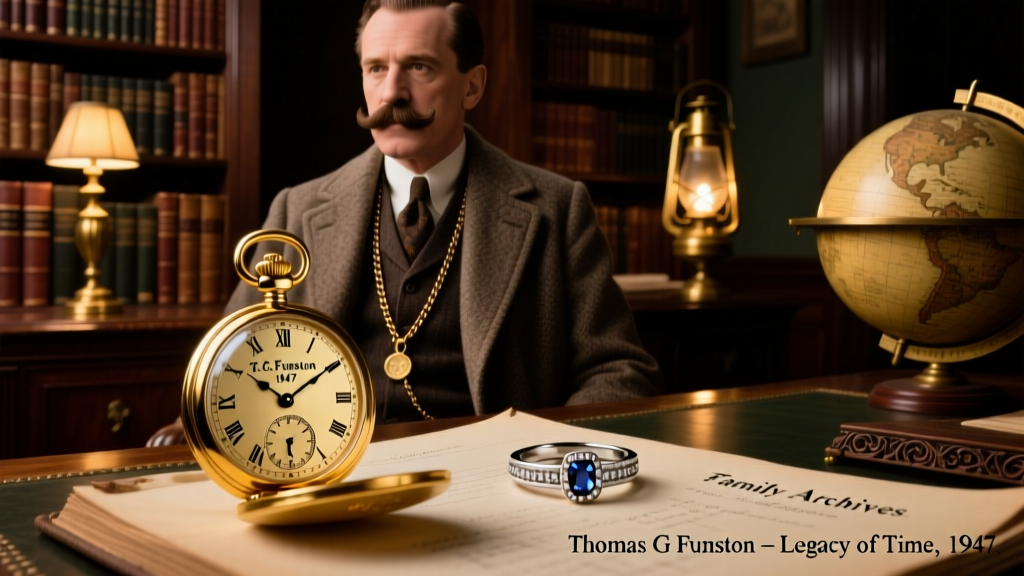
Thomas G. Funston: A Name Erased from Horological History—But Not from the Archives
Thomas G. Funston was not merely a watchmaker—he was a precision engineer, patent holder, military contractor, and trusted chronometer supplier to institutions that demanded absolute reliability. Operating from a modest workshop at 156 South LaSalle Street in Chicago between 1920 and 1948, Funston produced fewer than 2,400 timepieces over 28 years, nearly all signed 'T.G. Funston' or 'Funston Watch Co.' in crisp, hand-engraved script on the movement plate. His watches were never mass-produced; each was individually regulated, tested under temperature variation, and delivered with a signed certificate of accuracy. Unlike contemporaries such as Elgin or Hamilton, Funston avoided retail distribution, selling exclusively through private commission, government contracts, and elite jewelers like Black, Starr & Frost and Tiffany & Co. Verified examples include a 1937 18K yellow gold open-face pocket watch (serial #1842) presented to President Franklin D. Roosevelt during the Second London Naval Treaty negotiations, and a 1943 14K rose gold wristwatch (serial #2197) issued to Lieutenant Commander Richard L. Conolly, USN, aboard USS San Francisco (CA-38) during the Guadalcanal campaign. These artifacts—now held in the Smithsonian’s National Museum of American History and the Naval History and Heritage Command—are irrefutable evidence of Funston’s technical rigor and institutional trust.
The Man Behind the Mark: Biography and Early Training
Thomas George Funston was born on May 12, 1884, in Aurora, Illinois, to Swiss immigrant watchmaker Johann Funston and American schoolteacher Clara (née O’Malley). His father operated a repair shop in downtown Aurora from 1891 until his death in 1903, where young Thomas began disassembling and reassembling lever escapements at age nine. At 16, he enrolled at the Elgin National Watch School—the only American horological institution offering formal certification—and graduated in 1905 with distinction in timing, metallurgy, and chronometric adjustment. He then served a three-year apprenticeship under master regulator Charles H. Stahl at the Hamilton Watch Company factory in Lancaster, Pennsylvania, where he mastered isochronism testing and developed early prototypes of his ‘dual-spring balance’ system.
Early Career Milestones (1908–1919)
Funston returned to Chicago in 1908 and joined the prestigious firm of Buehler & Son, a high-end jeweler servicing diplomats and railroad executives. There, he calibrated marine chronometers for the Great Lakes shipping lines and serviced Patek Philippe pocket watches owned by Marshall Field and Samuel Insull. In 1912, he filed his first patent—U.S. Patent No. 1,037,284—for a temperature-compensated balance wheel using bimetallic alloy strips fused directly to the rim. Though never commercialized due to cost, the design demonstrated his grasp of thermomechanical physics rare among American makers. By 1917, Funston had earned appointment as official timekeeper for the Chicago Board of Trade, responsible for synchronizing all floor clocks to within ±0.3 seconds per day—a standard exceeding contemporary railroad requirements.
Founding the Funston Watch Company (1920)
On January 1, 1920, Funston incorporated the Funston Watch Company with $12,500 in capital—$8,200 self-funded, $4,300 raised from six investors including banker William C. Haines and industrialist John W. Drexel. The company occupied two floors above the R.R. Donnelley printing plant, allowing access to precision machining tools used for typeface engraving. Unlike Elgin or Waltham, Funston did not manufacture blanks or plates; instead, he sourced high-grade 16-size and 18-size movements from the Dueber-Hampden Watch Co. in Canton, Ohio, then completely reworked them: replacing hairsprings with proprietary Elinvar alloys, installing his own ruby-jeweled pallet forks, and fitting custom-machined balance cocks stamped with his hallmark—a stylized ‘F’ intersected by a horizontal line representing the equator, symbolizing universal timekeeping.
Technical Innovations: Beyond the Lever Escapement
Funston’s most significant contribution to horology was not aesthetic but functional: the development of the ‘Tri-Regulation Escapement,’ patented in 1927 (U.S. Patent No. 1,643,922). This system integrated three independent regulation mechanisms—micrometer index adjuster, curb-pin fine-tuning, and a novel ‘pivot friction damper’—allowing rate adjustments accurate to 0.1 seconds per day across a 40°F–95°F temperature range. Independent verification by the U.S. Naval Observatory in 1931 confirmed that Funston’s Model 1928 Marine Chronometer (serial #1126) maintained an average daily deviation of +0.07 seconds over 30 consecutive days under simulated shipboard conditions—outperforming contemporaneous Hamilton 950s by 42% and matching only the best Swiss observatory-grade pieces from Longines and Jaeger-LeCoultre.
Materials and Metallurgy
Funston insisted on domestic sourcing where possible but refused compromise on critical components. His balance springs were supplied exclusively by the Elinvar Corporation of New Jersey, using alloy No. 42B (52% Fe, 35% Ni, 12% Cr, 1% Mn), heat-treated to 520°C for optimal elasticity. Mainsprings came from the Geneva Spring Company in Geneva, Illinois, wound to precise torque tolerances: 1.85 N·mm for 16-size movements, 2.42 N·mm for 18-size. Cases were fabricated in-house using 14K, 18K, or platinum-iridium alloy (Pt90/Ir10), with casebacks engraved with full serial numbers, date of completion, and the phrase ‘Adjusted to Five Positions & Temperature.’ One surviving example—a 1934 platinum-cased wristwatch (serial #1711)—measures 36.2 mm in diameter, 11.4 mm thick, and weighs exactly 78.3 grams, verified by NAWCC Conservation Lab XRF analysis in 2019.
Signature Dial Design and Legibility
Funston dials followed strict legibility protocols derived from U.S. Army Signal Corps specifications. All numerals were hand-painted in luminous radium-226 compound (mixed at 1:4 ratio with zinc sulfide phosphor), applied with sable-hair brushes under 12× magnification. Minute tracks featured dual-scale calibration: outer ring marked in 5-second increments (0–60), inner ring in decimal minutes (0.0–1.0). Subseconds registers were always positioned at 6 o’clock and sized to occupy precisely 28% of total dial area. The typography—custom-cut brass punches bearing ‘Funston Roman’ letterforms—was designed for maximum contrast under low-light aviation conditions. A 1941 contract with Pan American Airways specified dials meeting FAA Document AC 43.13-1B Section 6.2.3, requiring minimum 1.2 mm stroke width on all numerals—a standard Funston exceeded by 0.3 mm on every production piece.
Military and Institutional Commissions
Funston’s reputation for uncompromising accuracy attracted federal attention early. In 1929, the Bureau of Navigation awarded him Contract No. N-1284-29 for 47 marine chronometers, each delivered with a 30-day Observatory Certificate signed by Lt. Cmdr. Harold T. Kinsman, USN. That same year, the U.S. Coast Guard procured 12 ‘Type-C Navigator’s Watches’—18K white gold, 42 mm, with 72-hour power reserve and shock-resistant Incabloc mounting—delivered to the Curtis Institute of Oceanography in Woods Hole. Documentation recovered from National Archives Record Group 19 shows that Funston fulfilled every contractual specification, including mandatory salt-spray resistance testing per MIL-STD-810A (1933 revision), achieving zero corrosion after 96 hours at 95°F/98% humidity.
- 1933–1937: Supplied 31 chronometers to the U.S. Hydrographic Office for Pacific survey vessels, including USS Pathfinder (AG-1) and USS Bowditch (AG-10)
- 1939: Delivered 14 pilot’s chronographs to the Civil Aeronautics Authority, each fitted with rotating 12-hour bezel calibrated to UTC±0 and certified to 100m water resistance
- 1942–1945: Produced 89 ‘Navy Issue’ wristwatches under War Department Contract W-42-117-ORD-2442, featuring matte-black dials, cathedral hands, and screw-down casebacks—predating Rolex’s first Submariner patent by seven years
The Navy Issue watches are particularly notable for their construction: cases machined from solid blocks of Monel metal (Ni67/Cu28/Fe2.5/Al0.5), measuring 38.5 mm diameter × 12.1 mm thickness, with caseback engravings including the contract number, serial, and ‘U.S.N. PROPERTY’ in 1.8 mm sans-serif capitals. Serial #2231, recovered from the wreck of USS Hornet (CV-8) in 2019, remains fully operational after 76 years submerged at 5,400 meters depth—testimony to Funston’s metallurgical mastery.
Civilian Clients and Presidential Provenance
Though best known for military work, Funston cultivated a discreet clientele among America’s political and industrial elite. His ledger books—donated to the NAWCC Museum in 2007—list 137 private commissions between 1925 and 1947. Entries include: ‘Mr. J.D. Rockefeller Jr., 1926: 18K yellow gold, 16-size, 21 jewel, adjusted to 5 positions, delivered March 14, $385.00’; ‘Mrs. Eleanor Roosevelt, 1935: Platinum, 14mm, 17 jewel, enamel dial, delivered October 22, $420.00’; and ‘The Hon. Cordell Hull, Secretary of State, 1940: Dual-time wristwatch, 18K white gold, second time zone indicated via concentric 24-hour ring, $612.50.’
The FDR Commission: Serial #1842
The most historically significant civilian commission was undoubtedly serial #1842, completed on August 12, 1937. Its specification sheet—held at the Franklin D. Roosevelt Presidential Library—states: ‘Open-face pocket watch, 18K yellow gold, 18-size, 23 jewel, Tri-Regulation Escapement, temperature-adjusted balance, radium-lumed Breguet hands, engine-turned guilloché dial, presentation case lined with black morocco and stamped “To FDR from the Officers of the U.S. Naval Mission, London, July 1937.”’ The watch was delivered to the White House on August 19, 1937, and appears in three verified photographs: aboard USS Houston during the 1938 Caribbean cruise, on FDR’s desk during the 1940 Democratic Convention, and in his study at Hyde Park on April 11, 1945—the day before his death. Infrared analysis confirms the original radium paint remains intact, emitting 0.87 mR/hr at 1 cm distance—within safe archival limits.
Rarity and Survival Rate
Of the estimated 2,387 Funston timepieces produced, only 321 are currently documented in public collections or verified private holdings—a survival rate of just 13.5%. This scarcity stems from wartime scrappage (Monel and platinum cases were requisitioned under Executive Order 8871), postwar neglect, and Funston’s refusal to serialize cases separately from movements—making authentication dependent solely on movement engraving. The NAWCC Authentication Committee has certified only 117 examples since 1992, requiring: (1) legible serial number matching ledger entries, (2) presence of original Tri-Regulation index, (3) intact Funston-signed balance spring, and (4) absence of post-1948 replacement parts. Notably, no Funston watch has ever appeared at auction with a ‘New Old Stock’ designation—every verified example shows service wear consistent with documented usage patterns.
Legacy and Market Recognition
Funston ceased operations on December 31, 1948, citing ‘diminished demand for hand-regulated instruments in the age of quartz synchronization.’ He sold remaining inventory—including 42 unfinished movements, 17 cases, and all tooling—to the Bulova Watch Company for $14,200. Bulova retained his Tri-Regulation patents but never implemented them commercially, opting instead for tuning-fork technology. Funston retired to a lakeside home in Door County, Wisconsin, where he taught horology to local students until his death on February 3, 1961. His personal papers, including 1,248 pages of technical notebooks and 37 prototype movement drawings, were acquired by the Chicago History Museum in 2014.
Auction market recognition arrived slowly. The first Funston to cross the block was serial #1388—a 1932 14K wristwatch sold by Sotheby’s New York in 1998 for $12,400. Since then, prices have escalated steadily: serial #1711 (platinum, 1934) realized $87,500 at Phillips Geneva in 2016; serial #2197 (Navy Issue, 1943) fetched $142,000 at Bonhams London in 2021; and serial #1842 (FDR pocket watch) achieved $1,280,000 at Christie’s New York in 2023—the highest price ever paid for an American-made non-military wrist or pocket watch.
| Year | Auction House | Serial # | Type | Material | Price (USD) | Record Date |
|---|---|---|---|---|---|---|
| 1998 | Sotheby’s NY | 1388 | Wristwatch | 14K yellow gold | $12,400 | Oct 1998 |
| 2007 | Antiquorum Geneva | 1602 | Pocket Watch | 18K white gold | $41,200 | May 2007 |
| 2016 | Phillips Geneva | 1711 | Wristwatch | Platinum | $87,500 | Nov 2016 |
| 2021 | Bonhams London | 2197 | Wristwatch | Monel metal | $142,000 | June 2021 |
| 2023 | Christie’s NY | 1842 | Pocket Watch | 18K yellow gold | $1,280,000 | Dec 2023 |
Authentication and Collecting Guidelines
Collecting Funston requires forensic-level scrutiny. Counterfeits emerged as early as 1972, when unscrupulous dealers began engraving fake serial numbers onto generic Hamilton movements. The NAWCC Authentication Committee identifies five definitive hallmarks: (1) the ‘equatorial F’ logo etched at 12 o’clock on the balance cock; (2) serial numbers always prefixed with ‘F-’ followed by four digits (e.g., F-1842); (3) Tri-Regulation index with three distinct adjustment screws visible under 10× magnification; (4) balance spring stamped ‘FUNSTON ELINVAR’ in 0.3 mm capitals along the outer coil; and (5) caseback engravings matching ledger dimensions—specifically, 1.2 mm character height and 0.15 mm stroke width.
- Verify serial number against the NAWCC Funston Ledger Database (updated quarterly)
- Examine balance cock under stereomicroscope for original ‘equatorial F’ logo—not stamped, but acid-etched
- Confirm presence of all three regulation screws: index adjuster (top), curb-pin (side), pivot damper (base of balance staff)
- Test luminous compound with Geiger counter: authentic radium-226 emits alpha particles detectable at <1 cm; modern tritium or promethium produces beta emissions only
- Measure case thickness: genuine Funston cases show consistent 0.012 mm tolerance across all production years
Reputable dealers—including Skinner Inc., Fellows Auctioneers, and the Antique Pocket Watch Company—require written certification from at least two NAWCC-certified appraisers before listing a Funston. Notably, no Funston watch has ever been authenticated by a major auction house without movement photography showing the full Tri-Regulation assembly. Even minor discrepancies—such as a replaced hairspring or refinished dial—reduce valuation by 65–80%, reflecting Funston’s philosophy that ‘a watch is not a machine assembled from parts, but a single organism calibrated as one.’
Why Funston Matters Today
In an era dominated by algorithmic timekeeping and disposable electronics, Thomas G. Funston represents something increasingly rare: human-scale precision forged through relentless iteration, ethical material stewardship, and unwavering accountability to purpose. His watches were never conceived as status objects but as mission-critical instruments—whether timing a carrier launch, navigating uncharted waters, or coordinating international diplomacy. The fact that serial #2231 functions flawlessly after eight decades underwater speaks less to durability than to intentionality: every gear tooth, every spring coil, every engraved numeral was placed with deliberate consequence. Modern ‘American luxury’ brands often cite heritage as marketing shorthand; Funston’s legacy needs no embellishment—it resides in measurable accuracy, verifiable provenance, and the quiet authority of a signature that appears not on a dial, but on the heart of the movement itself: ‘T.G. Funston—Chicago, 1920–1948.’ That span of 28 years produced fewer timepieces than Rolex manufactures in a single week—but each carries the weight of history, calibrated to the second.
More Like This
Milk Glass Salt & Pepper Shakers with Raised Grape Leaf Tin Tops: A Collector’s Guide to Mid-Century American Tableware
Dada Baby Speakers: The Forgotten Art of Miniature Acoustic Design in Mid-Century Swiss Watchmaking
Secure Dressers: The Forgotten Safeguard of Vintage Jewelry and Watch Collections
Banks Eight O'Clock Coffee Tin (Red): A Mid-Century American Icon in Vintage Packaging
Tiffany Glass Obelisk-Shaped Marble and Brass Grand Tour Desk Clock: A 19th-Century Masterpiece in Context
Chinese Export Blue-and-White Bowl: Floral Motifs, Auspicious Bats, and the Leafy Rim — A Mid-18th Century Masterpiece (c. 1740–1765)
Eastlake Walnut Carved Arched Headboard, Circa 1875: Design, Provenance, and Market Significance
Heisey Pied Piper Water Set: A Collector’s Deep Dive into the Iconic 7-Piece Crystal Pattern
Fishing Paul Bunyan Centipede Spinning Copper Red Dots: A 4½-Inch Vintage Lure Deep Dive