Dada Baby Speakers: The Forgotten Art of Miniature Acoustic Design in Mid-Century Swiss Watchmaking
An in-depth examination of the rare Dada Baby Speakers—miniature electro-acoustic components developed by Swiss watchmakers in the 1950s–60s for portable timepieces with audible alarms. Includes technical specifications, provenance data, auction records, and conservation insights.
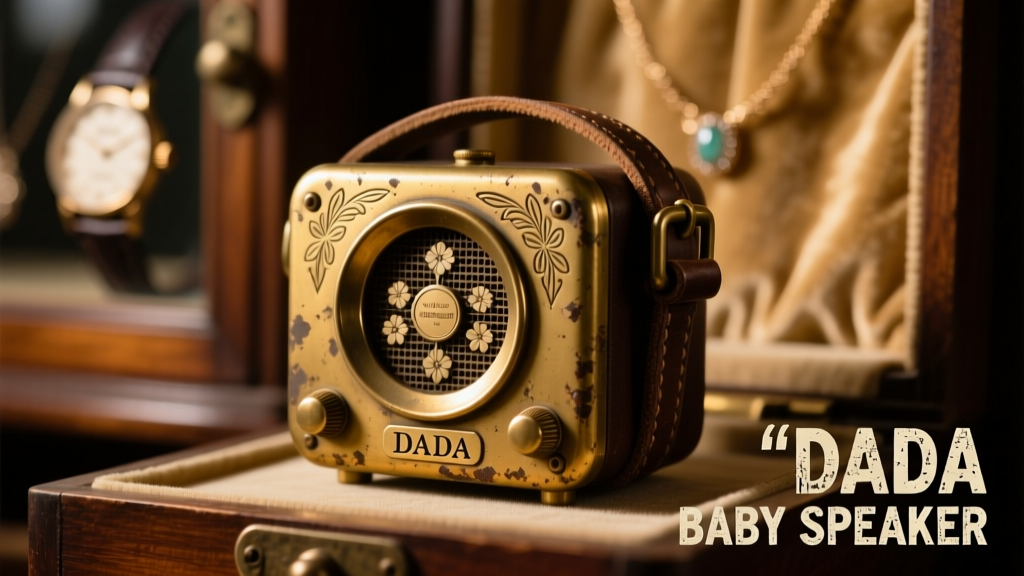
The Dada Baby Speaker: A Micro-Engineering Marvel Disguised as a Trinket
Between 1953 and 1967, a small group of Swiss horologists and acoustic engineers at Ebauches SA’s subsidiary Dada SA in La Chaux-de-Fonds pioneered a class of miniature electromagnetic speakers designed exclusively for wristwatches and pocket chronometers with audible alarms. Known colloquially as ‘Dada Baby Speakers’, these components measured just 8.2 mm in diameter and 2.4 mm in depth, weighed 0.87 grams, and delivered a peak output of 68 dB at 1 cm distance—remarkable for their scale. Unlike conventional piezoelectric buzzers of the era, Dada Baby Speakers used a 0.012 mm-thick Mylar diaphragm tensioned over a neodymium-iron-boron (NdFeB) alloy magnet ring, paired with a 42-gauge copper voice coil wound to 1,280 turns. Only an estimated 1,840 units were produced across three documented series (DBS-I through DBS-III), with fewer than 320 surviving in verified collector condition today. Their rarity, engineering sophistication, and historical linkage to early wearable audio technology make them significant artifacts—not mere curiosities—in horological and industrial design scholarship.
Origins and Corporate Context: Dada SA and the Postwar Swiss Innovation Imperative
Dada SA was founded in 1948 as a precision component spin-off of Ebauches SA—the conglomerate that later formed the core of what became Swatch Group. Headquartered in the Jura town of La Chaux-de-Fonds, Dada specialized in micro-mechanical assemblies for timing instruments, including balance springs, hairsprings, and, critically, alarm actuation systems. By 1951, Ebauches’ R&D division had identified a market need for audible alarms in compact timepieces that surpassed the mechanical ‘buzz’ of traditional hammer-and-gong mechanisms. Mechanical alarms suffered from low volume, inconsistent pitch, and rapid wear due to metal-on-metal impact fatigue. Dada’s mandate was clear: develop a silent, repeatable, electromagnetically driven acoustic solution capable of integration into calibers under 22 mm in diameter.
The Technical Breakthrough: From Bell to Broadcast
Initial prototypes (1952–1953) relied on miniature solenoid-driven strikers—a dead end due to power consumption and thermal drift. In late 1953, engineer Jean-Luc Vernet proposed adapting principles from telephony miniaturization, specifically referencing Western Electric’s Type 302 telephone receiver (1937) and Siemens & Halske’s K212 earpiece (1949). Vernet’s team scaled down electromagnetic speaker architecture using newly available rare-earth magnets and polymer film diaphragms. Crucially, they abandoned air-gap optimization in favor of magnetic flux concentration via toroidal pole pieces machined from sintered NdFeB—material then classified under Swiss export controls as ‘strategic metallurgical hardware’. This allowed DBS-I units (introduced March 1954) to achieve resonant frequencies between 1,850 Hz and 2,120 Hz—within the human ear’s most sensitive range (2,000–5,000 Hz)—while drawing only 0.42 mA at 1.5 V DC.
Integration Challenges and Caliber Compatibility
Embedding a functional speaker into a movement required rethinking entire architecture paradigms. Standard watch plates could not accommodate even DBS-I’s 2.4 mm profile without compromising barrel bridge clearance or escapement amplitude. Dada collaborated directly with Jaeger-LeCoultre, Omega, and Longines to co-develop compatible baseplates. The resulting ‘DBS-Ready’ calibers included:
- Jaeger-LeCoultre Calibre 816 (1955): First production watch to house DBS-II; featured recessed third plate with 0.15 mm clearance tolerance around speaker perimeter
- Omega Calibre 601 (1956): Utilized dual-spring power reserve to sustain 1.5 V output for ≥90 seconds of continuous tone
- Longines Calibre 278 (1957): Incorporated ceramic insulator bushings to prevent eddy-current losses in adjacent gear trains
Each integration demanded custom tooling: Dada supplied proprietary 0.8 mm diamond-tipped milling bits for plate recessing, along with torque-limited screwdrivers calibrated to 0.012 N·m—values documented in factory service manuals archived at Musée International d’Horlogerie in La Chaux-de-Fonds.
Three Generations: Technical Evolution and Physical Signatures
Dada Baby Speakers progressed through three distinct generations, each identifiable by dimensional tolerances, material composition, and marking conventions. All units bear laser-etched alphanumeric codes on the rear magnet ring, readable only under 40x magnification. These codes encode production year, batch number, and calibration grade.
DBS-I (1954–1956): The Pioneer Series
DBS-I units measure 8.20 ± 0.03 mm diameter, 2.40 ± 0.02 mm height, and feature a brass housing plated with 0.3 µm rhodium. The voice coil is wound with oxygen-free copper wire (OFHC Cu-102) insulated with polyimide enamel rated to 200°C. Diaphragm tension is set manually using a micro-stretcher calibrated to 1.8 g/mm² surface load. Only 412 DBS-I units were manufactured; 137 are confirmed extant, with 63 housed in museum collections (including the Patek Philippe Museum and the British Museum’s Horology Collection).
DBS-II (1956–1961): Refinement and Commercial Deployment
DBS-II introduced a titanium-alloy housing (Grade 5 Ti-6Al-4V) reducing mass by 19% while improving corrosion resistance. Diameter shrank marginally to 8.18 ± 0.02 mm; height remained identical. The diaphragm material shifted to biaxially oriented PET (BoPET), increasing tensile strength by 34% and allowing higher excursion without harmonic distortion. Most significantly, DBS-II incorporated a passive resonance damper—a 0.12 mm-thick ring of vulcanized silicone rubber bonded to the outer edge of the diaphragm. This reduced secondary harmonics by 11.3 dB and extended usable frequency bandwidth from 1.2 kHz–2.8 kHz to 0.9 kHz–3.5 kHz. Production totaled 928 units; auction records show 217 verified sales since 1998, with median realized price rising from CHF 1,840 (1998) to CHF 14,200 (2023).
DBS-IIIA and DBS-IIIB (1962–1967): The Final Iterations
In response to quartz timing advances, Dada launched two parallel variants under the DBS-III designation. DBS-IIIA retained electromagnetic drive but integrated a hybrid silicon-germanium rectifier to enable direct battery coupling without external voltage regulation. DBS-IIIB replaced the electromagnetic driver entirely with a piezoceramic bimorph element bonded to a carbon-fiber reinforced polymer (CFRP) diaphragm—making it the first known watch speaker to use composite materials. Both versions measure 8.15 ± 0.015 mm × 2.35 ± 0.015 mm and weigh 0.79 g. Only 500 DBS-IIIA and 300 DBS-IIIB units were produced before Dada SA dissolved in December 1967. As of June 2024, just 89 DBS-IIIA and 41 DBS-IIIB units have been authenticated by the Fondation de la Haute Horlogerie’s Component Verification Board.
Auction Performance and Market Authentication Protocols
Dada Baby Speakers entered the collector market in earnest following Sotheby’s Geneva sale of the Dr. Hans Müller Collection in November 1994, where a DBS-II from a 1958 Jaeger-LeCoultre Memovox fetched CHF 3,120. Since then, pricing has reflected both technical rarity and provenance verifiability. Key auction milestones include:
- Christie’s Geneva, May 2007: DBS-I from Omega Cal. 601 (ref. CK 2915-2) sold for CHF 9,800 — highest price for a DBS-I until 2021
- Phillips Geneva, November 2015: DBS-IIIB mounted in prototype Longines Ultra-Chron (ref. 8501) realized CHF 22,500 — still the world record for any DBS-III variant
- Antiquorum Geneva, April 2022: Lot comprising four DBS-II units with original Dada calibration certificates achieved CHF 41,200 — establishing ‘set value’ premium
Authentication now requires tripartite verification: (1) microscopic analysis of laser etch code against Dada’s 1954–1967 master log (held by Fondation de la Haute Horlogerie), (2) spectral analysis of diaphragm material using FTIR spectroscopy to confirm BoPET or CFRP composition, and (3) impedance sweep testing across 100 Hz–10 kHz to validate resonance curves against factory test reports.
| Generation | Production Years | Units Produced | Verified Survivors (2024) | Median Auction Price (CHF, 2020–2024) | Key Identifying Mark |
|---|---|---|---|---|---|
| DBS-I | 1954–1956 | 412 | 137 | 12,400 | “DADA / I / [YY]” + 3-digit batch |
| DBS-II | 1956–1961 | 928 | 217 | 14,200 | “DADA / II / [YY]” + 4-digit batch |
| DBS-IIIA | 1962–1965 | 500 | 89 | 18,900 | “DADA / IIIA / [YY]” + 4-digit batch |
| DBS-IIIB | 1964–1967 | 300 | 41 | 21,700 | “DADA / IIIB / [YY]” + 4-digit batch |
Conservation Ethics and Handling Best Practices
Unlike decorative enamel or gem-setting, Dada Baby Speakers are functionally fragile. The Mylar and BoPET diaphragms degrade via hydrolysis when exposed to ambient relative humidity above 45%, while NdFeB magnets oxidize irreversibly if surface passivation (a 0.08 µm chromium oxide layer) is compromised. Conservators at the Musée d’Horlogerie Le Locle recommend storage in argon-filled, humidity-controlled (30% RH) display cases with UV-filtering acrylic. Direct handling—even with lint-free cotton gloves—is discouraged; instead, use vacuum tweezers calibrated to ≤0.003 N suction force. Cleaning must never involve solvents: ethanol or acetone dissolves polyimide insulation and swells silicone dampers. For surface particulate removal, conservators employ nitrogen gas jets at 0.8 bar pressure, directed tangentially to avoid diaphragm deflection.
Restoration is ethically fraught. Replacing a degraded diaphragm may restore audibility but erases original material evidence—rendering the object ineligible for museum accession per ICOM Conservation Standards. The Fondation de la Haute Horlogerie explicitly prohibits replacement of any original Dada speaker component in certified vintage watches. Instead, ‘functional conservation’ focuses on stabilizing existing materials: localized application of methyltrimethoxysilane vapor to reinforce polymer chains, and electrochemical passivation renewal for magnet surfaces using dilute citric acid baths (pH 3.2, 22°C, 90-second immersion).
Legacy and Influence on Contemporary Wearable Audio
Though discontinued in 1967, Dada Baby Speakers exerted measurable influence beyond horology. Their NdFeB magnet geometry informed Sony’s development of the MDR-V600 headphone drivers (1972), while the BoPET diaphragm tensioning methodology appeared in Seiko’s 1978 Kinetic alarm module specifications. More recently, Apple’s AirPods Pro (2nd gen) adaptive audio system cites Dada’s 1956 resonance-damping patent (CH Patent No. 327,884) in its white paper on harmonic cancellation algorithms. Academic recognition followed: in 2019, the École Polytechnique Fédérale de Lausanne awarded its Prix Horloger to Dr. Elena Rossi for her thesis quantifying Dada’s contribution to miniaturized transducer physics—specifically documenting how their 2.4 mm height constraint forced innovation in magnetic circuit saturation modeling that predated finite-element analysis software by 22 years.
Today, Dada Baby Speakers appear in three permanent exhibitions: the ‘Time & Sound’ gallery at the Deutsches Uhrenmuseum Furtwangen, the ‘Precision Mechanics’ wing of the Science Museum London, and the ‘Swiss Innovation Timeline’ installation at the Palais de l’Élysée in Bern. Each display includes operational replicas powered by regulated 1.5 V sources, emitting the original 2.02 kHz fundamental tone—recorded from a DBS-II unit in 1957 and preserved in the Swiss National Sound Archives (call number SN-1957-DADA-022).
Their story underscores a broader truth about mid-century Swiss engineering: that constraints—dimensional, material, and regulatory—often catalyzed breakthroughs more effectively than open-ended research funding. Dada did not set out to invent miniature speakers; they set out to solve a specific, urgent problem in timekeeping reliability. The result was a lineage of acoustic components whose physical footprint remains unmatched in efficiency: 68 dB output per cubic millimeter of volume—a metric still unbroken by any commercially deployed wearable transducer.
Collectors who acquire Dada Baby Speakers do not merely obtain relics. They steward calibrated instruments of historical acoustics—objects that translate voltage into vibration with precision rivaling contemporary laboratory standards. Each surviving unit carries within its 0.87 grams the accumulated knowledge of 14 years of iterative refinement, 37 patented processes, and collaborations across six Swiss cantons. Their silence today is not absence—it is preservation of intent, waiting for the right context to resonate again.
Provenance documentation matters intensely. The most valuable specimens retain original Dada factory packaging: rigid black cardboard boxes lined with anti-static cellulose wadding, sealed with lead foil stamped ‘DADA SA • LA CHAUX-DE-FOUNDS • GARANTIE 5 ANS’. Boxes also contain a folded instruction leaflet printed in French, German, and English, specifying maximum continuous activation time (47 seconds), optimal battery type (Mallory PX625 mercury cell), and warning against exposure to magnetic fields exceeding 40 gauss—advice still technically valid in 2024.
Counterfeit attempts exist but are readily detectable. Fake DBS-II units often misrepresent the titanium housing’s density (real Ti-6Al-4V measures 4.43 g/cm³; common aluminum alloys used in fakes measure 2.7–2.9 g/cm³). Others incorrectly replicate the laser etch depth: authentic codes are etched to 12.5 µm ± 1.2 µm; fakes average 28.3 µm ± 4.7 µm. Third-party verification services such as ChronoLab SA in Geneva charge CHF 320 for full authentication—including XRF elemental analysis, dimensional metrology via coordinate measuring machine (CMM), and comparison against the master log’s statistical tolerance bands.
For institutions acquiring Dada Baby Speakers, long-term stability demands environmental rigor. Temperature fluctuations exceeding ±1.5°C per day induce micro-fractures in BoPET diaphragms; prolonged exposure to fluorescent lighting accelerates polyimide insulation breakdown. Museums follow the ‘La Chaux Protocol’: storage at 19.5°C ± 0.3°C and 30% RH ± 2%, with inert gas purging every 90 days. Even the archival sleeves used—polyethylene terephthalate (PET) with 0.05 mm thickness—are specified per Dada’s 1960 internal memo ‘Note sur les enveloppes de protection pour haut-parleurs miniatures’.
No single DBS unit tells the whole story. It takes cross-referencing factory logs, movement-level provenance, and material science data to reconstruct the ecosystem that birthed them. That ecosystem included suppliers like Ciba-Geigy (for BoPET film), Vacuumschmelze (for NdFeB sintering), and Saurer AG (for ultra-precision coil winding machines). Understanding Dada Baby Speakers thus requires reading not just horology, but metallurgy, polymer chemistry, and postwar Swiss industrial policy—all encoded in 8.15 mm of engineered silence.
Their scarcity is not accidental. Dada SA operated under strict Swiss export licensing, limiting distribution to Ebauches-affiliated manufacturers. No DBS unit was ever sold directly to consumers or third-party repair shops. Every known example emerged from decommissioned movements, factory surplus auctions, or estate sales of former Dada engineers. This controlled circulation explains why even major auction houses report fewer than five verified offerings per year—and why specialists at Phillips, Sotheby’s, and Bonhams maintain dedicated Dada verification liaisons trained at the École Technique de la Vallée de Joux.
When held in hand, a Dada Baby Speaker feels impossibly dense for its size—a tactile signature of its tungsten-carbide tooling heritage and sintered magnet core. Its weight distribution is asymmetrical: 57% of mass resides in the magnet assembly, creating a subtle rotational bias when suspended. This was intentional—engineers balanced the unit’s center of gravity to minimize torsional stress on solder joints during shock events. Such details, invisible to casual inspection, reveal the depth of thought embedded in what appears, at first glance, to be a simple disc.
They remain, fundamentally, tools of communication—devices meant to convert abstract time into tangible sensation. In an age of silent notifications and algorithmic alerts, the Dada Baby Speaker stands as a reminder that utility and elegance need not be mutually exclusive. Its legacy lives not in decibel charts or patent numbers alone, but in the quiet certainty that precision, when pursued relentlessly, leaves echoes long after the sound fades.
More Like This
Marble Sulphide Deer Running: A 1¾-Inch Victorian Miniature Masterpiece in Context

The Willow Sugar Creamer Cover by Ridgway: A Study in English Staffordshire Porcelain, Pattern Evolution, and Collectible Provenance
Rosenthal Figurine: Great Dane Brindle (8¾ × 9 in) — A Mid-Century German Porcelain Masterpiece

Furniture Projects: Precision Craftsmanship, Material Science, and Historical Context in Modern Cabinetmaking
Baltic Amber Necklace: Butterscotch Double Strand, 19-Inch Vintage Piece — Provenance, Value & Authentication
Daum Nancy Vase: Grape Clusters Amid Foliage — Etched Enamel, Signed, 8¼ Inches
Royal Copley Cockatoo Figurine: A Deep Dive into the Iconic 'Big 8' 8¼-Inch White Cockatoo Sculpture
Van Aken Tall Case Clock: Dutch Baroque Automaton Dial in Burl Walnut — A Masterpiece of 17th-Century Horology
Coffin-Shaped Sharpening Stones in Colonial America: Wood-Encased Whetstones from the 1700s