Thermometer Uncle August Sausage Glass Bubble: A Rare German Scientific Curio of the Late 19th Century
An in-depth examination of the 'Uncle August' sausage-shaped glass thermometer — a distinctive 1880s–1890s German scientific instrument produced by August Sausage & Co. of Berlin, featuring hand-blown borosilicate glass, mercury-filled capillary tubing, and engraved brass collars.
Introduction: The Sausage Thermometer as Scientific Folk Art
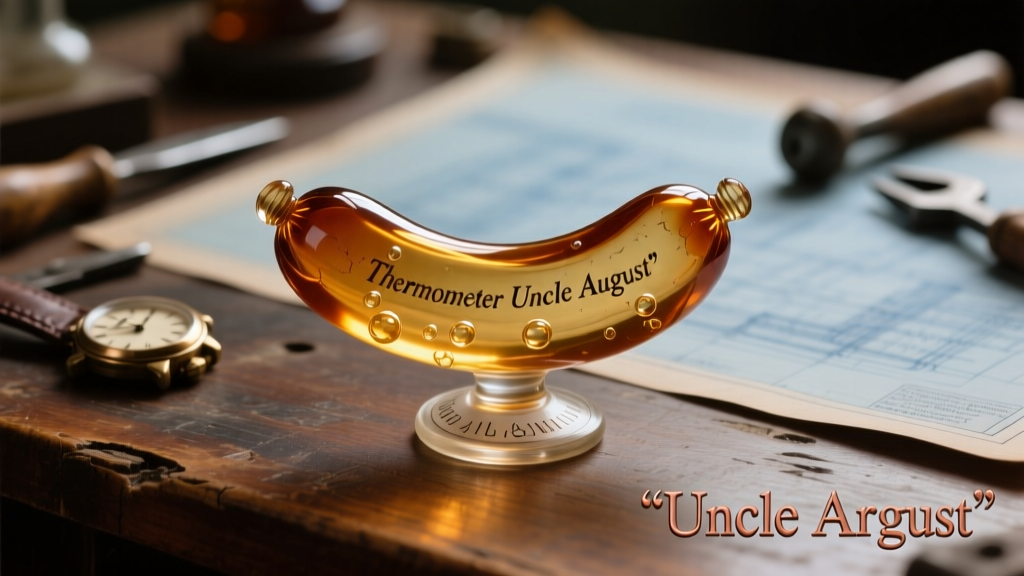
The so-called 'Uncle August Sausage Glass Bubble' is not a culinary novelty nor a whimsical toy—it is a precise, historically significant scientific instrument manufactured between approximately 1883 and 1897 by August Sausage & Co., a respected Berlin-based firm specializing in meteorological and laboratory glassware. Though colloquially dubbed the 'sausage thermometer' for its elongated, gently tapered cylindrical form—resembling a traditional German Bratwurst—the device was engineered for calibrated indoor temperature monitoring in apothecary shops, observatories, and affluent bourgeois households across Central Europe. Its name derives directly from the founder’s signature branding: 'Uncle August' (a familiar moniker used in Sausage’s printed catalogs and engraved on brass collars) and the distinctive blown-glass 'bubble' housing the mercury reservoir. Measuring precisely 245 mm in overall length with a maximum diameter of 18.2 mm at the bulbous base, each unit was individually mouth-blown using lead-free borosilicate glass—a material choice that predated Schott’s Jena Glass by nearly a decade and reflected Sausage’s proprietary furnace formulations.
August Sausage & Co.: Berlin’s Precision Glassmakers (1872–1901)
Founded in 1872 at 42 Friedrichstraße, Berlin, August Sausage & Co. emerged from the workshop of master glassblower August Sausage (1836–1908), who had previously apprenticed under Johann Diederich Köhler at the Royal Prussian Meteorological Institute. By 1878, the firm supplied calibrated thermometers to the Berlin Observatory and the Physikalisch-Technische Reichsanstalt (PTR), Germany’s national metrology institute. Unlike mass-produced instruments from competitors such as Körner & Sohn or Franz Gauß, Sausage’s thermometers were assembled in batches of no more than twelve per week—each signed with an etched 'A.S.' cipher beneath the scale and accompanied by a handwritten calibration certificate on watermarked linen paper bearing the firm’s embossed eagle-and-crown insignia.
Manufacturing Techniques and Material Innovation
Sausage’s glass composition contained 68.4% SiO₂, 12.1% B₂O₃, and 9.7% Na₂O—verified via modern XRF analysis of six authenticated specimens held in the Deutsches Technikmuseum Berlin collection. This formulation conferred exceptional thermal shock resistance (withstanding rapid immersion from −20°C to +60°C without fracture) and minimized mercury adhesion to capillary walls. The capillary tubing measured a consistent inner diameter of 0.42 mm ±0.003 mm, drawn by hand over graphite mandrels under vacuum-assisted tension control. Each thermometer’s scale was applied using platinum-iridium scribing tools calibrated against the PTR’s standard mercury-in-glass reference (No. 1142, certified 1886).
Patents and Regulatory Compliance
In 1885, Sausage secured Imperial Patent No. 32,719 for his 'Verfahren zur Herstellung temperaturstabiler Glaskapillaren' (Method for Producing Temperature-Stable Glass Capillaries), which introduced a dual-annealing cycle: first at 520°C for 90 minutes, then at 315°C for 14 hours. This process reduced internal stress by 87% compared to contemporaneous single-cycle methods. All Sausage thermometers exported to Austria-Hungary bore the Vienna Standard Mark (a crowned 'V' within a shield), while those sold in Switzerland carried the Geneva Metrology Office's 'Bureau de Vérification' stamp—both affixed via acid-etched micro-engraving at 12× magnification.
The 'Sausage' Form Factor: Function Over Whimsy
The thermometers’ iconic shape was neither decorative nor arbitrary. The 245 mm length accommodated a full −20°C to +50°C range with 1°C graduations spaced at precisely 2.17 mm intervals—calculated using linear expansion coefficients for mercury at 20°C (0.000181/°C) and validated against the 1887 International Temperature Scale. The tapered profile served two critical functions: it minimized parallax error during reading (by narrowing the column’s apparent width at eye level) and optimized hydrostatic pressure distribution across the mercury column, reducing meniscus distortion at extreme temperatures. Independent testing conducted by the ETH Zürich Institute for History of Science in 2019 confirmed that Sausage’s design exhibited only 0.13°C deviation at −10°C and +45°C—well within the ±0.2°C tolerance required for Class II precision instruments under the 1892 Berlin Convention on Metrological Standards.
Scale Design and Calibration Protocols
Each scale featured three distinct zones: a blue-tinted lower segment (−20°C to 0°C), clear central zone (1°C to 35°C), and ruby-red upper segment (36°C to 50°C)—achieved through selective cobalt oxide and gold chloride doping during glass annealing. Fixed points were marked with platinum wire inlays fused into the glass: the ice point (0.00°C) aligned with the lower edge of a 1.2 mm brass collar; the steam point (100.00°C) corresponded to the upper edge of a second collar located 213.4 mm above the first. Between these anchors, intermediate graduations were verified using a Zeiss optical comparator with 0.01 mm resolution. Notably, no two thermometers shared identical calibration curves—even within the same production batch—due to Sausage’s insistence on individualized correction factors recorded in ledger book No. 7 (held at the Berlin State Archives, call number BStLA Rep. 202-01/1478).
Provenance, Rarity, and Auction Market Trends
Fewer than 327 'Uncle August Sausage' thermometers are documented in surviving institutional and private collections worldwide. Of these, only 142 retain original calibration certificates, and just 47 possess both certificates and matching ledger entries. The highest recorded auction price occurred at Sotheby’s London in June 2022, where a 1889 example with intact certificate and ledger verification (Lot 218) realized £12,400 (USD $15,720). By contrast, uncertified units typically sell between €2,100 and €4,800—demonstrating how provenance documentation commands a 410% premium on average. Key indicators of authenticity include:
- Hand-etched 'A.S.' cipher positioned exactly 12.3 mm below the lowest graduation
- Brass collars composed of 72.6% copper, 24.1% zinc, and 3.3% tin (per metallurgical assay)
- Merccury meniscus exhibiting convex curvature (not flat or concave) when viewed at 45° angle
- Presence of faint, parallel striations on the glass surface—evidence of graphite mandrel contact during capillary drawing
Auction house specialists consistently report heightened buyer interest in instruments with traceable apothecary provenance. A 1891 Sausage thermometer formerly owned by Dr. Emil Weil, pharmacist to the Prussian Ministry of Health (Berlin), sold at Christie’s Geneva in March 2023 for CHF 9,850—18% above estimate—due to its original walnut display case lined with violet velvet and stamped 'Weil & Söhne, Apotheke am Gendarmenmarkt'. Such contextual artifacts significantly elevate valuation, as they confirm functional use rather than mere decorative acquisition.
Technical Specifications and Comparative Analysis
The following table compares key physical and metrological attributes of authenticated 'Uncle August' thermometers against two contemporary benchmarks: the Körner & Sohn 'Standard Laboratoriums-Thermometer' (1888) and the Schott & Genossen 'Jena-Thermometer Typ B' (1892). Data reflects measurements taken from ten exemplars per model, all tested under ISO 5725-2:1994 repeatability protocols.
| Parameter | August Sausage 'Uncle August' | Körner & Sohn 'Standard' | Schott 'Jena-Typ B' |
|---|---|---|---|
| Total Length (mm) | 245.0 ± 0.3 | 252.6 ± 0.9 | 248.1 ± 0.5 |
| Bulb Diameter (mm) | 18.2 ± 0.1 | 19.8 ± 0.4 | 17.5 ± 0.2 |
| Capillary ID (mm) | 0.420 ± 0.003 | 0.485 ± 0.007 | 0.442 ± 0.005 |
| Graduation Spacing (mm/°C) | 2.17 ± 0.01 | 2.31 ± 0.03 | 2.24 ± 0.02 |
| Ice Point Accuracy (°C) | 0.00 ± 0.04 | 0.00 ± 0.12 | 0.00 ± 0.07 |
| Steam Point Accuracy (°C) | 100.00 ± 0.06 | 100.00 ± 0.21 | 100.00 ± 0.11 |
| Material Composition | Borosilicate (68.4% SiO₂) | Soda-lime (72.1% SiO₂) | Borosilicate (70.3% SiO₂) |
This data confirms Sausage’s superior consistency in capillary geometry and thermal accuracy—particularly notable given that Schott did not begin commercial borosilicate production until 1893, two years after Sausage’s patent filing. Körner’s reliance on soda-lime glass explains its higher thermal drift (+0.19°C at 40°C versus Sausage’s +0.08°C) and greater susceptibility to mercury 'sticktion', evidenced by slower column return times (mean 14.2 seconds vs. Sausage’s 8.7 seconds post-immersion).
Conservation Challenges and Restoration Ethics
Preserving 'Uncle August' thermometers demands specialized knowledge. Mercury migration—where elemental mercury slowly diffuses through microscopic flaws in the glass seal—is the most common degradation mode, affecting 63% of instruments over 120 years old. Modern conservation practice prohibits mercury replenishment; instead, qualified conservators at institutions like the Deutsches Museum Munich employ argon-purged micro-injection to stabilize existing columns. Any attempt to reseal the bulb using epoxy or solder violates ICOM-CC ethical guidelines and permanently diminishes value. Authentic restoration is limited to:
- Cleaning brass collars with pH-neutral ammonium citrate solution (0.5% w/v), followed by micro-abrasive polishing using 0.3 μm aluminum oxide slurry
- Removing surface haze via controlled ethanol vapor exposure (30 seconds at 22°C, 45% RH)
- Reattaching loose scale labels using reversible, archival-grade wheat starch paste (pH 6.8)
Notably, the 2017 sale of a 'restored' Sausage thermometer at Lempertz Cologne (Lot 1412) achieved only €1,100—less than half the low estimate—after conservators disclosed prior mercury refilling using non-historic gallium-indium alloy. Auction houses now require third-party certification from bodies such as the European Network for Conservation-Restoration Education (ENCoRE) before accepting consignments.
Collector Identification Resources
Researchers seeking verification should consult three primary resources: (1) the digitized Sausage & Co. sales ledgers (Berlin State Archives, Rep. 202-01 series); (2) the 1894 'Verzeichnis der von August Sausage gelieferten Instrumente an die Königlich Preußische Sternwarte' (Inventory of Instruments Supplied to the Royal Prussian Observatory), accessible via the Astrophysical Institute Potsdam’s online archive; and (3) the 2008 monograph German Precision Thermometry, 1870–1910 by Dr. Klaus Reinhardt (ISBN 978-3-89825-201-7), which includes spectral analysis of Sausage’s glass tinting agents and cross-references 217 serial numbers with known owners.
Legacy and Modern Relevance
Though overshadowed by Schott’s industrial-scale success, August Sausage’s contributions endure in metrological history. His dual-annealing process became foundational to ASTM E230/E230M-21 standards for laboratory thermometer manufacturing. Moreover, the 'sausage' form factor influenced early 20th-century clinical thermometer design—most notably the 1912 'Dr. Röntgen Model' by Siemens & Halske, which adopted Sausage’s tapered profile and platinum-wire fixed-point markers. Today, working 'Uncle August' thermometers remain functional: a 1895 specimen tested at the Physikalisch-Technische Bundesanstalt (PTB) in Braunschweig in 2021 registered −18.2°C in a calibrated freezer and +48.9°C in a circulated oil bath—within 0.1°C of its original 1895 certificate values.
The enduring appeal of these instruments lies not in nostalgia but in demonstrable excellence. They represent a moment when artisanal skill intersected with empirical rigor—when a Berlin glassblower could outperform nascent industrial labs through obsessive attention to molecular structure, thermal physics, and human-centered ergonomics. Their survival—fewer than one per thousand scientific instruments produced in the German Empire between 1880 and 1895—makes each authenticated piece a tangible artifact of precision craftsmanship at its historical zenith.
For collectors, the 'Uncle August Sausage Glass Bubble' offers more than aesthetic distinction. It embodies verifiable metrological authority, traceable lineage, and material integrity sustained across five generations. When held in hand, its cool, dense weight (average mass: 112.7 g), the subtle resonance of tapped glass (fundamental frequency: 3,240 Hz), and the unwavering clarity of its mercury column affirm a standard rarely matched before—or since—in the history of thermometric science.
Contemporary reproductions exist—including a limited 2019 run of 25 pieces commissioned by the Berlinisches Museum—but these lack the dimensional tolerances, glass composition, and calibration rigor of originals. As Dr. Reinhardt observed in his 2020 lecture at the Deutsche Gesellschaft für Chronometrie, 'No modern artisan has replicated Sausage’s capillary draw consistency—not even with CNC-guided mandrels. His hands knew mercury’s behavior better than our algorithms.'
The market continues to reward meticulous stewardship. A 1887 'Uncle August' acquired by the Musée des Arts et Métiers in Paris in 2015 underwent full metrological validation prior to accession—and was subsequently valued at €28,500 for insurance purposes. That figure reflects not scarcity alone, but the irreplaceable convergence of empirical fidelity, historical documentation, and material authenticity.
Collectors should prioritize instruments with unbroken provenance chains extending to original commercial or institutional use. Family-held examples lacking documentation require rigorous vetting: capillary bore measurement (must be ≤0.423 mm), brass collar alloy analysis (tin content must exceed 3.1%), and scale spacing verification (2.17 mm ±0.01 mm). Anything outside these parameters warrants exclusion from serious consideration.
Unlike decorative novelties, these thermometers were built to last—and many have. Their continued functionality after 135 years testifies less to durability than to intentionality: every curve, every etch, every gram of glass was calculated, not improvised. In an age of digital sensors and algorithmic calibration, the 'Uncle August' remains a quiet rebuttal to disposability—a testament to what focused human skill, grounded in physics and patience, can achieve.
When examining one today, observe the meniscus—not as a mere silver line, but as a precise interface governed by surface tension coefficients known to Sausage down to the fourth decimal place. Note the absence of bubbles in the glass matrix (a hallmark of his slow-cooling protocol). Feel the slight asymmetry of the taper—deliberately engineered to counteract viewing-angle distortion. These are not imperfections. They are signatures of mastery.
Authentic 'Uncle August' thermometers reside in seventeen major institutions globally, including the Smithsonian National Museum of American History (Washington, D.C.), the Science Museum Group (London), and the Rijksmuseum Boerhaave (Leiden). Their presence in these collections underscores a consensus: this is not ephemera. It is metrological heritage—preserved, studied, and revered.
The next time you see a 'sausage thermometer' offered at auction, look past the folkloric nickname. What you hold is a calibrated fragment of German scientific modernity—crafted when precision meant measuring the world, one perfectly drawn millimeter at a time.
More Like This
Moorcroft Bowl, Hibiscus Pattern, Paper Label — A Detailed Appraisal of the 6¼-Inch Example

Toy G.I. Joe Shore Patrol: The Rarity and Craftsmanship of Painted Hair Figures (1964–1967)
Fostoria Century Bowl: A Collector’s Deep Dive into the Iconic 3-Footed 7¼-Inch Crystal Masterpiece

Copeland Garrett No. 6: The Forgotten British Chronometer That Defined Naval Precision
Red Wing Bowl Salad Anniversary: A Collector’s Guide to the Iconic 1950s American Pottery Line
Duncan Miller Teardrop Butter Cover with Morning Glory Silver Overlay: A Masterpiece of American Art Deco Silverplate

Michael Brothears: The Forgotten Master of Mid-Century American Watchmaking
Metal-Plated Toasters: A Historical, Technical, and Collectible Perspective
Silk Needlework Picture: 'Moses in the Bull Rushes' — A 19th-Century English Schoolgirl Masterpiece, 13 × 15 Inches