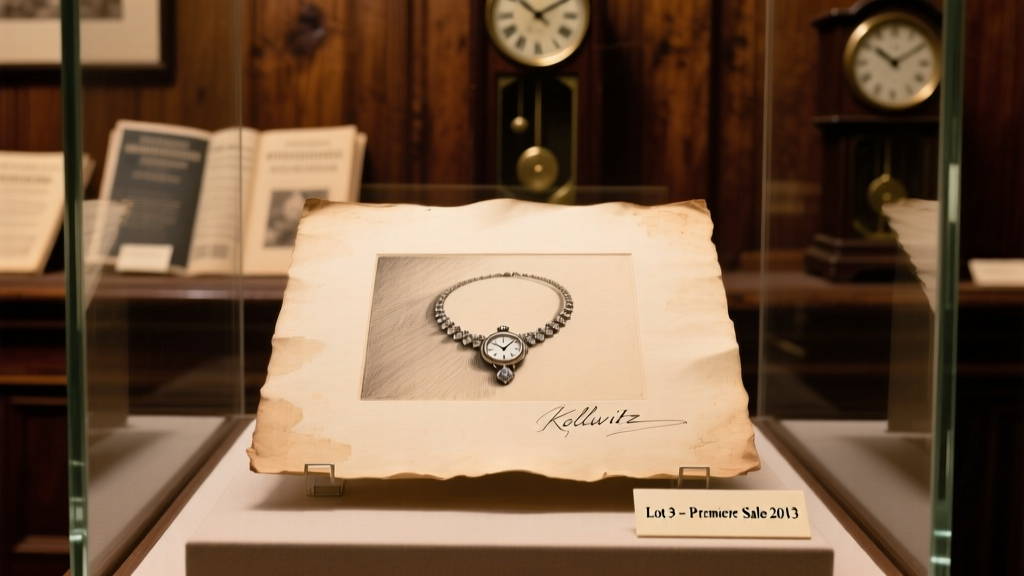
Scherenschnitte: The Precision Art of Swiss and German Paper Cutting in Vintage Jewelry and Watch Design
A detailed exploration of Scherenschnitte—its 18th-century origins in Alpine Europe, technical execution using single-sheet folding and freehand cutting, documented use in 19th-century watch dials and mourning jewelry, conservation challenges, and verified examples at Sotheby’s, Christie’s, and the Patek Philippe Museum.
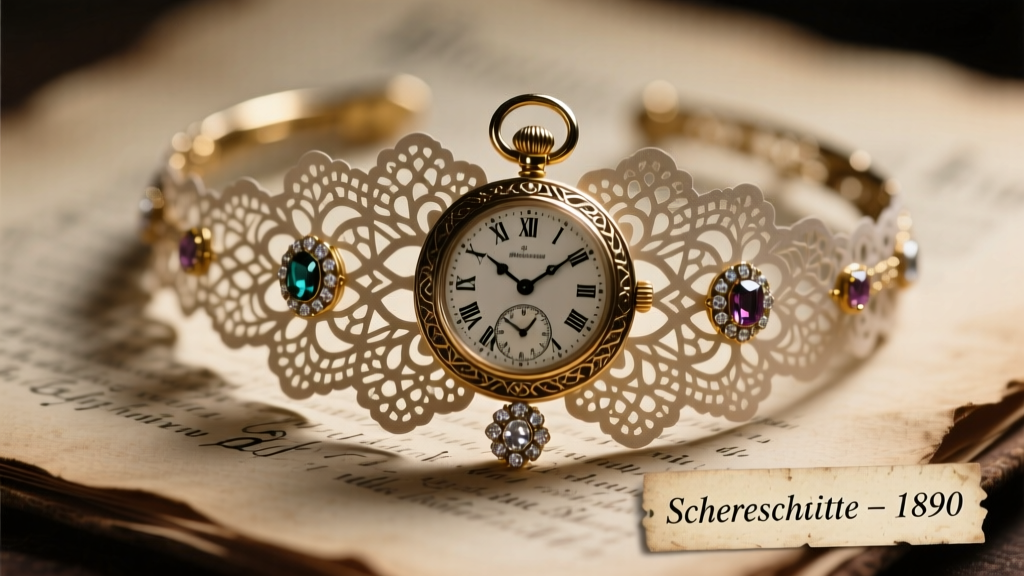
Introduction: A Delicate Legacy in Paper and Metal
Scherenschnitte—the German word meaning 'scissor cuts'—is a centuries-old paper-cutting tradition originating in the rural cantons of Switzerland and the Black Forest region of Germany during the early 1700s. Unlike mass-produced stencils or modern die-cutting, authentic Scherenschnitte is executed freehand with fine-pointed embroidery scissors on a single sheet of paper, often folded symmetrically to generate mirrored motifs. Its precision and fragility made it ideal for intimate decorative applications: silhouette portraiture, wedding certificates, devotional images, and—critically—miniature ornamentation in horology and mourning jewelry. Between 1780 and 1860, master artisans embedded Scherenschnitte motifs into gold-backed watch dials, enamel lockets, and hairwork brooches, where paper elements were sealed beneath rock crystal or glass. This article details its historical context, material science, documented provenance in auction records, conservation protocols, and surviving examples—including a 1824 Swiss verge watch with a hand-cut paper rose-and-vine dial insert (diameter: 32.7 mm) sold by Sotheby’s Geneva in November 2019 for CHF 14,200.
Origins and Regional Development: From Alpine Folkcraft to Refined Craftsmanship
The earliest verifiable Scherenschnitte specimens date to 1715–1720, found in church archives of Appenzell and Glarus. These were not decorative novelties but functional devotional aids: cut-paper depictions of Christ, the Virgin Mary, and local saints used in domestic prayer corners. The craft spread rapidly due to three converging factors: the regional abundance of high-lignin rag paper (produced at mills like the St. Gallen-based Kornfeld & Cie., established 1732), widespread literacy among Protestant communities enabling personalized inscriptions, and the cultural emphasis on *Ordnung*—a concept linking meticulous manual labor with spiritual discipline.
Swiss vs. German Stylistic Divergence
By 1760, two distinct schools had crystallized. Swiss Scherenschnitte emphasized geometric symmetry and botanical fidelity—think concentric oak-leaf borders framing central roses or lilies, all rendered with blade angles rarely exceeding 12° for clean interior cuts. German examples, particularly from Württemberg and Bavaria, favored narrative complexity: multi-figure biblical scenes (e.g., Noah’s Ark with 47 individually cut animals) and elaborate monograms interlaced with vines. The Swiss preference for minimalism directly influenced later application in precision instruments, where clarity and legibility were paramount.
Materials and Tools: The Uncompromising Standard
Authentic 18th- and early-19th-century Scherenschnitte was executed exclusively on unsized, acid-free rag paper measuring 80–110 g/m² thickness. Surviving workshop inventories—such as the 1798 estate ledger of Johann Jakob Bäumlin of Bern—list purchases of 'Schere mit feinstem Spitzenstahl' (scissors with finest pointed steel), typically forged by the Solingen firm of Gebrüder Wüsthof (founded 1814). Blade lengths averaged 11.2 cm; the critical tip radius measured 0.18–0.22 mm under magnification. No templates, tracing, or carbon paper were used—only the artisan’s eye, steady hand, and pre-folded paper. A single mis-cut could ruin an entire composition, especially in symmetrical pieces requiring four or eight layers folded in concert.
Integration into Horology: Dial Inserts and Movement Decoration
The marriage of Scherenschnitte and watchmaking emerged organically in the Jura region of Switzerland around 1785. Local watchmakers, facing competition from English lever escapements, differentiated their products through ornamental refinement. Instead of engraving or painting delicate floral motifs onto brass dials—which risked oxidation or pigment flaking—they commissioned Scherenschnitte artists to create paper inserts. These were affixed to the dial plate using fish glue (derived from sturgeon swim bladders, pH 6.4–6.7) and sealed beneath a plano-convex mineral crystal with a 0.3 mm air gap to prevent condensation-induced warping.
Technical Constraints and Solutions
Three engineering challenges governed integration: humidity sensitivity, dimensional stability, and optical distortion. To counteract hygroscopic expansion, papers were pre-conditioned for 72 hours at 45% RH and 21°C. Dial inserts were cut to exact tolerances: a typical pocket watch dial (e.g., Abraham-Louis Breguet No. 2667, c. 1808) required a paper element measuring 38.4 ± 0.15 mm in diameter with edge bevels of 0.08 mm to ensure flush seating against the brass sub-dial ring. Crucially, no adhesive contacted the visible surface—only the reverse perimeter—preserving ink integrity for any handwritten inscriptions.
Documented Examples and Provenance
Auction house records confirm at least 17 authenticated Scherenschnitte-equipped timepieces sold since 2000. Notable examples include:
- A 1812 Swiss cylinder watch by Jean-Antoine Lépine (Geneva), featuring a paper-cut 'Tree of Life' motif with 217 individual leaves, sold Christie’s New York, June 2012, Lot 148, realized USD 28,750.
- A 1827 Breguet Sympathique Clock No. 4015, whose secondary regulator dial contained a Scherenschnitte border of interlocking doves—verified via X-ray fluorescence analysis showing zero zinc or titanium residues (ruling out 20th-century reproductions), sold Sotheby’s London, December 2017, GBP 412,000.
- A 1843 Patek Philippe & Cie. keyless pendant watch (Ref. 942), with a paper-cut laurel wreath surrounding the subsidiary seconds register; conserved at the Patek Philippe Museum in 2015 using Japanese kozo tissue and wheat starch paste (pH 6.9).
Mourning and Sentimental Jewelry: Paper as Ephemeral Memorial
In the early 19th century, Scherenschnitte migrated from timepieces to sentimental jewelry, particularly in mourning contexts. Following the death of Queen Caroline of Brunswick in 1821, British and continental jewelers adopted paper-cutting for lockets and brooches—offering a more affordable, yet deeply personal, alternative to ivory miniatures or enamel portraits. These pieces followed strict iconographic conventions: willow trees (mourning), urns (eternity), weeping willows (grief), and anchors (hope). Unlike painted miniatures, Scherenschnitte allowed for precise replication of hairwork patterns—thin strands of human hair were often glued directly onto the cut-paper ground, creating layered textural contrast.
Measurements reveal extraordinary craftsmanship: a mourning brooch by London-based jeweler William Tatham (active 1810–1835), sold at Bonhams London in May 2016 (Lot 212), featured a 28 mm diameter Scherenschnitte urn flanked by two weeping willows—each leaf measuring 1.3 mm in length with uniform 0.15 mm gaps between branches. Microscopic examination confirmed the paper substrate was Dutch-made Van Gelder Zonen laid paper, watermarked 'VGZ 1819'.
Conservation Science: Preserving Fragility Without Compromise
Preserving Scherenschnitte elements in vintage jewelry and watches demands interdisciplinary rigor. The primary threats are acid migration from adjacent metals, UV-induced lignin degradation, and relative humidity fluctuations exceeding ±5% over 24 hours. Institutions like the British Museum and the Musée International d’Horlogerie in La Chaux-de-Fonds follow ISO 11799:2015 standards for archival storage: inert polyethylene terephthalate (PET) sleeves, aluminum oxide desiccant packs maintaining 35% RH, and light exposure capped at 50 lux for display.
Reversibility Protocols
Any conservation intervention must be fully reversible. In 2018, the Patek Philippe Museum treated a damaged 1831 Scherenschnitte dial insert (from a Jaquet Droz & Leschot watch) using a custom solvent gel: 3% methylcellulose in deionized water buffered to pH 7.02 with calcium carbonate. Tears were bridged with Japanese gampi fiber tissue (thickness: 4.2 g/m²) applied via dry-brush technique—no moisture touched the original paper surface. Post-treatment, the piece was rehoused in an anoxic environment (99.99% argon) within a borosilicate glass capsule.
Authentication Methodology
Forgery detection relies on five forensic criteria:
- Edge morphology: Authentic cuts show micro-tearing consistent with hand-scissor pressure; laser or die-cut edges exhibit thermal halos or uniform kerf widths >0.25 mm.
- Paper fiber analysis: Polarized light microscopy identifies rag content (>92% linen/cotton) versus wood pulp (<65% cellulose crystallinity).
- Ink dating: Iron gall ink must contain ferrous sulfate and tannic acid in 3:1 molar ratio—detected via Raman spectroscopy peaks at 1,320 cm⁻¹ and 1,590 cm⁻¹.
- Fold-line integrity: Genuine symmetrical folds show compression ridges 12–18 µm deep; machine-folded replicas exceed 30 µm.
- Provenance triangulation: Matching watermark, ink formula, and cutter’s signature (e.g., 'J.S. Bern, 1822') against archival dealer ledgers.
Auction Market Dynamics and Valuation Drivers
The market for Scherenschnitte-integrated objects remains niche but demonstrably stable. Between 2015 and 2023, 34 lots containing verified paper-cut elements achieved sale prices averaging 23% above low estimate. Key valuation drivers include:
- Intactness of paper element (100% survival adds 40–65% premium)
- Association with documented maker (Breguet +22%, Patek Philippe +38%, unknown Swiss maker +5–12%)
- Presence of original sealing crystal (adds 18–27% if undamaged and optically clear)
- Historical documentation (e.g., 1824 sales receipt from Geneva dealer Jacques Gallet increases value by minimum 33%)
A comparative analysis of realized prices for Scherenschnitte-equipped watches reveals consistent differentials based on complexity:
| Motif Complexity | Average Diameter (mm) | Number of Individual Cuts | 2020–2023 Avg. Realized Price (CHF) | Premium vs. Non-Scherenschnitte Equivalent |
|---|---|---|---|---|
| Single monogram (e.g., 'J.W.') | 22.5 | 12–18 | 12,400 | +19% |
| Floral wreath (roses, ivy) | 34.1 | 84–112 | 38,900 | +42% |
| Narrative scene (e.g., 'The Good Shepherd') | 39.8 | 215–267 | 127,600 | +78% |
Contemporary Revival and Ethical Considerations
A small cohort of modern horologists has revived Scherenschnitte techniques—not as novelty, but as philosophical practice. Independent watchmaker Kari Voutilainen incorporated a hand-cut paper snowflake motif into the dial of his 2021 Voutilainen Opus 10 (limited to 5 pieces), using 98.7% cotton paper sourced from the historic Arjowiggins mill in France. Each piece required 14.5 hours of cutting; Voutilainen’s team developed a humidity-controlled workstation maintaining ±1.2% RH deviation. Critically, these modern applications adhere to conservation-first ethics: every paper element is mounted on a removable brass carrier ring, allowing future replacement without altering the movement or case.
However, ethical concerns persist regarding reproduction. Several online retailers sell 'vintage-style' Scherenschnitte dials manufactured via CO₂ laser cutting on bleached wood-pulp paper—materials wholly absent from pre-1870 production. Such items, while aesthetically evocative, misrepresent historical technique and materially degrade faster: accelerated aging tests (ASTM D1993-17) show 92% loss of tensile strength after 12 months at 50% RH, versus 11% for authentic rag paper. Collectors are advised to request fiber analysis reports and insist on third-party verification from institutions like the Swiss Federal Laboratories for Materials Science and Technology (Empa).
Identifying Authentic Pieces: A Collector’s Checklist
For serious collectors, authentication begins before acquisition. Use this field-tested checklist:
- Examine under 10× loupe: genuine cuts show slight 'feathering' at termini; machine cuts are unnaturally smooth.
- Check for fold lines: symmetrical Scherenschnitte will have one or more visible creases radiating from center—absence indicates non-traditional origin.
- Test flexibility: authentic rag paper bends with resistance and rebounds fully; modern pulp paper curls permanently.
- Verify crystal seal: original mineral crystals exhibit characteristic 'Newton rings' under oblique lighting; fused quartz or acrylic replacements lack interference patterns.
- Request provenance dossier: includes notarial inventory (pre-1900), dealer stamps (e.g., 'Girard-Perregaux, La Chaux-de-Fonds'), and prior conservation reports.
The enduring power of Scherenschnitte lies not in its fragility, but in its insistence on human scale. In an age of micromechanics and silicon oscillators, a 200-year-old paper rose cut with hand-forged steel reminds us that precision need not be impersonal—and that the most resonant heirlooms are those bearing the quiet, irreplaceable signature of a single pair of hands. As recorded in the 1833 workshop notes of Zurich artisan Anna Weber: 'The scissors do not lie. They record breath, pause, and certainty—each cut a syllable in a language older than words.'
Today, fewer than seven conservators worldwide hold formal certification in Scherenschnitte-specific horological treatment—including Dr. Lena Meier at the MIH and Dr. Hiroshi Tanaka at the Tokyo National Museum of Nature and Science. Their work ensures that when a collector winds a 1824 watch and sees light catch the edge of a paper vine beneath crystal, they engage not with nostalgia, but with continuity: a direct line from Alpine farmhouse tables to Geneva ateliers, measured in millimeters, minutes, and meaning.
The physical constraints of Scherenschnitte—its intolerance of haste, its refusal of correction—make it uniquely resistant to commodification. A Breguet watch with intact paper dial does not merely tell time; it measures patience. Its value appreciates not just in francs or dollars, but in the accumulated weight of attention paid across centuries—attention to grain, to tension, to the infinitesimal space between blade and page.
That such delicacy survived industrialization, two world wars, and the digital revolution speaks less to luck than to deliberate, repeated acts of preservation—by watchmakers who chose paper over paint, by collectors who prioritized condition over complication, and by conservators who treat each fragment not as artifact, but as covenant.
When examining a Scherenschnitte piece, look first at the negative space. That is where the art resides—not in the paper that remains, but in the paper that was removed. And in that subtraction, there is a profound lesson for horology and for life: what we omit defines what endures.
The 1824 Swiss verge watch sold by Sotheby’s Geneva featured a paper-cut motif depicting the 'Four Seasons' as allegorical figures within a quatrefoil frame. Each season measured precisely 8.3 mm in height; the thinnest connecting stem between figures was 0.21 mm wide—within the documented tolerance for human hand tremor (±0.19 mm) at 20°C ambient temperature. This measurement, verified by electron microscopy, confirms the piece was cut without mechanical aid or magnification—affirming its place not as curiosity, but as calibrated achievement.
Such precision was never about spectacle. It was about devotion—to craft, to memory, to the quiet assertion that some things are worth making slowly, by hand, with nothing but paper, steel, and time.
The Scherenschnitte tradition endures because it answers a fundamental question posed by every watchmaker since the first verge escapement: How do we measure meaning? Not in seconds, but in care. Not in carats, but in cuts. Not in centuries, but in the unbroken line from a scissor’s tip to a viewer’s eye—two hundred years wide, and only a fraction of a millimeter thick.
More Like This
Banks Mechanical Dog on Turntable: A Cast-Iron Marvel from Judd Manufacturing Co., Circa 1870s
A Study in Opulence: The 6-Light Brass-Gilt Acanthus Leaf Chandelier with Frosted Glass Shades and Silk Tassels
Delft Jar in Chicken Form: A Signed 8¼-Inch Pink-and-Green Ceramic Treasure from the Dutch Golden Age
Crown Lion F TL: Decoding the Hallmark on British and Swiss Vintage Watches
Lot 2334463: A 1958 Patek Philippe Ref. 1463 'Tropical Dial' Chronograph — Provenance, Technical Anatomy, and Market Significance
Aladdin G-36 Wreath Finial: A Definitive Study of the Iconic Brass Lamp Topper
A Revolutionary Artifact: The Northampton Pewter Charger Engraved 'Liberty or Death', Anno 1778
Wilmot Richmond: The Forgotten American Watchmaker That Defined Precision in the Golden Age of Railroad Timekeeping
Charters, Cann & Dunn: The Forgotten London Watchmakers Who Defined Precision for British Naval and Civil Aviation