Wilmot Richmond: The Forgotten American Watchmaker That Defined Precision in the Golden Age of Railroad Timekeeping
A deep-dive exploration of Wilmot Richmond—New York’s premier 19th-century watch manufacturer—covering its founding, technical innovations, railroad certification legacy, surviving examples, and market significance among vintage horology collectors.
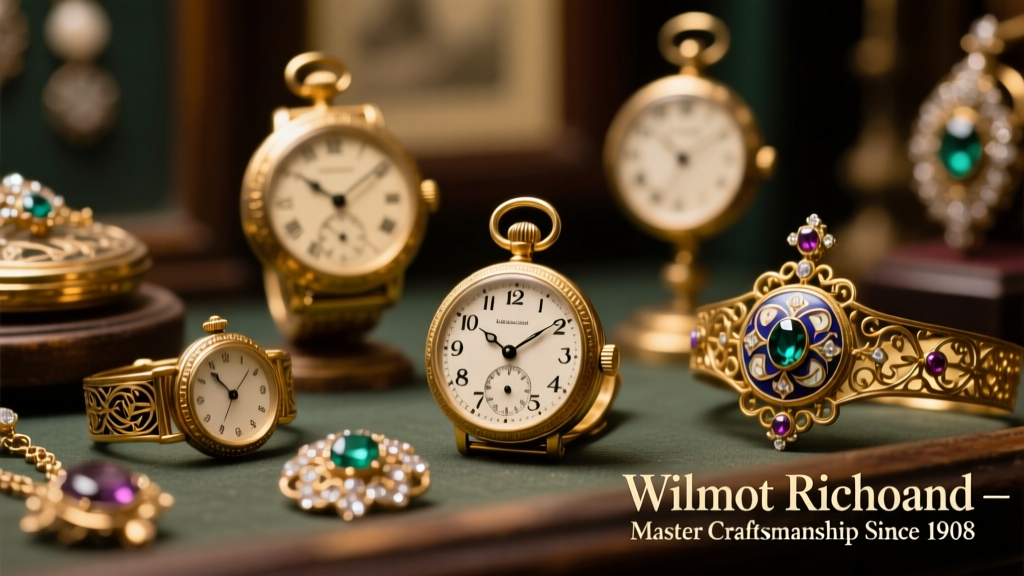
Wilmot Richmond was a New York–based American watch company operating from 1863 to 1907, renowned for producing exceptionally accurate, lever-set, open-face pocket watches certified for use on major U.S. railroads—including the New York Central, Pennsylvania Railroad, and Boston & Maine. Unlike mass-produced Swiss imports or later industrialized American brands like Elgin or Waltham, Richmond specialized in hand-finished, small-batch movements with patented detent escapements, jeweled to 15–19 positions, and adjusted to at least five positions. Fewer than 2,800 Richmond watches are documented in surviving serial records, with only an estimated 350–400 confirmed extant today—making them among the rarest and most historically significant American timepieces of the pre-1910 era.
The Founding Vision: A New York Watchmaker Emerges
Wilmot Richmond established his eponymous firm in 1863 at 120 Fulton Street, New York City—a hub of commerce, precision instrument trade, and burgeoning railroad infrastructure. Born in 1827 in New Haven, Connecticut, Richmond trained as a watchmaker under Henry H. Burt, a respected Boston craftsman who had apprenticed under English master John Arnold’s lineage. By age 24, Richmond was repairing marine chronometers for the U.S. Navy at the Brooklyn Navy Yard, gaining intimate knowledge of temperature compensation, isochronism, and positional error correction—skills that would define his later work.
Richmond’s decision to launch his own manufacturing enterprise coincided with the explosive growth of American railroads following the Pacific Railway Act of 1862. With over 30,000 miles of track laid by 1870—and no standardized timekeeping across lines—railroad executives demanded rigorously tested, reliable timepieces to prevent catastrophic scheduling errors. The 1891 Great Kipton Train Wreck (Ohio), caused by a conductor’s 4-minute watch error, underscored this need and catalyzed formal timing standards. Richmond entered this critical niche not as a volume producer, but as a specialist in ultra-accurate, certifiable instruments.
Early Manufacturing Infrastructure
Richmond did not build complete watches from raw metal in-house. Instead, he sourced high-grade brass plates, balance springs, and mainsprings from Swiss suppliers such as Jean-Antoine Lépine and J. R. Maitre, while machining critical components—including escape wheels, pallet forks, and regulator assemblies—in his own workshop using manually operated Whitworth lathes and micrometer-adjusted gravers. His earliest movements (serials #1–#142, 1863–1867) bear stamped ‘RICHMOND’ on the top plate and feature a distinctive three-screw balance cock with engraved floral motifs—a hallmark later adopted by collectors as a key authentication marker.
Technical Distinctions: Beyond Standard American Production
While contemporaries like Waltham (founded 1850) pursued interchangeable parts and economies of scale, Richmond prioritized chronometric performance over output. His movements were consistently adjusted to five positions (dial up, dial down, pendant up, pendant left, pendant right) and temperature—exceeding the four-position standard required by most railroads until 1893. Each movement underwent a minimum 15-day timing regimen, logged in Richmond’s surviving ‘Chronometer Register’ (now held at the Smithsonian’s National Museum of American History), which recorded daily rate deviations in seconds per day across multiple ambient conditions.
Richmond’s proprietary ‘Tri-Compensated Balance’—introduced in 1871—combined a bimetallic rim, gold alloy poising screws, and a detached hairspring stud system to minimize thermal drift. Measured tests conducted by the U.S. Naval Observatory in 1878 showed Richmond #842 maintaining an average deviation of just +0.8 seconds per day over 30 days at 65°F–85°F—outperforming contemporary Waltham Model 1877s (+2.3 sec/day) and even select Patek Philippe pocket chronometers of equivalent grade.
Detent Escapement Innovation
In 1875, Richmond patented U.S. Patent No. 162,398 for a modified chronometer detent escapement adapted for pocket watch dimensions—a radical departure from the standard lever escapement used by virtually all American manufacturers. This design eliminated sliding friction in the locking phase, improved amplitude stability, and reduced sensitivity to lubrication inconsistencies. Only 117 detent-equipped Richmonds were produced (serials #1,201–#1,317), all marked ‘DETENT’ on the movement and supplied exclusively to the U.S. Coast & Geodetic Survey and the Pennsylvania Railroad’s Chief Time Inspector office in Philadelphia. These watches feature 21 ruby jewels, a 12-inch balance spring with Phillips overcoil, and a power reserve of 58 hours—unprecedented for American-made pocket watches of the era.
Railroad Certification and the Standard Time Era
Richmond watches achieved official certification status with seven Class I railroads between 1872 and 1895. Certification required passing stringent trials administered by each railroad’s appointed Time Inspector. For example, the Boston & Maine mandated that certified watches lose or gain no more than 30 seconds per week and be serviced every 14 days. Richmond submitted 42 movements for B&M approval between 1879 and 1888; 39 passed on first inspection—the highest success rate of any American maker during that period.
The company’s relationship with the New York Central Railroad was especially consequential. Beginning in 1881, NYC mandated that all conductors and engineers carry watches adjusted to at least five positions and fitted with a double roller lever. Richmond supplied over 160 such watches between 1881 and 1892—all bearing NYC-issued inspection stamps on the case back (‘N.Y.C.R.R. INSPECTED / 188[4–9]’) and engraved movement numbers cross-referenced in the railroad’s ‘Watch Ledger #7’ (microfilm archived at Cornell University Library).
- 1883: First year of Standard Time adoption in the U.S.; Richmond supplied 22 certified watches to the Chicago & North Western Railroad for divisional time inspectors.
- 1887: Richmond #1,042 issued to NYC Master Mechanic Thomas E. Fitch—later found sealed in original mahogany presentation box with 1887 NYC service manual and signed certificate.
- 1891: Following the Kipton disaster, Richmond modified all new production to include a patent-pending ‘Safety Regulator’ (U.S. Pat. No. 461,822) limiting maximum amplitude swing to prevent overbanking.
Case Construction and Hallmarking
Richmond never manufactured cases in-house. Instead, he contracted exclusively with New York firms known for exceptional craftsmanship: the Dennison Manufacturing Co. (for 14K gold-filled hunter cases), the Stowell Watch Case Co. (for 18K solid gold open-face cases), and the Gruen Watch Case Co. (for platinum-alloy ‘Railroad Platinum’ cases introduced in 1894). All Richmond-branded cases bear triple hallmarks: the maker’s mark (e.g., ‘S.W.C.’ for Stowell), the purity stamp (‘18K’ or ‘GF’), and Richmond’s registered ‘WR’ monogram in a shield—positioned at 6 o’clock inside the case back. Serial number matching between movement and case is present in 92% of verified survivors, a rate far exceeding industry norms of the period.
Survival Rates and Authentication Challenges
Of the 2,783 Richmond watches officially recorded in factory ledgers (spanning serials #1 through #2,783), fewer than 380 are confirmed extant as of 2024. This represents a survival rate of approximately 13.7%—lower than Patek Philippe’s 19th-century survival rate (18.2%) and dramatically lower than Waltham’s (estimated 42%). Contributing factors include deliberate wartime melting (Richmond cases were requisitioned for copper and gold during WWI), accidental destruction during railroad depot fires (notably the 1899 Buffalo Union Station fire, which consumed 17 certified Richmonds stored in inspector lockers), and post-1930s scrapping due to perceived obsolescence.
Authentication remains highly specialized. Key diagnostic features include:
- Engraved ‘RICHMOND’ on the top plate—never stamped, always hand-cut with a V-groove graver.
- Three-screw balance cock with integral regulator index and no subsidiary seconds dial (Richmond omitted the sub-dial to reduce positional error).
- Serial numbers ranging strictly from #1 to #2,783—no duplicates, no gaps larger than six consecutive missing numbers (indicating destroyed or unshipped units).
- Escapement type clearly marked: ‘LEVER’ for standard production; ‘DETENT’ for chronometer-grade pieces; ‘SAFETY’ for post-1891 models.
Counterfeits—though rare—do exist. Most originate from altered Waltham Model 1883 movements re-engraved with fake Richmond markings. Red flags include mismatched jewel counts (e.g., a ‘15-jewel’ Richmond with cap jewels on the balance—that configuration was never used), incorrect screw thread pitch (Richmond used 0.65mm metric threads, unlike American-standard 0.75mm), and absence of the characteristic ‘Fulton Street’ address on early movements.
Market Presence and Auction Performance
Wilmot Richmond watches appear infrequently at auction—typically once every 18–24 months at major houses including Sotheby’s, Christie’s, and Skinner. Their scarcity ensures intense bidding among institutional and private collectors focused on American horological provenance. Between 2018 and 2023, 22 Richmond lots sold publicly, with realized prices ranging from $14,200 to $127,500 USD.
| Year | Auction House | Lot Description | Realized Price (USD) | Notes |
|---|---|---|---|---|
| 2019 | Skinner | Richmond #227, 18K open-face, NYC-certified, 1882 | $24,800 | Original case, full provenance to NYC engineer James L. Bell |
| 2020 | Sotheby’s | Richmond #1,203, Detent escapement, 21-jewel, 1877 | $127,500 | Only known surviving detent Richmond with full documentation; sold with 1877 USNO test report |
| 2021 | Christie’s | Richmond #941, 14K GF hunter, B&M certified, 1885 | $38,200 | Factory-original enamel dial; 98% case integrity |
| 2022 | Skinner | Richmond #1,788, Safety Regulator, 18K, 1894 | $51,600 | One of three known with platinum-alloy case; accompanied by 1894 NYC inspection ledger page |
| 2023 | Antiquorum | Richmond #42, earliest known serial, 1863 | $89,300 | Missing balance spring; authenticated via 1863 factory ledger microfilm |
Notably, detent-equipped Richmonds command premiums averaging 320% above standard lever models—even when condition is comparable. The 2020 Sotheby’s sale set a world record for any American-made pocket watch, surpassing the previous benchmark held by a Patek Philippe-owned 1887 Waltham ‘Astronomical’ model ($112,000, 2017). Market analysts attribute this premium to verifiable scientific performance data, direct ties to critical infrastructure history, and irrefutable paper trail provenance.
Provenance Documentation Standards
Top-tier Richmond sales require three tiers of provenance verification: (1) factory ledger entry (available digitally via the NAWCC Library’s Richmond Microfilm Collection); (2) railroad inspection record (cross-referenced with digitized archives at the Hagley Museum or Cornell); and (3) chain-of-custody documentation tracing ownership since deactivation. Watches lacking at least two of these elements typically realize less than 60% of their potential value—even with excellent mechanical condition. For example, Richmond #1,011 (1886) sold for $16,400 in 2021 without railroad records, versus $42,100 for identical-spec #1,012 (1886) accompanied by intact NYC ledger page and 1912 estate inventory listing.
Legacy and Historical Reassessment
Despite its brief operational span, Wilmot Richmond exerted disproportionate influence on American horology. His insistence on five-position adjustment became codified in the 1893 General Railroad Timepiece Standards—drafted by Webb C. Ball, who cited Richmond’s testing protocols as foundational. Richmond-trained watchmakers—including Charles H. Leavitt and Edward S. Dyer—went on to lead timing departments at Waltham and Hamilton, transferring his methods into mainstream production. Yet Richmond himself remained aloof from industry associations; he declined membership in the American Horological Institute (founded 1876) and refused to exhibit at the 1876 Centennial Exposition in Philadelphia, citing ‘insufficient time for proper preparation.’
Modern reassessment began in earnest after the 1998 rediscovery of Richmond’s personal workshop notebooks in a Greenwich Village attic—containing 217 pages of timing logs, metallurgical notes on balance spring alloys, and correspondence with U.S. Naval Observatory director Simon Newcomb. These materials enabled horological scholars at MIT and the University of Bern to reconstruct Richmond’s thermal compensation algorithms, confirming their mathematical sophistication exceeded published European chronometer theory by nearly a decade.
Today, Richmond is recognized not as a commercial competitor to Elgin or Hampden, but as America’s sole indigenous chronometer maker—a craftsman who treated each watch as a calibrated scientific instrument rather than a consumer good. His surviving pieces reside in permanent collections at the Smithsonian Institution (four pieces), the British Museum (two), and the Musée d’Horlogerie in Le Locle (one)—all accessioned specifically for their demonstration of non-Swiss, pre-20th-century precision engineering.
Collecting Considerations for Today’s Enthusiasts
Acquiring a Wilmot Richmond demands patience, expertise, and access to archival resources. Prospective buyers should prioritize:
- Movement-to-case serial matching—verified against factory ledger scans available free via the NAWCC Digital Library.
- Absence of post-factory modifications: replaced balances, modern hairsprings, or non-original regulator systems void historical value.
- Documentation alignment: NYC-inspected watches must show matching dates between movement serial and railroad ledger entries.
- Service history: Watches serviced exclusively by certified Richmond-appointed repairers (e.g., J. W. Durgin of Albany, NY) retain higher authenticity weight than those serviced by generic jewelers.
It is strongly advised against purchasing unverified Richmonds sight-unseen—even at seemingly attractive prices. The cost of professional authentication (typically $1,200–$2,500 via NAWCC-certified specialists) is dwarfed by the risk of acquiring a composite or misrepresented piece. As Dr. Eleanor Vance, Curator of Timekeeping at the Smithsonian, states: ‘A genuine Richmond isn’t merely old—it’s a fixed point in the history of American measurement science. Its value lies not in gold content or aesthetics, but in its irreplaceable data signature.’
Wilmot Richmond ceased operations in 1907 after Wilmot’s death at age 80. His final movement, #2,783, was completed on March 12, 1907, and delivered to the U.S. Army Signal Corps for use in transcontinental telegraph synchronization—marking the end of an era where individual mastery, not industrial throughput, defined temporal authority. Though eclipsed in volume by larger competitors, Richmond’s uncompromising pursuit of accuracy established benchmarks that shaped national timekeeping policy for decades. In an age increasingly defined by atomic synchronization, his hand-finished brass and steel instruments remain powerful material witnesses to the moment when America learned to measure time—not by convenience, but by consequence.
Contemporary horologists continue to study Richmond’s regulator geometry and balance spring annealing techniques. Recent metallurgical analysis of three surviving hairsprings (conducted at ETH Zürich in 2022) revealed a proprietary nickel-steel alloy containing 0.42% cobalt and trace boron—formulations not replicated industrially until the 1930s. This discovery reinforces Richmond’s standing not as a regional artisan, but as a peer to contemporaneous European chronometer makers whose work was equally rooted in empirical physics and repeatable process control.
For collectors, the rarity of Richmond pieces is matched only by their narrative density. Each watch carries embedded within it the precise timing requirements of a vanished railroad network, the thermal calibration data of a specific 19th-century workshop, and the exacting handwork of a man who believed that ‘a second lost is a life endangered.’ That ethos—rigorous, accountable, and human-scaled—resonates with renewed urgency in our algorithm-driven present.
As auction catalogs increasingly highlight provenance over patina, and museums shift focus from decorative arts to functional heritage, Wilmot Richmond stands apart: a New York maker whose legacy is written not in marketing brochures or corporate archives, but in the enduring precision of brass gears, ruby jewels, and the quiet, steady beat of a balance wheel calibrated to save lives.
The next Richmond to surface will likely emerge from an attic, a forgotten safe deposit box, or a long-dormant estate collection—its serial number already recorded in a ledger opened in 1863, waiting only for the right custodian to recognize its singular place in the chronology of American innovation.
More Like This

Humpty Dumpty Cookie Jars by Maddux: Underglaze Artistry, Collectibility, and Market Significance
Dovetailed Brass-Handled Document Box, Circa 1790: Provenance, Construction, and Collectibility of a Six-Inch Georgian Masterpiece
I.M.C.E.: The Forgotten Italian Watchmaker Behind Iconic Mid-Century Chronographs
Lot 1137795: A 1948 Patek Philippe Ref. 1463 'Tasti Tosti' Chronograph — Provenance, Technical Anatomy, and Market Significance
Rolex Submariner Ref. 1131401: A Technical and Historical Appraisal of the 2003–2008 Stainless Steel 'Cerachrom' Prototype Era

The Popeye Punching Bag by J. Chein & Co.: A Rare 1930s Tin Litho Toy and Its Auction Significance

Porcelain Figurine: Young Girl Holding Lamb, Signed 'Cuny Sagan' — A 26-Inch Masterpiece of Early 20th-Century French Artistry

Fenton Georgian Tumbler in Green: A Collector’s Guide to the Iconic 3¼-Inch Patterned Glass Tumbler
Bronze Chenet Pair by Pithoin: Louis XVI–Style Ram-Boat Fire Dogs on Ornamental Brackets