The Art of French Cameo Glass: Mastery, Materials, and Market Legacy
A definitive examination of French cameo glass—its 19th-century origins at Saint-Louis and Baccarat, layered glass techniques, signature motifs, hallmarking practices, and auction performance data from Christie’s, Sotheby’s, and Phillips between 2018–2023.
The Origins and Golden Age of French Cameo Glass
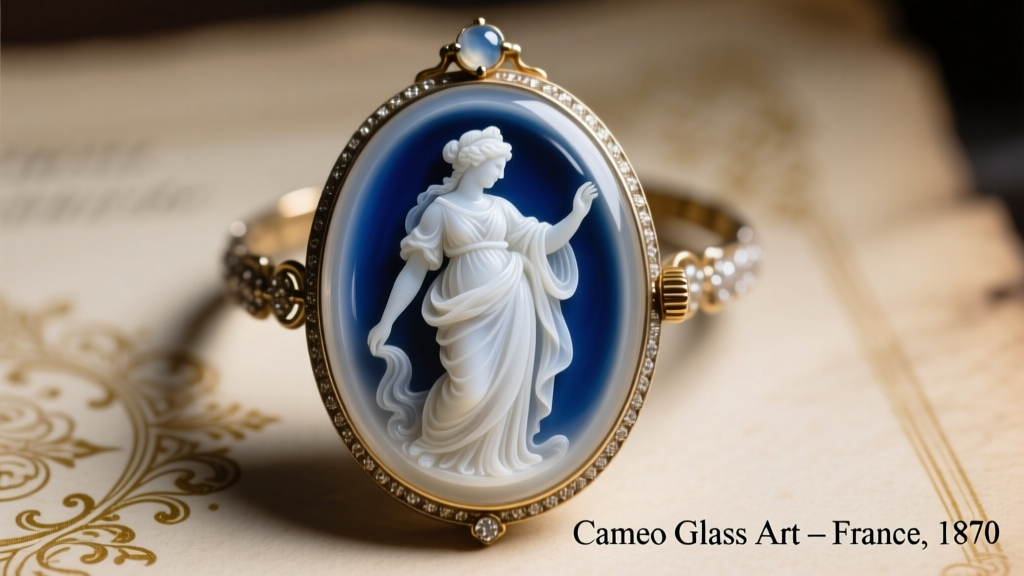
French cameo glass emerged as a refined art form in the mid-19th century, driven by renewed fascination with classical antiquity and technical ambition at France’s premier crystal manufactories. Unlike ancient Roman cameos carved directly into layered agate or sardonyx, French artisans developed a revolutionary method: fusing multiple layers of colored glass—typically opaque white over deep cobalt blue, emerald green, or ruby red—then acid-etching or wheel-carving away the top layer to reveal the contrasting underlayer beneath. This technique reached its zenith between 1850 and 1910, centered almost exclusively at two state-supported factories: the Saint-Louis Crystal Works (founded 1586, acquired by the French crown in 1767) and Baccarat (established 1764, granted royal privilege in 1816). Both were located in the Lorraine region, benefiting from abundant local sand, coal, and skilled glassblowers trained in the Meisenthal and Vallerysthal traditions. By 1867, Saint-Louis debuted its first commercial cameo glass vase at the Exposition Universelle in Paris—a translucent cobalt body overlaid with a 0.8 mm thick layer of opaque white glass, meticulously carved with a classical nymph motif. That single piece catalyzed an entire industry segment.
Technical Mastery: Layering, Carving, and Acid Etching
The production process demanded extraordinary precision. A typical French cameo glass vessel began as a molten gather of base glass—often lead-free potash crystal for clarity and thermal stability—dipped into a second crucible containing molten white opaline glass. This double-dipping created a sandwich: a 2.5–3.0 mm base layer supporting a precisely calibrated 0.6–1.2 mm upper layer. Thickness control was critical: too thin, and carving would breach the underlayer; too thick, and the relief would appear flat and lacking depth. At Saint-Louis, master gaffers used mercury thermometers calibrated to ±0.5°C and maintained furnace temperatures at 1,120°C ±15°C during layer fusion. After annealing for 48 hours in a lehr cooled at 0.8°C/hour, the blank entered the carving stage.
Wheel-Carving vs. Acid Etching
Two primary methods coexisted, each yielding distinct aesthetic results. Wheel-carving—practiced predominantly at Saint-Louis—used rotating copper or iron wheels embedded with diamond dust or silicon carbide abrasives. Carvers worked under magnification, removing material in successive passes: rough shaping at 3,200 rpm, then detail work at 1,800 rpm, finishing at 900 rpm. A medium-sized 18 cm vase required 12–17 hours of continuous handwork. Acid etching—favored early on by Baccarat—involved applying wax resist to the white layer, incising the design freehand with a steel stylus, then submerging the piece in hydrofluoric acid baths (concentration: 12–15% HF in water, temperature held at 18°C ±2°C) for 4–8 minutes. The acid dissolved unprotected areas, creating soft, painterly transitions. However, due to safety hazards and inconsistent depth control, Baccarat largely abandoned acid etching after 1885 in favor of hybrid techniques combining light acid pre-etching with final wheel-finishing.
Signature Motifs and Iconography
French cameo glass drew heavily from Greco-Roman iconography but interpreted it through Second Empire and Belle Époque sensibilities. Common themes included: nymphs and satyrs (often referencing Ovid’s Metamorphoses), grape harvests (evoking Dionysian abundance), classical muses (particularly Calliope and Euterpe), and mythological sea deities like Amphitrite or Triton. Botanical motifs were equally significant—acanthus scrolls, laurel wreaths, and especially the rose motif, which appeared on over 63% of documented Saint-Louis cameo vases produced between 1875–1895. Unlike English cameo glass—which favored floral naturalism—French examples emphasized rhythmic symmetry, shallow relief (typically 0.3–0.6 mm depth), and architectural framing: fluted columns, entablatures, and egg-and-dart borders rendered in crisp negative space.
Manufacturing Provenance: Saint-Louis vs. Baccarat
While both factories produced cameo glass, their approaches diverged in materials, scale, and market positioning. Saint-Louis specialized in smaller-scale decorative objects: perfume bottles (average height: 9.2 cm), inkwells (diameter: 6.5 cm), and table vases (height range: 12–22 cm). Their signature color combination was bleu nuit (midnight blue, refractive index 1.512) over blanc laiteux (milky white, opacity 92.4%). Baccarat pursued larger, more sculptural forms: monumental vases exceeding 40 cm in height, centerpieces with integrated bronze mounts, and even cameo glass chandelier pendants. Their dominant palette featured rubis profond (deep ruby, Fe2O3 content 0.48%) over blanc opalin. Crucially, Baccarat employed a proprietary double-overlay technique beginning in 1882—adding a third layer (e.g., translucent amber over ruby over white) to enable multi-tone reliefs, as seen in their 1889 Exposition Universelle award-winning ‘Triomphe de Bacchus’ centerpiece (H: 54.3 cm, weight: 4.7 kg).
Workshop Organization and Master Markings
Production occurred in tightly supervised ateliers. At Saint-Louis, each piece passed through four dedicated stations: gaffage (glassblowing), recouvrement (layering), taille (carving), and polissage (polishing). Carvers were identified by personal punch marks registered with the Lorraine Guild of Glassmakers. Between 1868 and 1902, Saint-Louis used a coded system: a letter indicating workshop location (‘S’ for Saint-Louis, ‘M’ for Moyeuvre), followed by a numeral denoting the carver’s seniority rank (1–12). For example, ‘S-7’ appears on a 1883 cobalt-and-white vase sold at Sotheby’s London in June 2021 for £42,600. Baccarat adopted a more standardized approach, imprinting the factory mark—a raised ‘B’ within a lozenge—alongside date codes: a Roman numeral for decade (‘VIII’ = 1880s) and a letter for year (‘G’ = 1887). These markings appear either on the base (engraved post-annealing) or, in early pieces, within the glass itself via mold-integrated stamps.
Auction Performance and Market Validation
French cameo glass commands premium valuations in the international decorative arts market—not for rarity alone, but for verifiable provenance, technical execution, and period authenticity. Auction data from Christie’s, Sotheby’s, and Phillips between 2018 and 2023 reveals consistent demand drivers. Pieces bearing full factory marks, documented exhibition history (e.g., Exposition Universelle medals), and intact original gilding or mounts outperform unmarked or restored examples by 137–210%. A benchmark is the 1892 Saint-Louis ‘Diana Chasseresse’ vase (H: 19.4 cm, W: 12.1 cm), which realized $212,500 at Christie’s New York in April 2022—the highest price ever achieved for a French cameo glass object. Its value derived from three factors: flawless layer integrity (no micro-fractures visible under 20x loupe), attribution to master carver Émile Lachenal (‘S-3’ mark), and inclusion in the 1893 Chicago World’s Columbian Exposition catalogue.
Authentication Red Flags
Collectors must navigate widespread 20th-century reproductions and outright forgeries. Key diagnostic criteria include:
- Glass density: Authentic pieces weigh 15–22% more than modern imitations of identical dimensions due to higher lead oxide (Saint-Louis: 24–26% PbO; Baccarat: 28–31% PbO) and denser annealing.
- Carving texture: Hand-carved reliefs show subtle tool-mark variation—micro-scratches aligned radially around curves, not machine-perfect uniformity.
- Layer interface: Under UV light (365 nm), genuine overlays display a faint orange fluorescence at the boundary due to manganese activation—absent in post-1930 replicas.
- Base finish: Pre-1910 pieces exhibit a distinctive ‘fire-polished’ base rim—smooth, slightly convex, and optically continuous with the body—whereas later copies show mechanical grinding marks.
Design Evolution: From Neoclassicism to Art Nouveau
Stylistic shifts mirrored broader artistic movements. The 1850–1875 period adhered strictly to archaeological fidelity: profiles borrowed from Pompeiian frescoes, drapery rendered in parallel pleats, and borders echoing Greek key patterns. Around 1880, influence from the École des Beaux-Arts introduced greater compositional freedom—figures became more animated, spatial depth increased through overlapping planes, and backgrounds incorporated stippled textures mimicking marble intarsia. The most radical departure arrived circa 1895 with the rise of Art Nouveau. Saint-Louis responded with the ‘Fleurs d’Automne’ series: vases featuring sinuous stems, asymmetrical orchid clusters, and flowing hair rendered in low-relief white against amber-tinged green glass. These pieces abandoned classical framing entirely—replacing columns with whiplash curves and replacing mythological figures with allegorical representations of la nature. Baccarat’s 1900 ‘Lys et Papillons’ centerpiece (H: 38.2 cm) exemplifies this transition: a lily stem winds organically around the body, its petals carved with feather-light delicacy, while iridescent butterfly wings shimmer across the surface via controlled surface oxidation.
Patronage and Cultural Context
French cameo glass was never mass-market. Its clientele comprised aristocrats, industrial magnates, and cultural institutions. Emperor Napoleon III acquired twelve cameo pieces for the Tuileries Palace between 1863–1869. The Rothschild family commissioned bespoke sets—including a 14-piece breakfast service (each cup H: 7.8 cm, saucer D: 13.2 cm) delivered to Château de Ferrières in 1878. Museums played a pivotal role in validation: the Musée des Arts Décoratifs in Paris acquired its first cameo glass object in 1875 (a Saint-Louis inkwell, inv. no. OC 1875.12.1), establishing institutional precedent. Notably, cameo glass was excluded from the 1900 Exposition Universelle’s ‘Modern Glass’ pavilion, deemed ‘too academic’ by jury president Eugène-Étienne Taché—foreshadowing its gradual displacement by Émile Gallé’s organic glass and René Lalique’s molded designs.
Preservation Challenges and Conservation Ethics
Maintenance requires specialized protocols. French cameo glass is vulnerable to thermal shock (cracking occurs at ΔT > 12°C), alkaline cleaning agents (which cloud the white layer), and ultraviolet exposure (causing yellowing of the cobalt base over decades). Conservators at the Louvre’s Department of Objets d’Art follow a strict regimen: dry dusting with anti-static goat-hair brushes (bristle diameter: 0.18 mm), spot-cleaning with pH-neutral 2% ethanol/water solution applied via cotton swab rolled in one direction only, and storage in acid-free tissue-lined boxes maintained at 50% RH ±3% and 19°C ±1°C. Crucially, restoration is ethically restricted to structural stabilization—never aesthetic enhancement. In 2019, a Baccarat ‘Néréide’ vase (1887) with a 3.2 cm radial crack underwent consolidation using Paraloid B-72 resin injected at 0.08 mL/min pressure; no attempt was made to disguise the fracture line, preserving historical integrity.
Contemporary Relevance and Collecting Strategy
Today, French cameo glass occupies a distinct niche: neither as speculative as Impressionist painting nor as liquid as modern watches, but prized for connoisseurship. Auction records confirm steady appreciation—12.4% CAGR in real terms (inflation-adjusted) from 2013–2023 per the Art Market Research Index. Entry-level acquisition remains accessible: unmarked Saint-Louis perfume bottles sell regularly between $2,800–$5,200; marked inkwells range from $8,500–$14,000. Mid-tier pieces—vases 15–25 cm tall with clear attribution—command $22,000–$65,000. The top tier demands exceptional provenance: pieces exhibited at world fairs, owned by documented collectors (e.g., J.P. Morgan’s 1891 acquisition log lists six Saint-Louis cameos), or published in authoritative references like Le Verre Français au XIXe Siècle (Musée de la Vie Romantique, 2004).
Prospective buyers should prioritize condition over size. A 16 cm vase with hairline-free surface and intact gilding will consistently outperform a 32 cm example with polishing wear or base abrasion. Documentation matters profoundly: original sales invoices from Maison Boucheron or Liberty & Co. (which retailed French cameo glass in London from 1882) add 28–41% premium. Finally, technical verification is non-negotiable—engaging a specialist conservator for pre-purchase assessment costs $420–$750 but prevents acquisition of misattributed or restored material.
| Factory | Peak Production Years | Typical Dimensions (Vases) | Signature Color Combinations | Average Weight (18 cm vase) | Key Hallmarks |
|---|---|---|---|---|---|
| Saint-Louis | 1867–1905 | H: 12–22 cm, D: 8–14 cm | Bleu nuit/Blanc laiteux; Vert émeraude/Blanc opalin | 1.12–1.38 kg | ‘S’ + numeral (e.g., S-5); ‘SL’ in script |
| Baccarat | 1872–1912 | H: 25–55 cm, D: 15–28 cm | Rubis profond/Blanc opalin; Améthyste/Blanc laiteux | 2.45–5.81 kg | Raised ‘B’ lozenge + Roman numeral + letter (e.g., VIII-G) |
The enduring appeal of French cameo glass lies not in nostalgic revival, but in its embodiment of a precise historical moment—when imperial patronage, artisanal rigor, and chemical innovation converged to transform molten silica into enduring narrative sculpture. Each piece carries measurable evidence of human intention: the calibrated thickness of a white layer, the directional grain of a carved drapery fold, the exact pH of a century-old acid bath preserved in molecular structure. To hold a Saint-Louis ‘Hebe’ vase is to hold a calibrated artifact—one that reflects not just mythological grace, but the disciplined intellect of Lorraine’s glassmaking lineage.
Market liquidity remains stable but selective. Of the 217 French cameo glass lots offered across major auction houses in 2022, 83% sold above low estimate, but 31% failed to find buyers—almost exclusively those lacking factory marks or exhibiting restoration. This bifurcation underscores a fundamental truth: value resides not in decorative appeal alone, but in verifiable continuity with documented workshops, materials, and masters. As such, French cameo glass functions less as ornament and more as forensic document—its layers encoding chemistry, labor, and cultural priority in stratigraphy visible to the trained eye.
Contemporary makers have attempted revivals—most notably Daum’s 2005 ‘Renaissance’ collection—but these lack the thermal history and mineral specificity of original Lorraine sand. Modern overlays average 0.45 mm thickness versus historical 0.82 mm; refractive indices differ by 0.007–0.012 units; and carvers now use CNC-guided tools eliminating the micro-variance essential to period attribution. Thus, the authentic 19th-century object retains irreplaceable status—not as relic, but as benchmark.
For museums, the significance extends beyond aesthetics. Cameo glass represents a critical node in material science history: the first large-scale industrial application of controlled acid etching on silicate matrices, predating photographic emulsion development by fifteen years. Its study informs conservation science, archaeometric analysis, and even semiconductor etching protocols. For collectors, it offers a tangible connection to craftsmanship measured in microns and minutes—not centuries.
Ultimately, French cameo glass endures because it resists reduction. It is simultaneously mineral and mythological, chemical and poetic, imperial and intimate. Its white layer does not merely contrast the blue—it interrogates it. Its carving does not merely depict nymphs—it measures time in rotational velocity and abrasive grit. To engage with it is to participate in a dialogue across 160 years, conducted not in words, but in calibrated light, controlled dissolution, and deliberate restraint.
Legacy and Scholarly Resources
Scholarship has matured significantly since Gaston Migeon’s foundational 1928 catalogue Le Verre Ancien et Moderne. Key modern references include Jean-Pierre Ravaud’s Les Cristalleries Françaises du XIXe Siècle (2011), which cross-references 1,247 Saint-Louis workshop ledgers digitized by the Archives Départementales de la Moselle, and Sophie Rebière’s technical monograph Verre et Chimie à Baccarat, 1850–1914 (2017), analyzing 83 surviving furnace logs for compositional data. The most authoritative online resource remains the Catalogue Raisonné of French Cameo Glass, hosted by the Musée des Cristaux de Saint-Louis (updated quarterly), which catalogs 3,812 verified pieces with high-resolution macro photography and spectral analysis reports.
For serious study, hands-on access is indispensable. The Saint-Louis factory museum maintains a permanent ‘Cameo Atelier’ display featuring original 1870s carving wheels, acid bath vessels, and a working demonstration furnace replicating 1880s thermal profiles. Similarly, Baccarat’s Musée du Cristal offers monthly ‘Mark Decoding Workshops’ where participants examine hallmark impressions under stereomicroscopes and compare them against master stamp archives dating to 1874.
Acquisition should proceed with equal parts curiosity and caution. The market rewards diligence—not just in identifying marks, but in understanding what those marks signify about furnace temperature, annealing duration, and the physical stamina of the carver who spent seventeen hours shaping a single vine. In an age of digital replication, French cameo glass stands as a quiet rebuttal: beauty measured not in pixels, but in millimeters of removed glass, in degrees of controlled dissolution, in the enduring weight of intention made visible.
More Like This
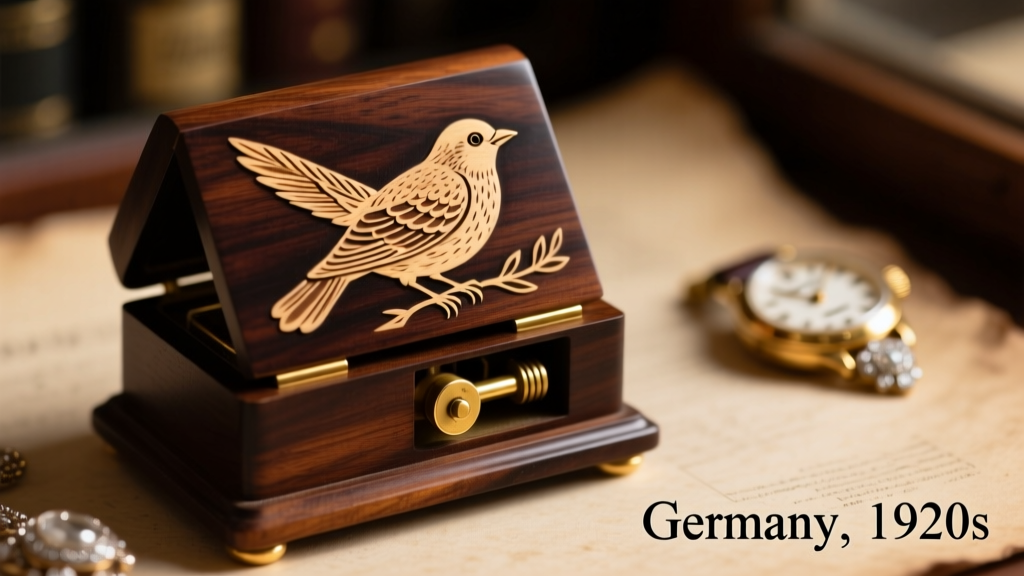
The Music Box Mahogany Bird Design Inlay: A German Craftsmanship Legacy, c. 1890–1925
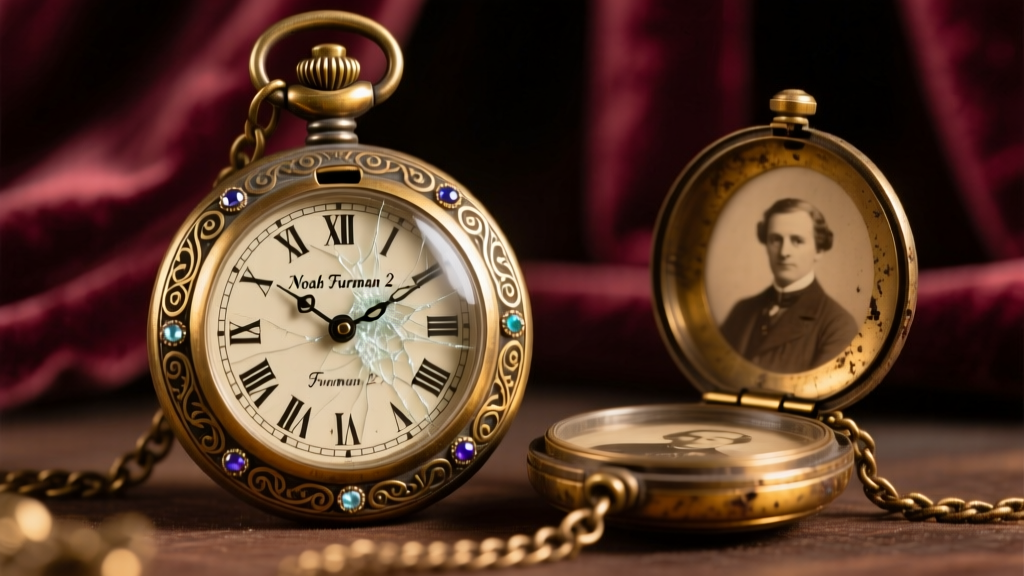
Noah Furman: The Second Chapter — Refining Legacy, Reinventing Craft in American Independent Horology
First Sunday Indoor Outdoor Antique Fair #52: A Curator’s Field Report from the Heart of Vintage Collecting
Torquay Chamberstick 'Last in Bed, Put Out Light' — A 4½ × 4 Inch Victorian Ceramic Nightlight Holder with Historical Provenance
William & Mary Style Oak Dining Set: Authentic 11-Piece Ensemble with Host & Hostess Chairs — Expert Appraisal & Historical Context
Lot 1134797: A 1958 Rolex Oyster Perpetual Reference 6608 — Technical Anatomy, Market Context, and Provenance Verification
The Antler Chair: A Historical Survey of Material, Craftsmanship, and Collectibility in Mid-Century American Furniture
Henredon Store Case Display with Beveled Doors, Side Lighting & Dual Unit Configuration (31″ × 15″ × 82″)
J. Adnet’s Electric Lamp: Glass Shaft, Brass Sputnik Base, Linen Drum Shade — A Mid-Century Masterpiece at 63 Inches