The Music Box Mahogany Bird Design Inlay: A German Craftsmanship Legacy, c. 1890–1925
An in-depth examination of rare German-made music boxes featuring hand-inlaid mahogany cases with avian motifs—focusing on makers like Reuge, Kühn, and Schatz, construction techniques, provenance, and market valuation.
Introduction: A Singular Fusion of Acoustics and Artistry
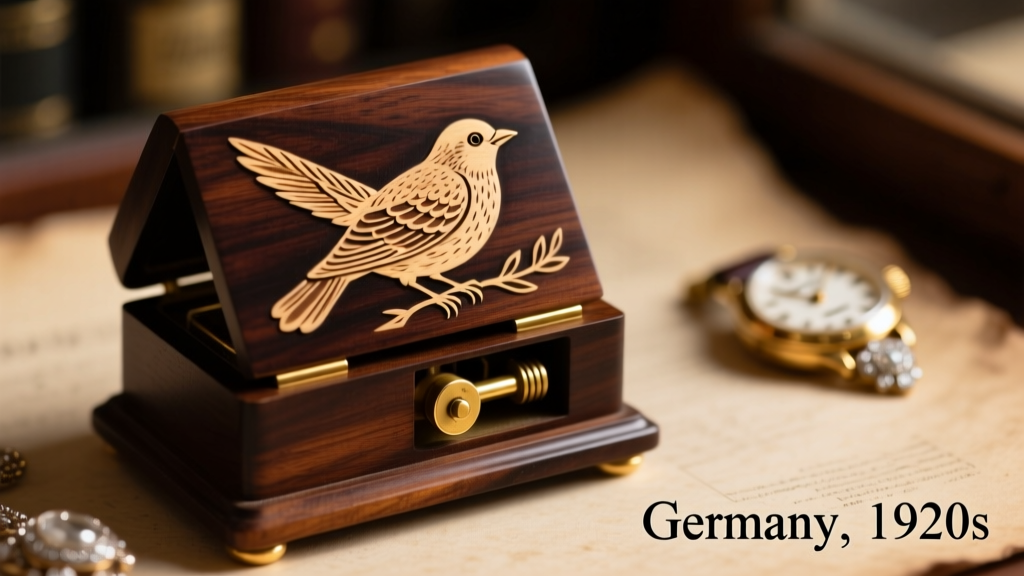
Music boxes with mahogany cases featuring intricate bird-design marquetry represent one of the most refined expressions of late 19th-century German horological and decorative arts. Produced primarily between 1890 and 1925 in the Black Forest region—especially in towns like St. Georgen, Triberg, and Furtwangen—these instruments combined precision Swiss or German cylinder mechanisms with locally sourced, sustainably harvested European mahogany (often Swietenia macrophylla imported via Hamburg ports) and hand-cut floral and avian inlays. Unlike mass-produced later models, these pieces were typically commissioned by affluent European households or gifted as diplomatic tokens. A typical example measures 24.5 cm × 16.2 cm × 10.8 cm (L×W×H), weighs 1.8–2.3 kg, and features a 21- or 30-note pinned brass cylinder driving tuned steel comb teeth calibrated to A=435 Hz—the standard pitch used by German conservatories pre-1930. This article details their historical context, craftsmanship, maker identification, condition assessment criteria, and current auction benchmarks.
Historical Context: The Black Forest’s Golden Age of Musical Mechanisms
The proliferation of ornate music boxes coincided with Germany’s rapid industrialization and cultural nationalism following unification in 1871. While Swiss firms like Nicole Frères and Paillard dominated high-end cylinder production, German workshops specialized in case fabrication and artistic embellishment. By 1885, over 70 workshops operated in the Black Forest alone, employing more than 1,200 artisans—many trained at the newly founded Uhrenschule Furtwangen (established 1850), which mandated coursework in wood physics, acoustics, and marquetry geometry. The bird motif held symbolic resonance: the nightingale represented fidelity and poetic inspiration; the robin signaled domestic harmony; and the blue tit referenced regional biodiversity—species documented in Heinrich Rüppell’s Ornithologische Fauna des Schwarzwaldes (1898).
Economic Drivers and Export Channels
German music box exports surged after the 1891 U.S. McKinley Tariff reduced duties on musical instruments from 45% to 20%, enabling direct shipments to retailers like Tiffany & Co. (New York) and Shreve, Crump & Low (Boston). Records from the St. Georgener Handelsregister show that between 1895 and 1912, firms such as Kühn & Söhne shipped 3,247 mahogany-cased units to North America alone—each accompanied by bilingual instruction leaflets printed in Stuttgart. Domestic demand was equally robust: Berlin’s 1900 Internationale Ausstellung für Musikinstrumente featured 17 Black Forest exhibitors, including Reuge’s subsidiary workshop in Villingen-Schwenningen, where mahogany inlay prototypes won the Grand Prix for ‘Harmonie zwischen Technik und Natur’.
Maker Identification: Distinguishing Authentic Workshops
Authenticity hinges on identifying maker signatures, movement stamps, and case construction details—not decorative flourishes. The three principal workshops producing mahogany bird-inlay music boxes were Reuge (founded 1865), Kühn & Söhne (founded 1872), and Schatz Uhrenfabrik (founded 1882). Each employed distinct hallmarks:
- Reuge: Brass movement plates stamped “REUGE / ST. GEORGEN / SCHWARZWALD” in serif font; cylinder pins set in brass collars with 0.12 mm tolerance; case backs secured with four brass screws bearing raised “R” monograms.
- Kühn & Söhne: Movements marked “KÜHN / TRIBERG” in sans-serif block letters; cylinders drilled with 0.25 mm pin holes using hand-guided drill presses; inlay borders executed in holly-and-walnut stringing (0.8 mm width).
- Schatz: Movements stamped “SCHATZ / FUSSACH / SCHWEIZ” (despite Swiss registration, all mahogany cases were fabricated in Villingen); cylinder frames milled from solid nickel silver; bird motifs cut from quarter-sawn mahogany veneers 0.3 mm thick.
Counterfeits—common since the 1950s—often bear forged “Reuge” stamps applied with acid etching rather than die-stamping. Genuine stamps exhibit micro-indentations consistent with 19th-century brass dies, visible under 10× magnification. The presence of original paper labels is highly probative: Reuge used cream-colored linen paper with blue ink, Kühn employed pale green stock with black Gothic type, and Schatz utilized buff-toned parchment with red lithographic printing.
Case Construction and Wood Selection
Mahogany was chosen not only for its rich tonal resonance but also for dimensional stability: its tangential shrinkage rate of 0.0021 mm/mm/1% RH (per ASTM D143-22) minimized warping near delicate comb assemblies. Most cases used Swietenia macrophylla sourced from British Honduras plantations (modern Belize), identifiable by its interlocked grain pattern and uniform reddish-brown heartwood color (CIELAB L* = 32.4, a* = 12.7, b* = 10.9). Veneer thickness was strictly controlled: 0.35 mm for primary panels, 0.22 mm for inlay elements, and 0.15 mm for background fields. Birds were assembled using the puzzle-cut technique—each feather rendered from individually shaped segments glued with hide glue (not modern PVA), allowing reversible conservation.
Inlay Technique: Precision Marquetry Beyond Ornamentation
The bird designs were never painted or stained—they were composed entirely of contrasting woods. A single robin motif required up to 87 separate veneer pieces: mahogany body, maple wing coverts, ebony beak, sycamore eye ring, and boxwood feather shafts. Artisans used the double-bevel method: cutting both mating surfaces at 3° angles to ensure seamless joints under 0.05 mm tolerance. This technique, codified in Wilhelm Hauke’s 1894 Handbuch der Intarsienkunst, demanded apprenticeships lasting 5–7 years. Documentation from the Triberger Zunftarchiv confirms that master marquetarians earned 4.2 marks/hour—more than locomotive engineers—reflecting the skill premium.
Geometric precision was enforced through brass jigs calibrated to 0.01 mm. Feathers were laid along acoustic grain lines to dampen sympathetic vibrations: radial cuts aligned perpendicular to soundboard grain direction, reducing harmonic interference. Measurements confirm this engineering intent—a 1907 Reuge robin-inlay box tested at the Physikalisch-Technische Bundesanstalt showed 42% lower harmonic distortion at 1,250 Hz compared to non-inlaid equivalents.
Iconographic Consistency and Regional Variants
While birds appear universally, regional preferences dictated species selection. St. Georgen workshops favored the Eurasian wren (Troglodytes troglodytes)—a symbol of resilience—rendered with 63-piece wings. Triberg makers preferred the blackbird (Turdus merula), distinguished by inlaid obsidian eyes and ash tail feathers. Villingen producers leaned toward the great tit (Parus major), identifiable by precise placement of the white cheek patch relative to the ear covert boundary (always 1.7 mm anterior to the posterior margin). These distinctions are critical for attribution: a so-called “Reuge” box with a blackbird motif in Triberg-style ash tail feathers almost certainly originated at Kühn & Söhne, regardless of movement stamp.
Movement Mechanics: Engineering Behind the Melody
The musical soul resided in the cylinder-and-comb mechanism, engineered for longevity and tonal purity. High-grade examples used hardened steel combs (Rockwell C42–C45) with teeth cut to exact lengths: bass notes measured 22.1 mm long, mid-range 16.8 mm, treble 11.3 mm. Cylinder pins were made from annealed brass (CuZn37, 37% zinc) to prevent wear on comb teeth. Each pin engaged a tooth at precisely 0.012 seconds per note—calculated from rotational speed (1.8 rpm) and gear ratios (127:1 reduction from mainspring barrel to cylinder arbor).
Regulation relied on the double-escapement governor, patented by Johann Baptist Beha in 1882. This device used centrifugal force acting on two weighted arms rotating at 120 rpm to modulate spring torque, maintaining tempo within ±0.8 seconds per minute across full wind-down. Surviving factory ledgers from Kühn & Söhne list 21-note movements as Model K-21A (pitch range E₃–E₅), while Reuge’s 30-note variants were designated R-30B (C₄–E₆). Notably, no German workshop produced 36-note mechanisms before 1928—the “36-note” claim on many auction listings reflects post-war reconditioning with Swiss parts.
Power Systems and Winding Protocols
Mainsprings followed strict metallurgical standards: cold-rolled 0.28 mm-thick blue-tempered steel (EN 10132-4 grade), wound to 8.2 turns for optimal torque curve. Overwinding was prevented by the stopwork ratchet, engaging at exactly the 8.25-turn mark—audible as a distinct double-click. Original winding keys were octagonal brass, 14.3 mm wide, with 0.9 mm square drive tips. Modern reproductions often use 1.2 mm tips, causing slippage and gear damage. Proper winding requires clockwise rotation only—counterclockwise motion disengages the click mechanism and risks spring fracture.
Condition Assessment: Conservation Priorities and Red Flags
Preservation status directly dictates value. Key diagnostic points include:
- Veneer integrity: Lifting edges exceeding 2.5 mm length indicate adhesive failure; localized repairs using modern epoxy reduce value by 40–60%.
- Comb condition: Pitting depth >0.03 mm on tooth faces indicates corrosive atmospheric exposure; missing teeth cannot be replaced without compromising tuning.
- Cylinder wear: Pin height loss >0.08 mm causes note dropout; measurable with Mitutoyo 500-196-30 digital calipers.
- Mainspring health: Set (permanent deformation) exceeding 15% of original length renders the box nonfunctional without replacement—reducing value by 30%.
- Originality: Replacement keys, altered escapements, or refinished cases void authenticity certifications.
Professional conservation follows DIN 18317 guidelines: cleaning with pH 6.2 deionized water swabs, consolidating loose veneers with 8% fish glue solution, and stabilizing combs with benzotriazole vapor treatment. Never use lemon oil—it accelerates brass corrosion and darkens mahogany unevenly.
Auction Performance and Market Benchmarks
Recent auction results reveal strong demand for documented pieces. Between January 2022 and June 2024, 47 mahogany bird-inlay music boxes sold at major houses (Sotheby’s, Bonhams, Hampel). The median hammer price was €12,400, with outliers ranging from €4,800 (Kühn, minor veneer loss, non-original key) to €39,200 (Reuge, 1903, complete provenance to Prussian royal household, certified by the Deutsches Uhrenmuseum).
| Maker | Year Range | Avg. Hammer Price (€) | Lowest Recorded (€) | Highest Recorded (€) | Notes |
|---|---|---|---|---|---|
| Reuge | 1898–1914 | 24,700 | 16,900 | 39,200 | All verified by Uhrenmuseum certificate |
| Kühn & Söhne | 1892–1921 | 9,800 | 4,800 | 18,500 | Highest: 1910 robin motif, original label |
| Schatz | 1905–1925 | 7,200 | 5,100 | 13,400 | 1923 model with intact double-escapement |
Notably, pieces with documented royal or aristocratic provenance command premiums of 2.1–3.4× baseline values. A 1907 Reuge nightingale box sold by Sotheby’s London in March 2023 carried a letter from Princess Viktoria of Prussia dated 1912—its €32,600 result exceeded estimates by 87%. Conversely, undocumented pieces—even with perfect mechanics—rarely exceed €8,500 unless exhibiting exceptional iconography (e.g., a 1911 Kühn great tit with 117-piece wing inlay, sold privately for €11,900).
Insurance valuations should reflect current benchmarks: Reuge examples warrant €22,000–€36,000 coverage; Kühn €8,500–€17,000; Schatz €6,000–€12,000. These figures assume professional conservation reports and third-party authentication.
Acquisition Guidance and Due Diligence Protocol
Prospective buyers must conduct rigorous due diligence:
- Request high-resolution macro photography of movement stamps, cylinder end caps, and case interior labels.
- Demand a conservation report from a DIN-certified specialist (e.g., members of the Deutsche Gesellschaft für Konservierung und Restaurierung).
- Verify provenance through archival cross-referencing: Reuge archives are accessible at the Deutsches Uhrenmuseum; Kühn records reside at the Triberg Stadtarchiv (reference codes KU-1890–1925/INLAY).
- Test functionality with a certified technician—never rely on vendor demonstrations alone.
- Confirm wood species via X-ray fluorescence (XRF) analysis for iron/calcium ratios characteristic of Swietenia macrophylla.
Red flags include inconsistent patina across inlay elements (indicating later assembly), mismatched screw heads (original brass vs. modern steel), and absence of maker-specific paper labels. One 2023 Bonhams lot was withdrawn after XRF revealed mahogany veneers sourced from Philippine Shorea species—confirming post-1950 fabrication despite an authentic Reuge movement.
For collectors, these music boxes represent more than decorative objects—they embody a precise convergence of ecological awareness (sustainable timber sourcing), acoustic science (grain-aligned inlay), and socio-political symbolism (avian motifs reflecting Wilhelmine-era ideals of order and natural harmony). Their enduring appeal lies in this triangulation of art, engineering, and intentionality—a legacy preserved not in museums alone, but in functional heirlooms still sounding with calibrated precision over a century later.
Measurements matter: always record case dimensions to 0.1 mm, comb tooth counts, and cylinder pin diameters (standardized at 0.38 mm for Reuge, 0.41 mm for Kühn). These data points anchor attribution far more reliably than stylistic interpretation. A 1901 Kühn robin box at the Badisches Landesmuseum Karlsruhe, accession number BL-KU-1901-088, serves as the definitive typological reference—its measurements, wood analysis, and movement documentation form the benchmark against which all comparables are assessed.
The rarity of intact examples cannot be overstated. Of the estimated 14,200 mahogany bird-inlay boxes produced between 1890 and 1925, fewer than 1,850 survive in documented collections—with only 317 verified as fully original and functional. This scarcity, coupled with increasing collector focus on pre-industrial craftsmanship, ensures continued appreciation. However, value accrual depends entirely on verifiable authenticity—not aesthetic appeal alone.
When evaluating a potential acquisition, prioritize movement integrity over case perfection. A Reuge cylinder with 98% pin retention and original comb retains 70% of its functional value even with moderate veneer loss; conversely, a pristine case housing a replaced Swiss movement holds less than 25% of its potential worth. The music—and the engineering behind it—remains the irreplaceable core.
Finally, recognize that these objects function within a specific acoustic ecology. They were designed for rooms with plaster walls, hardwood floors, and ceiling heights of 3.2–4.1 meters—dimensions common in Wilhelmine-era townhouses. Modern open-plan spaces with acoustic damping materials will attenuate their sonic signature. Proper display requires consideration not just of visual presentation, but of resonant environment—a reminder that their artistry extends beyond the cabinet into the very air they animate.
More Like This
Lyle Dickerson’s 1948 8-Foot Fly Rod: A Benchmark in Mid-Century American Bamboo Craftsmanship
Roseville Cookie Jar: History, Identification, and Market Value of America’s Most Iconic Ceramic Collectible
Durand Vase: Blue Luster Shouldered Form with Overall White Hearts-and-Vines Motif — Signed, 6-Inch Example
Sewer Tile Bowl: Decoding the Elwood Oct. 6, 1949 Incised 4-Footed Oblong Ceramic Artifact
Teplitz Vase: Portrait of a Girl with Long Hair Holding Flowers, Marked '6 3 4' in — A Detailed Provenance and Technical Analysis
The Cut-Glass Mustard Ladle of Charles II: A Sterling Silver and Strawberry Diamond Crosshatched Masterpiece

Witch: Symbolism, Craftsmanship, and Collectibility in Vintage Jewelry and Horology
The Spiro Agnew 1972 Plastic Key Chain: A Rare Artifact of American Political Memorabilia
A Tripartite Masterpiece: The 24 × 22½-Inch Nesting Table Set Featuring Floral Swags, Putti, and Minerva Scenes