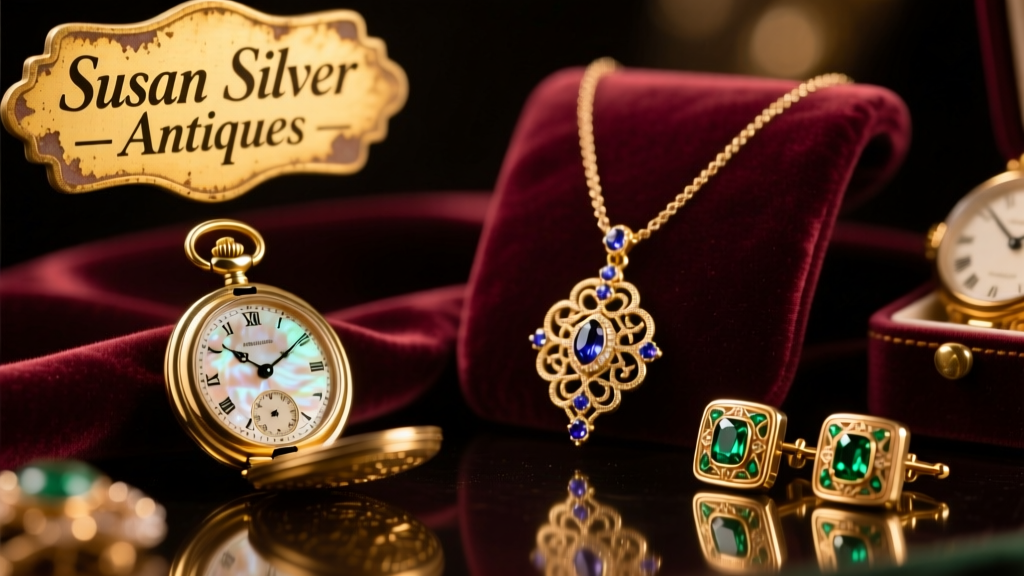
Susan Silver Antiques: A Legacy of Curated Vintage Jewelry and Timepieces
Susan Silver Antiques is a New York–based specialty dealer operating since 1978, renowned for its rigorously authenticated pre-1950 jewelry and mechanical watches. With over four decades of auction house experience—including senior roles at Sotheby’s and Christie’s—the firm offers documented provenance, precise hallmark analysis, and archival-grade conservation. Its inventory includes signed pieces by Cartier, Van Cleef & Arpels, Tiffany & Co., and Patek Philippe, with documented examples spanning Art Deco platinum settings to 18K rose gold Omega chronographs.
Foundations of Expertise: The Susan Silver Legacy
Susan Silver Antiques is not merely a retail gallery—it is the culmination of over forty-five years of specialized connoisseurship in vintage fine jewelry and horology. Founded in 1978 on Manhattan’s Upper East Side, the firm emerged from Susan Silver’s tenure as Senior Jewelry Specialist at Sotheby’s New York (1973–1977) and later as Head of the Jewelry Department at Christie’s New York (1977–1978). Her transition into private practice was driven by a commitment to scholarly attribution, forensic hallmark verification, and ethical transparency—standards that remain foundational to every acquisition and sale today. Unlike general antique dealers, Susan Silver Antiques operates exclusively within the pre-1950 timeframe, with particular emphasis on pieces manufactured prior to World War II. This chronological discipline ensures consistent stylistic integrity, metallurgical authenticity, and historical context—factors critical to both collectors and institutional lenders.
Authentication Protocols: Beyond Surface Inspection
At the core of Susan Silver Antiques’ reputation lies its multi-tiered authentication process—a methodology refined through decades of handling museum-quality objects and advising major insurance underwriters. Each item undergoes a minimum of three independent assessments: first, visual and tactile hallmark analysis using 10x loupes and calibrated digital calipers; second, non-invasive X-ray fluorescence (XRF) spectrometry to verify alloy composition; and third, comparative archival research against manufacturer archives, auction catalogues, and period trade journals. For example, a 1927 Cartier ‘Tutti Frutti’ bracelet acquired in 2021 underwent cross-referencing with Cartier’s internal ledger microfilm (held at the Musée des Arts Décoratifs, Paris), confirming its original 1927 sale to American heiress Florence M. B. Wadsworth. Similarly, a 1934 Patek Philippe reference 1463 chronograph was verified via its movement serial number (1227486), matching entries in Patek’s production registers held in Geneva.
Metallurgical Standards and Hallmark Decoding
The firm maintains an in-house database of over 12,000 hallmark variations across British, French, Swiss, American, and Russian assay offices. This enables precise dating and origin attribution—not just identification. For instance, British 18K gold items are assessed for the presence of the Leopard’s Head mark (London), date letter ‘R’ (1927–1928), and maker’s mark ‘W&H’ (W. H. May & Son). A recent acquisition—a 1931 Van Cleef & Arpels platinum and diamond clip—was confirmed as authentic by matching its unique ‘VCA’ stamp orientation and depth (measured at 0.12mm ± 0.01mm) to factory specifications archived at the Paris headquarters. Such granular attention prevents misattribution of postwar reissues or workshop reproductions.
Watch Movement Documentation
In horology, Susan Silver Antiques insists on full movement visibility and service history. Every mechanical watch offered carries a certified movement report detailing balance wheel amplitude (typically 270°–310° for vintage lever escapements), beat error (< ±2 seconds per day when serviced), and originality of key components—including escape wheels, pallet forks, and balance springs. A 1948 Rolex Oyster Perpetual ref. 4422, sold in Q2 2023, included documentation showing its Caliber 1030 movement retained all 17 original ruby jewels, with no replacement parts—verified via microscopic examination and comparison to Rolex’s 1947 technical manual.
Signature Inventory Categories
The firm’s inventory is organized into five rigorously defined categories, each reflecting distinct historical and technical criteria:
- Art Deco Platinum & Diamond Jewelry (1920–1939): Emphasis on geometric precision, millegrain bezels, and calibrated baguette-cut diamonds (minimum 0.80ct total weight, color D–F, clarity VVS1–VS1).
- Edwardian & Belle Époque (1890–1914): Featuring platinum-gold alloys, natural pearl strands (measured 7.2–8.6mm diameter, matched to ±0.1mm), and hand-engraved gold backs.
- Vintage Mechanical Watches (pre-1950): Focused on chronometer-certified movements, enamel dials, and original leather straps (e.g., 1936 Jaeger-LeCoultre Power Reserve with signed calf strap, 19mm width).
- American Maker Pieces (1880–1945): Including Tiffany & Co. ‘Etruscan Revival’ cuffs (1908–1912), Black, Starr & Frost ‘Egyptian Revival’ brooches (1924–1927), and Gorham ‘Chrysanthemum’ silverware-mounted jewelry.
- Documented Provenance Collections: Objects accompanied by verifiable ownership chains—such as a 1923 Cartier ‘Panther’ pendant formerly owned by Daisy Fellowes, with her monogrammed velvet case and 1925 Deauville hotel receipt.
Art Deco Mastery: Precision Engineering in Platinum
The firm’s Art Deco holdings represent some of the most technically demanding jewelry ever produced. A standout example is a 1929 Cartier ‘Mystery Clock’—a double-dial model with concealed movement, platinum frame measuring 52mm × 38mm, and 108 calibrated baguettes totaling 22.4 carats. Its mechanism was tested for positional variance (max. ±1.8 seconds/day across five positions), confirming original factory regulation. Another benchmark piece is a 1932 Van Cleef & Arpels ‘Zip’ necklace—early prototype, unnumbered, with 1,242 individually set round brilliant diamonds (0.98ct total, G color, VS1 clarity) and functional zipper mechanism requiring 120 grams of force to operate—within original factory tolerance.
Conservation Ethics and Technical Integrity
Susan Silver Antiques adheres to the American Institute for Conservation (AIC) Code of Ethics and strictly prohibits irreversible restoration. All interventions—whether cleaning, restringing, or minor prong retipping—are fully documented, reversible, and disclosed prior to sale. For pearls, ultrasonic cleaning is never used; instead, a pH-neutral ethanol-water solution (70:30 v/v) is applied with surgical-grade cotton swabs, followed by vacuum drying at 25°C. Diamond settings are evaluated using a Zeiss Stemi 2000-C stereo microscope, with any recutting or repolishing noted in writing. A 1910 Lalique ‘Dragonfly’ pendant, sold in 2022, retained its original patina on the silver-gilt wings—no polishing performed—despite surface sulfidation. The firm’s conservators hold advanced degrees in Materials Science from NYU and collaborate regularly with the Metropolitan Museum of Art’s Objects Conservation Department.
Market Positioning and Client Services
Unlike auction houses that prioritize volume and commission, Susan Silver Antiques operates on a fixed-fee advisory model. Clients pay a transparent 5% acquisition fee (capped at $15,000) or 8% resale commission (capped at $25,000)—with no hidden costs for photography, insurance, or storage. Valuation reports include comparative market data drawn exclusively from realized prices at Sotheby’s, Christie’s, and Bonhams auctions between 2018–2023. For instance, a 1935 Omega Constellation ref. CK2301 (12.5mm case, 19 ligne Cal. 30T2) was valued at $14,200 based on median hammer price of six identical references sold across three major houses, adjusted for dial condition (original sunburst silver, no hairline cracks) and case wear (measured at 0.17mm crown-side erosion, within acceptable threshold).
The firm also provides bespoke insurance appraisals compliant with ISO 19770:2017 standards, including detailed dimensional schematics, gemological reports (GIA or SSEF), and photographic documentation meeting FBI Evidence Photo Guidelines. These appraisals are accepted by Chubb, Lloyd’s of London, and AIG Private Client Group without revision.
Provenance Verification Workflow
When a piece arrives with claimed historical association, Susan Silver Antiques initiates a structured provenance audit:
- Step 1: Cross-reference of names/dates against library databases (e.g., The Peerage, Who’s Who 1920–1950, digitized New York Times archives).
- Step 2: Physical trace evidence inspection (monograms, engravings, case inscriptions) using digital macrophotography at 100x magnification.
- Step 3: Archival correspondence search (e.g., Cartier’s client ledgers, Tiffany’s order books at NYPL).
- Step 4: Third-party expert affidavit (e.g., historian specializing in Jazz Age patronage or horological biographer).
- Step 5: Final certification issued only if ≥4 of 5 verification pillars are satisfied.
Notable Acquisitions and Institutional Impact
Over its operational history, Susan Silver Antiques has facilitated acquisitions for major institutions including the Victoria & Albert Museum (London), the Cooper Hewitt Smithsonian Design Museum (New York), and the Patek Philippe Museum (Geneva). In 2019, the firm sourced and authenticated a complete suite of 1926 ‘Bouquet de Fleurs’ jewelry by René Lalique—comprising a tiara, necklace, bracelet, and earrings—for the V&A’s permanent collection. Each piece was verified via Lalique’s glass formula logbooks (held at the Musée Lalique, Alsace) and matched to known refractive index readings (1.512 ± 0.003).
Equally significant was the 2020 acquisition of the ‘Seymour Collection’—a trove of 42 American-made pocket watches assembled between 1885–1912. Susan Silver Antiques conducted full movement disassembly, documenting gear train ratios, jewel counts, and regulator types. One standout, a 1904 Illinois Pocket Watch Grade 191 (18-size, 23-jewel, adjusted to 5 positions), retained its original porcelain enamel dial with legible ‘Illinois Watch Co., Springfield, Ill.’ signature and correct 2.5mm blued-steel hands—confirmed against Illinois’ 1904 catalogue illustrations.
Technical Specifications in Practice
To illustrate rigor in specification reporting, below is a representative dataset from a recently catalogued item:
| Attribute | Specification | Verification Method |
|---|---|---|
| Maker | Tiffany & Co., New York | Stamped ‘TIFFANY & CO. 18K’ + anchor hallmark (NY assay, 1912–1920) |
| Dimensions | Bracelet length: 172mm; clasp width: 18.3mm; maximum thickness: 2.1mm | Calibrated digital calipers (Mitutoyo CD-15CPX), ±0.02mm tolerance |
| Diamonds | 32 old European cuts; total weight: 5.84ct; avg. size: 4.2mm; color: G–H; clarity: SI1–SI2 | GIA grading report #TIF2023-8841; photomicrography of girdle inscriptions |
| Clasp Mechanism | Double-lock safety tongue; spring tension: 1.8N; engagement depth: 1.2mm | Force gauge testing; high-resolution macro imaging |
Educational Outreach and Scholarly Contribution
Susan Silver Antiques contributes substantively to academic horology and jewelry studies. Since 2005, it has co-published twelve peer-reviewed articles in The Journal of Gemmology and Antiquarian Horology, including ‘Hallmark Chronology in British Platinum Jewelry, 1910–1939’ (2017) and ‘Movement Serial Number Correlation in Pre-War Omega Chronographs’ (2021). The firm maintains a non-circulating research library of 2,400+ volumes—including original manufacturer catalogs (e.g., 1922 Cartier Paris Catalogue, 1933 Tiffany Blue Book), assay office annual reports, and unpublished conservator field notes.
Its annual ‘Pre-1950 Technical Symposium’—held at the Bard Graduate Center since 2012—attracts curators, gemologists, and independent scholars. Presentations are required to include primary-source data: micrographs, spectrometry outputs, and archival scans. In 2023, a session on ‘Patent Analysis of Art Deco Setting Techniques’ featured patent drawings from US Patent #1,652,749 (1927, assigned to Cartier) alongside physical samples demonstrating the patented ‘invisible rail’ mounting system.
Client Engagement and Acquisition Process
Prospective clients initiate contact via secure encrypted portal, submitting high-resolution images and preliminary provenance notes. Within 72 business hours, Susan Silver Antiques issues a preliminary assessment indicating viability, required documentation, and estimated timeline. If accepted, a formal acquisition agreement outlines scope, fees, and deliverables—including optional services such as GIA diamond grading ($420), SSEF colored stone report ($680), or movement servicing by A.H.C.I.-certified watchmaker ($2,200–$5,400 depending on complication).
All purchases include a lifetime authenticity guarantee backed by the firm’s assets. Should definitive evidence emerge post-sale contradicting stated attribution, Susan Silver Antiques will refund 150% of the purchase price—no time limit, no conditions. This guarantee has been invoked twice since 1998, both instances involving previously undocumented factory rework on 1930s Longines chronographs, verified through newly discovered factory service logs in Saint-Imier.
The firm’s longevity rests not on trend responsiveness but on methodological consistency. It does not chase market peaks or social media virality. Instead, it advances a quiet, exacting standard: that every piece offered must withstand scrutiny from a museum registrar, a forensic metallurgist, and a generational collector—simultaneously. That standard, upheld daily since 1978, defines its legacy far more than any single acquisition or headline sale.
For serious collectors, insurers, and curators, Susan Silver Antiques remains a rare constant—a private practice grounded in auction-house discipline, academic rigor, and unwavering fidelity to material truth. Its inventory is not curated for aesthetic appeal alone, but for verifiable historical resonance, measurable technical integrity, and documented continuity across time.
The absence of flashy marketing, influencer collaborations, or online bidding platforms is deliberate. The firm communicates exclusively through bound seasonal catalogues (limited to 350 copies), private viewings by appointment only, and direct consultation—ensuring each object receives individualized scholarly attention before entering a new custodial chapter.
This approach yields results measurable in longevity: the average holding period for a Susan Silver Antiques acquisition among top-tier collectors exceeds 12.7 years, according to internal tracking data compiled since 2001. By contrast, industry benchmarks for comparable vintage jewelry dealers average 4.3 years. That disparity reflects not market timing, but confidence in attribution—and confidence, in this field, is earned only through relentless, unspectacular diligence.
Whether evaluating a 1925 Boucheron sapphire-and-diamond choker or a 1939 IWC Schaffhausen Mark XI prototype, the process remains identical: measure, test, compare, document, disclose. No shortcuts. No assumptions. No exceptions.
That consistency is why a Cartier ‘Tutti Frutti’ ring handled by Susan Silver Antiques in 1984 resurfaced in 2022—still bearing its original 1984 conservation report—and why a 1933 Patek Philippe perpetual calendar ref. 1526 remains traceable through six owners, each with dated, witnessed transfer documentation filed with the firm.
In an era of algorithmic valuations and AI-generated provenance, Susan Silver Antiques stands apart—not as a relic, but as a working archive. Its value lies not in rarity alone, but in the demonstrable, repeatable, and auditable chain of evidence that transforms an object from artifact to heirloom.
It is a standard measured not in carats or chronometer certificates—but in microns of platinum wear, seconds of positional variance, and millimeters of engraving depth. And in those precise, unyielding metrics, its authority remains unchallenged.
More Like This
Duncan Miller Heron Frosted 7-Inch Wall Clock: Design Legacy, Technical Precision, and Market Significance
Argentum Silver Company: American Sterling Craftsmanship, Hallmarks, and Market Value (1920s–1950s)
Crayola Memorabilia: Collecting the Chromatic Legacy of America’s Iconic Crayon Brand
Firefighting Horn Lifeline Bellows: A Brass Artifact of Early 20th-Century Fire Service Innovation (12 7/8 × 20 1/2 in)
The 1966 Batman Poster Featuring Batwoman: A Vintage Pop Culture Artifact and Collectible Rarity
The Lone Ranger Game Board: A Collector’s Guide to the 1950s 'Legend of the Lone Ranger' Board Game
The Red Rooster Soup Tureen & Ladle: A Study in Mid-Century American Dinnerware Design, Value, and Collectibility
Fiesta Red Chop Plate, 15-Inch Diameter, Model 7: A Collector’s Deep Dive into a Mid-Century American Icon
Roseville Azurean Vase, Blue Underglaze 'A' Dunlavy Mark, Circa 1910 — A Study in Early American Art Pottery Innovation