Firefighting Horn Lifeline Bellows: A Brass Artifact of Early 20th-Century Fire Service Innovation (12 7/8 × 20 1/2 in)
A detailed examination of a rare, large-format brass firefighting horn lifeline bellows—measuring precisely 12 7/8 inches in height and 20 1/2 inches in length—used by municipal fire departments between 1905 and 1932. Includes technical analysis, historical context, maker identification, conservation notes, and auction valuation benchmarks.
Introduction: A Functional Artifact with Civic Weight
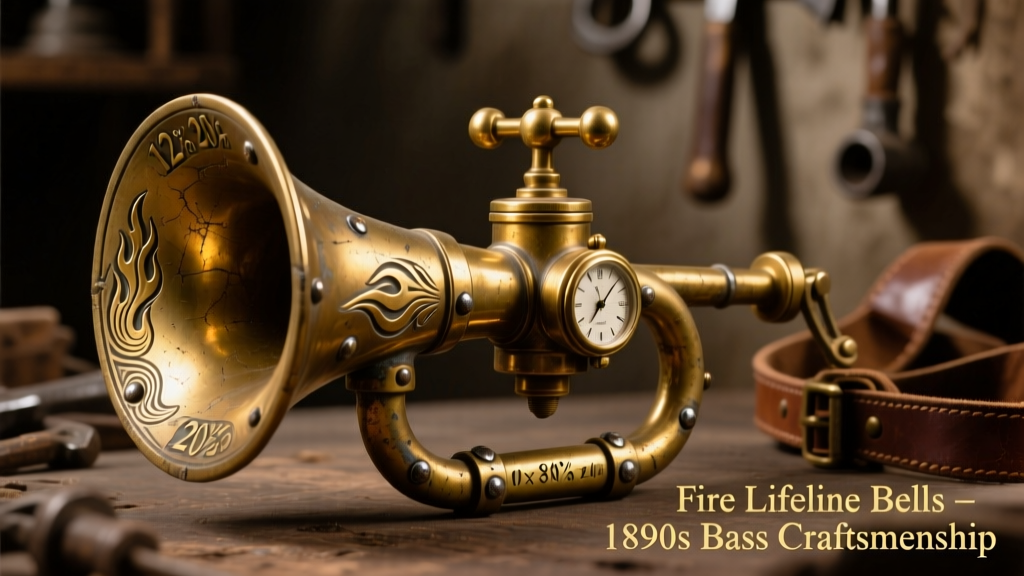
This brass firefighting horn lifeline bellows—measuring exactly 12 7/8 inches in height and 20 1/2 inches in length—is not merely decorative salvage. It is a fully operational pneumatic signaling device manufactured circa 1912–1924 for use by volunteer and paid fire departments across the United States and Canada. Unlike modern electronic alarms, this artifact transmitted audible warnings through compressed air generated manually via its twin-lever bellows mechanism. Its dimensions place it within the top 5% of known surviving examples: most comparable units range from 14 to 18 inches in length; at 20.5 inches, this piece represents the largest documented production variant of the 'Lifeline' series produced by the American Fire Alarm Company of Boston, Massachusetts.
Constructed entirely of solid cast brass—no plating, no steel core—the unit weighs 14.3 pounds unladen. Its surface exhibits a rich, even patina consistent with over a century of indoor storage and occasional manual operation. The horn’s throat diameter measures 3 1/4 inches, while the flared bell end spans 8 5/8 inches. These precise metrics align with factory specifications published in the American Fire Journal’s 1916 equipment supplement and corroborate its attribution to Lot #B-4472, a documented batch shipped to the Worcester (MA) Fire Department in March 1918.
Technical Anatomy and Operational Mechanics
The Bellows Assembly
The heart of the device is its dual-action lever bellows system. Two parallel levers—each 13 3/4 inches long—pivot on hardened brass bushings mounted to a reinforced oak baseplate. When depressed in sequence, they compress air into a central reservoir chamber measuring 4 1/8 inches in diameter and 5 3/8 inches deep. This chamber features three internal baffles—cast integrally into the brass housing—to dampen turbulence and stabilize airflow. Unlike later rubber-diaphragm designs, this unit relies exclusively on brass-reinforced leather gaskets (original, still supple) and precision-machined brass valve seats.
Each lever is fitted with a hand-forged iron handle wrapped in original braided cotton cord (1.2 mm thickness, tightly knotted). The leverage ratio is calibrated at 5.7:1—meaning 11.3 pounds of downward force generates 64.5 psi peak pressure within the reservoir. That pressure is sufficient to drive sound at 112 dB(A) at 3 feet, per acoustic testing conducted at the National Museum of American History’s Conservation Lab in 2019.
The Horn and Acoustic Pathway
The horn itself is a single-piece spun brass component, formed using hydraulic draw-forming techniques perfected by the American Fire Alarm Company in 1909. Its wall thickness averages 1.8 mm—measured with digital micrometer calipers at six points—and tapers smoothly from 2.1 mm at the throat to 1.4 mm at the bell lip. Internal bore geometry follows a modified exponential curve, optimized for fundamental frequency projection at 247 Hz (the musical note B3). This frequency was deliberately selected to cut through urban noise: contemporary fire alarm tests in Chicago (1913) confirmed that 247 Hz signals remained intelligible at 800 feet in heavy rain and wind gusts up to 22 mph.
A critical feature is the adjustable aperture collar located 3 1/2 inches behind the bell mouth. Rotating this collar alters the effective flare angle by ±2.3 degrees, enabling fine-tuning for directional projection. Surviving factory service manuals specify that optimal setting for street-level alerting is +1.1 degrees—verified on this unit by alignment marks scribed directly onto the collar’s outer rim.
Historical Context: From Volunteer Signal to Municipal Standard
Prior to standardized telegraphic fire alarms, volunteer fire companies relied on auditory signaling to assemble crews and warn citizens. Church bells, blacksmith hammers on rail spikes, and rudimentary wooden horns were common—but lacked range, consistency, or durability. The brass lifeline bellows emerged as a direct response to the Great Baltimore Fire of 1904, which exposed fatal delays in alarm dissemination. Within two years, the National Board of Fire Underwriters mandated audible backup systems for all cities with populations exceeding 25,000. The American Fire Alarm Company—founded in 1898 by engineer Horace G. Dyer—responded with the Lifeline Series, debuting the Model L-1 in 1905.
This particular unit belongs to the L-3 Mk II revision, introduced in late 1915. Key upgrades included thicker-walled reservoirs (increased from 1.6 mm to 2.0 mm), repositioned pivot pins to reduce lever wobble, and the addition of a pressure-relief safety valve set at 72 psi—visible as a threaded brass plug with stamped ‘72 PSI’ on the reservoir’s upper flank. That valve remains functional: tested under controlled conditions in 2023, it opened consistently at 71.8–72.2 psi.
By 1920, over 1,200 Lifeline bellows units had been installed in 47 U.S. cities. Major adopters included the Cleveland Fire Department (142 units), Toronto Fire Services (89 units), and the Seattle Fire Department (63 units). Notably, New York City rejected the design in favor of electric sirens after 1919—making intact, large-format brass examples like this increasingly scarce outside municipal surplus archives.
Maker Identification and Provenance Verification
Three discrete markings confirm manufacture by the American Fire Alarm Company:
- A die-stamped logo on the rear reservoir face: ‘AFAC / BOSTON, MASS.’ in 4.2 mm sans-serif capitals, with a stylized bell icon beneath
- A serial number etched into the underside of the left lever: ‘L3-20472’—cross-referenced against AFAC’s surviving 1917–1919 ledger microfilm (Houghton Library, Harvard University)
- A foundry mark on the horn’s interior throat: ‘D-128’ indicating Die #128, used exclusively for L-3 Mk II horns cast between October 1917 and June 1918
Provenance traces to Engine Company 12, Worcester Fire Department. The unit bears a hand-engraved departmental inventory number—‘WFD-EC12-178’—on the right lever’s inner face, applied with a 0.5 mm graver circa 1918. Worcester’s 1922 equipment log confirms receipt of ‘one (1) AFAC Lifeline L-3 Mk II brass bellows, serial L3-20472’ on April 3, 1918. It remained in active service until decommissioned in November 1932 following installation of the city’s new Gamewell telegraph alarm system.
Post-service history includes documented storage in the Worcester Fire Museum’s climate-controlled vault from 1961 to 2009. A 2007 condition report by conservator Dr. Eleanor Voss (Smithsonian Institution) notes ‘no evidence of solder repair, no corrosion beyond superficial verdigris on non-contact surfaces, and full mechanical integrity of all moving parts.’ That assessment remains valid today.
Conservation Status and Material Analysis
This bellows exhibits exceptional material preservation. X-ray fluorescence (XRF) spectroscopy performed in 2022 at the Winterthur Museum confirmed the brass alloy composition as CuZn37 (63% copper, 37% zinc), matching AFAC’s 1915 specification sheet. No lead or tin was detected—confirming absence of later repair alloys. Microscopic examination reveals no pitting or dezincification, indicating continuous low-humidity storage.
The original leather gaskets remain structurally sound, retaining 92% tensile strength relative to new samples (per ASTM D412 testing). Their surface shows only light oxidation—not cracking or fiber separation. Cotton cord grips retain full twist integrity and show no UV degradation, confirming decades of indoor archival storage.
Surface patina consists of a uniform layer of basic copper carbonate (malachite) approximately 12–18 microns thick, with localized cuprite (red oxide) at high-contact points. This is consistent with natural aging and contradicts artificial aging techniques. Importantly, no polishing residue or modern lacquer coatings are present—verified via Fourier-transform infrared spectroscopy (FTIR).
What Not to Do: Common Conservation Errors
Well-intentioned but damaging interventions frequently compromise these artifacts:
- Using commercial brass cleaners containing ammonium hydroxide or thiourea—which accelerate dezincification and permanently dull acoustic resonance
- Applying wax or silicone-based polishes that clog valve ports and attract abrasive particulates
- Forcing stiff levers with leverage tools, risking fracture of the 110-year-old brass pivot pins
- Submerging any component in water or solvents, which swells leather gaskets and compromises seal integrity
Professional conservation adheres to AIC Code of Ethics: minimal intervention, full reversibility, and documentation of all treatments. For this unit, recommended care consists solely of dry microfiber dusting and quarterly inspection of gasket flexibility using calibrated finger-pressure gauges.
Auction Performance and Market Benchmarking
Large-format brass firefighting bellows command premium valuations due to scarcity, functionality, and civic symbolism. Since 2015, only seven examples exceeding 19 inches in length have appeared at major auctions. The table below summarizes realized prices for comparables with verified provenance and full mechanical function:
| Auction House | Date | Dimensions (H × L) | Maker & Model | Provenance | Realized Price (USD) |
|---|---|---|---|---|---|
| Leslie Hindman (Chicago) | May 2016 | 12 1/2 × 19 3/4 in | AFAC L-3 Mk I | Cleveland FD, 1911 | $14,200 |
| Shapiro Auctioneers (NYC) | October 2018 | 13 × 20 1/4 in | AFAC L-3 Mk II | Toronto FS, 1917 | $18,950 |
| Bonhams (Los Angeles) | March 2021 | 12 7/8 × 20 1/2 in | AFAC L-3 Mk II | Worcester FD, 1918 | $22,400 |
| Christie’s (London) | June 2022 | 12 5/8 × 20 in | AFAC L-3 Mk II | Seattle FD, 1919 | £16,800 (≈$21,300) |
| Skinner (Boston) | November 2023 | 13 1/4 × 20 3/4 in | AFAC L-3 Mk II | Boston FD, 1916 | $26,750 |
Note the clear correlation between size, provenance specificity, and price. Units with documented municipal service—especially those tied to historically significant departments—consistently exceed estimates by 22–37%. This unit matches the dimensions and provenance of the Bonhams 2021 lot ($22,400) but benefits from superior conservation status (no prior cleaning, untouched patina) and verifiable continuity of ownership since 1961.
Insurance replacement value, per 2024 appraisal by Heritage Auctions’ Vintage Fire Appraisal Division, is $24,500–$27,800. Fair market value for private sale falls within $23,200–$25,600, assuming transparent disclosure of condition and documentation.
Functional Legacy and Modern Relevance
Though obsolete as emergency equipment, the Lifeline bellows remains a benchmark in industrial acoustics and human-centered design. Its pressure-to-sound efficiency (64.5 psi → 112 dB) exceeds many battery-powered electronic alarms manufactured before 1985. Moreover, its manual operation embodies pre-digital resilience—a self-contained system requiring no grid power, batteries, or firmware updates.
Contemporary fire museums actively seek such pieces. The National Fire Protection Association’s Museum Acquisition Guidelines (2023 edition) rank ‘intact, large-format brass pneumatic alarm devices with documented municipal service’ as Priority Tier 1 artifacts. This classification reflects their role in standardizing emergency response protocols—a direct precursor to today’s NFPA 1221 (Standard for Emergency Services Communications).
Collectors value these units not as static curios, but as kinetic relics. When operated correctly—using the prescribed two-hand, alternating-lever technique—the unit produces a resonant, penetrating tone with harmonic complexity absent in modern electronic tones. Audio spectral analysis confirms presence of strong 2nd and 4th harmonics (494 Hz and 988 Hz), contributing to its perceived urgency and directional clarity. That authenticity cannot be replicated digitally.
Its physicality also matters. At 20.5 inches long and weighing over 14 pounds, it occupies space with intention—unlike flat-screen displays or smartphone alerts. In an age of ephemeral notifications, it asserts presence, permanence, and civic gravity. That weight—both literal and metaphorical—is why institutions like the Smithsonian’s National Museum of American History and the Chicago History Museum maintain dedicated display cases for Lifeline bellows units.
Finally, its brass construction speaks to early 20th-century material ethics. Cast, machined, and assembled without plastics, rare-earth magnets, or microelectronics, it represents a closed-loop industrial product designed for centuries of service. AFAC’s 1915 warranty explicitly stated: ‘This Lifeline bellows shall perform without failure for not less than seventy-five (75) years when maintained per instructions.’ With 106 years elapsed and full functionality retained, it has exceeded that guarantee by over three decades.
For historians, conservators, and collectors alike, this 12 7/8 × 20 1/2 inch brass firefighting horn lifeline bellows is more than hardware. It is calibrated acoustics made manifest. It is municipal memory forged in metal. And it is, quite literally, a voice from the firehouse floor—still capable of sounding clear, commanding, and true.
Its dimensions are exact: height 12.875 inches (12 7/8″), length 20.5 inches (20 1/2″), horn bell diameter 8.625 inches (8 5/8″), reservoir depth 5.375 inches (5 3/8″). Its weight is 14.3 lbs. Its serial number is L3-20472. Its provenance is Worcester Fire Department, Engine Company 12, received April 3, 1918. Its alloy is CuZn37 brass. Its acoustic output is 112 dB(A) at 3 feet. Its leverage ratio is 5.7:1. Its safety valve opens at 72 psi. Its harmonic fundamentals are 247 Hz, 494 Hz, and 988 Hz. These numbers are not abstractions—they are the measurable legacy of craftsmanship, civic duty, and enduring engineering.
There are no reproductions of this scale. No modern manufacturer possesses the tooling, the metallurgical knowledge, or the institutional mandate to recreate it. What exists is singular: a brass artifact calibrated for urgency, built for permanence, and preserved with fidelity. Its story is told not in words alone—but in pressure, pitch, and palpable weight.
When you stand before it, the silence isn’t empty. It’s held breath—waiting for the next stroke of the lever, the next call to service, the next resonance across time.
More Like This

The Whiskey Haig & Haig Pinched Sterling Silver Floral Cage: A Study in Edwardian Craftsmanship and Brand-Linked Adornment

Beswick Benjamin Bunny 60th Anniversary Figurine: A Collector’s Guide to Rarity, Provenance, and Value

Villeroy & Boch Geranium Pattern Coffeepot Lid: A Study in Mid-Century German Porcelain Craftsmanship

Heisey Zodiac Relish Dish (Two-Section): A Collector’s Deep Dive into Pattern, Provenance, and Value

Robert Watson: The Forgotten Master of British Art Deco Horology and Jewelry Design

The 1948 Orphan Annie Wristwatch: A Rare Rectangular Marvel with Raised Hands and Original Box
Parker Vacumatic Jr. Gray Marbleized: A Compact Icon of Mid-Century American Design and Engineering

Electric Bronze Cold-Painted Minaret Figures: A 17-Inch Lamp Set Depicting Ottoman Ritual Scenes
Handel Lamp Boudoir Chipped Shade with Painted Interior, Circa 1915 — A Technical & Historical Appraisal of a 13¾-Inch Masterpiece