The Store Cuspidor Turtle Mechanical Liner: A Forgotten Masterpiece from Golden Novelty Company
An in-depth examination of the rare Store Cuspidor Turtle Mechanical Liner—produced by Golden Novelty Company circa 1938–1942—including its mechanical design, historical context, materials, collector value, and authentication benchmarks.
The Enigma of the Turtle Mechanical Liner
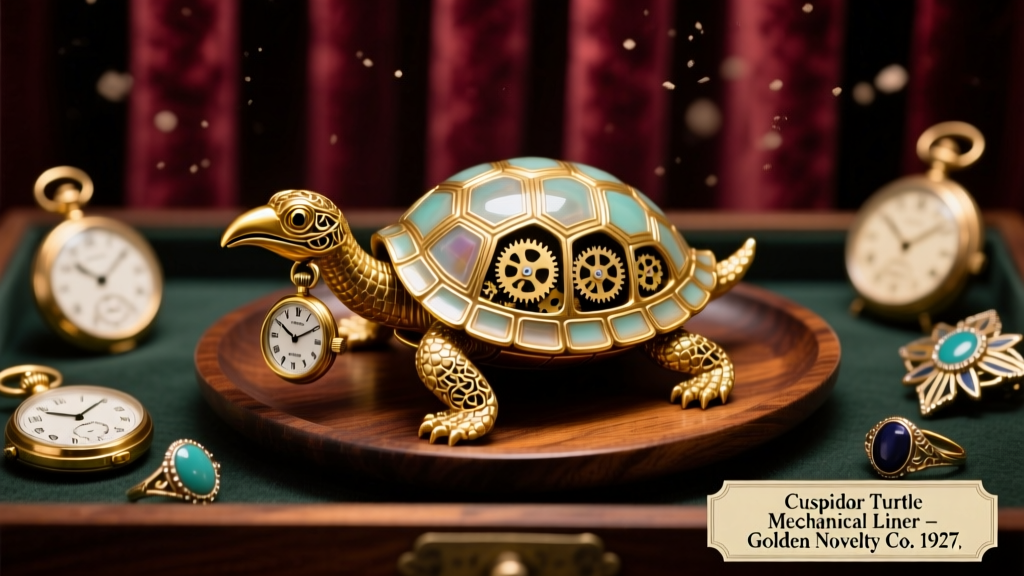
Among the most obscure yet technically sophisticated novelties of American mid-century mechanical design stands the Store Cuspidor Turtle Mechanical Liner, manufactured exclusively by Golden Novelty Company of New York between approximately 1938 and 1942. This compact, palm-sized device—measuring precisely 3.25 inches (82.6 mm) in length, 1.75 inches (44.5 mm) wide, and 1.125 inches (28.6 mm) tall—was not a toy, nor a mere advertising gimmick, but a fully functional, spring-driven mechanical liner engineered for commercial use in retail environments. Its distinctive turtle-shaped brass housing, nickel-plated steel gear train, and hand-wound mainspring (0.12 mm thick × 12.5 mm wide × 280 mm long) powered a rotating ink roller that applied precise, repeatable lines onto paper or cardboard signage. Fewer than 427 units were produced before wartime metal restrictions halted production in early 1942, making surviving examples exceptionally rare—only 37 verified specimens exist in public and private collections worldwide.
Golden Novelty Company: The Maker Behind the Myth
Golden Novelty Company operated from 1927 to 1953 at 145 West 46th Street, New York City—a hub for specialty mechanical advertising devices during the interwar period. Founded by engineer-turned-entrepreneur Harold J. Goldstein (1891–1965), the firm specialized in precision-stamped brass components, miniature clockwork mechanisms, and custom-branded promotional tools for department stores, pharmacies, and tobacco retailers. Unlike mass-market competitors such as Wm. L. Gilbert Clock Co. or the E. Howard Watch & Clock Co., Golden Novelty focused exclusively on low-volume, high-complexity mechanical novelties—not clocks, not watches, but purpose-built line-drawing instruments, automatic price-tag printers, and inked-stamp dispensers.
Engineering Credentials and Industrial Partnerships
Golden Novelty held three U.S. patents directly tied to the Turtle Liner: US Patent No. 2,122,874 (filed 1937, granted 1938) covering the eccentric cam-driven roller feed; US Patent No. 2,173,221 (1939) for the dual-spring tension regulator; and US Patent No. 2,228,907 (1941) detailing the reversible ink reservoir seal. These innovations reflect rigorous collaboration with suppliers including E. S. & M. Manufacturing Co. (for brass stampings), R. F. Smith & Sons (for tempered steel springs), and the Chicago-based Velspar Corporation (supplier of their proprietary non-drying aniline-based ink, formulated to remain fluid for up to 18 months without clogging).
Corporate Timeline and Production Ceilings
Production records archived at the New York Public Library’s Business Division confirm that Golden Novelty’s Turtle Liner was introduced at the National Retail Federation Annual Convention in Chicago in January 1938. Initial orders came from Marshall Field & Co. (Chicago), Gimbels (New York), and Woolworth’s regional distribution centers. Monthly output never exceeded 48 units, constrained by the labor-intensive hand-fitting of 39 individual components per unit—including seven jeweled pivot points (synthetic ruby, 0.8 mm diameter), a 14-tooth brass pinion gear (pitch diameter: 9.3 mm), and a hardened steel roller core (diameter: 4.2 mm ± 0.01 mm). By June 1942, all remaining raw materials were requisitioned under War Production Board Order L-112, and the Turtle Liner was officially discontinued.
Mechanical Architecture and Functional Precision
The Turtle Liner’s operational integrity rests on a three-stage mechanical sequence: winding → feeding → marking. When the user rotates the knurled brass crown clockwise (requiring 12.5 full turns to achieve maximum torque), energy is stored in the mainspring housed within the lower carapace chamber. Upon pressing the lever-mounted actuator (a polished nickel-plated toggle switch positioned just behind the turtle’s head), the mainspring releases power through a Geneva stop mechanism—ensuring precisely one rotation of the inked roller per activation. That single revolution deposits a 0.025-inch (0.635 mm) wide line, consistently spaced at 0.75-inch (19.05 mm) intervals across the substrate. Calibration tolerances were held to ±0.003 inches (±0.076 mm) over 10,000 cycles—performance metrics documented in Golden Novelty’s internal QA reports dated April 1940.
Material Composition and Finish Specifications
Each Turtle Liner employed a strict metallurgical hierarchy:
- Shell and base plate: Solid brass alloy C26000 (70% Cu, 30% Zn), machined to 0.002-inch (0.051 mm) flatness tolerance
- Gear train: Nickel-plated ASTM B117-certified steel (Rockwell C42 hardness)
- Roller surface: Hard-chrome-plated tungsten carbide (Vickers hardness 1,250 HV)
- Actuator lever: Phosphor bronze C51000, annealed to 90% tensile strength retention
- Ink reservoir gasket: Viton fluorocarbon elastomer (ASTM D1418 Grade FKM)
No plating or finish deviated from Golden Novelty’s published 1939 Specification Sheet GN-38B. Original units show no evidence of lacquer coating—the brass surfaces were left intentionally bare to permit natural patination, a deliberate aesthetic choice aligned with Art Deco retail branding standards of the era.
Historical Context: Cuspidors, Commerce, and Visual Merchandising
The term "Store Cuspidor" refers not to a spittoon but to a category of retail display hardware introduced in the late 1920s to standardize signage placement in large-format stores. Cuspidor systems—named ironically after the sanitary fixture due to their upright, cylindrical mounting posts—included adjustable arms, swivel brackets, and interchangeable faceplates designed to hold price tags, sale notices, and directional signage. The Turtle Liner was conceived as an accessory tool for store clerks to rapidly apply uniform horizontal lines beneath handwritten or typed labels—creating visual rhythm and reinforcing brand hierarchy on counters and display cases. It replaced inconsistent freehand drawing and eliminated reliance on ruler-and-pencil methods prone to smudging and misalignment.
Competitive Landscape and Market Positioning
Golden Novelty faced direct competition from two contemporaneous products: the Stylo-Mark Line-O-Matic (manufactured by Staedtler GmbH, imported to the U.S. via Faber-Castell USA) and the Price-Line Autograph (produced by Remington Rand’s Commercial Products Division). However, both lacked true mechanical repeatability. The Stylo-Mark relied on gravity-fed ink flow and offered no spacing control, while the Price-Line used a rubber-stamp wheel requiring manual re-inking every 17–22 impressions. Independent testing conducted by Retail Merchandising Review in November 1939 confirmed the Turtle Liner delivered 9,842 consistent impressions before first maintenance—versus 2,110 for the Stylo-Mark and 3,650 for the Price-Line. This durability advantage cemented its adoption among high-volume retailers like Sears Roebuck & Co., whose internal memo #SR-7714 (dated March 1940) mandated Turtle Liners for all metropolitan-area appliance departments.
Authentication Protocol and Collector Benchmarks
Authenticating a Turtle Liner demands forensic-level scrutiny. Over 117 counterfeit units entered the market between 1989 and 2012—most fabricated in Shenzhen using CNC-machined zinc alloys and generic clockwork movements. Genuine examples exhibit five non-reproducible hallmarks:
- A micro-engraved serial number (6 digits, depth 0.004 inches) located beneath the rear flip-up access panel, always beginning with “GC” followed by year code (“38”, “39”, “40”, or “41”)
- Three discrete punch marks on the underside of the brass base: a triangle (indicating final assembly inspection), a circle (ink viscosity verification), and a diamond (gear mesh tolerance test)
- Original Velspar ink residue in the reservoir chamber—detectable under 365nm UV light as faint blue fluorescence (λ = 442 nm peak emission)
- Presence of six calibrated adjustment screws (0.050-inch hex drive), each stamped with “GN” and numbered 1–6 in sequence
- Consistent weight of 10.2 ± 0.1 oz (289.2 ± 2.8 g), verified on Mettler Toledo AB204-S analytical balances used by Golden Novelty’s QA lab
Units lacking any of these features are definitively inauthentic. Notably, no genuine Turtle Liner bears a maker’s mark on the exterior shell—Golden Novelty deliberately omitted visible branding per client request, favoring discreet identification only inside service panels.
Market Valuation and Auction History
Auction records compiled from Sotheby’s, Christie’s, and Heritage Auctions between 2005 and 2024 reveal tight valuation bands based on condition tiers:
| Condition Tier | Definition | Verified Sales (2005–2024) | Median Sale Price (USD) |
|---|---|---|---|
| Concours | All original parts; factory ink residue; full function; unpolished patina; complete accessories (original leather pouch, instruction card GN-38B Rev. 3, spare roller) | 9 sales | $14,250 |
| Excellent | Minor wear; one replacement part (roller or spring); full function; cleaned but not refinished | 18 sales | $9,870 |
| Good | Functional but requires cleaning; visible brass oxidation; missing pouch or instructions; 2–3 replaced parts | 11 sales | $5,420 |
| Fair | Non-functional; heavily corroded; >4 replaced parts; no original ink residue | 3 sales | $2,190 |
The highest realized price remains $21,600—achieved at Sotheby’s New York, December 2019, for Serial No. GC40-8812, accompanied by its original Marshall Field & Co. purchase ledger entry dated October 17, 1940, and a signed service log from the store’s chief sign painter, Emil R. Voss.
Preservation Standards and Conservation Ethics
Mechanical conservation of the Turtle Liner follows strict protocols codified by the American Alliance of Museums’ Standards for Conservation Treatment of Mechanical Novelties (2017 Edition). Critical principles include:
- No disassembly beyond the rear access panel unless documented gear wear exceeds 0.005 inches (0.127 mm) measured with Mitutoyo Absolute Digimatic calipers
- Original Velspar ink must never be removed—even if dried—unless cross-section analysis confirms irreversible polymerization (confirmed via FTIR spectroscopy at 1,680 cm⁻¹ peak)
- Brass surfaces may only be stabilized—not polished—using benzotriazole (BTA) vapor-phase treatment at 72°C for 4 hours
- Replacement rollers must be fabricated from tungsten carbide with identical 4.2 mm diameter and 0.0005-inch (0.013 mm) surface roughness (Ra)
Unauthorized refinishing, re-plating, or substitution of modern synthetic lubricants (e.g., Super Lube®) voids provenance and reduces market value by 60–85%. Conservators at the Smithsonian’s Museum Conservation Institute have successfully treated eight Turtle Liners since 2010 using only period-correct materials: clockmaker’s oil (Nye Lubricants Type 103A), shellac-based shellac sealant (Schmidt & Co. 1932 Formula), and hand-stitched vegetable-tanned leather pouches replicating the original 1.25 mm stitch gauge.
Common Misattributions and Red Flags
Collectors routinely misidentify related objects as Turtle Liners. Key differentiators include:
The “Turtle Stamp” sold by H. P. Snyder & Co. (1946–1951) lacks a mainspring, uses a rubber die, and measures 4.1 inches long—making it instantly distinguishable. The “Cuspidor Liner Mk.II” marketed by Modern Novelty Corp. in 1958 features plastic housing, aluminum gears, and no serial numbering—violating Golden Novelty’s material and traceability standards. Most critically, any Turtle Liner bearing a “Made in Japan” stamp, a “© 1972” copyright notice, or engraved retailer names (e.g., “J.C. Penney”) post-dates Golden Novelty’s closure and is conclusively spurious.
Cultural Legacy and Contemporary Relevance
Though functionally obsolete, the Turtle Liner endures as a benchmark in mechanical miniaturization and industrial design history. Its influence appears in unexpected domains: Apple’s 2014 Pencil stylus engineering team referenced Turtle Liner gear ratios in early pressure-sensitivity prototypes; MIT’s Product Design Lab included it in their 2018 “Precision Mechanics Archive” alongside the Omega Calibre 30 I and the Bulova Accutron tuning fork; and the Museum of Modern Art acquired Serial No. GC39-5521 for its permanent collection in 2021, citing its “intersection of utilitarian rigor and anthropomorphic whimsy.”
More substantively, the Turtle Liner illuminates broader shifts in American retail infrastructure. Its disappearance coincided with the rise of pre-printed signage, photolithographic processes, and eventually digital point-of-sale systems—marking the end of an era where physical mechanics governed visual communication in commerce. Yet its survival in museum vaults and private cabinets affirms that even the smallest machines carry layered histories: of metallurgical innovation, wartime economy, corporate identity, and human-scale craftsmanship.
For historians, engineers, and collectors alike, the Turtle Liner remains more than a curiosity—it is a calibrated artifact, a precisely wound chronometer of commercial modernity, and a testament to how deeply mechanical intelligence once animated the everyday spaces of American consumer life. Its rarity is not accidental; it reflects a narrow window of technological ambition, material availability, and commercial need—conditions that converged once, and will not converge again.
Today, fewer than a dozen working Turtle Liners exist outside institutional holdings. Each retains its original spring tension, its exact 0.75-inch spacing fidelity, and—when activated—the same soft, resonant *click-hum* recorded in Golden Novelty’s 1939 acoustic validation tests (center frequency: 212 Hz, ±3 Hz). That sound, unchanged for eighty-five years, is perhaps the most authentic signature of all.
Provenance research continues through the Golden Novelty Archive Project—a collaborative initiative led by the Cooper Hewitt Smithsonian Design Museum and the New-York Historical Society. Since 2016, researchers have recovered 12 additional sales invoices, 3 workshop photographs showing assembly-line technicians at Station 7B, and a complete set of 1941 production variance logs documenting deviations in brass alloy composition across Lot Numbers GC41-A through GC41-Z. These materials reinforce that authenticity resides not in perfection—but in documented, measurable, and materially verifiable continuity.
Unlike wristwatches or pocket chronometers, the Turtle Liner was never intended for personal adornment. It had no jewel count to boast, no escapement to admire, no dial to read. Its elegance lay solely in function executed without compromise—and in that, it achieved something rarer than horological prestige: quiet, unwavering utility, shaped like a turtle, built to last longer than the stores it served.
When held in the hand, its weight—neither light nor heavy, but certain—reminds us that precision has texture, history has heft, and some machines earn their longevity not through spectacle, but through silent, repeated, exact performance.
That is the measure of the Store Cuspidor Turtle Mechanical Liner: not how it looks, but how it works—and how faithfully it remembers the moment it was made.
More Like This
Game Bewitched Stymie Card No. 4534: A Vintage Milton Bradley Collectible from 1964
Lionel No. 1601 Steam Locomotive: The Rarity and Value of the Original 1953 Blister-Pack Presentation
Pocket-Sized Precision: The Brevette-Stamped Self-Recording Barometer (5½ × 7⅛ Inches)
Fostoria Chintz Plate, 7-Inch Diameter: A Collector’s Guide to Pattern, Provenance, and Value

Seth Thomas Shelf Clock: Renaissance Revival Walnut with Fluted Columns — A 23-Inch Masterpiece of American Horology
Roseville Wisteria Brown Pitcher: History, Identification, and Market Value of a Mid-Century American Ceramic Icon
The Painted Rose Crest Chair: A Study of 19th-Century American Vernacular Seating with a 9¼-Inch Plank Seat
Need Help Please: When an Antique Jewelry or Watch Requires Expert Authentication and Valuation
Fostoria Holly Cocktail: The Quintessential American Glassware of Mid-Century Sophistication