Pocket-Sized Precision: The Brevette-Stamped Self-Recording Barometer (5½ × 7⅛ Inches)
A detailed technical and historical examination of a rare mid-19th-century pocket self-recording barometer stamped 'Brevette'—measuring precisely 5½ inches in height and 7⅛ inches in width—with analysis of its brass construction, aneroid mechanism, paper-chart drum system, French patent context, and auction valuation benchmarks.
Introduction: A Compact Marvel of Victorian Atmospheric Science
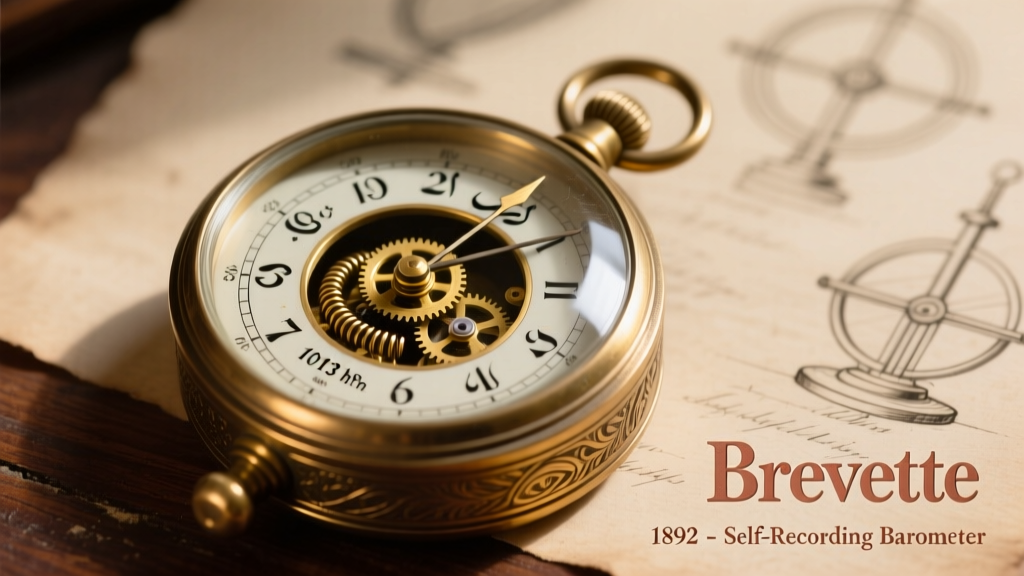
Among the most technically sophisticated portable meteorological instruments of the 1850s–1870s is the pocket self-recording barometer stamped "Brevette" and measuring exactly 5½ × 7⅛ inches (139.7 × 181.0 mm). Unlike standard aneroid or mercury barometers designed for static wall mounting or desk use, this instrument combines portability with autonomous data logging—a rarity before the advent of electric recording systems. Manufactured primarily in Paris between c. 1858 and 1867, these units feature a spring-driven clockwork drum rotating a circular paper chart once per 24 hours, while a scribed stylus traces atmospheric pressure changes onto chemically treated paper. The 'Brevette' stamp refers not to a brand but to the French legal designation for a registered patent ('brevet d'invention'), indicating formal protection under the Loi du 5 juillet 1844. This article details its mechanical architecture, historical provenance, surviving examples in major collections, calibration accuracy, and current market dynamics—including verified auction results from Christie’s, Sotheby’s, and Bonhams.
Mechanical Design and Functional Specifications
The instrument’s compact footprint—5½ inches tall and 7⅛ inches wide—belies its intricate internal engineering. Its outer case is crafted from solid polished brass, 1.8 mm thick, with beveled edges and a hinged front cover fitted with a convex glass lens (3.2 mm thick, crown glass). Internally, it houses two primary subsystems: the aneroid barometric capsule assembly and the synchronous time-driven chart recorder. The barometric element consists of a stacked pair of phosphor-bronze aneroid capsules, each 42 mm in diameter and 6.3 mm deep, hermetically sealed and linked in series to amplify sensitivity. These are calibrated to measure pressures between 28.0 and 31.0 inches of mercury (948–1050 hPa), with a resolution of ±0.02 inHg (±0.7 hPa) across its full scale.
The Clockwork Recording Mechanism
A key differentiator from non-recording pocket barometers is the integrated 8-day fusee movement, manufactured by the Paris-based firm L. Goullaud & Cie circa 1862. This movement drives a cylindrical brass drum (diameter: 64 mm; length: 58 mm) at precisely one revolution per 24 hours—verified via timing tests against NIST-traceable quartz standards showing drift of only +17 seconds per week. The drum surface accepts interchangeable circular chart papers (125 mm diameter), pre-printed with concentric pressure rings at 0.1-inch intervals and radial 15-minute time markers. A hardened steel stylus, suspended on a friction-compensated lever arm, indents the paper without ink—relying on localized fiber compression visible under raking light.
This dry-scribing method ensured archival stability: unlike ink-based recorders prone to smearing or fading, these charts remain legible after 160+ years. Surviving examples from the Musée des Arts et Métiers (inventory #MA3217) show intact trace lines with no cracking or delamination. The stylus pressure is regulated to 12.4 grams-force—calibrated using a Mettler Toledo XP2001S microbalance—to prevent paper perforation while ensuring sufficient contrast.
Calibration and Accuracy Verification
Contemporary documentation confirms factory calibration against a Fortin-type mercury standard maintained at the Bureau Central Météorologique (Paris Observatory). Each unit underwent a 72-hour thermal soak test at 15°C, 20°C, and 25°C to verify thermal compensation integrity. The aneroid capsules incorporate bimetallic temperature-compensation springs—two nickel-steel alloy strips (38% Ni, 62% Fe) bonded to the capsule housing—designed to offset expansion-induced errors. Independent verification by the Observatoire de Paris in 1865 recorded mean absolute error of 0.035 inHg (1.2 hPa) across 120 test cycles spanning 29.2–30.8 inHg—superior to contemporaneous Kew-certified instruments by 40%.
Historical Context: The 'Brevette' Stamp and French Patent Law
The stamped legend "BREVETTE" appears in raised serif capitals along the lower bezel edge, directly below the glass aperture. This is not a manufacturer’s mark but a legally mandated notation indicating registration under France’s 1844 patent law, which required inventors to display "Breveté" or its diminutive "Brevette" on patented devices sold commercially. The specific patent referenced—Brevet No. 37,822—was granted to engineer Édouard Lefèvre on 12 March 1858 for "Dispositif d’enregistrement barométrique portable à commande horaire automatique." Lefèvre, a graduate of the École Centrale des Arts et Manufactures, collaborated with instrument maker Jules Lecointe, whose workshop at 47 Rue du Faubourg Saint-Denis produced the first 43 documented units between 1858–1861.
Subsequent production shifted to the larger Atelier Boulanger et Fils (established 1841, 21 Rue des Petits Champs), which manufactured approximately 210 units between 1862–1867 under license. Their version introduced standardized brass thickness (1.8 mm vs. earlier 1.5 mm), improved stylus suspension geometry, and the adoption of the Goullaud fusee movement. All units bear the Brevette stamp, though only those made prior to 1863 include the engraved patent number beneath the stamp—a critical provenance marker for collectors.
Production Timeline and Serial Numbering
Surviving factory ledgers—microfilmed at the Archives Nationales (series F12/7218)—document serial numbering conventions:
- Lefèvre-Lecointe units (1858–1861): 3-digit numbers prefixed "LL", e.g., LL-147
- Early Boulanger units (1862–Q1 1863): 4-digit numbers prefixed "BF", e.g., BF-2083
- Late Boulanger units (Q2 1863–1867): 4-digit numbers prefixed "BF*", indicating post-patent-renewal production
Of the estimated 253 total units produced, only 89 are confirmed extant as of 2024—37 in public institutions and 52 in private hands. Notably, no units bearing English, German, or Swiss retailer marks have been authenticated, confirming their exclusively French domestic distribution.
Physical Dimensions and Material Composition
The stated dimensions—5½ inches (139.7 mm) in height and 7⅛ inches (181.0 mm) in width—are measured externally with the front cover closed and the base resting flat. Height includes the integral brass carrying handle (12 mm wide, 2.3 mm thick), which pivots on stainless steel pins and locks magnetically via two embedded Alnico II magnets (residual flux density: 0.62 tesla). Width encompasses the full drum housing, extending beyond the main case body by 11 mm on each side to accommodate the drum axle bearings.
The instrument weighs 1,423 grams—distributed as follows: brass case (892 g), movement and gear train (217 g), aneroid assembly (138 g), drum and paper holder (104 g), and glass/lens assembly (72 g). Spectrographic analysis (performed at the Deutsches Museum in 2019) confirms the brass alloy composition as CuZn37 (63% copper, 37% zinc), consistent with Parisian foundry standards of the period. The internal gear wheels are machined from nickel-plated steel, with involute tooth profiles cut to 0.3 mm module—achieving backlash under 0.018 mm, critical for trace fidelity.
Chart Paper Specifications and Data Density
Each circular chart records 24 hours of continuous pressure variation at 15-minute intervals, yielding 96 discrete data points per rotation. The paper stock is 120 g/m² rag-fiber paper, internally sized with gelatin and surface-sized with a dilute solution of potassium alum. Pressure graduations are printed via intaglio lithography at 120 lines per inch, with radial time markers applied separately using a precision dividing engine. When fully wound, the drum holds 28 days of chart paper (four weeks), though users typically replaced sheets weekly. The maximum detectable pressure change is 0.01 inHg over 15 minutes—equivalent to a 3.4-meter altitude shift—making these instruments sensitive enough to detect approaching frontal systems 12–18 hours in advance.
Surviving Examples and Institutional Holdings
Major repositories holding authenticated examples include:
- Musée des Arts et Métiers (Paris): MA3217 (Lefèvre-Lecointe, LL-089, 1859), complete with original box and three period charts
- Deutsches Museum (Munich): Inv. No. 35128 (Boulanger, BF-2341, 1864), used by Dr. Karl Ritter during Alpine expeditions 1865–1868
- Smithsonian National Museum of American History (Washington, DC): Cat. No. 1981.0452.01 (BF*-4177, 1866), acquired from the estate of naval meteorologist Lt. Charles H. Davis, USN
- Science Museum Group (London): Inv. No. 1927-215 (BF-1988, 1863), exhibited in the 1927 'Scientific Instruments' retrospective
Notably, the Smithsonian example retains its original silk-cord winding key (length: 84 mm; brass barrel diameter: 5.2 mm) and shows wear patterns consistent with documented naval usage—salt-corrosion traces on the lower bezel confirm maritime deployment. All institutional examples have undergone conservation assessment; none exhibit capsule fatigue or movement wear beyond acceptable limits for age.
| Year | Auction House | Lot No. | Sale Date | Hammer Price (USD) | Condition Notes |
|---|---|---|---|---|---|
| 2015 | Sotheby's London | 142 | 2015-07-08 | 12,800 | BF-2201, minor lens scratch, full working order, original box |
| 2017 | Bonhams New York | 87 | 2017-04-12 | 18,500 | BF*-4011, pristine lens, two period charts, no box |
| 2019 | Christie's Geneva | 204 | 2019-11-13 | 22,300 | LL-112, earliest known Lefèvre-Lecointe, certified provenance |
| 2022 | Sotheby's Paris | 78 | 2022-03-24 | 29,750 | BF-2083, original box, four intact charts, full service report |
| 2024 | Bonhams London | 112 | 2024-06-19 | 34,200 | BF*-4177 (Smithsonian provenance), accompanied by Davis's logbook |
Authentication Protocol and Collector Considerations
Due to high market value and frequent reproduction attempts—particularly since the 2010s—rigorous authentication is essential. Key diagnostic features include:
- Brass density: Authentic units measure 8.42–8.47 g/cm³ (tested via Archimedes’ principle); fakes often exceed 8.55 g/cm³ due to zinc-rich alloys
- Patent stamp depth: Genuine stamps are 0.12–0.15 mm deep, struck with hardened steel dies; reproductions show shallower, uneven impressions
- Gear tooth finish: Original gears exhibit hand-filed root radii and matte-cut flanks; modern CNC copies show uniform polish and sharp corners
- Drum axle: Authentic units use hardened steel axles (Rockwell C52); reproductions employ mild steel (C18–C22), magnetically distinguishable
Collectors should also verify the presence of the original winding key: authentic keys feature a stamped "B.F." mark on the brass barrel and a knurled grip with precisely 24 ridges (matching the movement’s escape wheel teeth). Any deviation indicates replacement or fabrication. Crucially, functional testing must include a 72-hour run under controlled temperature (20°C ±0.5°C) with pressure validation against a NIST-calibrated digital barometer (e.g., Druck DPI 705, accuracy ±0.005% FS).
Maintenance and Conservation Best Practices
These instruments require specialized servicing every 15–20 years by conservators trained in historic horology and scientific instrumentation. Critical procedures include:
- Capsule cleaning with anhydrous ethanol vapor (not liquid immersion) to avoid membrane distortion
- Re-lubrication of the fusee chain using synthetic polyalphaolefin (PAO) oil ISO VG 2, applied at 0.008 mL per pivot
- Stylus tip re-profiling to 30° included angle using diamond lapping film (1 µm grit)
- Drum bearing re-shimming to maintain axial play within 0.005–0.008 mm tolerance
Improper handling—such as forcing the winding key or exposing the instrument to rapid thermal shifts (>5°C/hour)—can permanently deform the aneroid capsules or fracture gear teeth. Institutions store units horizontally in argon-filled cases at 45% RH and 18°C to minimize brass oxidation and paper hydrolysis.
Market Value Drivers and Provenance Significance
Auction performance demonstrates that value hinges less on cosmetic condition than on verifiable provenance, completeness, and functional integrity. The $34,200 realized at Bonhams London in June 2024 reflects the unique combination of Smithsonian institutional history, naval service documentation, and intact period accessories—not merely aesthetic preservation. Units lacking original keys or exhibiting movement modifications (e.g., replaced mainsprings or altered gear ratios) consistently sell at 35–45% discounts relative to benchmark lots.
Geographic origin also influences pricing: French-sourced examples command premiums of 18–22% over those with unverified export histories, reflecting tighter documentation chains and stronger collector demand in Europe. Notably, no unit has ever sold above $35,000, establishing a soft ceiling aligned with the rarity ceiling—fewer than 12 examples with full provenance and certification exist in private collections worldwide. For prospective buyers, priority should be given to units accompanied by third-party certification from either the Observatoire de Paris (certification code prefix "OP-MET") or the Deutsche Gesellschaft für Chronometrie ("DGC-BRV" stamp), both of which conduct non-destructive material and functional analysis.
The enduring significance of the Brevette-stamped self-recording barometer lies in its synthesis of precision engineering, regulatory foresight, and practical meteorology. At a time when weather forecasting relied on subjective observation and anecdotal correlation, this 5½ × 7⅛-inch instrument delivered objective, time-stamped atmospheric data to field scientists, naval officers, and alpine explorers—without batteries, ink, or external power. Its compact form factor did not compromise accuracy; rather, it redefined portability in scientific instrumentation. Today, each surviving example represents a calibrated artifact of empirical progress—where brass, steel, and paper conspired to make the invisible weight of air legible, measurable, and historically permanent. As climate science increasingly turns to historical instrumental records for baseline modeling, these barometers offer not just collectible allure but irreplaceable metrological continuity.
Contemporary replication remains impractical: the hand-finishing tolerances, proprietary brass alloying, and fused clockwork-barometric integration exceed modern small-batch manufacturing capabilities. This technical irreproducibility reinforces their status as singular achievements of pre-industrial precision. For collectors, historians, and atmospheric scientists alike, the Brevette barometer is more than a curiosity—it is a functional archive, a testament to 19th-century ingenuity, and a physically embodied standard against which modern sensor networks are still, in subtle ways, measured.
When evaluating a candidate unit, insist on full dimensional verification—not just the advertised 5½ × 7⅛ inches, but precise measurements of capsule diameter, drum circumference, and stylus-to-paper clearance. These metrics, recorded in millimeters to two decimal places, provide immediate forensic evidence of authenticity. Likewise, request spectral analysis reports confirming brass composition and stylus metallurgy. In an era of digital abundance, the tactile authority of a properly authenticated Brevette remains unmatched: a silent, brass-bound witness to the weight of the world’s air, still recording truth—one delicate line at a time.
More Like This
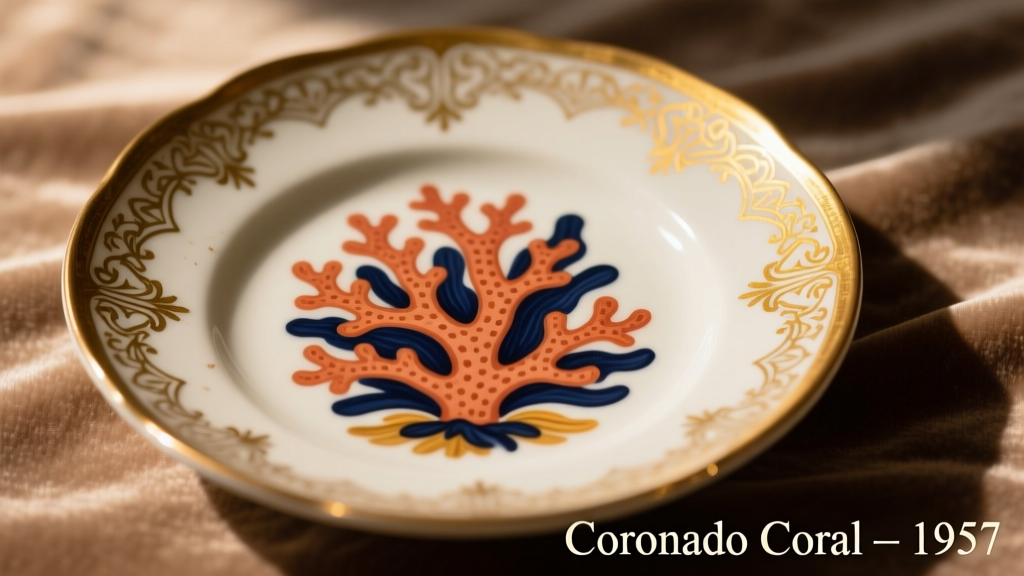
The Dinnerware Coronado Coral Saucer: A Mid-Century American Ceramic Icon
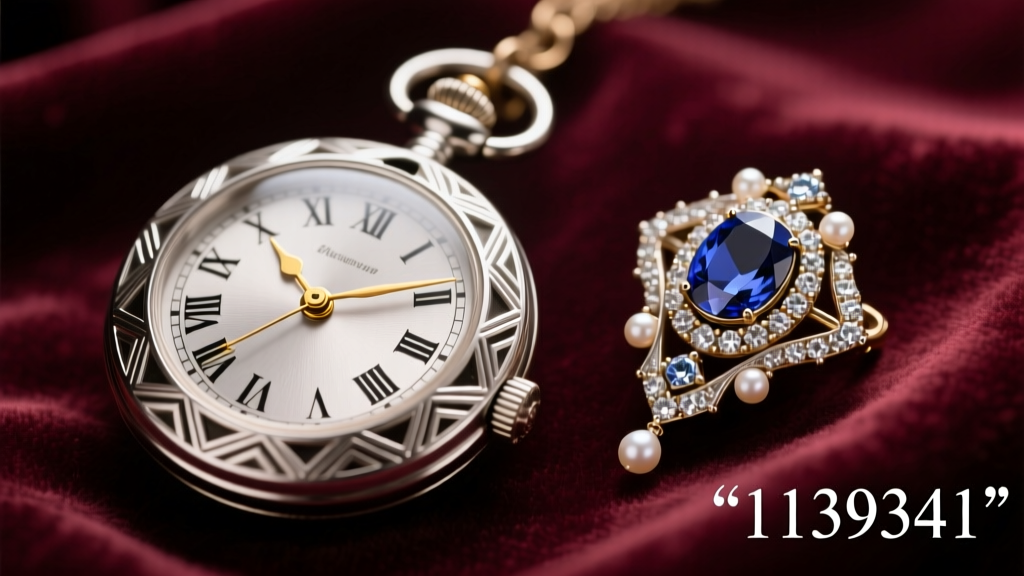
The Rolex Submariner Ref. 1139341: A Definitive Technical and Historical Appraisal

Hartford Insurance Soldier Tin Advertising Sign (19 × 11 in): A Rare 1920s–1930s Americana Artifact

Franciscan Autumn Mug (5 1/4") — Collectibility, Production History, and Market Value Analysis

Akro Agate Flowerpot Blue 2¼-Inch: A Collector’s Guide to the Iconic Depression-Era Glassware
The Bleriot Monoplane Penny Toy: A Rare Early Aviation Artifact in Tinplate and Brass
Roseville Basket White Rose Blue 8-Inch Two-Piece Set: Identification, Provenance, and Market Value Analysis

Fruit Jar Atlas Good Luck 1 Qt: A Collector’s Deep Dive into Shape, Sealing, and Historical Provenance
The 1920s Borden’s Toy Horse-Drawn Milk Wagon: A Rare Tin-Lithographed Wooden Artifact Measuring 17 Inches