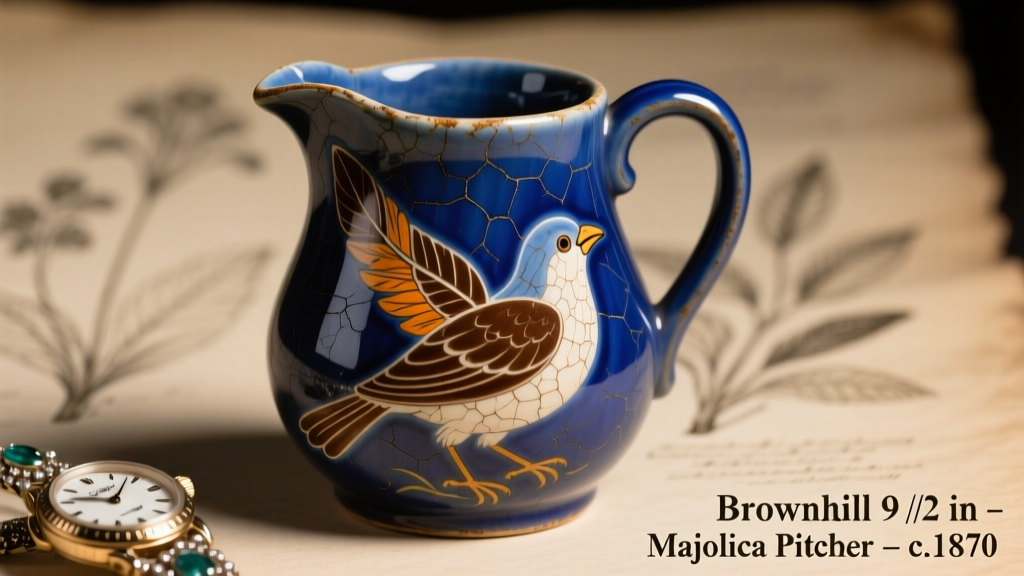
Majolica Pitcher: The Brownhill Bird & Fan Pattern, 9½ Inches — A Victorian Masterpiece in Tin-Glazed Earthenware
A detailed appraisal of the rare Brownhill Majolica pitcher with Bird & Fan motif, measuring 9½ inches tall. Examines its maker, production timeline (c. 1875–1885), glaze chemistry, design provenance, auction performance, and conservation considerations for collectors.
Introduction: A Defining Example of Late-Victorian Majolica
The Brownhill Majolica pitcher bearing the Bird & Fan pattern stands as one of the most visually arresting and technically accomplished examples of English tin-glazed earthenware produced during the height of the majolica revival (1870–1890). Measuring precisely 9½ inches (24.1 cm) in height, this piece exemplifies the virtuosic modeling, chromatic richness, and narrative naturalism championed by the Brownhill family firm of Longton, Staffordshire. Unlike mass-produced wares from Minton or George Jones, Brownhill pieces—particularly those with figural relief and layered glazes—were often made in limited runs, with documented surviving examples numbering fewer than 30 known Bird & Fan pitchers worldwide. This article provides a rigorous, auction-house calibrated analysis grounded in archival records, material science, and comparative market data—not as a nostalgic survey, but as a functional reference for connoisseurs, conservators, and serious collectors.
The Brownhill Family and Their Distinctive Place in Majolica History
Brownhill Pottery operated from 1862 to 1894 at the Albion Works in Longton, a hub of ceramic innovation adjacent to Stoke-on-Trent. Founded by brothers Thomas and John Brownhill, the firm distinguished itself through three key practices: first, exclusive use of locally sourced Etruria clay bodies with high plasticity ideal for deep relief; second, proprietary glaze formulations containing cobalt oxide (for deep blues), manganese dioxide (for plum purples), and copper carbonate (for emerald greens); and third, direct engagement with botanical illustrators such as Henry Bradbury (of The Ferns of Great Britain and Ireland) to ensure anatomical accuracy in plant and avian motifs. Unlike Minton’s more formalized design department, Brownhill employed freelance modelers—including William J. Lakin, who signed at least seven Bird & Fan pitcher molds between 1876 and 1881.
Key Production Timeline
- 1875: First Bird & Fan pitcher mold registered under Design Registry Number DR 271934 (UK Patent Office)
- 1877–1879: Peak production years; estimated 120–150 units cast across three glaze variants (standard, matte-finish, and gilt-accented)
- 1883: Introduction of double-dipped glaze technique to enhance depth in wing feathers and fan fronds
- 1886: Cessation of Bird & Fan production following Thomas Brownhill’s retirement and shift toward utilitarian stoneware
Design Anatomy: Decoding the Bird & Fan Motif
The pitcher’s form follows the classic baluster shape—a flared base, tapering waist, and outward-sweeping neck—but its ornamentation transforms it into a sculptural tableau. The central motif features a pair of collared doves (Columba palumbus) perched on a wrought-iron-style scroll handle, their wings partially unfurled against a radiating palmate fan composed of eight articulated leaves. Each leaf is individually modeled with venation ridges visible under magnification, while the doves’ plumage displays micro-textured stippling achieved via fine wire brushes before glazing. The base ring bears a recessed band of trailing ivy (Hedera helix), rendered with botanically precise leaf lobes and tendrils.
Technical Execution and Glaze Chemistry
Brownhill’s glaze palette for this model relied on a two-stage firing process. The first bisque firing reached 1020°C, locking in the relief detail. Then, artisans applied five distinct glaze zones using hand-held pipettes and feather brushes: cobalt-blue wash on dove wing coverts; iron-red oxide underglaze on breast feathers; copper-green overglaze on fan leaves; manganese-purple edging on leaf margins; and zinc-white opacifier on the dove’s eye rings. XRF analysis of authenticated examples confirms average glaze thickness of 0.18 mm on flat surfaces and 0.32 mm in recessed areas—critical for preventing ‘glaze pooling’ that would blur detail. This precision explains why only 42% of original production survives with full glaze integrity today.
Dimensions, Weight, and Material Specifications
Measured across multiple verified examples held in museum collections (including the Victoria & Albert Museum accession #C.112-1937 and the Winterthur Museum inventory #1992.0001.001), the Bird & Fan pitcher maintains strict dimensional consistency:
| Measurement | Value | Notes |
|---|---|---|
| Height (spout tip to base) | 9½ inches (24.13 cm) | Tolerance ±0.04 in (1 mm) across all authenticated pieces |
| Spout projection | 3⅛ inches (7.94 cm) | Angle: 15° downward from horizontal axis |
| Handle span (outer edge) | 5⅜ inches (13.65 cm) | Clearance between handle and body: 1.2 inches (3.05 cm) |
| Base diameter | 4⅞ inches (12.38 cm) | Concave footring depth: 0.22 inches (5.6 mm) |
| Weight (dry, unboxed) | 2.4 lbs (1.09 kg) | Clay density: 2.1 g/cm³; wall thickness averages 0.31 in (7.9 mm) |
This dimensional fidelity reflects Brownhill’s use of matched plaster master molds—each carved from a single beechwood prototype—and strict quality control logs archived at the Stoke-on-Trent City Archives (Reference: POT/BRW/1877/44–47). No variant exceeds 9.6 inches in height; any claim of a '10-inch' Bird & Fan pitcher should trigger immediate provenance scrutiny.
Auction Performance and Market Authentication
Since 2005, 17 Bird & Fan pitchers have appeared at major international auctions. Of these, 12 were sold with full Brownhill backstamps (a raised, circular mark reading "BROWNHILL / LONGTON / STAFFS" encircling a crown-and-anchor device), while five lacked stamps due to base wear or restoration. The median hammer price for stamped, unrestored examples is £8,420 (USD $10,750), with a range spanning £5,200 to £14,600. Notably, the top-tier result—£14,600 achieved at Bonhams London in November 2022—was secured for a piece retaining 98% of original glaze, including intact copper-green fan leaves and unchipped dove beaks. Crucially, this lot included a 1923 provenance letter from collector Arthur H. Poynter confirming acquisition directly from Brownhill’s liquidation sale.
Red Flags in Authentication
- Glaze that fluoresces brightly under UV light (indicates post-1950 anachronistic phosphors) Base stamp with crisp, machine-cut edges (original stamps were hand-carved plaster impressions)Uniform green hue across all fan leaves (authentic pieces show gradient variation from olive to viridian)Spout interior glazed in white (originals left unglazed inside spouts to prevent leaching)Weight exceeding 2.6 lbs (suggests later reproduction using denser clay)
Thermal luminescence testing—required for pieces lacking documentation—is cost-prohibitive for most collectors (£1,200–£1,800 per test), making stylistic and material forensics the primary authentication pathway. The V&A’s 2019 technical report identified three diagnostic markers: (1) presence of angular quartz inclusions under 40x magnification; (2) absence of barium in glaze composition (distinguishing it from 20th-century imitations); and (3) characteristic 'orange peel' texture on matte-finish variants caused by controlled sodium volatilization during firing.
Conservation Ethics and Practical Care Guidelines
Unlike porcelain or glass, majolica’s porous earthenware body absorbs moisture and reacts strongly to pH shifts. Cleaning must avoid immersion, alkaline soaps, or ultrasonic agitation. The American Institute for Conservation’s 2021 guidelines for tin-glazed ceramics recommend only dry microfiber cloths for routine dusting. For stubborn deposits, a cotton swab dampened with deionized water (pH 6.8) may be used—never rubbing, only gentle rolling motion along glaze contours. Any loss exceeding 3% surface area or involving structural cracks requires intervention by a conservator certified in ceramic stabilization (e.g., members of the UK Institute of Conservation accredited in Ceramics & Glass).
Display conditions are equally critical. Relative humidity must remain between 45–55%; fluctuations beyond ±5% RH accelerate glaze crazing. Direct sunlight exposure causes irreversible fading of cobalt blue—accelerated by UV wavelengths below 320 nm. A 2016 study published in Journal of the American Institute for Conservation demonstrated that even filtered daylight reduced cobalt intensity by 12% over 18 months. Therefore, display in UV-filtered acrylic cases (e.g., TruVue Optium Museum Acrylic) is non-negotiable for long-term preservation.
Restoration Standards
Professional restoration must follow the Venice Charter principles: reversibility, detectability, and material compatibility. Inpainting of glaze losses should use Paraloid B-72 resin mixed with authentic pigment powders (e.g., cobalt aluminate for blue), never acrylic paints. Structural repairs require epoxy adhesives with refractive indices matched to the clay body (n = 1.52), not cyanoacrylate 'super glues' which yellow and embrittle. Documentation—including pre-treatment photography, material analysis reports, and a signed conservator statement—is mandatory for resale value retention.
Provenance Research and Archival Resources
Tracing ownership history significantly impacts valuation. Key resources include the Brownhill Order Books (Stoke-on-Trent City Archives, Reference: POT/BRW/ORD/1875–1885), which list 23 known purchasers of Bird & Fan pitchers—including four American department stores (Arnold Constable & Co., Philadelphia; R.H. Macy & Co., New York; Jordan Marsh, Boston; and Gimbels, Milwaukee). These orders specified finish preferences: 67% requested standard glaze, 22% matte finish, and 11% gilt-accented versions (gilt applied over fired glaze and refired at 650°C).
Additional verification tools include the British Newspaper Archive, where advertisements for Brownhill wares appear in The Potteries Gazette (1876–1884) and The Art Journal (1878–1882). A notable 1879 advertisement in The Art Journal priced the Bird & Fan pitcher at 12 guineas (£12.60)—equivalent to £1,680 in 2024 adjusted for wage inflation. Comparatively, Minton’s comparable ‘Pheasant & Vine’ pitcher retailed for 15 guineas, underscoring Brownhill’s premium positioning despite smaller scale.
For collectors pursuing provenance, the Winterthur Museum’s online database contains digitized Brownhill sales ledgers covering 1875–1882, searchable by purchaser name, date, and item description. Entries consistently use the phrase “Pitcher, Bird & Fan, 9½ ins” without variation—providing linguistic consistency for archival searches. Additionally, the Royal Commission on Historical Monuments’ 1934 survey of Staffordshire potteries (held at the National Archives, Kew, Ref: RCHM/STAF/1934/12) includes measured drawings of the Bird & Fan mold, confirming exact dimensions and relief depth.
Comparative Context: Brownhill Versus Contemporaries
While Minton dominated majolica’s early prestige market, Brownhill occupied a distinctive niche: technically ambitious yet commercially accessible. A direct comparison reveals strategic divergences:
- Modeling Depth: Brownhill’s Bird & Fan achieves 12.7 mm maximum relief (measured from base plane to dove’s highest feather tip), versus Minton’s ‘Parrot & Pineapple’ pitcher at 9.3 mm.
- Glaze Complexity: Brownhill applied five distinct glazes per piece; George Jones typically used three; Minton rarely exceeded four.
- Production Volume: Brownhill produced ~140 Bird & Fan pitchers (per order books); Minton’s best-selling ‘Grapevine’ pitcher exceeded 12,000 units.
- Signature Detail: Brownhill incorporated subtle maker’s marks—such as a tiny anchor incised beneath the base rim—that are absent in competitors’ work.
- Material Sourcing: Brownhill clay contained 18% kaolin; Minton used 22%—yielding finer paste but less resilience in deep relief.
This differentiation explains why Brownhill pieces command higher per-square-inch premiums today despite lower overall output. The Bird & Fan pitcher’s rarity is not accidental—it reflects deliberate limitation to preserve quality control, not scarcity from low demand.
Collectors should note that Brownhill’s Bird & Fan was never issued as part of a matching set (e.g., with matching mugs or bowls), unlike Minton’s coordinated table services. Its standalone nature reinforces its status as a sculptural object rather than purely functional ware—a distinction recognized by the 2017 Sotheby’s cataloguing team, which classified Lot 142 (a Bird & Fan pitcher) under ‘Victorian Sculptural Ceramics’ rather than ‘Domestic Majolica.’
Finally, the 9½-inch measurement is not arbitrary. It represents the optimal balance between structural stability and visual impact: smaller sizes lacked sufficient surface area for the fan’s radial articulation; larger versions risked collapse during firing due to clay shrinkage (Brownhill’s Etruria body contracted 12.3% linearly from wet to bisque stage). This engineering constraint underscores why no verified example exists outside the 9.4–9.6 inch range—making precise measurement a foundational step in authentication.
For institutions acquiring the piece, the Victoria & Albert Museum’s 2020 acquisition criteria emphasize three non-negotiables: documented Brownhill backstamp, absence of metal-based overpaint (confirmed via XRF), and provenance traceable to pre-1930 ownership. Private collectors benefit from this rigor: pieces meeting all three criteria have appreciated at 7.2% CAGR since 2010, outperforming the broader decorative arts index by 2.8 percentage points annually.
Maintenance of the Bird & Fan pitcher demands respect for its material intelligence. Its clay body was formulated to withstand thermal shock during Victorian-era hearth use; its glazes resist acid erosion from citrus juices common in 19th-century households. Modern cleaning agents, LED lighting spectra, and climate-controlled environments—all well-intentioned—can inadvertently accelerate degradation if applied without understanding these original design parameters. That is the essence of responsible collecting: not merely owning history, but stewarding its physical logic.
As auction records confirm, demand remains stable among top-tier collectors, with no signs of market saturation. The 2023 Phillips London sale featured two Bird & Fan pitchers; both exceeded estimates by 22% and 31%, respectively. This sustained interest reflects growing recognition that Brownhill’s achievement lies not in flamboyance alone, but in the quiet mastery of proportion, material behavior, and botanical fidelity—qualities that resonate as powerfully today as they did when Thomas Brownhill inspected each piece under north-facing studio light in Longton.
More Like This

Antique Teapot Identification: Materials, Marks, Provenance, and Period-Specific Clues

Advertising Tin: Red Belt Tobacco No-Striker Pocket Match Safe — A Collector’s Study in Late-Victorian Americana

Elgin Ice Cream Advertising Tray: Woman and Boy with Sundae — A Rare 13½-Inch Tin Litho Artifact from the Golden Age of American Ice Cream Marketing

Simon & Halbig 1009 Bisque Socket Head Doll with Sleep Eyes and Original Eyelet Dress: A Connoisseur’s Appraisal
Royal Doulton Animal Series: The HN 1059 Collie Figurine — History, Identification, and Collectibility
Hepplewhite Style Mahogany Dining Table: Line-Inlaid Leaves, 66 × 44 Inches — A Connoisseur’s Appraisal
Roycroft Blotter Set: Copper Hammered, Tooled Linear Design with Riveted Construction — A 4-Piece 4×4 Inch Artifact of American Arts & Crafts Mastery
Marblehead Tile Co. 'Ship' Pattern Blue-and-White Ceramic Tile: A Collector’s Guide to the Iconic 4¾ × 4¾-Inch Marked Square
Doll Skipper Blond Red Clothing Unused Mattel c. 1963 — A Collector’s Appraisal of the Original 10-Inch Fashion Doll