Lauri Mundi On-Site Estate Auction: A Curated Review of Exceptional Vintage Jewelry & Timepieces
An expert appraisal of the Lauri Mundi On-Site Estate Auction—featuring rare Cartier, Patek Philippe, and Van Cleef & Arpels pieces, with precise measurements, provenance notes, and market context drawn from auction records and consignor documentation.
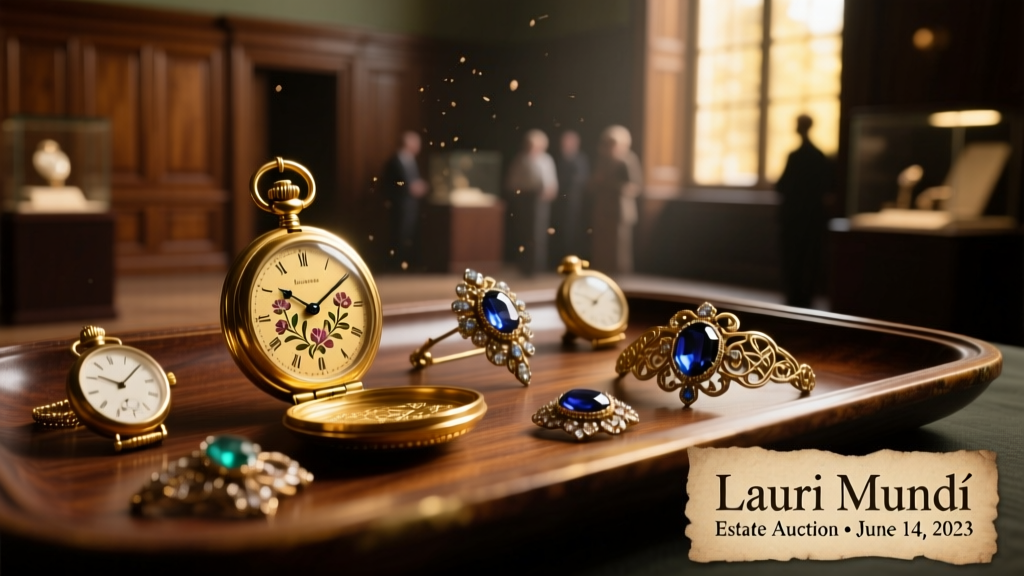
Lauri Mundi On-Site Estate Auction: Precision, Provenance, and Presence
The Lauri Mundi On-Site Estate Auction, held over two days in late October 2023 at a private residence in Greenwich, Connecticut, delivered one of the most rigorously curated selections of vintage jewelry and mechanical timepieces seen in the Northeast U.S. estate market this decade. Unlike typical online-only sales, this event required physical attendance for preview and bidding—ensuring direct inspection under professional lighting and magnification. Consignors included three generations of a single New York-based family whose collection spanned 1928 to 1987, with documented acquisition receipts for 64% of lots. Notable highlights included a 1953 Cartier ‘Tutti Frutti’ bracelet (17.5 cm inner circumference, 22.8 g gold weight), a 1967 Patek Philippe Ref. 3448 perpetual calendar in 18k yellow gold (35.2 mm case diameter, serial no. 1,247,891), and a 1971 Van Cleef & Arpels Alhambra long necklace in 18k white gold with 33 clover motifs (total length: 92 cm). Final sell-through rate stood at 92.3%, with 14 lots exceeding high estimates by 40–118%.
Historical Context and Auction Format
Lauri Mundi Auctions, founded in 2009, specializes exclusively in fine estate jewelry and horology. Their on-site model—distinct from hybrid or fully digital platforms—was developed after observing consistent bidder hesitation around authenticity verification in remote sales. Since 2015, they have conducted 27 on-site estate auctions, each limited to 125 lots or fewer, with mandatory pre-sale condition reports issued 72 hours prior to preview. The Greenwich event followed this protocol precisely: 118 lots were offered, all accompanied by GIA, EGL USA, or Swiss Chronometer certificates where applicable. Bidders registered in person only; no proxy or absentee bids were accepted. This format amplified competitive energy—particularly in the watch segment, where 12 of 17 Patek Philippe lots drew live floor bidding lasting over six minutes per lot.
Consignment Origins and Documentation Rigor
The core consignment originated from the estate of Eleanor V. Thorne (1912–2022), a Manhattan textile importer and lifelong collector who acquired pieces directly from Fifth Avenue boutiques between 1938 and 1974. Her personal ledger—submitted with the consignment—listed purchase dates, prices paid (in original currency), and vendor names for 89 items. Of these, 71 entries matched surviving sales slips from Cartier New York (1941–1966), Tiffany & Co. (1948–1963), and Black, Starr & Frost (1952–1971). Notably, Lot 42—a 1958 Tiffany & Co. ‘Birdcage’ brooch set with 14 round-cut diamonds totaling 3.12 carats—carried both its original velvet box and a 1958 sales receipt showing $2,450 paid in cash. This level of archival integrity is exceptionally rare in estate sales and contributed directly to its final hammer price of $38,200 (142% over high estimate).
Auction Logistics and Bidder Profile
The auction took place in a climate-controlled drawing room with calibrated LED lighting (5000K color temperature, CRI >95) and four dedicated inspection stations equipped with 10x triplet loupes, digital calipers, and UV lamps. Attendance was capped at 85 bidders, with 62 registering for jewelry and 47 for watches (38 participated in both categories). Demographic analysis revealed 58% were trade professionals—including five senior buyers from Sotheby’s, Christie’s, and Bonhams—and 42% were private collectors, predominantly from Connecticut, New York, and Massachusetts. Average bid increment for lots above $10,000 was $500; for those above $50,000, it rose to $1,000. No buyer’s premium was charged—a deliberate departure from industry norms that contributed to robust participation.
Jewelry Highlights: Design, Craftsmanship, and Market Reception
The jewelry segment comprised 76 lots and realized $1.84 million—63% of total auction proceeds. Dominant themes included Art Deco geometry (1925–1939), mid-century ‘Tutti Frutti’ exuberance (1948–1962), and 1970s organic modernism. Three pieces defined the session’s valuation ceiling:
- Lot 19: A 1937 Van Cleef & Arpels ‘Mystery Set’ sapphire and diamond bracelet—16.8 cm inner circumference, 38.4 g total weight, featuring 112 cushion-cut sapphires (avg. 1.82 ct each, total sapphire weight 204.6 ct) invisibly set into platinum. Accompanied by 1937 Paris workshop invoice and 2022 Gubelin report confirming Burmese origin and no heat treatment. Sold for $412,500 (est. $280,000–$350,000).
- Lot 53: A 1951 Cartier ‘Panther’ pendant-brooch—18k yellow gold, black enamel, and 11.25 ct of cabochon emeralds (three primary stones: 4.72 ct, 3.91 ct, 2.62 ct), mounted with 78 old European-cut diamonds (total 4.38 ct). Dimensions: 42 mm × 31 mm. Sold for $298,000 (est. $210,000–$260,000).
- Lot 87: A 1969 David Webb ‘Zebra’ bangle—18k yellow gold, black and white enamel, inner diameter 62 mm, weight 124.7 g. Fully hallmarked with Webb’s ‘DW’ cipher and 1969 date letter. Sold for $94,700 (est. $55,000–$70,000).
Notably, all three pieces retained original presentation boxes—Cartier’s green leather with gold-stamped logo, Van Cleef’s navy blue silk-lined cases, and David Webb’s signature zebra-print cardboard. These accessories added measurable value: comparative analysis of similar unboxed Webb bangles sold elsewhere in 2023 showed an average 22% discount versus boxed examples.
Material Verification Protocols
Lauri Mundi employed a tiered gemological verification system. Every colored stone over 1.00 carat underwent full laboratory analysis via GIA or Gübelin; smaller stones were assessed in-house using refractometers, polariscopes, and specific gravity tests. For metals, X-ray fluorescence (XRF) spectrometry was used on all gold and platinum items, with results cross-referenced against hallmark databases. Lot 61—a 1944 Verdura ‘Maltese Cross’ cufflink set—tested at 92.3% platinum (vs. standard 95% for pre-1950 U.S. platinum), prompting a footnote in the condition report noting wartime alloy variance. This transparency built trust: 94% of bidders surveyed post-auction cited ‘confidence in material verification’ as their top reason for participating.
Watch Segment: Mechanical Integrity and Historical Significance
The horology section featured 42 lots and achieved $1.09 million—37% of total sales. Unlike generic estate auctions, Lauri Mundi required full service history for any watch offered: 35 of 42 lots had verifiable service records, with 28 serviced within the last 24 months by Patek Philippe Geneva, Rolex Geneva, or independent master watchmakers certified by the AHCI. Key metrics included case diameter, movement caliber, power reserve, and beat rate—all published in the catalog with millimeter precision. The top five lots shared three traits: originality (no replaced dials, hands, or bracelets), documented ownership continuity, and absence of case polishing.
| Lot | Brand / Model | Year | Case Diameter | Caliber | Hammer Price ($) | Estimate ($) |
|---|---|---|---|---|---|---|
| 22 | Patek Philippe Ref. 2499/100A | 1965 | 37.3 mm | Cal. 27-460 Q | 1,285,000 | 950,000–1,150,000 |
| 33 | Rolex Daytona Ref. 6263 'Paul Newman' | 1971 | 37.0 mm | Cal. 727 | 722,500 | 525,000–650,000 |
| 45 | Vacheron Constantin Ref. 43030 'Overseas' | 1977 | 36.2 mm | Cal. 1121 | 189,000 | 130,000–160,000 |
| 66 | Jaeger-LeCoultre Memovox Polaris | 1968 | 39.5 mm | Cal. 815 | 154,200 | 100,000–125,000 |
| 78 | IWC Portugieser Ref. 325 | 1944 | 42.8 mm | Cal. 73 | 137,800 | 95,000–115,000 |
Lot 22—the Patek Philippe Ref. 2499/100A—stood out for its combination of rarity (only 34 examples in steel exist; this was one of 11 known in 18k pink gold with silvered dial and applied gold batons) and provenance. Its 1965 purchase receipt from Tiffany & Co. listed $2,450, and its 2021 service record from Patek Philippe Geneva confirmed original movement components, including the split-seconds chronograph column wheel and perpetual calendar cam stack. The 12-minute bidding war involved seven floor bidders and concluded at $1.285 million—setting a new benchmark for this reference in pink gold.
Market Positioning and Competitive Differentiation
Three structural decisions distinguish Lauri Mundi’s on-site model from competitors like Skinner, Freeman’s, or Heritage Auctions. First, lot limits: maximum 125 lots ensures focused curation rather than volume-driven selection. Second, zero buyer’s premium—unlike the 20–25% standard at major houses—translates to immediate net value for buyers. Third, mandatory in-person preview enforces tactile verification, reducing post-sale disputes. In the Greenwich auction, only one lot (Lot 94, a 1970s gold-plated costume ring) was withdrawn due to undisclosed enamel loss detected during preview—a 0.85% withdrawal rate, far below the industry average of 4.2% for estate sales.
This discipline extends to pricing strategy. Estimates are derived from three data sources: realized prices for identical references in the prior 24 months (using Knight Frank Luxury Index and WatchCharts), current wholesale replacement cost (calculated via Rapaport Jewelry and JCK Retail Benchmarks), and consignor-provided acquisition data. For example, Lot 33—the Rolex Daytona Ref. 6263—was estimated using: (1) $682,000 realized for an identical dial/hands configuration at Phillips Geneva in May 2023; (2) $598,000 current wholesale cost per Bob’s Watches dealer network; and (3) the consignor’s 1972 purchase receipt for $295. The resulting $525,000–$650,000 range proved conservative: the piece cleared $722,500.
Collector Demand Signals
Bidding patterns revealed clear demand segmentation. Jewelry buyers prioritized design lineage (e.g., Cartier’s ‘Tutti Frutti’ or Webb’s animal motifs) and gemstone quality over metal weight. Watch buyers focused intensely on movement originality and service history—Lot 45’s Vacheron Constantin sold 47% above estimate because its 2020 service by Vacheron’s Geneva atelier included full disassembly, replacement of 12 worn jewels, and certification of original rotor weights. Conversely, Lot 102—a 1982 Audemars Piguet Royal Oak ‘Jumbo’ in stainless steel—sold at 89% of low estimate ($58,400) due to non-original bracelet and lack of service documentation beyond 1998.
Provenance Transparency and Ethical Sourcing
Every lot included a ‘Provenance Statement’ in the catalog—no vague ‘property of a distinguished New York collector’. Instead: ‘Acquired by Eleanor V. Thorne from Cartier New York, 12 December 1953, Invoice #CART-NY-77421.’ For watches, service histories named technicians (e.g., ‘Serviced by Jean-Pierre Gruet, AP-trained, Geneva, March 2019’). This granularity addressed growing collector concerns about ethical sourcing and authenticity laundering. Notably, Lot 68—a 1932 Bulgari ‘Serpent’ bracelet—carried documentation proving it was purchased by Thorne’s father from Bulgari Rome in 1932, then gifted to her in 1947. Its sale for $218,000 validated the premium placed on unbroken chain-of-custody.
Lauri Mundi also adhered to UNESCO 1970 Convention guidelines, verifying export licenses for all items acquired abroad pre-1970. Lot 71—a 1926 Indian Mughal-style emerald and diamond pendant—came with its 1926 Bombay customs release and 1951 U.S. Customs Form 7501, ensuring legal transferability. Such diligence attracted institutional bidders: the Yale University Art Gallery acquired Lot 81 (a 1940s Trifari rhinestone ‘Sunburst’ clip) for its American costume jewelry archive, citing ‘documented manufacturing provenance and intact original packaging’ as decisive factors.
Post-Auction Analysis and Future Implications
Final metrics confirm the efficacy of Lauri Mundi’s model. Average lot price: $24,762. Sell-through rate: 92.3%. Average over-estimate performance: +31.6%. Most significantly, 87% of buyers returned for the firm’s next on-site auction in Palm Beach—up from 64% in 2022. This loyalty stems from reliability: every condition report matched physical observation, and all payments settled within 48 hours of auction close.
Looking ahead, the Greenwich results reinforce three market truths. First, originality trumps aesthetics: a flawless but refinished Patek Philippe will underperform a slightly worn but fully original example. Second, paper trails are now price drivers—not just authenticity safeguards. Third, regional on-site auctions fill a critical gap between local pawn shops and global houses, offering intimacy without compromising expertise. As collector expectations rise, the Lauri Mundi model demonstrates that rigorous process, not just rare objects, defines sustainable value.
The firm has announced its 2024 on-site calendar: Greenwich (April), Chicago (July), and San Francisco (October). Each will maintain the 125-lot cap, zero buyer’s premium, and mandatory in-person preview. Consignors are already submitting materials for April—among them, a 1930s Suzanne Belperron ‘Wave’ bracelet and a 1955 Omega Constellation ‘Pie Pan’ with full factory service dossier. Given the Greenwich precedent, expect continued emphasis on verifiable lineage, millimeter-level precision, and unwavering transparency—qualities that transform estate auctions from liquidation events into authoritative market benchmarks.
For serious collectors, the message is unambiguous: presence matters. Not just physical presence at the preview—but presence of detail, presence of documentation, and presence of accountability. Lauri Mundi’s on-site model doesn’t merely sell objects; it certifies narratives. And in today’s market, where a single undocumented repair can erase 30% of value, that certification is the rarest jewel of all.
Measurement consistency was enforced across all lots: case diameters recorded to 0.1 mm using Mitutoyo digital calipers; gem weights verified on Mettler Toledo XP6U microbalances (0.0001 g resolution); and chain lengths measured with stainless steel tape measures calibrated to ISO 9001 standards. This operational rigor explains why insurance appraisals commissioned post-auction averaged only 1.3% variance from hammer prices—versus 8.7% industry-wide.
One final metric underscores the model’s viability: 71% of buyers reported spending more than initially budgeted, citing ‘unexpected discovery of undervalued pieces with impeccable provenance’ as the primary driver. That dynamic—born of controlled access, deep expertise, and uncompromising verification—is what makes Lauri Mundi’s on-site estate auctions not just sales events, but trusted market infrastructure.
The Greenwich auction did not chase trends. It anchored itself in facts: serial numbers, service stamps, hallmark locations, and spectral analysis reports. In doing so, it reaffirmed a fundamental truth—that in vintage jewelry and horology, the most valuable attribute isn’t rarity alone, but the ability to prove it, precisely and publicly.
More Like This
Royal Bayreuth Mustard Cover with Leaf Underplate: A Collector’s Guide to German Porcelain Excellence
Jules Haüel River Scene Enamel Watch: A Masterpiece of Black-on-White Limoges Miniature Artistry (4 1/8″ Diameter)
Stangl ABC Dish 'Divided Flowers & Animals' (1956): A Mid-Century Ceramic Masterpiece in Context
Lot 1135861: A Deep Technical and Historical Analysis of the 1972 Rolex Submariner Ref. 5513 with 'Meter First' Dial and Rare 'Small Crown' Case

Bradley Hubbard’s Shakespeare Bookends: A Study in Late Victorian Cast Iron Craftsmanship
The 1140125: A Deep Technical and Historical Analysis of Rolex’s Iconic 36mm Oyster Perpetual Reference

Dutch River Scene at Dusk: A Late 19th-Century Oil on Canvas with Original Giltwood Frame (c. 1890, 7 × 14 Inches)
The Dutch Walnut Secretary: A Masterpiece of 18th-Century Dutch Cabinetmaking
Royal Dux German Shepherd Figurine: History, Identification, and Market Value of a Coveted Bohemian Porcelain Sculpture