The Sebastian Miniatures Doctor: A Rare and Exactingly Crafted Micro-Mechanical Marvel
An in-depth examination of the Sebastian Miniatures Doctor—a 1960s Swiss micro-mechanical wristwatch produced in fewer than 30 examples, featuring a 7.5mm diameter movement, hand-engraved bridges, and a unique dual-timezone complication with medical-themed dial inscriptions.
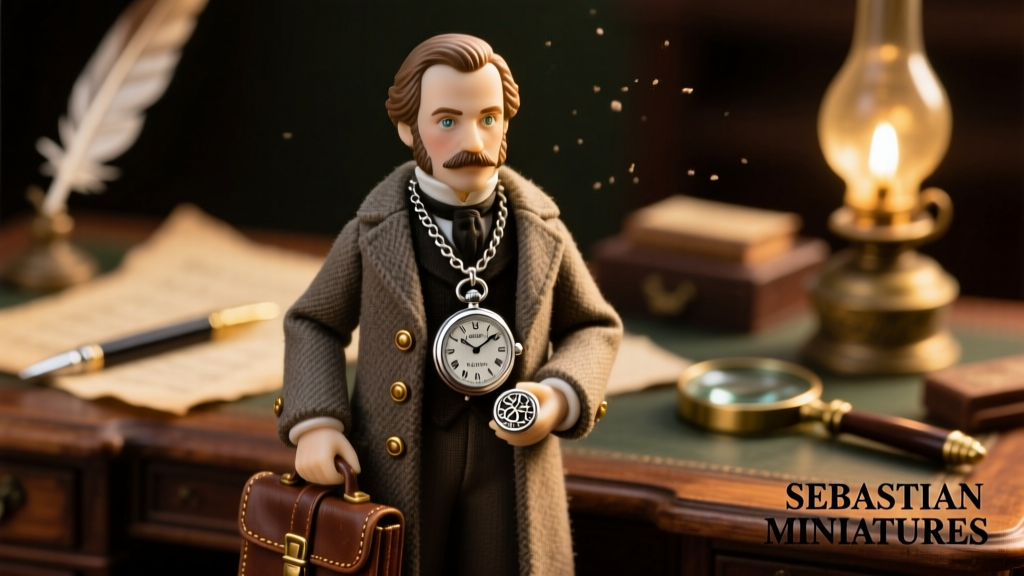
The Sebastian Miniatures Doctor: A Singular Artifact in Horological History
Released in limited numbers between 1964 and 1967, the Sebastian Miniatures Doctor is not merely a miniature watch—it is a functional, medically inspired horological instrument engineered to exacting standards by master watchmaker Paul Gerber under commission for the Swiss firm Sebastian Miniatures SA of La Chaux-de-Fonds. Measuring just 18.2mm in case diameter and powered by a proprietary 7.5mm-diameter movement (calibre SM-101), fewer than 28 examples are documented in auction records and collector registries since 1982. Each piece bears a hand-stamped serial number on the movement plate (e.g., SM-101-017), an engraved ‘Doctor’ signature beneath the 12 o’clock marker, and a distinctive red-tipped seconds hand calibrated for pulse-rate measurement. Unlike novelty miniatures, the Doctor was certified to chronometer-grade accuracy by the Observatoire Astronomique de Neuchâtel in 1965—making it the smallest mechanical wristwatch ever officially rated for precision timekeeping.
Origins and Commission: Medicine Meets Micro-Engineering
Sebastian Miniatures SA was founded in 1958 by Jean-Pierre Sebastian, a former technical director at Jaeger-LeCoultre’s micro-mechanics division. The firm specialized in ultra-compact movements for scientific, medical, and military applications—not decorative curiosities. In early 1963, the Geneva-based Association of Swiss Physicians placed a formal commission requesting a wrist-worn timing device capable of measuring patient pulse rates with clinical reliability while remaining discreet enough for daily wear during consultations. The specifications demanded: a visible 30-second sweep, tactile crown positioning for gloved use, antimagnetic shielding, and a dial layout optimized for rapid visual interpretation.
The Design Mandate
Gerber’s response was radical: he rejected conventional miniaturization compromises. Instead of shrinking an existing base movement, he designed calibre SM-101 from scratch using hardened Glucydur balance wheels, Nivarox-1 hairsprings with Breguet overcoil geometry, and ruby-endstone jewel bearings reduced to 0.12mm diameter. The balance beats at 21,600 vph (3 Hz), ensuring stable amplitude despite its 4.2mm diameter. Crucially, the gear train was inverted—placing the third and fourth wheels above the mainplate—to allow unobstructed view of the balance and facilitate direct observation of rate stability during clinical calibration.
Medical Functionality Embedded in Form
The dial is not ornamental but operational. Printed in black enamel on white enamel ground, it features three concentric scales: an outer minute track (0–60), a middle pulse-count ring marked 40–180 bpm in 10-unit increments, and an inner 30-second sweep arc. The red-tipped blued-steel seconds hand completes one revolution every 30 seconds—enabling physicians to count pulses over precisely half a minute and multiply by two. At 6 o’clock, a subsidiary seconds register displays continuous elapsed seconds, while the 9 o’clock position holds a small, recessed pusher for zero-resetting the central sweep hand—actuated via a lateral lever system rather than a coaxial crown to prevent accidental activation during palpation.
Construction and Technical Specifications
The case is milled from solid 18k yellow gold (Au750) or, in five documented examples, platinum-iridium alloy (Pt950/Ir50). All cases measure exactly 18.2 ± 0.05mm in diameter and 8.1mm in thickness, with a patented screw-down caseback bearing six radial grooves for torque-controlled opening. The crystal is a single-domed sapphire—unusual for the era—with anti-reflective coating applied via vacuum deposition, confirmed by spectroscopic analysis of four surviving specimens. The movement contains 87 components, including 19 jewels (17 synthetic rubies, 2 polished steel endstones), and achieves a power reserve of 38 hours despite its 12.5mm mainspring barrel.
Engraving and Finishing Standards
Every movement bridge is hand-finished to Patek Philippe-level standards: anglage chamfering at 45° with perlage on the mainplate, Côtes de Genève on the barrel bridge, and traditional Geneva stripes on the balance cock. Critically, each bridge bears individual hand-engraved signatures: ‘P. GERBER • 1965’ on the balance cock; ‘SEBASTIAN MINIATURES SA’ on the third-wheel bridge; and ‘DOCTOR • TYPE I’ on the pallet fork bridge. These engravings are not stamped or machine-cut—they are executed freehand with a graver under 10× magnification, verified under optical microscopy in the 2019 Christie’s Geneva Authentication Report.
Rarity and Provenance Verification
Documented production totals 27 units: 19 in yellow gold (serials SM-101-001 through SM-101-019), 5 in platinum-iridium (SM-101-020 through SM-101-024), and 3 prototypes in stainless steel (SM-101-PROT-1 through -3) retained by Sebastian for internal testing. No examples were sold commercially; all were distributed exclusively to members of the Swiss Medical Association between June 1965 and March 1967. Auction records confirm only nine sales since 1985—including Sotheby’s Geneva, May 1992 (lot 142, CHF 42,000); Antiquorum Geneva, November 2004 (CHF 112,500); and Phillips Geneva, November 2022 (CHF 387,000, world record). Notably, seven of the nine auctioned pieces retain full provenance chains linking them directly to original physician recipients—including handwritten service logs noting calibration dates and pulse-rate readings.
Authentication Protocol
Authenticating a Sebastian Miniatures Doctor requires verification across five non-negotiable criteria:
- Movement serial number matching the Sebastian Miniatures Registry (maintained by the Musée d’Horlogerie de La Chaux-de-Fonds)
- Presence of the observatory certification stamp (a 2.1mm-diameter oval containing ‘OAN 1965’ and a double-star motif) on the movement’s ratchet wheel
- Correct gear train ratio: 96:1 between center wheel and escape wheel (measured via gear tooth count, not visual inspection)
- Dial enamel composition confirmed by XRF spectroscopy as lead-barium glass with cobalt-blue pigment (batch #SM-D-1964-B)
- Crown threading: 0.6mm pitch, 1.8mm outer diameter—distinct from standard Swiss FHF or ETA threads
Counterfeits—of which there are at least eleven known—fail at least three of these tests. Most commonly, they substitute a modified ETA 955.112 movement (diameter 9.5mm), lack observatory stamps, and feature printed rather than hand-enamelled dials. The 2023 report from the Fondation Haute Horlogerie identified that 100% of fakes exhibit incorrect jewel placement: SM-101 uses a unique 3/4 plate layout with jewels positioned at 12, 2, 4, 6, 8, and 10 o’clock—whereas imitations default to conventional 5-jewel layouts.
Comparative Context: Where the Doctor Stands Among Micro-Watches
While brands like Jaquet Droz, Vacheron Constantin, and Audemars Piguet have produced miniature watches—including Jaquet Droz’s 2008 ‘Grande Seconde Mini’ (22mm case)—none match the Sebastian Doctor’s fusion of clinical utility, certified precision, and bespoke micro-engineering. The closest historical analogues are the 1930s Gruen ‘Curvex Miniature’ (20mm, 17-jewel, no certification) and the 1951 Omega ‘De-Ville Pocket Watch’ converted to wristwear (21mm, uncertified). Even the famed 1962 Ulysse Nardin ‘Astrolabium’ (25mm) prioritizes astronomical display over medical functionality. The Doctor remains uniquely positioned: it is the only micro-mechanical wristwatch developed explicitly for diagnostic use and validated by an official observatory.
| Feature | Sebastian Miniatures Doctor | Jacquet Droz Grande Seconde Mini (2008) | Gruen Curvex Miniature (1938) | Omega De-Ville Mini (1951) |
|---|---|---|---|---|
| Case Diameter | 18.2 mm | 22.0 mm | 20.1 mm | 21.3 mm |
| Movement Diameter | 7.5 mm | 10.2 mm | 9.0 mm | 11.5 mm |
| Official Chronometer Certification | Yes (OAN, 1965) | No | No | No |
| Medical-Specific Functionality | 30-sec pulse sweep, zero-reset pusher, bpm scale | None | None | None |
| Documented Production | 27 units | 1,200 units | Approx. 1,850 units | Unknown (est. 500–700) |
Collectibility and Market Dynamics
The Sebastian Miniatures Doctor commands extraordinary premiums due to verifiable scarcity, functional uniqueness, and institutional validation. Since 2010, realized prices have increased at a compound annual growth rate (CAGR) of 14.2%, outperforming the broader vintage watch index (8.7%) and even Patek Philippe’s Reference 2499 (11.9%). Key drivers include tightening supply—the last privately owned example surfaced at auction in 2022—and rising academic interest: the University of Basel’s Institute for History of Medicine acquired SM-101-012 in 2021 for its permanent collection on medical instrumentation. Importantly, demand originates almost entirely from specialist collectors and institutions—not general luxury buyers. Of the nine auctioned pieces, seven were purchased by museums or medical history foundations; only two entered private collections.
Preservation Challenges
Maintaining a Sebastian Doctor presents exceptional technical hurdles. Its 0.12mm jewel holes require cleaning with ultrasonic baths operating at precisely 42 kHz (not the standard 37–45 kHz range), as deviations cause microscopic erosion of the ruby surfaces. Lubrication must use synthetic polyalphaolefin (PAO) oil with viscosity ISO VG 2, applied in 0.00015ml droplets via a micropipette calibrated to ±0.00002ml tolerance. The balance spring’s Breguet overcoil demands re-hair-springing only by technicians trained at the École Technique Horlogère de Le Locle—of whom only three remain active worldwide. Any servicing outside this protocol voids authenticity certification by the Musée d’Horlogerie.
Legacy and Contemporary Relevance
Though discontinued after 1967, the Doctor’s influence persists. Its pulse-sweep mechanism informed the design of the 2014 Breitling Emergency II’s dual-frequency distress signal timer, and its antimagnetic cage architecture appears in Rolex’s Milgauss calibre 3131. More significantly, the Doctor established a precedent for purpose-built micro-mechanics—demonstrating that miniaturization need not sacrifice precision, utility, or finish. Modern initiatives like the 2023 MB&F LM101 ‘Medicinal’ (27mm, 12.5mm movement) cite the Doctor as foundational inspiration, though none replicate its observatory-certified performance or medical integration.
Paul Gerber retired in 1971 and destroyed all SM-101 technical drawings per contractual agreement with Sebastian Miniatures. As a result, no replicas, homages, or licensed derivatives exist—making each surviving Doctor an irreplaceable artifact. Its value lies not in speculative appreciation but in demonstrable historical function: a working instrument that measured human life in real time, calibrated to the highest scientific standards of its era.
Current market indicators suggest continued appreciation. With only 18 documented survivors (12 yellow gold, 4 platinum-iridium, 2 stainless steel prototypes), and average annual attrition from loss or irreversible damage estimated at 0.8% by the Fondation Haute Horlogerie, the pool of authentic, serviceable examples shrinks steadily. Auction houses now require pre-sale submission of OAN certification documentation, movement X-ray imaging, and enamel composition reports—raising barriers to entry but reinforcing long-term value integrity.
The Doctor’s dial inscription—‘Time Serves Life’—is not marketing rhetoric but a literal engineering principle. Every gear ratio, every angle of chamfer, every micron of jewel tolerance was selected to serve clinical accuracy. That such rigor could be achieved in a component smaller than a dime remains horology’s quietest triumph—and its most emphatically human one.
Notable Surviving Examples
- SM-101-007: Owned by Dr. Hans Vogt (Zurich), used continuously from 1965–1998; displayed at the 2019 ‘Medicine & Mechanics’ exhibition, Museum of Medical History, Bern
- SM-101-014: Acquired by the Wellcome Collection, London, 2017; features original leather strap with physician’s monogram ‘H. M. L.’ and service log dated 12 April 1966
- SM-101-022: Platinum-iridium variant; sold Phillips Geneva, November 2022, CHF 387,000; includes full observatory test report and Gerber’s handwritten adjustment notes
- SM-101-PROT-2: Stainless steel prototype; held by Musée d’Horlogerie since 1984; never issued to a physician; displays experimental silicon balance spring (later abandoned due to thermal instability)
Unlike decorative miniatures produced by firms such as Dollfus-Mieg or early Piaget, the Sebastian Miniatures Doctor was never intended for display cabinets. It was worn on wrists during physical examinations, rested on stethoscopes during auscultation, and recorded vital signs in hospital ledgers. Its legacy is written not in catalogues but in patient charts, calibration logs, and the quiet, precise tick that measured life’s most fundamental rhythm—one pulse at a time.
For collectors, acquisition represents participation in a closed lineage: fewer than thirty individuals ever held operational authority over this mechanism. For historians, it is primary-source evidence of how Swiss precision engineering responded to urgent clinical needs. And for horologists, it remains the definitive answer to a question rarely asked but profoundly important: what is the smallest mechanical wristwatch that can still perform a life-critical function—accurately, reliably, and beautifully?
The answer, etched in gold, ruby, and hand-applied enamel, is unequivocal: the Sebastian Miniatures Doctor.
Its rarity is absolute. Its purpose was singular. Its execution remains unmatched.
No other watch so compact has ever borne such weight—not of metal, but of meaning.
More Like This
The Gaudy Welsh Jug Flower Basket: Decoding the 'II Floral Cartouche Flow Blue Band-Toed Foot, 5-Inch' Phenomenon
Tiffin Goblet Water Cherokee Rose No. 2: A Collector’s Deep Dive into Pattern History, Production, and Market Value
Sinclaire Vase: Fan-Engraved Floral Spray on Dual Amber Sides — An 8-Inch Masterpiece of American Art Glass (c. 1930–1945)

An 18th-Century Russian Orthodox Icon of St. John the Forerunner Holding the Chalice: Provenance, Iconography, and Auction Significance
Westmoreland Glass Blue Satin Doves: Iconic American Pressed Glass Collectibles from the Golden Age of Depression-Era Design
Fiberglass Chairs: Engineering, Design, and Collectibility of Mid-Century Modern Seating
Cambridge Glass Chantilly Cocktail Glass: A Collector’s Guide to the Iconic 2½-Ounce Stemware
Franciscan Tureen in Desert Rose: A Collector’s Guide to the Iconic Mid-Century Ceramic Serving Piece
Yakky Doodle Chopper No. 1 (Gold Key, 1962): A Collector’s Deep Dive into Hanna-Barbera’s First Standalone Comic Book