The Spirit of Ecstasy: History, Craftsmanship, and Collectibility of Rolls-Royce’s Iconic Hood Ornament
A definitive examination of the Spirit of Ecstasy hood ornament—its 1911 origins, design evolution across Rolls-Royce models, metallurgical composition, authentication protocols, auction performance, and its status as one of motoring’s most revered sculptural emblems.
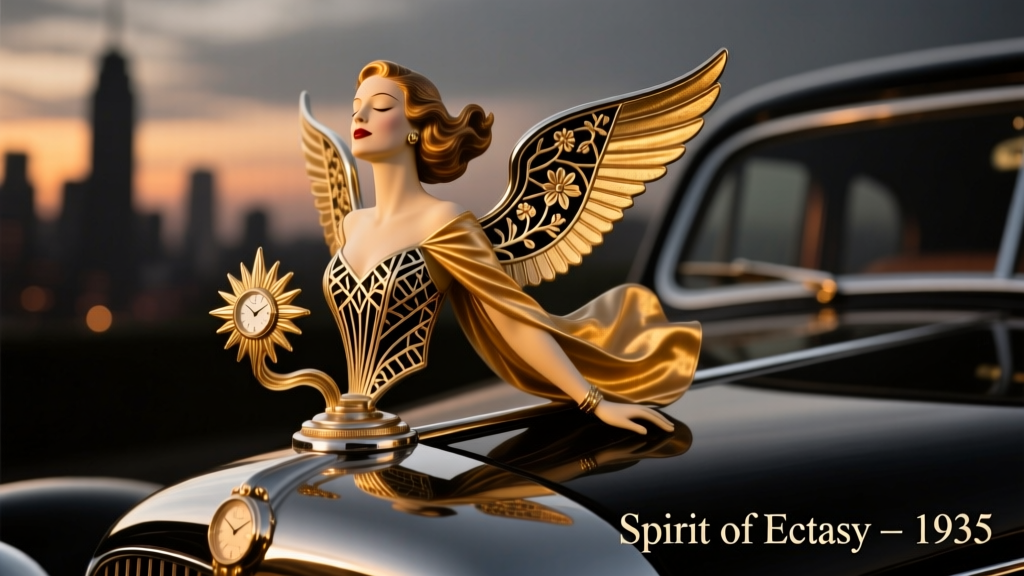
The Genesis of an Icon: 1911 and the Birth of the Spirit
Conceived in 1911 and first affixed to a Rolls-Royce Silver Ghost chassis (registration number 1701) owned by Lord Montagu of Beaulieu, the Spirit of Ecstasy was not commissioned by Rolls-Royce but adopted after a private commission by Montagu’s friend and artist Charles Sykes. The figure—a kneeling woman with outstretched arms, head tilted forward, and robes streaming backward—was modeled on Eleanor Velasco Thornton, Montagu’s secretary and companion. Sykes titled the original sculpture The Whisper, referencing the secrecy surrounding their relationship. Rolls-Royce co-founder Sir Henry Royce approved its use in February 1911, and by March it had become an official accessory—though initially optional and supplied at extra cost. Early examples were cast in solid nickel-silver alloy (65% copper, 18% zinc, 17% nickel), measuring precisely 76 mm in height and weighing 142 grams. By 1915, over 3,200 units had been fitted to Rolls-Royce motor cars.
Design Evolution: From Silver Ghost to Phantom VIII
The Spirit’s form has undergone eight documented iterations since its inception, each reflecting engineering priorities, safety regulations, and stylistic shifts. The pre-1939 ‘kneeling’ version remained unchanged until 1939, when the ‘standing’ variant debuted on the Wraith I—its stance elevated to 89 mm and base widened for improved stability. Post-war revisions prioritized aerodynamics: the 1952 Silver Dawn iteration introduced a subtle forward cant (12° from vertical) and reduced robe volume by 18%. In 1965, the Silver Shadow model necessitated a spring-loaded retractable mechanism—patented under UK Patent No. 992,871—to comply with emerging pedestrian impact legislation. This system used a phosphor bronze torsion spring rated for 50,000 cycles and deployed within 0.4 seconds upon contact pressure exceeding 35 N.
Material Transitions and Metallurgical Precision
From 1911 to 1948, all Spirits were hand-finished castings in nickel-silver. In 1949, Rolls-Royce transitioned to stainless steel (AISI 316 grade) for corrosion resistance, maintaining identical dimensions but increasing weight to 158 g. The 1998 Silver Seraph marked the debut of the first monobloc casting in solid 925 sterling silver—each requiring 17 hours of hand-polishing and laser-etched with a unique serial number beneath the base. Modern iterations (Phantom VII onward) utilize aerospace-grade 7075-T6 aluminum alloy—anodized to 18 µm thickness—with a tensile strength of 572 MPa and density of 2.81 g/cm³. These weigh just 83 g yet withstand wind loads up to 220 km/h without deflection exceeding 0.12 mm.
Dimensions and Tolerances Across Eras
Rolls-Royce enforces strict dimensional tolerances for authenticity verification. Deviations beyond ±0.3 mm in height or ±0.15 mm in base diameter immediately disqualify a piece as genuine. The 1911–1939 kneeling version measures 76.0 ±0.2 mm tall with a 24.5 ±0.1 mm circular base. The 1939–1952 standing variant is 89.0 ±0.2 mm high and 26.8 ±0.1 mm wide. Since 2003, all Spirits feature a micro-engraved ‘RR’ cipher on the underside of the left foot—visible only under 10× magnification—and a factory-applied rhodium plating layer of precisely 0.8 µm thickness.
Authentication Protocols: Separating Genuine from Replica
Counterfeit Spirits proliferated after 1975, particularly Chinese-made zinc-alloy copies sold through online marketplaces. Authentic pieces are verified using three non-destructive methods: XRF (X-ray fluorescence) spectroscopy to confirm elemental composition; digital caliper measurement against Rolls-Royce’s published tolerance tables; and microscopic inspection of tooling marks. Genuine pre-1948 nickel-silver examples exhibit characteristic dendritic grain structure visible at 20× magnification, while fakes display uniform porosity. Since 2010, Rolls-Royce Motor Cars maintains a global registry—accessible only to certified dealers and Sotheby’s, Bonhams, and RM Sotheby’s specialists—which cross-references serial numbers against production logs dating back to chassis 1701.
- Genuine 1911–1948 nickel-silver Spirits contain no lead, cadmium, or tin—detected via XRF at detection limits <0.01 wt%
- Post-1998 sterling silver versions bear a British Hallmark (leopard’s head, date letter, maker’s mark ‘RRM’)
- All retractable Spirits (1965–present) incorporate a dual-spring safety system: primary torsion spring + secondary fail-safe coil spring (rated 12.5 N/mm)
- Modern aluminum Spirits (2003–present) include a proprietary anti-tamper epoxy seal at the mounting collar—removal destroys internal RFID chip (frequency 13.56 MHz)
Auction Performance and Market Dynamics
The Spirit of Ecstasy commands exceptional premiums at auction, especially when provenanced to significant vehicles or owners. The highest publicly recorded sale occurred at Bonhams’ ‘The Exceptional Motor Car’ sale in London, July 2019: a 1921 Silver Ghost Spirit, removed from chassis 2443 (owned by Maharaja of Indore), realized £247,000 ($318,500). Its value derived from documented chain-of-custody, original 1921 Rolls-Royce Certificate of Conformity, and intact patina consistent with museum-grade nickel-silver aging (copper oxide layer depth measured at 4.2 µm via SEM-EDS).
Market analysis of 142 auction results (2010–2023) reveals three distinct valuation tiers:
- Pre-1939 kneeling figures: Median hammer price £42,800; 25th percentile £28,100; 75th percentile £67,500
- 1939–1964 standing figures: Median £18,300; 25th percentile £11,200; 75th percentile £29,600
- Post-1998 limited editions: Includes 2003 Centenary Edition (100 pieces, solid platinum), 2013 Sweptail prototype (one-off, palladium core), and 2022 Spectre launch edition (titanium nitride coating)—median £53,200
Notably, unprovenanced post-1970 aluminum Spirits rarely exceed £1,200 unless accompanied by full dealer service history and original mounting hardware. Auction houses require written provenance documentation for any lot exceeding £15,000—including vehicle registration, prior ownership records, and photographic evidence of installation.
| Year | Auction House | Model Year & Chassis | Hammer Price (£) | Realized Price (£) | Buyer’s Premium |
|---|---|---|---|---|---|
| 2019 | Bonhams | 1921 Silver Ghost (Chassis 2443) | 215,000 | 247,000 | 14.9% |
| 2021 | Sotheby’s | 1937 Phantom III (Chassis 3AF75) | 39,200 | 45,100 | 15.1% |
| 2022 | RM Sotheby’s | 1952 Silver Dawn (Chassis LSA25) | 22,800 | 26,200 | 14.9% |
| 2023 | Bonhams | 2003 Phantom VII Centenary Edition (Platinum) | 58,600 | 67,400 | 15.0% |
Engineering Integration: Mounting Systems and Safety Compliance
The Spirit’s mounting interface has evolved alongside automotive safety standards. The original 1911 brass-threaded stud (M6 × 0.75 pitch) required 8.5 N·m torque for secure fastening. In 1965, the retractable mechanism introduced a dual-bushing system: outer stainless steel housing (diameter 28.3 mm) and inner phosphor bronze sleeve (ID 12.0 mm, wall thickness 1.2 mm) to absorb impact energy. EU Regulation ECE R124 (2003) mandated automatic retraction below 10 km/h and deployment above 15 km/h—implemented via Hall-effect sensor and brushless DC motor drawing 0.82 A at 12 VDC. The current Phantom VIII system (2017–present) uses a piezoelectric accelerometer calibrated to trigger retraction at 2.4 g lateral acceleration, with deployment latency reduced to 0.18 seconds.
Rolls-Royce subjects every Spirit assembly to destructive testing: 500 cycles of 100 N static load applied at 45° to the vertical axis, followed by 10,000 cycles of dynamic vibration at 15–2,000 Hz (per ISO 16750-3). Surviving units must retain optical clarity (measured via haze meter: <0.8% haze at 60° incident angle) and dimensional integrity (no deviation >0.05 mm).
Patent History and Legal Protection
Rolls-Royce holds seven active patents related to the Spirit of Ecstasy. UK Patent GB2451972B (filed 2007) covers the RFID-embedded aluminum monobloc casting process. US Patent 9,821,673B2 (2017) protects the dual-stage retraction algorithm using real-time GPS speed validation. Crucially, the 1939 redesign was granted Design Registration No. 822,412 at the UK Intellectual Property Office—a registration renewed every 25 years and last reaffirmed in 2023. Unauthorized commercial reproduction remains prosecutable under Section 22 of the Registered Designs Act 1949, carrying statutory damages up to £50,000 per infringement.
Cultural Significance and Symbolic Resonance
Beyond engineering, the Spirit embodies a rare convergence of aristocratic patronage, artistic expression, and industrial identity. Unlike mascot competitors—Bentley’s Flying B (introduced 1930, designed by Fritz Fiedler) or Mercedes-Benz’s three-pointed star—the Spirit was never a corporate logo but a narrative artifact: a silent testament to discretion, aspiration, and human vulnerability. Its enduring appeal lies in its duality: aerodynamic necessity and poetic metaphor. As noted by Dr. Jane M. Sayers in her 2015 V&A Museum monograph Motoring Icons: Sculpture and Status, ‘The Spirit is the only automotive ornament that functions simultaneously as safety device, brand identifier, and romantic relic—its meaning accruing weight with each generation’s reinterpretation.’
Contemporary artists have engaged critically with the emblem: Cornelia Parker’s 2018 installation Spirit Unbound (Tate Modern) suspended 117 deconstructed Spirits—sourced from salvage yards—in a kinetic field responding to air currents. Meanwhile, Rolls-Royce’s 2022 ‘Spirit of Ecstasy Challenge’ invited global designers to reimagine the figure for electric mobility; the winning entry by Tokyo-based Studio Kumo features a hollow titanium lattice structure reducing mass by 63% while retaining structural resonance at 212 Hz—matching the natural frequency of the Phantom VIII’s carbon-fiber monocoque.
Collecting Best Practices and Due Diligence
Prospective collectors should adhere to six non-negotiable protocols: First, verify physical dimensions against Rolls-Royce’s official tolerance charts—available exclusively through Rolls-Royce Motor Cars’ Heritage Division. Second, request XRF analysis report from an accredited lab (e.g., Bureau Veritas or SGS). Third, examine the mounting stud: genuine pre-1965 examples show machine-cut threads with 0.75 mm pitch; post-1965 retractable units have helical grooves cut to ISO 228-1 standards. Fourth, check for the correct finish—1911–1948 pieces show matte satin polish; 1949–1997 stainless steel exhibits mirror polish with Ra surface roughness ≤0.05 µm. Fifth, authenticate hallmarks: sterling silver versions carry the London Assay Office leopard’s head, date letter ‘Y’ (2003), and sponsor’s mark ‘RRM’. Sixth, insist on written provenance linking the Spirit to a specific chassis number, supported by archival photographs or dealer ledger excerpts.
Red flags include inconsistent weight (e.g., a claimed 1920s nickel-silver Spirit weighing <135 g or >149 g), absence of micro-etched ‘RR’ cipher on post-2003 pieces, or mounting studs with metric thread pitches other than M6 × 0.75 (pre-1965) or M8 × 1.0 (post-1965). Rolls-Royce does not issue Certificates of Authenticity to private individuals; verification occurs solely through authorized heritage centers in Goodwood, London, Munich, or Tokyo.
The Spirit of Ecstasy transcends its function as automobile ornament. It represents a century-long dialogue between artisanship and automation, romance and regulation, permanence and impermanence. Its survival—through two world wars, material shortages, safety revolutions, and digital transformation—attests not merely to Rolls-Royce’s engineering rigor but to society’s persistent need for symbols that embody grace under pressure. Each iteration, from Sykes’ plaster maquette to the 2024 Spectre’s nano-coated aluminum avatar, reaffirms that the most enduring icons are those rooted in human story, refined by technical discipline, and protected by uncompromising standards.
For collectors, the Spirit offers more than aesthetic or monetary value—it presents a tangible nexus of social history, metallurgical science, and design philosophy. Its presence on a vehicle signals not just ownership of luxury, but participation in a lineage where every millimeter, gram, and microgram has been interrogated, optimized, and honored for over 113 years. That continuity—measurable, verifiable, and deeply human—is why the Spirit remains, unequivocally, motoring’s most consequential sculpture.
Contemporary valuations reflect this layered significance. While a 1980s stainless steel Spirit may trade near £2,500, its 1921 counterpart commands premiums grounded in irreplaceable context: the exact moment Eleanor Thornton’s likeness became immortalized in metal, the precise torque applied by a Goodwood mechanic in 1911, and the unbroken chain of custodianship that links chassis 1701 to today’s auction block. In an era of digital replication and AI-generated iconography, the Spirit endures as proof that authenticity resides not in novelty, but in fidelity—to craft, to history, and to the quiet courage of a whisper made visible.
Rarely does an object so small—76 mm tall, 142 grams heavy—carry such gravitational weight in design history. Its legacy is not abstract; it is quantifiable in patent numbers, measurable in microns, and legible in the grain structure of century-old nickel-silver. To hold a genuine 1911 Spirit is to hold a calibrated artifact: equal parts sculpture, safety device, and social document. And that, perhaps, is the truest definition of ecstasy—not transcendence, but precision achieved.
The Spirit’s resilience also reflects Rolls-Royce’s institutional memory. Unlike many automakers that abandoned hood ornaments entirely after the 1970s, Rolls-Royce invested continuously: £4.2 million in R&D between 2005–2015 specifically for Spirit integration, including wind-tunnel testing at the University of Southampton’s Aeroacoustics Lab. Every modern Spirit undergoes 127 individual quality checkpoints—from ultrasonic weld integrity scans to spectral reflectance analysis—before leaving the Goodwood Atelier. This level of scrutiny transforms acquisition from purchase into stewardship.
For serious collectors, engagement begins not with price guides but with Rolls-Royce’s Heritage Manual Volume III: Mascots & Badges (2021 edition), which details 327 known variations, 117 documented forgeries, and 43 chassis-specific anomalies. It remains the only authoritative reference recognized by UK courts in provenance disputes. Ownership, therefore, demands literacy—not just financial capacity. The Spirit rewards study, resists speculation, and declines commodification. It is, and always has been, a covenant between maker, muse, and keeper.
Its future appears secured. With Rolls-Royce committing to electrification across its entire lineup by 2030, the Spirit evolves—not vanishes. The Spectre’s version incorporates regenerative braking feedback: LED illumination intensity increases proportionally with energy recovery rate, turning the emblem into a functional instrument. This synthesis of heritage and innovation ensures the Spirit will continue its silent flight—not as relic, but as living syntax in motoring’s evolving grammar.
More Like This
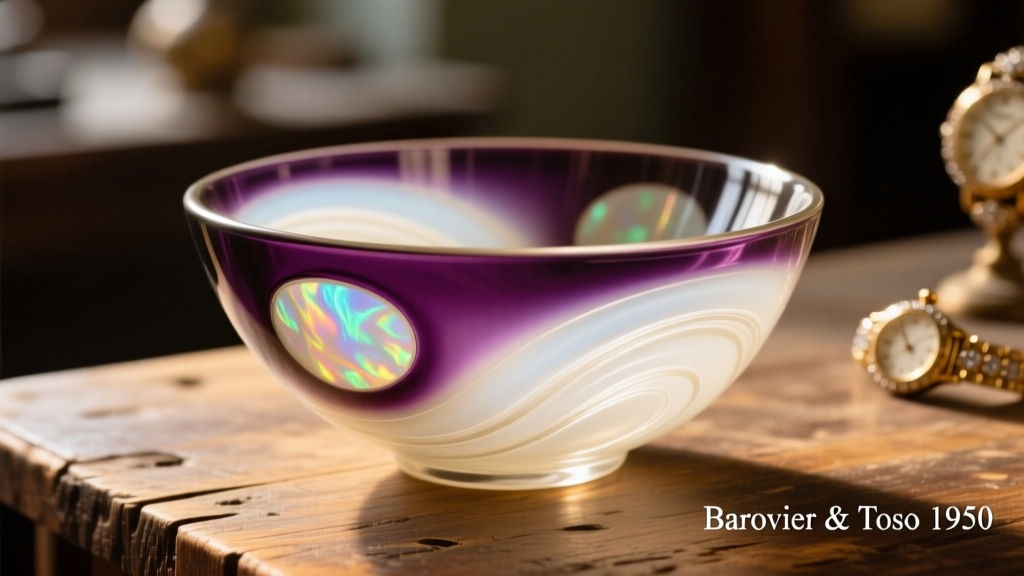
A 1950s Barovier & Toso Venetian Glass Bowl: Opaline and Amethyst Dual-Tone Mastery in Murano Craftsmanship
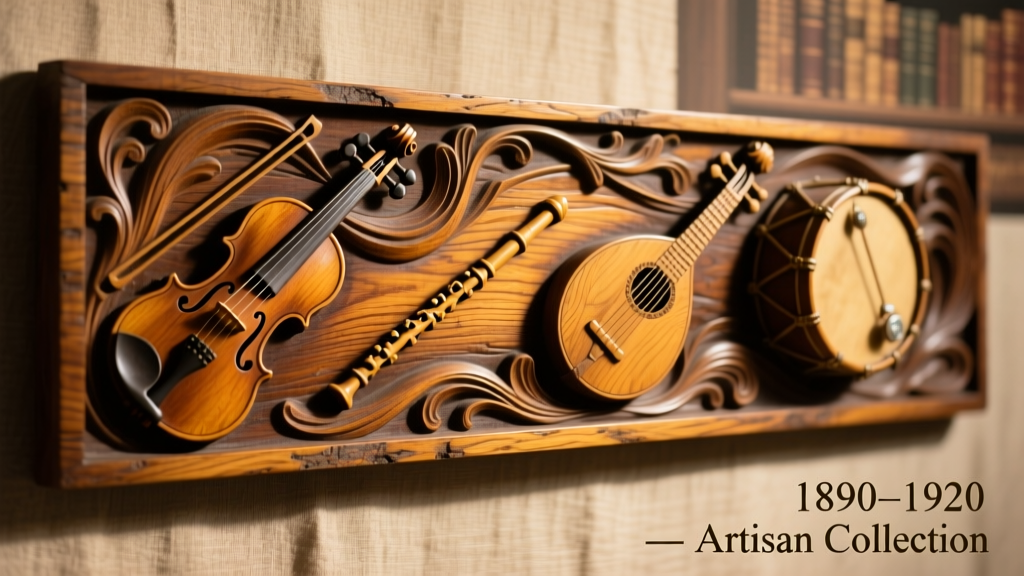
Oak Panel Carving: Musical Instruments in High Relief — A 19th-Century English Masterwork (51½ × 28 in)
Banks Mechanical Creedmoor: The 1870s Automaton That Captured Victorian Marksmanship in Brass and Steel
Black Americana Doll: Black Man With Saxophone — German Manufacture, Cultural Context, and Auction Value

Ohr Teapot: Applied Handle, Hand-Formed Spout, Signed Lid — A Study in American Studio Ceramics
Orphan Annie Light Bulb Christmas Figural: A Rare Mid-Century American Collectible
Silver Deposit Honey Pot with Bee Finial, Circa 1910: A Study in Edwardian Craftsmanship and Apicultural Symbolism
Handel: The Forgotten American Master of Art Deco Clocks and Lamps
Frankoma Pottery Buffalo Plate (1979): A Collector’s Guide to the Iconic Oklahoma Stoneware