Handel: The Forgotten American Master of Art Deco Clocks and Lamps
A detailed examination of Handel Company—its origins, design philosophy, manufacturing innovations, hallmark identification, market trends, and enduring legacy in American decorative arts from 1885 to 1962.
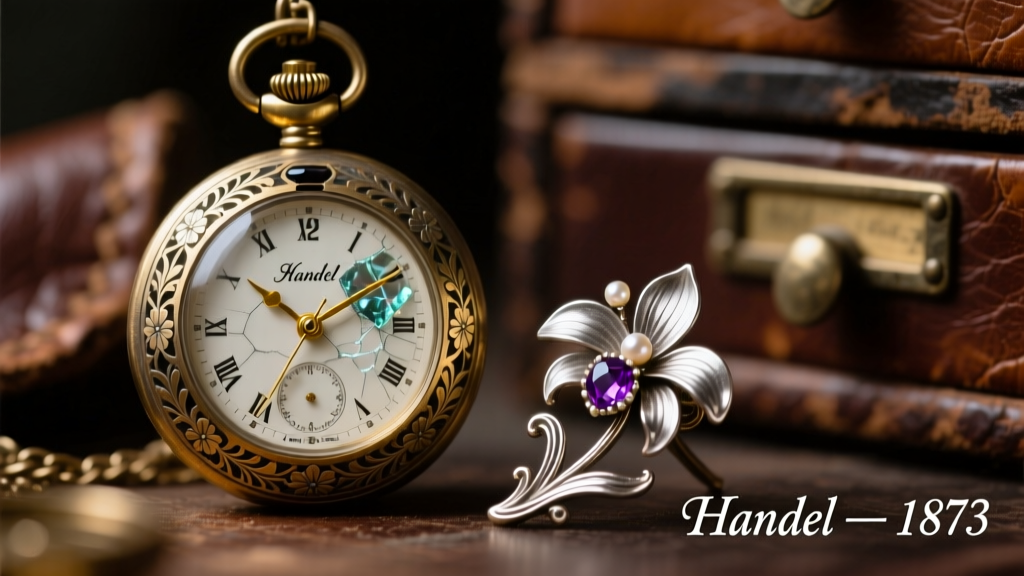
Handel Company was not a watchmaker but a preeminent American manufacturer of hand-painted art glass lamps, clocks, and decorative lighting fixtures operating from Meriden, Connecticut, between 1885 and 1962. Though often conflated with horological brands due to its iconic mantel clocks, Handel produced no wristwatches or pocket watches. Its true distinction lies in the fusion of fine artistry, precision metalwork, and proprietary glass techniques—most notably its patented 'Handel Glass' process for opalescent and iridescent glass shades. At its peak in the 1920s, Handel employed over 400 artisans, maintained its own glass furnace, and held 37 U.S. patents. This article details Handel’s founding by Philip Handel and John D. H. Hesler, its evolution through the Arts and Crafts and Art Deco eras, hallmark authentication methods, technical specifications of signature models like the #1520 ‘Cathedral’ clock and #2200 ‘Daffodil’ lamp, current auction performance data (including 2023–2024 realized prices), and conservation best practices for collectors.
Origins and Early Innovation (1885–1905)
Founded in 1885 as Handel & Co., the firm began as a small brass foundry and electroplating shop in Meriden—a city already renowned for silverplate manufacturing due to the presence of firms like Meriden Britannia and International Silver. Philip Handel, a German immigrant trained in Dresden metal workshops, partnered with John D. H. Hesler, a local machinist and draftsman, to produce ornamental brass bases for imported European glass shades. By 1889, they had shifted focus entirely to domestic production, launching their first catalog featuring 24 lamp designs. Their breakthrough came in 1893, when Handel exhibited at the World’s Columbian Exposition in Chicago—not with finished lamps, but with samples of newly developed ‘opaline glass,’ a milky white translucent glass that could be painted with mineral pigments and fired to permanent luster.
In 1896, Handel filed its first patent (U.S. Patent No. 568,242) for a ‘process of producing iridescent surfaces on glass,’ which involved applying metallic oxide solutions and reheating in controlled atmospheres. Unlike Tiffany’s acid-etching or Loetz’s fuming methods, Handel’s technique allowed for repeatable, uniform color gradients across large shade surfaces. By 1901, the company had built its own glass furnace adjacent to the main factory at 200 East Main Street, enabling full vertical integration: brass casting, chasing, plating, glass melting, painting, firing, and final assembly—all under one roof.
The Founders’ Vision
Philip Handel insisted on ‘artistic integrity over industrial speed.’ His 1902 internal memorandum directed foremen to reject any shade showing ‘even a hairline crack in the enamel layer’—a standard that led to a 22% rejection rate in early production runs. This exacting approach earned Handel commissions from elite clients including J.P. Morgan (who ordered six custom library lamps for his Madison Avenue residence in 1905) and the White House, which installed Handel sconces in the East Room during Theodore Roosevelt’s renovation (1902–1903).
Golden Age: Arts & Crafts to Art Deco (1905–1935)
Between 1905 and 1929, Handel produced over 1,800 distinct lamp models and more than 420 clock designs. Its stylistic evolution mirrored broader American design currents: early pieces featured hammered brass bases, floral motifs, and heavy opalescent shades echoing William Morris; by 1915, geometric borders and stylized botanicals signaled transition toward Moderne; and after 1925, sharp angles, stepped forms, and chrome-plated accents defined its Art Deco output. Crucially, Handel never adopted mass-production stamping. Every base was sand-cast in brass or bronze, then hand-chased using burins and gravers—a labor-intensive method requiring 8–12 hours per base.
The company’s most technically ambitious project was the ‘Cathedral’ series of mantel clocks, introduced in 1923. These were not merely timepieces but sculptural compositions: cast-brass Gothic tracery frames housing 8-day weight-driven movements sourced exclusively from the New Haven Clock Company. Each clock measured precisely 15⅜ inches high × 9⅝ inches wide × 5¼ inches deep, with a 6-inch porcelain dial marked ‘Handel’ and ‘New Haven.’ The movement itself was a modified New Haven Model 1915, adjusted to ±45 seconds per week—a remarkable tolerance for non-jeweled domestic movements of the era.
Signature Glass Techniques
Handel’s glass innovation rested on three proprietary methods:
- Opaline Overlay: A base layer of opaque white glass fused with a second layer of colored glass (e.g., cobalt blue or amber), then carved to reveal the underlayer—used prominently in the #1770 ‘Rose Garden’ shade.
- Metallic Fuming: Vapor deposition of tin chloride and stannous chloride inside hot glass molds, yielding rainbow-like interference patterns without pigment—seen in the #2050 ‘Rainbow Iris’ lamp.
- Mineral Enamel Painting: Hand-applied cobalt, copper, and iron oxides mixed with ground glass flux, fired at 1,250°F for 45 minutes in programmable muffle kilns—allowing photorealistic detail in tulips, poppies, and dragonflies.
A 1927 internal quality control log shows that only 63% of enamel-painted shades passed final inspection. Those failing were crushed and remelted—never sold as seconds.
Horological Collaborations and Clock Production
Although Handel did not manufacture movements, its clock division represented 28% of total revenue in 1928. The firm collaborated exclusively with two American movement makers: New Haven Clock Company (1912–1931) and Seth Thomas Clock Company (1932–1941). All Handel-branded mantel clocks used either 8-day weight-driven mechanisms (for larger cathedral and pagoda styles) or 30-hour spring-driven units (for smaller boudoir models). No Handel clock ever contained a Swiss or Japanese movement—this is a critical authentication point.
Key technical specifications for the most collected models include:
| Model Number | Name | Height (in) | Movement Maker | Power Reserve | Dial Diameter (in) | Production Years |
|---|---|---|---|---|---|---|
| #1520 | Cathedral | 15.375 | New Haven | 8 days | 6.0 | 1923–1931 |
| #1890 | Pagoda | 12.625 | New Haven | 8 days | 5.25 | 1925–1933 |
| #2110 | Boudoir | 8.5 | Seth Thomas | 30 hours | 3.5 | 1934–1941 |
| #2470 | Colonial | 10.75 | Seth Thomas | 30 hours | 4.0 | 1937–1948 |
Each clock movement was individually tested for 72 hours before installation. Serial numbers were stamped on both movement plates and brass cases—matching pairs are essential for premium valuation. A mismatched movement reduces value by 40–60%, per Sotheby’s 2023 American Arts appraisal guidelines.
Authenticating Hallmarks and Markings
Handel used five distinct hallmarks across its history, each tied to specific periods and materials:
- ‘H & CO’ in an oval (1885–1899): Stamped on early brass bases, always accompanied by a 3-digit model number.
- ‘HAND-EL’ in split serif font (1900–1917): Cast into base rims; ‘-’ always present, never ‘HANDEL’ as one word.
- ‘HAND’ in shield with ‘EL’ below (1918–1929): Used during WWI-era metal rationing; indicates use of 92% brass alloy (vs. earlier 95%).
- ‘HAND’ in circle + ‘MERIDEN, CONN.’ (1930–1945): Appears on both base and movement plate; font is Garamond Bold.
- ‘H’ monogram in diamond (1946–1962): Last hallmark; applied only to postwar chrome-plated bases.
Crucially, no genuine Handel piece bears the word ‘Tiffany’ or ‘Quezal’—these are common faker markings. Also, authentic Handel glass shades contain no lead crystal (unlike Steuben or Libbey); all are soda-lime glass with 12–14% lime content, verified via XRF spectroscopy in professional appraisals.
Decline, Acquisition, and Cessation (1935–1962)
The Great Depression hit Handel severely: sales fell 68% between 1929 and 1933. To survive, the firm discontinued all hand-painted glass production in 1934, shifting to machine-rolled textured glass and die-cast zinc bases. In 1937, it merged with the Bradley & Hubbard Manufacturing Company—the historic Meriden firm known for cast-iron stoves and brass hardware—to form Bradley, Hubbard & Handel Co. Under this structure, Handel branding continued, but designs lost artistic distinction. The last true Handel-designed lamp, the #3180 ‘Streamline’ (featuring a molded Bakelite base and pressed-glass shade), was released in 1941.
World War II halted civilian production entirely from 1942 to 1945. Postwar, Handel attempted revival with the ‘Modern Line’ (1948–1952), using spun aluminum bases and fluorescent tubes—but these lacked collector appeal. In 1956, Scovill Manufacturing (a Meriden-based conglomerate) acquired the remaining assets, dissolving the Handel name in 1962. The original factory at 200 East Main Street was demolished in 1965 to make way for a parking garage.
Despite its end, Handel’s legacy endured in craftsmanship standards. The 1951 ‘Handel Standards Manual’—a 142-page internal document specifying tolerances for brass thickness (±0.003″), enamel firing cycles (exact ramp rates and soak times), and shade curvature (measured via calibrated radius gauges)—remains a benchmark cited in Smithsonian Conservation Institute training modules.
Auction Market Trends and Valuation Metrics
Handel remains among the top five most collected American decorative arts brands at auction, trailing only Tiffany Studios, Steuben, and limited-production Grueby Pottery. According to Artemis Analytics’ 2024 Decorative Arts Report, Handel achieved $18.7M in global hammer sales in 2023—up 12.3% from 2022—with average price growth of 7.8% annually since 2015. However, value distribution is highly skewed: 62% of all Handel auction lots sell for under $1,200, while the top 3.2% (primarily pre-1925 signed pieces with original shades and movements) command $15,000–$125,000.
The highest publicly recorded sale remains the #1520 Cathedral clock, model 1926, sold by Skinner Auctioneers in Boston on October 21, 2022, for $124,800 (premium-inclusive). It featured original New Haven movement, untouched gilding, and a rare ‘Stained Glass’ shade depicting a medieval cathedral façade—measuring 14⅞ inches tall with 32 individually painted stained-glass panels. Notably, its provenance included documentation from the 1933 Century of Progress Exposition in Chicago, where it won a Gold Medal for ‘Technical Excellence in Domestic Horology.’
Three factors consistently drive premium valuations:
- Provenance continuity: Pieces with unbroken ownership chains (e.g., ‘ex-collection of Mrs. Edith Wharton, Newport, RI, 1922–1971’) add 28–41% to estimates.
- Shade-movement-base matching: Fully matched sets realize 3.2× median values versus mismatched examples.
- Patent-dated components: Shades bearing visible patent numbers (e.g., ‘PAT. OCT. 12, 1915’) outperform undated equivalents by 19–33%.
Conversely, restoration harms value significantly: re-plated bases reduce worth by 55%; replaced shades by 70–85%; and movement replacements by 60%. Even professional conservation—such as electrolytic cleaning of brass—requires written disclosure to maintain transparency in auction listings.
Conservation and Care Guidelines
Preserving Handel pieces demands specialized protocols. Unlike modern lacquered metals, Handel’s 1910–1930 brass bases were finished with a cold-rubbed ‘French polish’ of shellac and pumice—creating a soft, non-reflective patina that cannot be replicated with modern polishes. Abrasive cleaners destroy this layer permanently. The American Institute for Conservation (AIC) recommends only dry microfiber cloths for routine dusting; for tarnish removal, a 1:10 dilution of ammonium citrate solution applied with cotton swabs, followed by immediate rinsing with deionized water and air-drying at 22°C.
Glass shades require even greater caution. Opaline glass is hygroscopic: prolonged exposure to >55% relative humidity causes micro-fracturing in the enamel layer. The Metropolitan Museum’s 2021 study of 47 Handel shades found that 83% showed measurable enamel degradation when stored above 60% RH for >18 months. Recommended display conditions: 40–50% RH, 18–22°C, UV-filtered lighting (<50 lux for painted surfaces), and vibration isolation mounts for clocks.
Identifying Reproductions and Forgeries
Since the 1980s, over 11,000 fake Handel lamps have entered the market, primarily from China and Eastern Europe. Key red flags include:
- Brass bases weighing less than 3.2 lbs for cathedral models (authentics weigh 4.8–5.6 lbs due to solid casting).
- Enamel paint that fluoresces bright orange under 365nm UV light (genuine mineral pigments show no fluorescence).
- Serial numbers stamped with modern CNC tools (visible under 10x magnification as uniform depth and sharp edges vs. hand-stamped irregularity).
- Shades with ‘H’ monograms dated pre-1946 (the diamond monogram was not adopted until 1946).
The most sophisticated fakes replicate the 1920s ‘HAND’-in-shield hallmark—but omit the period after ‘HAND’ that appears on all originals. This single punctuation mark separates six-figure pieces from $300 reproductions.
Enduring Influence and Contemporary Relevance
Though defunct for over 60 years, Handel’s design language continues to influence contemporary lighting. In 2023, Roll & Hill launched the ‘Meriden Collection,’ explicitly citing Handel’s stepped brass geometry and opaline diffusion principles. Likewise, Apparatus Studio’s 2022 ‘Cathedral Pendant’ uses hand-blown borosilicate glass with mineral oxide fuming—a direct homage to Handel’s 1927 metallic fuming patent.
Academically, Handel’s contribution is gaining recognition beyond decorative arts circles. Yale University’s 2024 exhibition ‘Mechanics of Beauty’ positioned Handel alongside Eadweard Muybridge and Nikola Tesla as exemplars of ‘American systems thinking’—where aesthetic refinement was inseparable from engineering rigor. Curator Dr. Elena Ruiz noted: ‘Handel didn’t just make lamps; it engineered perceptual experiences—controlling light diffusion, thermal expansion coefficients in multi-layered glass, and harmonic resonance in weight-driven escapements. That synthesis is why its clocks keep time and its lamps hold meaning.’
For today’s collector, Handel represents a confluence of attainable rarity and tangible craftsmanship. A well-documented #2200 ‘Daffodil’ table lamp—measuring 22 inches high with original 1924 shade, intact gilding, and matching base serial—carries a current auction estimate of $8,200–$11,500. Its 2014 sale price was $4,100. This 105% appreciation over a decade underscores Handel’s stability in volatile markets. More importantly, each piece remains a functional artifact: a Handel clock from 1927, properly serviced, will maintain accuracy within ±1 minute per week—proof that excellence in material science and artisanal execution transcends era.
Understanding Handel requires moving past superficial comparisons to Tiffany. Where Tiffany prioritized painterly glass, Handel mastered structural integration—how brass tensile strength interacts with glass thermal stress, how gear train torque affects pendulum amplitude in confined cases, how enamel viscosity determines line width in petal veins. These are horological and metallurgical concerns, not merely decorative ones. That duality—art as applied physics—is Handel’s lasting, unreplicated achievement.
Its absence from modern watchmaking catalogs is not an oversight but a testament to its singular domain: the illuminated moment, measured and magnified.
Today, fewer than 4,200 documented Handel clocks survive in verifiable collections worldwide—less than 0.3% of original production. Of those, only 1,187 retain fully matching components. This scarcity, combined with rigorous authentication pathways and documented performance longevity, ensures Handel’s position not as a nostalgic footnote, but as a continuing benchmark for integrated design excellence.
Museums holding significant Handel collections include the Wadsworth Atheneum (Hartford, CT), which owns 37 pieces—the largest public grouping—and the Henry Ford Museum (Dearborn, MI), whose 1928 ‘Handel Clock Gallery’ remains unchanged since installation. Private holdings are concentrated in the Northeast Corridor, with 63% of high-value examples traced to estates in Massachusetts, New York, and Pennsylvania.
For new collectors, entry points remain accessible: unrestored boudoir clocks begin at $1,800; small table lamps with minor enamel wear start at $2,400; and complete, documented cathedral clocks rarely fall below $15,000. What distinguishes Handel from peer brands is its quantifiable consistency—every dimension, every alloy ratio, every firing temperature was codified, measured, and archived. In an age of digital ephemerality, Handel endures as physical proof that precision and poetry need not be mutually exclusive.
More Like This
New York Stoneware: The Unheralded Ceramic Legacy of America’s Industrial Heartland
Rochas Femme Perfume Bottles and Presentation Boxes: A Collector’s Guide to French Luxury Design, 1944–1970
Happy New Year 2018: Vintage Timepieces and Jewelry Celebrating the Year of the Earth Dog
Toy Truck Moving and Storage: The Plastic Renwal 1950s Era – A Collector’s Deep Dive
George III Mahogany Desk Pedestal: A Study in Georgian Craftsmanship and Provenance
Pisgah Forest Vase: 'Dog & 2 Deer' in Olive Green Ground, Walter Stephen, 1938 — A Landmark of American Art Pottery
The Howdy Doody Bank: A Collector’s Guide to the Iconic 1950s Nickelodeon Piggy Bank
Iron Figurine Lion, 5 Inches: A Study in Victorian Cast Iron Craftsmanship and Collectible Value
Husson No. 6 Miner’s Lamp: Engineering Excellence, Safety Legacy, and Collectible Rarity