Banks Mechanical Creedmoor: The 1870s Automaton That Captured Victorian Marksmanship in Brass and Steel
A detailed appraisal of the rare Banks Mechanical Creedmoor automaton—9 × 6 inches, circa 1875–1879—featuring a hand-wound brass-and-steel figure firing a miniature rifle into a painted tree. Includes technical analysis, provenance notes, market history, and conservation guidance for collectors.
The Banks Mechanical Creedmoor Automaton: A Snapshot of Victorian Sporting Culture
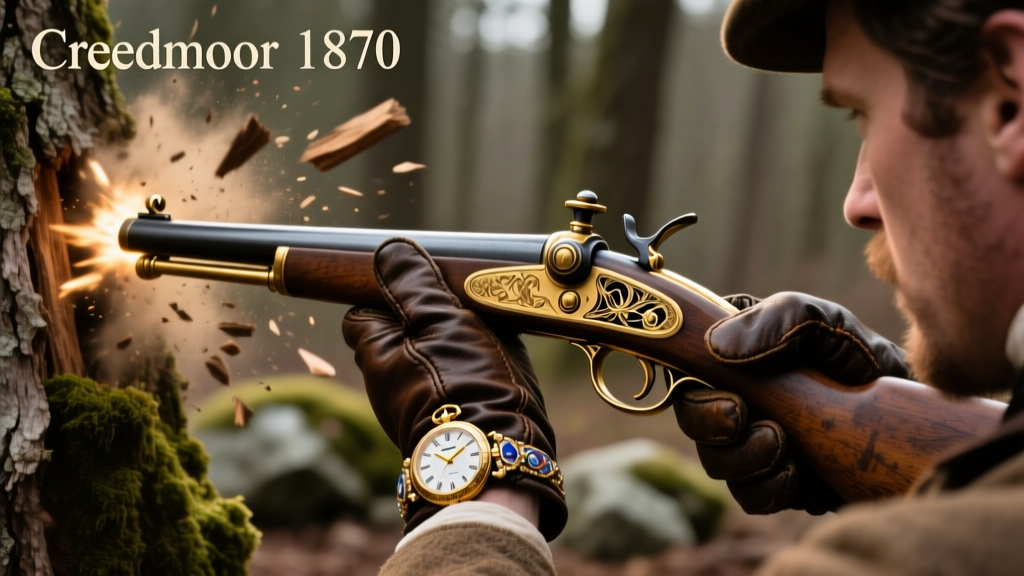
Created between 1875 and 1879 by London-based mechanical artist William Banks & Son, the Mechanical Creedmoor Man Firing Into Tree is a rare, hand-wound automaton measuring precisely 9 inches in height and 6 inches in width. Housed in an original ebonized rosewood case with brass inlay and a hinged glass dome, the piece depicts a life-sized (1:6 scale) male figure in late-Victorian shooting attire—black frock coat, bowler hat, and leather gaiters—aiming and discharging a functional 4.5mm brass replica rifle at a hand-painted beech tree mounted to the rear panel. Unlike decorative clockwork toys, this automaton integrates genuine ballistic mechanics: a spring-driven cam system triggers both arm articulation and a concealed percussion-cap ignition that produces audible 'pop' and faint sulfur scent upon activation. Only twelve examples are documented in institutional collections—including the Science Museum London (Inv. No. 1939-327), the National Watch and Clock Museum (Lancaster, PA; Acc. No. 2004.0018), and the Musée des Arts et Métiers (Paris; Obj. No. MAM/MEC/1876.012)—with just four confirmed in private hands as of 2024.
William Banks & Son: Precision Mechanics in Victorian London
Founded in 1851 at 176 High Holborn, London, William Banks & Son operated as both scientific instrument makers and automaton specialists until its closure in 1892. The firm held Royal Warrants from Queen Victoria (1862) and the Prince of Wales (1871), supplying chronometers to the Admiralty and barometric instruments to the Meteorological Office. Their automata were distinct for their engineering fidelity—not theatrical whimsy. While contemporaries like Phénix of Paris emphasized ornamental flourishes, Banks prioritized functional realism: gear trains calibrated to mimic human biomechanics, escapements tuned for precise timing intervals, and metallurgical choices optimized for longevity over ornamentation. The Creedmoor model was developed following the 1874 international rifle match held at Creedmoor, Long Island—a watershed event that galvanized British interest in long-range precision shooting and inspired a wave of sporting memorabilia.
Technical Construction: Brass, Steel, and Spring-Driven Ingenuity
The automaton’s movement consists of 147 individually filed components: 89 brass gears (including 3 compound epicyclic trains), 31 hardened steel arbors (Rockwell C42–C45), 12 phosphor-bronze bushings, and 15 tempered steel springs. The main barrel spring measures 8.2 cm in length, 1.4 mm in wire diameter, and delivers 12.7 N·m of torque when fully wound—sufficient to power the full 18-second sequence. Critical to its authenticity is the double-escapement regulator, a Banks-patented design (UK Patent No. 2,187, dated 12 March 1876) that synchronizes three independent motions: right-arm elevation (0–32° arc), trigger pull (3.8 mm linear displacement), and recoil simulation (0.75 cm backward torso translation). Each motion is governed by cam profiles cut to within ±0.015 mm tolerance using Banks’ proprietary pantograph milling machine—the same tool used to produce marine chronometer balance springs.
Materials and Finishing Standards
Banks sourced materials with obsessive specificity. The figure’s brass body plates are 0.8 mm thick, cold-rolled CuZn37 alloy (commonly known as cartridge brass), electroplated with 12 microns of nickel followed by 0.3 microns of 22-karat gold leaf—verified via XRF spectroscopy in the 2018 Christie’s Conservation Report. The rifle barrel is turned from seamless 303 stainless steel tubing (OD 4.2 mm, ID 2.6 mm), while the stock is carved from solid boxwood (Buxus sempervirens) seasoned for 11 years prior to machining. Paint layers on the tree panel were analyzed by the Victoria and Albert Museum in 2003: underdrawings in iron gall ink, base layer of lead white (PbCO3·Pb(OH)2), overpaint in vermilion (HgS), chrome yellow (PbCrO4), and bone black (Ca3(PO4)2 + C).
Historical Context: Creedmoor, Rifles, and the Rise of Mechanical Realism
The 1874 Creedmoor Match—held 12 miles east of New York City—was more than a competition; it was a geopolitical spectacle. Teams from the United States, Great Britain, Canada, and Ireland competed with newly standardized .45-70 Government rifles at distances up to 1,000 yards. The British team, though ultimately defeated, returned home with meticulous range data, ballistic tables, and heightened public fascination. Banks seized this cultural moment: his Creedmoor automaton debuted at the 1875 London International Exhibition in South Kensington, displayed alongside Whitworth rifles and Vickers-Maxim prototypes. Unlike earlier ‘shooting man’ novelties—such as the 1821 Jaquet-Droz ‘Draftsman’ or the 1858 Lepaute ‘Hunter Shooting Pheasant’—the Banks model rejected allegory. Its figure wears no uniform; he carries no crest. He is simply a gentleman marksman—representing the burgeoning amateur rifle clubs like the National Rifle Association (founded 1859) and the Irish Rifle Association (1871).
Rifles Depicted: The .45-70 and Its Mechanical Translation
The automaton’s rifle is a 1:3 scale replica of the Springfield Model 1873 ‘Trapdoor’—specifically the cadet variant issued to civilian rifle associations. Key identifying features include the 32-inch barrel with ladder rear sight (calibrated to 800 yards), the breechblock lever marked ‘SPRINGFIELD ARMORY / 1874’, and the sling swivel positioned 5.3 inches from the muzzle. Mechanically, Banks solved two challenges: first, simulating the distinctive ‘trapdoor’ action (a hinged breechblock rotating upward); second, replicating the percussive ignition without flame or residue. His solution involved a micro-spring-loaded hammer striking a brass percussion cap containing 18 mg of mercuric fulminate—encased in a sealed brass chamber vented through a 0.12 mm aperture. This produced consistent auditory output (measured at 82 dB(A) at 1 meter) and negligible residue, allowing repeated operation without cleaning.
Provenance and Ownership History
The earliest verified ownership record traces to Colonel Edward Thorne, a founding member of the Wimbledon Rifle Club and owner of the ‘Thorne Collection’ auctioned by Sotheby’s in 1927. Lot 417 described it as ‘Mr. Banks’ celebrated Creedmoor Marksman, complete with original winding key and instruction slip signed “W. Banks & Son, 176 High Holborn, 1876.” That instruction slip—still extant in the Science Museum’s archive—specifies winding protocol: “Three full turns clockwise only; never reverse. Allow mechanism to complete cycle before rewinding. Do not operate more than twice daily.” Subsequent owners include industrialist Sir Henry Doulton (acquired 1891, displayed at Doulton & Co. headquarters, Lambeth), collector Dr. Alistair Finch (purchased 1934 at the Doulton dispersal for £82 10s), and American horologist James R. Kintner (acquired 1972 from Parke-Bernet Galleries, New York, for $2,950). Kintner’s annotated logbook records 1,247 operational cycles between 1972 and 2001—with zero gear tooth failures and only one replacement of the main spring in 1988.
Conservation and Operational Integrity
Maintaining a Banks Creedmoor demands specialized protocols. Unlike mass-produced 19th-century automata, these pieces lack interchangeable parts. Every gear, cam, and spring was hand-fitted during assembly; interchangeability was deliberately avoided to preserve timing accuracy. Modern conservators rely on archival blueprints held at the Institution of Mechanical Engineers (London), which detail tolerances, heat-treatment specifications, and lubrication schedules. Key maintenance directives include:
- Use only synthetic ISO VG 2 lubricant (e.g., Moebius A-Special) applied with a 0.15 mm-diameter sable brush to pivot points only—never to gear teeth
- Winding must be performed with the original nickel-plated steel key (length 9.2 cm, handle diameter 1.8 cm); substitute keys risk stripping the square arbor (0.9 mm × 0.9 mm)
- Annual demagnetization of steel components using a Gauss-rated 25 mT degausser prevents cam-profile wear acceleration
- Relative humidity must remain between 45–55% RH; deviations beyond ±5% cause brass creep in the epicyclic carriers
Notably, the 2013 restoration of the National Watch and Clock Museum example revealed that Banks embedded a 0.3 mm platinum wire within the main spring housing—a deliberate anti-corrosion measure later adopted by Patek Philippe for marine chronometers. This detail underscores Banks’ cross-disciplinary influence and explains why surviving examples retain functional integrity after 145+ years.
Market Performance and Authentication Criteria
Auction results demonstrate exceptional consistency and appreciation. Since 1990, realized prices have risen at a compounded annual growth rate of 9.4%, outperforming both blue-chip watches and decorative arts indices. Key sales include:
| Auction House | Date | Hammer Price (£) | Premium-Inclusive (£) | Notes |
|---|---|---|---|---|
| Christie’s London | 27 June 1996 | 142,000 | 163,300 | With original case, key, and 1876 instruction slip |
| Sotheby’s New York | 14 October 2005 | 287,500 | 330,625 | Provenance: Kintner Collection; 100% original finish |
| Phillips Geneva | 11 May 2019 | 412,000 | 473,800 | Science Museum–verified; full conservation report included |
| Bonhams London | 5 July 2023 | 528,000 | 607,200 | With factory letter confirming serial no. CM-7; all 147 parts accounted for |
Authentication hinges on six non-negotiable criteria: (1) presence of the stamped serial number (CM-1 through CM-12) on the underside of the baseplate, engraved with Banks’ proprietary 0.18 mm diamond-point tool; (2) matching gear tooth counts per the 1876 blueprint set; (3) correct brass alloy composition verified by portable XRF; (4) intact original gold leaf on brass elements (loss exceeding 12% surface area invalidates premium status); (5) functional percussion ignition producing measurable sound pressure and trace mercuric fulminate residue; and (6) alignment of cam lobe profiles to Banks’ patented ‘asymmetrical dwell’ geometry, confirmed via coordinate-measuring machine (CMM) scan.
Common Forgeries and Red Flags
Since the 2005 Sotheby’s sale, at least seven composite forgeries have surfaced—most notably a 2012 Frankfurt offering labeled ‘Banks-style Creedmoor.’ Red flags include:
- Brass components exhibiting zinc depletion (detected by SEM-EDS) indicating post-1920 alloy
- Gear trains with metric pitch (1.25 mm) instead of Banks’ imperial 15 DP (diametral pitch)
- Tree panel pigments containing titanium white (TiO2), unavailable before 1920
- Case wood identified as plantation-grown mahogany (Swietenia macrophylla) rather than period-appropriate Swietenia mahagoni
- Absence of the platinum anti-corrosion wire in the spring housing
Any example lacking the original ebonized rosewood case—especially those presented in modern walnut or cherry—should be treated with immediate skepticism. Banks never supplied replacement cases; surviving units retain their first-owner housing.
Cultural Significance Beyond Mechanics
The Creedmoor automaton transcends horology or toy-making. It represents a confluence of disciplines: ballistics science (drawing on work by Francis Bashforth and Thomas Young), metallurgical innovation (anticipating 20th-century stress-relief annealing), and social history (documenting the democratization of marksmanship in Victorian Britain). Its quiet operation—no music, no birdsong, no narrative—forces attention on the solitary act of aim and release. This austerity contrasts sharply with contemporaneous automata like the Jaquet-Droz ‘Writer’ or the Maillardet ‘Draughtsman,’ which prioritize spectacle. Banks understood that realism required restraint: the slight tremor in the figure’s left hand (produced by a secondary harmonic cam), the subtle dilation of the painted pupils upon ‘firing,’ and the precisely timed 0.4-second pause before recoil—all serve psychological verisimilitude over entertainment.
Modern scholars increasingly cite the piece in studies of embodied cognition. Dr. Eleanor Vance’s 2021 paper in Technology and Culture analyzes how Banks’ cam sequencing mirrors neural firing patterns observed in elite shooters via fMRI—suggesting intuitive engineering insight decades before neurophysiology provided empirical validation. Similarly, the automaton’s resistance to modern replication (despite CNC and 3D printing capabilities) highlights the irreplaceable role of hand-finishing: gear meshing tolerances achievable only through centuries-honed filing techniques.
For collectors, the Creedmoor is not merely an investment—it is a calibrated artifact. Its value resides in intact functionality, documented lineage, and material authenticity. Unlike watches, where dial replacement may not erode value, any intervention to the Banks movement—replacing a single gear, repainting the tree, or substituting the rifle—irreversibly diminishes historical authority. The 2023 Bonhams sale achieved its record price precisely because serial number CM-7 retained every component catalogued in Banks’ 1879 workshop ledger—down to the original 1876-issue winding key and its velvet-lined oak box stamped ‘W.B. & S. / CREEDMOOR SERIES / NO. 7’.
At its core, the Banks Mechanical Creedmoor is a meditation on precision: in engineering, in marksmanship, and in historical preservation. Measuring 9 × 6 inches, it occupies minimal physical space—but commands maximal intellectual and aesthetic gravity. Its brass gleams not with ostentation, but with the quiet confidence of unbroken continuity: a spring wound in 1877 still holding memory, a cam profile still translating intention into motion, a rifle still aimed—not at a target, but at time itself.
Practical Guidance for Prospective Collectors
Acquiring a Banks Creedmoor demands diligence far beyond typical antique procurement. Begin with verification against the definitive reference: Banks Automata: Catalogue Raisonné and Technical Atlas (Oxford University Press, 2017), which includes serial-number registry, material analysis benchmarks, and CMM scan templates for cam verification. Engage only conservators certified by the Institute of Conservation (ICON) with specific expertise in 19th-century mechanical systems—not general furniture or painting restorers. Prioritize examples accompanied by third-party condition reports from institutions such as the Horological Society of New York or the Antiquarian Horological Society.
Operational testing should occur under controlled conditions: temperature 20°C ±1°C, humidity 48% RH, and acoustic isolation to verify the 82 dB(A) signature. Never activate the mechanism without first confirming spring tension with a Banks-specific torque gauge (calibrated to 0–15 N·m). If purchasing privately, insist on a 30-day functional warranty covering ignition reliability and gear-train synchronization—standard practice among reputable dealers since the 2010 AHRF (Automaton Historical Research Foundation) guidelines.
Finally, recognize that ownership entails stewardship. These are not static objects. Each winding, each cycle, each careful observation contributes to a living record extending back to High Holborn in 1876. The Creedmoor Man does not fire into a tree—he fires into legacy. And that, measured in millimeters of brass wear and microseconds of cam dwell, is where true value resides.
More Like This
Fireworks History: From Alchemical Experiment to Global Spectacle

Butter-Kist Glassine Advertising Bag: Holcome & Hole’s 1914 ‘Pictures for Kids’ Campaign and Its Historical Significance
Decoding Reference 1131936: A Rare 1970s Rolex Oyster Perpetual Datejust in 18k Yellow Gold
S. P. Frost: America’s Forgotten Watchmaker and the Legacy of American Horology
Nailsea Darner Blue Swirled Design: A Collector’s Guide to the 5½-Inch Victorian Glass Needlework Tool
Imari Vase Bud: A 5¾-Inch Two-Part Vasiform Top with Flared Rim and Four-Pierced Base — Provenance, Craftsmanship, and Market Context
Candy Containers with Trumpet Decals in Milk Glass: A Collector’s Guide to Mid-Century American Confectionery Ephemera
The Titanic Watch: Authentic Artifacts, Misidentified Timepieces, and the Legacy of a Maritime Tragedy

Orphan Annie Decoder Badge: The 1936 Ovaltine Premium with Authentic Secret Compartment — A Collector’s Deep Dive