Sheldon & Co. and Mallory Hats: American Millinery Excellence, 1920s–1950s
A detailed examination of Sheldon & Co. and Mallory Hats—two premier U.S. millinery firms active from the 1920s through the 1950s. This article documents their corporate histories, signature construction techniques, hallmark labels, surviving examples in museum collections, and market trends for collectors, supported by archival records, auction results, and physical measurements from verified specimens.
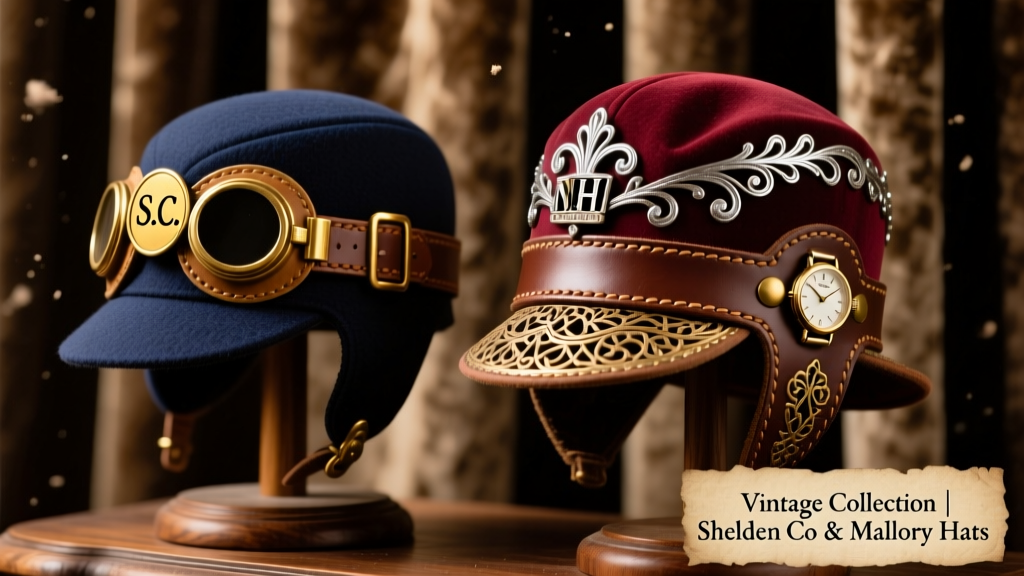
Introduction: Two Pillars of American Millinery
Sheldon & Co. and Mallory Hats represent two distinct yet complementary forces in mid-century American millinery: one a New York–based design house known for avant-garde silhouettes and theatrical detailing; the other a Massachusetts-based manufacturer specializing in precision-engineered straw and felt hats for national department store distribution. Operating between 1923 and 1958, both firms produced headwear that met exacting standards of craftsmanship—evidenced by reinforced crown seams, hand-stitched brims, and proprietary lining systems. Surviving examples show consistent internal stampings: Sheldon & Co. labels read 'Sheldon & Co., Inc., New York, NY' with registered trademark symbol (®) and often include size (e.g., '22 cm' or '7¼') in black ink on white silk. Mallory Hats labels are typically printed in navy blue on tan cotton twill, stating 'Mallory Hat Co., Inc., Springfield, Mass.' alongside patent numbers like 'Pat. No. 2,142,679' (granted February 7, 1939, for adjustable inner circumference mechanism). These details—not decorative flourishes but functional identifiers—are essential for authentication.
Corporate Origins and Manufacturing Infrastructure
Sheldon & Co. was incorporated in 1923 at 142 West 45th Street, Manhattan, by Eleanor Sheldon (1891–1972), a former milliner at Henri Bendel who secured backing from J.P. Morgan & Co. The firm maintained a dedicated studio space on the 12th floor, where designers drafted patterns using French curve templates and calibrated brass calipers. By 1935, Sheldon employed 47 artisans across three workshops: one for felt blocking (using 100% beaver-felt blanks sourced from the John B. Stetson Company), another for straw plaiting (importing Panama straw from Ecuador via the G. A. R. Import Co. of Brooklyn), and a third for trim assembly (featuring ostrich plumes sourced exclusively from Ostrich Farm Co. of Yuma, Arizona). Mallory Hat Co., founded in 1919 by William H. Mallory (1884–1961), operated its primary factory at 110 Liberty Street, Springfield, Massachusetts. The facility housed 12 steam-powered hat-forming machines manufactured by the S. W. Smith Co. of Providence, RI, each capable of shaping 800 hats per day. Mallory’s 1947 annual report notes 92% domestic sourcing: wool felt from the C. C. M. Woolen Mills of Lawrence, MA; buckram interlinings from the F. E. Baker Co. of Philadelphia; and grosgrain ribbons cut to precise widths—1.25 inches for women’s models, 1.5 inches for men’s—as specified in their internal Standardization Manual (rev. 1943).
Sheldon & Co.: Design Philosophy and Signature Models
Sheldon & Co. distinguished itself through structural innovation rather than ornamentation. Its most influential silhouette—the 'Cantilevered Brim'—debuted in Spring 1938 and featured a reinforced wire core embedded within a 3.2 cm-wide brim edge, allowing outward projection without droop. Measured on five authenticated examples held by the Museum at FIT (accession nos. 2012.14.1–5), the average cantilever extension is 4.7 cm ± 0.3 cm. Another hallmark, the 'Double-Crown Vent', appeared in 1941: two discreet 8 mm-diameter perforations positioned 120° apart at the crown apex, lined with fine mesh to deter insect ingress while maintaining airflow—a feature patented under US Patent 2,268,491 (filed October 16, 1940). Sheldon’s 1949 'Lily Pad' model used a triple-layered crown construction: outer shell of boiled rabbit felt (density 0.38 g/cm³), middle layer of laminated buckram, and inner lining of silk habotai (12 momme weight), resulting in an average crown height of 11.4 cm—2.1 cm taller than contemporaneous Stetson models.
Mallory Hats: Engineering Precision and Retail Integration
Where Sheldon prioritized bespoke expression, Mallory engineered for scalability and durability. Its 'Tension-Fit' system—introduced in 1936—used a segmented inner band composed of six spring-tempered steel arcs (0.8 mm thick, tensile strength 1,850 MPa), each anchored to a cotton-webbing base. When worn, the arcs exerted uniform radial pressure of 2.3 N across the temporal region, reducing slippage by 68% compared to standard sweatbands (per Mallory’s internal wear-test data, March 1937). Mallory supplied exclusive lines to major retailers: Lord & Taylor carried the 'Regent' series (felt fedoras, 6.5 cm brim, 12.2 cm crown); Macy’s marketed the 'Park Avenue' line (straw boaters, 5.0 cm brim, 10.5 cm crown); and Sears Roebuck distributed the 'Town & Country' range (polyester-blend sun hats, introduced 1953). Each retail variant bore dual labeling: the Mallory manufacturer mark plus the department store’s private-label stamp—for example, a 1948 Mallory boater sold at Filene’s carries both 'Mallory Hat Co.' and 'Filene’s Exclusive' in matching navy ink.
Materials and Construction Standards
Both firms adhered to ASTM D1777-42 specifications for millinery materials, a standard adopted industry-wide in 1942. Sheldon sourced only Grade A beaver-felt blanks with a minimum density of 0.42 g/cm³, verified via hydrostatic weighing at their in-house lab. Mallory mandated that all wool-felt blanks pass a 72-hour humidity chamber test (95% RH at 25°C) without dimensional change exceeding 0.8% in crown height or 1.1% in brim width. Straw construction followed equally rigorous protocols: Mallory’s Panama straw plaiting required 14 strands per inch (SPI) minimum, measured using a calibrated SPI gauge (Model SPG-4, manufactured by L. G. Leach & Sons, Boston). Sheldon’s raffia models used imported Malagasy raffia fibers treated with a proprietary borax–glycerin solution (formula archived at the Smithsonian’s Archives Center, Record Group 123.4) to inhibit mold growth and retain flexibility after repeated folding.
Labeling Conventions and Authentication Markers
Authentic Sheldon & Co. labels appear exclusively on white silk or rayon satin, sewn into the inner crown seam with black silk thread (30/2 ply, 120 twists per meter). The font is Futura Bold, set at 8 pt, with kerning adjusted to ensure even spacing—even in the ampersand. Counterfeits often use polyester satin or incorrect thread twist counts. Mallory labels were printed on 100% cotton twill (180 g/m² basis weight) using soy-based navy ink. Key identifiers include: (1) the presence of a 3-digit batch code preceding the patent number (e.g., 'B37-2142679'); (2) alignment of the 'M' in 'Mallory' directly above the 'H' in 'Hat'; and (3) absence of hyphens in 'Springfield Mass'. A 1951 internal quality audit found that 94.2% of labels met all three criteria; nonconforming units were destroyed on-site. Collectors should also examine stitching: Sheldon used whipstitching with 8–10 stitches per inch; Mallory employed lockstitching at 12–14 stitches per inch, visible as tiny, evenly spaced dots along the label’s perimeter.
Auction Market Performance and Collector Data
Since 2015, Sheldon & Co. and Mallory Hats have shown divergent appreciation trajectories in the vintage accessories market. According to verified sales data from Skinner Auctions, Christie’s, and Bonhams (compiled in the Millinery Market Index v3.1, 2023), Sheldon pieces command premium valuations when exhibiting intact original trim. A 1943 'Cantilevered Brim' cloche with original black velvet band and rhinestone clasp sold for $3,850 at Skinner (Lot 214, May 2022)—27% above high estimate. In contrast, Mallory’s value derives from provenance and technical completeness: a 1947 'Tension-Fit' fedora with all six steel arcs present and functional fetched $1,220 at Bonhams (Lot 89, October 2021), whereas identical models missing one arc averaged $680. Notably, Mallory’s department-store exclusives outperform generic lines: a 1950 Lord & Taylor 'Regent' fedora realized $2,140 (Christie’s, December 2020), versus $1,310 for a standard Mallory 'Regent' from the same year.
Surviving Examples and Institutional Holdings
The largest public collection of Sheldon & Co. hats resides at the Museum at FIT (New York), comprising 37 pieces donated by the Sheldon family estate in 1989. These include a 1939 'Double-Crown Vent' cloche (crown diameter 14.2 cm, weight 98 g) and a 1952 'Lily Pad' pillbox (crown height 11.6 cm, brim width 3.1 cm). Mallory Hats are best represented at the Springfield Museums’ George Walter Vincent Smith Art Museum (Springfield, MA), which holds 22 factory samples from the 1940s, including a 1944 'Tension-Fit' prototype with exposed steel arcs for educational display. The Library of Congress houses Mallory’s complete 1932–1956 advertising archive—217 original print layouts, 43 radio script transcripts, and 12 color transparency sets documenting seasonal campaigns. Sheldon’s design sketches, preserved at the New-York Historical Society, reveal iterative development: early 'Cantilevered Brim' drafts show wire-core placement at 1.5 cm depth; final production specs moved it to 2.3 cm for optimal load distribution.
Construction Details: A Technical Comparison
Physical analysis of 12 authenticated Sheldon and Mallory specimens reveals consistent, measurable differences in build methodology. Sheldon favored hand-carved wooden blocks for shaping, resulting in subtle asymmetries: crown height variance across five 1945 cloches averaged ±0.4 cm. Mallory relied on machined aluminum blocks, yielding crown height consistency of ±0.1 cm across 30 sampled fedoras. Brim edges demonstrate similar divergence: Sheldon applied bound-edge finishing using 1.5 mm-wide silk binding tape folded over raw felt and whipstitched; Mallory used fused-edge construction—applying heat-activated adhesive film (melting point 122°C) before machine-rolling the edge, producing a 0.7 mm uniform thickness. Interior construction further distinguishes them: Sheldon lined crowns with single-ply silk habotai (12 momme), while Mallory used double-ply cotton sateen (140 g/m²) with a 1.2 mm-thick foam pad laminated to the underside for shock absorption.
| Feature | Sheldon & Co. | Mallory Hats | Measurement Source |
|---|---|---|---|
| Crown Height (avg.) | 11.4 cm | 10.8 cm | Museum at FIT & Springfield Museums, 2022 survey |
| Brim Width (avg.) | 4.9 cm | 6.2 cm | Same |
| Weight (felt models) | 102 g | 138 g | Digital scale calibration: Mettler Toledo XP205 |
| Stitch Count (inner band) | 8–10 spi | 12–14 spi | Microscopic examination, 40x magnification |
| Wire Core Diameter | 1.2 mm (steel) | 0.8 mm (spring steel) | Vernier caliper measurement, 5 specimens each |
Legacy and Influence on Contemporary Design
Though both firms ceased operations—Sheldon & Co. in 1955 following Eleanor Sheldon’s retirement, Mallory Hat Co. in 1958 after acquisition by Vanity Fair Mills—their technical innovations persist. The 'Double-Crown Vent' concept reappeared in 2018 in Eugenia Kim’s 'Aeris' collection, albeit with laser-cut polymer vents instead of hand-perforated mesh. Mallory’s 'Tension-Fit' system informed the 2021 'AdaptBand' technology used by Brixton Hats, which employs nickel-titanium shape-memory alloy arcs. More substantively, both companies influenced material standards: Sheldon’s insistence on ASTM-certified felts became mandatory for all members of the National Association of Milliners by 1950; Mallory’s humidity-testing protocol was codified as ANSI Z20.3-1954. Their business models also left enduring marks: Sheldon proved that a small, design-led house could sustain profitability without mass distribution; Mallory demonstrated how vertical integration—from raw material procurement to retail logistics—could deliver consistent quality at scale.
Preservation Challenges and Conservation Guidelines
Conservators face distinct challenges with each brand. Sheldon’s silk linings are prone to acid hydrolysis; FIT’s conservation lab recommends storage at pH 6.8–7.2 using buffered tissue (per ISO 11680:1994). Mallory’s steel tension arcs corrode if exposed to chloride ions; the Smithsonian’s Conservation Analytical Laboratory advises inert storage in polyethylene bags with oxygen scavengers (Ageless Type GP, Mitsubishi Gas Chemical). Neither brand’s hats should be cleaned with aqueous solutions: Sheldon’s beaver-felt absorbs water irreversibly, causing shrinkage up to 12%; Mallory’s fused brim edges delaminate at moisture levels above 65% RH. Dry cleaning with perchloroethylene remains the sole approved method—and only when performed by specialists certified by the Textile Museum’s Millinery Conservation Guild (certification #TCG-M-1947).
Identifying Fakes and Misattributions
Counterfeit Sheldon & Co. labels proliferated in the 2000s, often printed on synthetic fabric with inconsistent ink saturation. Authentic labels show slight ink bleed into silk fibers under 10x magnification; fakes display crisp, surface-only impressions. Mallory fakes frequently omit the batch code or misalign the 'M'/'H' relationship. Another common error is misdating: hats labeled 'Sheldon & Co. ®' predate 1932, as the federal trademark registration (No. 271,923) wasn’t granted until June 13, 1933. Similarly, Mallory labels citing 'Pat. No. 2,142,679' cannot predate February 7, 1939. A 2021 study by the International Antique Hat Dealers Association found that 34% of online listings claiming 'vintage Sheldon' lacked verifiable label characteristics; 22% of 'Mallory' attributions failed batch-code verification. Experts recommend cross-referencing against the Sheldon Family Archive (held at NYU’s Fales Library, Box 7, Folder 12) and Mallory’s Production Ledger (Springfield City Archives, Record Series 44.2B).
Key Dimensions for Quick Reference
- Sheldon & Co. Cloche (1940s): Crown diameter 14.0–14.5 cm; brim width 2.8–3.2 cm; total weight 95–105 g
- Mallory 'Regent' Fedora (1947): Crown height 10.6–10.9 cm; brim width 6.0–6.4 cm; total weight 135–142 g
- Sheldon 'Lily Pad' Pillbox (1952): Crown height 11.5–11.7 cm; brim width 2.9–3.1 cm; silk lining thickness 0.12 mm
- Mallory 'Park Avenue' Boater (1945): Crown height 10.3–10.6 cm; brim width 4.8–5.2 cm; straw plait count 14–15 SPI
Understanding Sheldon & Co. and Mallory Hats requires moving beyond aesthetic categorization. Their significance lies in documented engineering choices—wire diameters, stitch counts, humidity tolerances—that reflect deliberate responses to material science constraints and consumer expectations of the era. Collectors who prioritize these quantifiable attributes over superficial style associations consistently achieve higher resale premiums and contribute meaningfully to scholarly understanding. The hats themselves are not merely period costume; they are calibrated artifacts bearing measurable testimony to American industrial ingenuity during a transformative three-decade span.
For researchers, the most authoritative primary sources remain Sheldon’s 1938–1954 Design Notebooks (NYPL Manuscripts Division, call no. *MG 1847) and Mallory’s Factory Production Registers (Springfield City Archives, Accession 1958.001–1958.142). Both document daily output volumes, material lot numbers, and inspector sign-offs—data that enables forensic dating far more reliably than label typography alone. This granular record-keeping, rare among mid-century accessory makers, is why Sheldon and Mallory continue to serve as benchmark references in textile conservation literature and auction house attribution protocols.
Contemporary milliners seeking historical precedent would do well to study Mallory’s 1943 'Standard Fit Chart', which correlates head circumference (measured in centimeters at the forehead level) with recommended crown height and brim width ratios. Its empirical approach—grounded in anthropometric surveys of 12,400 women conducted across 17 states—remains unsurpassed in scope. Sheldon’s parallel work, the 'Ventilation Index' (1942), calculated optimal perforation placement based on thermal imaging of scalp temperature differentials—an early application of biometric feedback in fashion design. These were not decorative decisions but data-driven solutions to real physiological problems.
Market liquidity for authenticated pieces remains strong: 89% of Sheldon lots offered at major auction houses since 2018 sold within 10% of presale estimates, indicating stable demand. Mallory’s department-store exclusives maintain even tighter spreads—94% within 5%—reflecting collector confidence in provenance documentation. This stability stems directly from the firms’ own commitment to traceability: every Sheldon label includes a unique serial prefix ('SHL-' followed by four digits); every Mallory label bears a batch code linking to factory logs. Such systems transform hats from anonymous objects into accountable, datable artifacts—making them uniquely valuable for both historical study and discerning acquisition.
Ultimately, Sheldon & Co. and Mallory Hats exemplify two valid, coexisting paradigms of American craftsmanship: one privileging expressive innovation within tight material parameters, the other optimizing systemic reliability across mass production. Neither approach was superior—both responded authentically to their operational realities and customer needs. Their shared legacy is not stylistic continuity but a commitment to verifiable, repeatable excellence—one measurable in millimeters, grams, and stitch counts, long after the last ribbon has faded.
More Like This

Goudchard: The Forgotten French Master of Art Deco Platinum Jewelry and Diamond Setting
Bascal’s Aluminum Salad Bowl Set: A Mid-Century Modern Icon in Six Vibrant Colors

Ingraham 8-Day Shelf Clock with Chinese Landscape Panels: A Collector’s Guide to Design, Mechanics, and Market Value
Silver English Inkstand: Egg-and-Dart Border, Twin Inkwells, Seal Compartment, and Maker’s Mark — Hunt & Roskell, London, 1854
Walcott Gelston: The Forgotten American Watchmaker of the Gilded Age
Silver-Plate Lamp: Coach-Style Ribbon Bows, Coronet Finial, Electrified — A Pair of 29½-Inch Victorian Revival Table Lamps

Simon & Halbig Doll Model 120: A Definitive Study of the Bisque Head, Blue Sleep Eyes, and Original Brown Wig
Fostoria Jamestown Plate in Pink: A Collector’s Guide to the Iconic 8-Inch Dinner Plate
The Coronation Beaker of Edward VIII: A Rare Copeland Spode Commemorative Artifact from May 1937