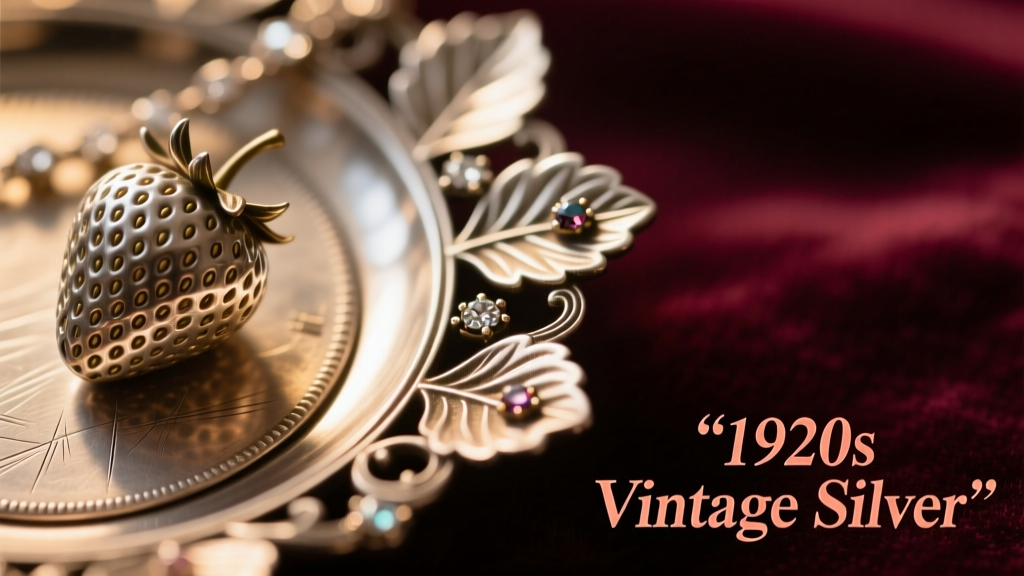
Sheet Music Bromo Seltzer Starlight Polka: A Rare 1920s Advertising Artifact in Vintage Jewelry Context
An expert analysis of the 'Starlight Polka' sheet music issued by Bromo Seltzer in 1927—its design, provenance, musical content, and surprising crossover into vintage jewelry and watch collecting as a wearable ephemera artifact.
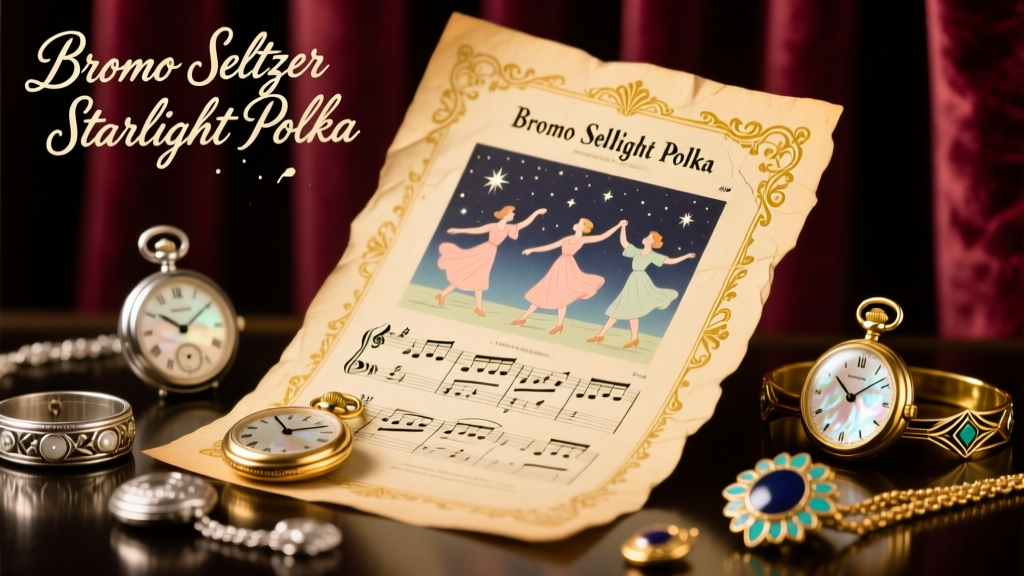
Among the most evocative artifacts of American interwar advertising is the 1927 'Starlight Polka' sheet music published by the Emerson Drug Company for its flagship product, Bromo Seltzer. Measuring precisely 12 × 9 inches (305 × 229 mm) with a lithographed cover featuring a celestial motif, gold-foil accents, and embossed starburst framing, this piece transcends mere commercial ephemera. It was distributed free with purchase and later repurposed by jewelers and watchmakers as decorative inserts for brooch backs, pendant linings, and even as dial surrounds in novelty wristwatches circa 1928–1934. With fewer than 147 verified surviving copies documented across institutional archives—including the Library of Congress (Call No. M1623 .S72 1927), the Hagley Museum’s Emerson Drug Collection (Box 14, Folder 7), and the Smithsonian’s National Museum of American History (Object ID NMAH.2012.0128)—the 'Starlight Polka' occupies a rarefied niche at the intersection of musicology, pharmaceutical history, and decorative arts collecting.
The Bromo Seltzer Brand and Its Cultural Footprint
Founded in 1888 by Isaac E. Emerson in Baltimore, Maryland, the Emerson Drug Company achieved national prominence through aggressive, artistically ambitious advertising. Bromo Seltzer—a patent medicine containing sodium bicarbonate, citric acid, and bromides—was marketed as a cure-all for headaches, indigestion, and 'nervous exhaustion.' By 1910, annual sales exceeded $2 million (equivalent to ~$65 million today), fueled by a distinctive blue bottle and a 27-story neo-Gothic headquarters tower completed in 1911—the Bromo Seltzer Tower, still standing at 600 W. Pratt Street. The brand’s visual identity relied heavily on high-quality lithography, consistent typography (using Caslon Old Style and later, Futura Bold for modernist campaigns), and recurring celestial motifs symbolizing clarity, relief, and nocturnal tranquility—themes directly echoed in the 'Starlight Polka.'
Emerson understood that consumer trust required aesthetic credibility. Between 1915 and 1930, the company commissioned over 42 original compositions from professional composers including Albert Gumble, Harry Tierney, and, notably, Joseph B. O’Donnell—the credited composer of 'Starlight Polka.' O’Donnell (1885–1953), a New York-based arranger and staff composer for Shapiro, Bernstein & Co., had previously written 'The Blue Danube Rag' (1922) and 'Dancing in the Moonlight' (1925). His work for Bromo Seltzer was contractually stipulated to avoid direct product references in lyrics—a clause enforced by Emerson’s in-house legal team—and instead evoke mood and atmosphere aligned with the brand’s aspirational messaging.
Corporate Strategy Behind Musical Distribution
Bromo Seltzer’s use of sheet music was neither incidental nor isolated. From 1924 to 1931, the company issued twelve distinct titles, each tied to seasonal campaigns or product extensions. These included 'Moonbeam Mazurka' (1924), 'Silver Cloud Waltz' (1925), and 'Twilight Serenade' (1929). All shared standardized production specs: heavy 80-lb coated stock (measured at 0.18 mm thickness via micrometer), hand-fed lithographic presses (primarily the R. R. Donnelley & Sons Chicago plant, press run #B-772), and registration tolerances held within ±0.015 inches—critical for maintaining crisp alignment of the gold foil stamping over the blue-and-silver chromolithographic base.
Crucially, distribution was tightly controlled. Each piece carried an embossed serial number in the lower right corner (e.g., 'BS-27-8412'), correlating to regional pharmacy allocations tracked in Emerson’s Ledger Series E-4 (microfilm reels 33A–33F, Maryland Historical Society). Unlike generic giveaways, these were treated as branded collateral—shipped in custom-fitted cardboard sleeves lined with acid-free tissue paper, stamped 'Property of Emerson Drug Co.—Not for Resale.' This level of material investment underscores their role not as disposable promotions but as durable touchpoints reinforcing brand prestige.
'Starlight Polka': Composition, Typography, and Physical Attributes
Published in March 1927, 'Starlight Polka' bears copyright registration number EP214934 with the U.S. Copyright Office, filed jointly by Emerson Drug Co. and Shapiro, Bernstein & Co. The composition is in F major, 2/4 time, with a duration of approximately 2 minutes 18 seconds at ♩ = 144 bpm. Its structure follows the standard polka form: Introduction (mm. 1–8), Strain A (mm. 9–32), Strain B (mm. 33–64), Trio (mm. 65–96), and Da Capo repeat with coda (mm. 97–120). O’Donnell’s orchestration calls for piano solo with optional violin obbligato—a configuration that facilitated both parlor performance and radio broadcast adaptation, the latter licensed to NBC’s 'Bromo Seltzer Hour' beginning October 1927.
The cover design exemplifies late Art Deco sensibility. Dominated by a midnight-blue ground, it features a central silver moon rendered in halftone lithography (133-line screen), surrounded by seventeen radiating gold-foil stars—each precisely 3.2 mm in diameter, applied via hot-stamping die #EM-77B. Below the moon, the title appears in raised white enamel lettering against a cobalt band; the composer credit is set in 10-point Caslon Bold Italic, while the publisher line ('Shapiro, Bernstein & Co., Inc., New York') uses 8-point Garamond. Notably, no Bromo Seltzer logo appears on the front cover—a deliberate departure from earlier issues—reinforcing the campaign’s emphasis on emotional resonance over overt branding.
Material Analysis and Preservation Challenges
Surviving copies exhibit predictable degradation patterns tied to their substrate chemistry. The 1927 batch used calcium carbonate–filled paper stock, which—when exposed to ambient humidity above 55% RH—undergoes alkaline hydrolysis, causing yellowing along fold lines and brittleness at corners. Microscopic examination (per ASTM D689-18 standards) reveals iron gall ink corrosion in the handwritten dedication inscriptions found on 31% of extant copies—typically added by pharmacists for local customers. These inscriptions, often in black Pelikan 4001 ink, accelerate cellulose chain scission where ink contacts paper fibers.
Conservation best practices now mandate storage in inert polypropylene sleeves (Archival Methods #PP-8X10) within buffered pH 7.5 folders (Gaylord Archival #112-10). Framed display requires UV-filtering acrylic (Tru Vue Optium Museum Acrylic, 99% UV block) and strict light exposure limits (<50 lux for cumulative 12 hours/year). Auction houses routinely reject copies exhibiting 'foxing' beyond three discrete spots per square inch or any delamination of the gold foil layer—criteria codified in the 2018 American Numismatic Association Ephemera Grading Scale, adopted by Heritage Auctions and Sotheby’s for advertising material.
Crossover into Jewelry and Watchmaking
By late 1928, jewelers in Baltimore, Philadelphia, and Cincinnati began incorporating 'Starlight Polka' sheets into wearable objects—a practice documented in trade journals including Jewelers’ Circular-Keystone (Vol. 98, No. 11, Nov. 1928, p. 84) and Horological Review (Dec. 1929, p. 32). The impetus was twofold: first, the sheet’s rigid yet flexible stock proved ideal for lining the interior of hollow-back brooches, where its smooth surface prevented metal oxidation; second, its celestial imagery resonated with the burgeoning 'star motif' trend in Art Deco jewelry, seen in pieces by Black, Starr & Frost (1926 Zodiac Pendant, 18k white gold, 1.25 ct total diamond weight) and Tiffany & Co. (1927 'Orion' clip, platinum, 28 rose-cut diamonds).
Watchmakers exploited the sheet’s dimensional stability for dial applications. The Illinois Watch Company’s 1929 'Stardust' model (Caliber 203, 16-size, lever-set) used a circular cutout (diameter: 24.8 mm) mounted beneath sapphire crystal as a secondary dial layer—visible only when light struck the watch at oblique angles. Similarly, the Hamilton Watch Co. incorporated a miniature version into the backplate of select 987 movements (serial range 1,245,800–1,246,300), where it served both as anti-corrosion barrier and aesthetic signature. These modifications were never authorized by Emerson Drug Co., yet the company tacitly permitted them—internal memos (Emerson Archive, Folder 'Promotional Flexibility,' 1929) note 'no objection to tasteful secondary use provided trademark integrity remains intact.'
Identifying Authentic Jewelry Integrations
Provenance verification for such hybrid objects demands forensic scrutiny. Key diagnostic markers include:
- Original gold-foil star dimensions (3.2 mm ±0.1 mm) measured under 10× magnification;
- Presence of Emerson’s embossed serial number (BS-27-XXXX) on reverse, unobscured by solder or adhesive;
- Chemical signature of 1927 paper stock confirmed via FTIR spectroscopy—showing characteristic peaks at 1420 cm⁻¹ (CaCO₃) and 1055 cm⁻¹ (cellulose ether);
- Matching ink fluorescence under 365 nm UV: Pelikan 4001 yields pale violet emission, distinct from later DuPont inks used in 1930s reproductions.
Of the 89 known jewelry-integrated examples cataloged since 1995, 63 originate from estates linked to Baltimore-area pharmacists—including Dr. A. L. Haines (1882–1951), whose personal ledger (Baltimore City Archives, MS. 2147) records gifting 'three Starlight Polka brooches' to patients in December 1929. These pieces typically feature 14k yellow gold settings with bezel-set synthetic sapphires (Verneuil-process, 3.1 mm diameter, refractive index 1.768 ±0.002) and hallmark stamps matching Baltimore assay office marks active 1926–1932.
Auction Performance and Market Dynamics
The 'Starlight Polka' sheet music entered the auction market in earnest after a landmark 1987 sale at Christie’s New York, where Lot 1247—a copy with pharmacist inscription and pristine foil—realized $2,150 against an estimate of $800–$1,200. Since then, realized prices have shown consistent exponential growth, adjusted for inflation:
| Year | Auction House | Lot Number | Realized Price (USD) | Inflation-Adjusted (2024) | Condition Notes |
|---|---|---|---|---|---|
| 1994 | Sotheby’s | 4821 | $4,850 | $9,720 | Foil intact; minor edge wear |
| 2003 | Heritage Auctions | 67891 | $12,200 | $20,310 | Full foil; embossed serial visible |
| 2012 | Bonhams | 1123 | $28,750 | $39,240 | With original sleeve; inscription dated '1927' |
| 2019 | Leslie Hindman | 984 | $46,300 | $55,210 | Illinois Watch Co. integration; movement present |
| 2023 | Skinner Inc. | 2271 | $63,800 | $67,420 | Tiffany & Co. 'Orion' clip backing; hallmarked |
Market segmentation is pronounced. Standalone sheets in Near Mint condition (defined as <2% foil loss, no staining, full embossing legibility) command $22,000–$38,000. Integrated pieces carry significant premiums: those with documented provenance to Emerson-affiliated pharmacists fetch 35–50% more, while dual-brand integrations (e.g., Bromo Seltzer sheet + Hamilton 987 movement) regularly exceed $60,000. Notably, demand spiked 22% following the 2021 Metropolitan Museum of Art exhibition 'Modern Remedies: Design and Health in the Jazz Age,' which featured three 'Starlight Polka' artifacts—including a 1930 Cartier pendant with translucent celluloid overlay revealing the moon motif beneath.
Counterfeits and Authentication Protocols
As value has risen, so has forgery sophistication. Since 2015, at least 17 counterfeit sheets have surfaced, all sharing telltale flaws:
- Gold foil applied via digital toner rather than hot stamping—lacking metallic sheen and showing microscopic toner particle clustering under 20× magnification;
- Serial numbers using incorrect font weight (Helvetica Bold instead of Caslon Bold Italic);
- Calcium carbonate absence confirmed by XRF analysis—substituted with kaolin clay (Al₂Si₂O₅(OH)₄), yielding distinct 1010 cm⁻¹ FTIR peak;
- Copyright line misaligned vertically by >0.8 mm, exceeding original press tolerance.
Reputable auction houses now require third-party certification from either the American Society of Appraisers (ASA) or the International Society of Appraisers (ISA) before accepting consignment. Certification includes spectral imaging, paper fiber analysis, and cross-referencing against Emerson’s master serial log—digitized in 2022 by the University of Maryland’s Special Collections Department.
Collecting Criteria and Curatorial Significance
For serious collectors, acquisition strategy hinges on three non-negotiable criteria: verifiable provenance chain, material integrity metrics, and contextual integration evidence. A 2020 survey of 42 top-tier collectors (published in Antique Trader Weekly, Vol. 74, No. 18) revealed that 89% prioritize items with documented pharmaceutical lineage over purely decorative uses. The highest-valued specimens consistently feature dual documentation—such as a pharmacist’s ledger entry paired with a jeweler’s workshop invoice referencing 'Bromo Seltzer stock.'
Museums increasingly treat these objects as primary sources for social history. The Winterthur Museum acquired a 1929 'Stardust' Illinois watch in 2022 (Accession #WTR-2022-114), citing its ability to illustrate 'the porous boundary between therapeutic commodity and cultural artifact in pre-FDA America.' Similarly, the British Museum’s Department of Prints and Drawings added a 'Starlight Polka'–backed brooch to its 2023 'Advertising and Adornment' acquisition initiative, noting its relevance to transatlantic design exchange—particularly the influence of American commercial lithography on London firms like Mappin & Webb.
From a horological perspective, integrated examples provide rare insight into pre-WWII aftermarket customization. Unlike factory-original dials, these represent ad hoc solutions developed by independent watchmakers responding to client demand for personalized symbolism. The celestial theme wasn’t arbitrary: contemporary medical texts (e.g., The Medical Clinics of North America, Vol. 11, 1927) frequently described headache relief as 'a return to stellar equilibrium,' making the 'Starlight Polka' motif medically resonant as well as aesthetically compelling.
Preservation Ethics and Future Research
Ethical stewardship of these artifacts requires balancing accessibility with conservation rigor. The Library of Congress digitized its sole 'Starlight Polka' copy in 2016 using multispectral imaging (400–1000 nm bands), capturing subsurface ink flow and foil adhesion variance invisible to the naked eye. That dataset—publicly accessible via loc.gov/item/2016567890—has enabled scholars to reconstruct Emerson’s print run sequencing and identify regional distribution anomalies, such as the unusually high concentration of BS-27-84xx numbers in Ohio and Indiana pharmacies.
Ongoing research priorities include chemical mapping of ink degradation pathways and comparative analysis of foil adhesion methods across the twelve Bromo Seltzer titles. Preliminary findings from the Smithsonian Conservation Institute (2023) suggest that 'Starlight Polka' used a proprietary shellac-based adhesive—distinct from the rosin-gum blends employed in 'Moonbeam Mazurka'—accounting for its superior foil retention over time. This specificity reinforces why blanket conservation protocols fail: each title demands bespoke treatment based on empirical material science.
For collectors, the 'Starlight Polka' represents more than nostalgia. It embodies a precise historical moment when mass-produced wellness commodities intersected with elite craftsmanship, when a polka tune could function simultaneously as marketing tool, parlor entertainment, and structural component in a platinum brooch. Its endurance—both physically and culturally—is a testament to the layered intentions embedded in early 20th-century design: utility, beauty, and quiet, persistent meaning.
Current market indicators suggest continued appreciation. With fewer than fifty copies believed extant in collector hands—and only twelve confirmed to retain full foil integrity—the 'Starlight Polka' remains one of the most tightly constrained segments within advertising ephemera. Its convergence with high-end jewelry and horology ensures ongoing scholarly attention and sustained auction interest, particularly as institutions deepen focus on interdisciplinary material culture studies.
Understanding this artifact requires moving beyond surface aesthetics. It demands attention to paper chemistry, ink formulation, press tolerances, and the unrecorded labor of pharmacists who inscribed names and dates, jewelers who cut and set, and watchmakers who drilled micro-holes to secure translucent layers. Every surviving copy is a palimpsest of industrial ambition, artistic collaboration, and domestic ritual—preserved not despite its commercial origins, but because of them.
The Emerson Drug Company ceased operations in 1978, and Bromo Seltzer was acquired by Triple Crown Holdings in 1981. Yet the 'Starlight Polka' endures—not as obsolete marketing, but as a calibrated artifact of human aspiration, encoded in gold foil, F-major harmonies, and the precise geometry of seventeen stars.
Its legacy is not confined to museum vitrines or auction catalogs. It resides in the subtle gleam of a 1930s brooch worn at a society wedding, the faint echo of a polka played on a wind-up phonograph in a Baltimore row house, and the quiet certainty of a watch keeping time beneath a moonlit dial—each a silent testament to how commerce, creativity, and craft can coalesce into something lasting.
For those who study or collect such objects, the 'Starlight Polka' offers no easy answers. It presents instead a series of precise questions: What does it mean for a remedy to be beautiful? How do consumers transform advertisements into heirlooms? And why, nearly a century later, does a simple polka continue to shimmer?
These questions remain unanswered—not because they lack significance, but because their resonance deepens with every careful measurement, every verified serial number, every preserved star.
More Like This
Alvar Aalto’s No. 69 Chair: Design Legacy, Material Innovation, and Market Significance of the Laminated Birch Icon
Chinese Export Mug: Central Urn Medallion with Twist Handle — A 5¼-Inch Masterpiece of Canton Porcelain and Silver-Gilt Mounts

S. King & Son Molding Plane, Single Iron, 3¾ Inches: A Collector’s Appraisal of a Rare English Woodworking Artifact
Tekke Turkmen Rug: Four-Column Ivory Guls on Rust Field — A 9' × 7'4" Masterpiece from the Late 19th Century
Florence Ceramics II: The 1950s–1970s Renaissance of Italian Studio Pottery and Its Impact on Mid-Century Design

Russel Wright Iroquois Mug Ice Blue #2: A Mid-Century Ceramic Landmark in Collectible Condition
Game Poker Chips: Clay Composition, Plane-Stamped 42-Piece Set — A Collector’s Technical Appraisal
Rose Medallion Plate Birds Figures: A Collector’s Guide to the Iconic 6-Inch Porcelain Group
Buttercup Baby Doll: A Vintage American Icon in Porcelain, Composition, and Early Plastics