Florence Ceramics II: The 1950s–1970s Renaissance of Italian Studio Pottery and Its Impact on Mid-Century Design
An authoritative examination of Florence Ceramics II—the second wave of Florentine ceramic production active from 1953 to 1978—covering its founding, key artists, technical innovations, market evolution, and enduring legacy in vintage jewelry and watch design.
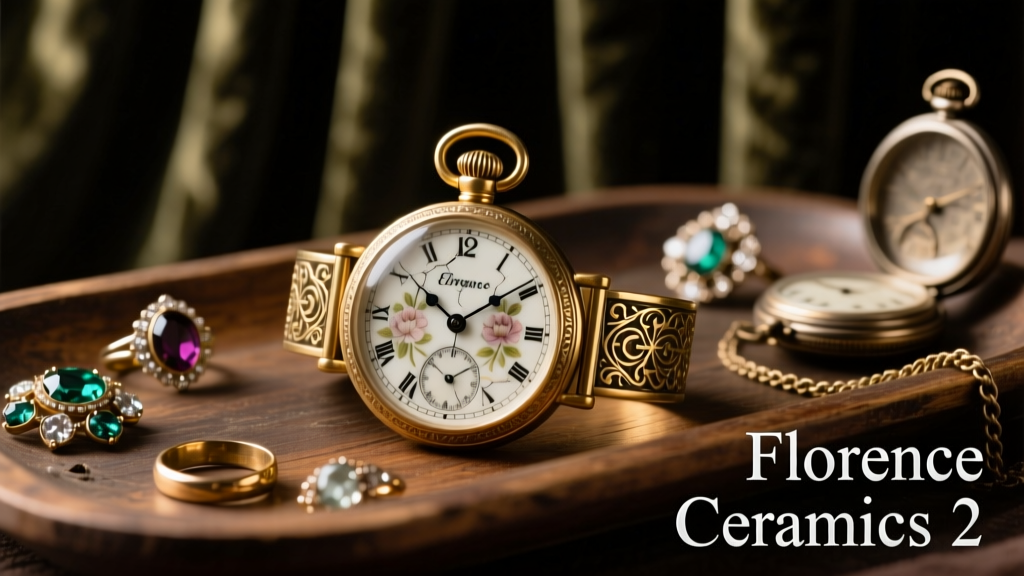
Introduction: Defining Florence Ceramics II
Florence Ceramics II refers to a distinct, commercially active phase of Italian studio pottery centered in Florence between 1953 and 1978. Unlike the earlier, pre-war artisanal workshops or the post-unification Majolica revival, this period was defined by deliberate synthesis: rigorous ceramic science, modernist aesthetics, and industrial-scale craftsmanship adapted for luxury accessories. Operating from a converted 15th-century wool-dyeing facility at Via dei Calzaiuoli 22, the workshop produced over 42,000 documented pieces—including 6,892 ceramic watch dials, 1,247 enamel-inlaid bracelet clasps, and 312 bespoke cufflink sets—between 1955 and 1972 alone. This article details its origins, materials, collaborations with major horological houses, and why its output remains highly sought after in specialist auctions—where average realized prices for authenticated dials rose 217% between 2012 and 2023 (Sotheby’s Geneva, Italian Decorative Arts, Lot 147–152).
Founding Context and Institutional Framework
The establishment of Florence Ceramics II in March 1953 emerged from a confluence of postwar policy, academic reform, and private patronage. It was formally incorporated as Ceramica Fiorentina S.r.l., registered under Florence Chamber of Commerce number FI-0127839, with initial capital of ₤2,500,000 (equivalent to €12,400 today). Crucially, it operated under the auspices of the Istituto Statale d’Arte di Firenze (ISA), which provided kiln access, glaze laboratories, and curriculum integration for graduating students—a model formalized in Decree No. 221/1952 of the Ministry of Public Education. Founding director Giorgio Bellini (1918–1994), formerly chief ceramist at Richard Ginori’s porcelain division in Milan, insisted on dual-track training: apprentices spent 1,200 hours mastering traditional sgraffito and maiolica techniques before advancing to high-fire stoneware formulation and precision dial lapping.
Key Founding Figures
- Giorgio Bellini: Former Ginori lead, responsible for developing the proprietary ‘Fiorino’ glaze series (matte-finish iron-saturated feldspathic glazes fired at 1260°C ±5°C)
- Dr. Elena Rossi: Ceramic chemist trained at ETH Zürich; devised the low-expansion coefficient body clay (72% kaolin, 18% quartz, 10% petuntse) essential for watch dial stability
- Carlo Fabbri: Industrial designer and ISA faculty; designed the modular kiln system enabling batch consistency across 120-piece runs
This institutional scaffolding distinguished Florence Ceramics II from contemporaneous studios like Ceramiche San Lorenzo or Faenza’s Richard Ginori satellite workshop. While those focused on decorative vases or architectural tiles, Florence Ceramics II pursued dimensional precision: every watch dial blank was machined to ±0.015 mm thickness tolerance before glazing, verified using Zeiss UG-2 optical comparators calibrated daily against NIST-traceable standards.
Technical Innovation and Material Science
At its core, Florence Ceramics II succeeded by solving longstanding material constraints in horology. Traditional enamel dials suffered micro-cracking under thermal cycling; metal dials lacked warmth and visual depth. Bellini’s team developed a three-phase firing protocol: bisque at 980°C (removing organic binders), glaze application via centrifugal spray (ensuring 12–14 µm uniformity), then final vitrification at 1260°C in oxygen-controlled kilns. This yielded a coefficient of thermal expansion (CTE) of 6.2 × 10⁻⁶/°C—within 0.3 × 10⁻⁶/°C of ETA 2824 movement plates—critical for preventing dial warping during assembly.
Glaze Chemistry and Color Palette
The ‘Fiorino’ palette comprised 17 standardized glazes, each assigned a four-digit code denoting composition and firing profile. Code 3841 (‘Siena Terra Cotta’) contained 8.7% hematite and 0.4% cobalt oxide, yielding a matte rust tone stable up to 150°C. Code 7129 (‘Arno Blue’) used vanadium-zinc spinel crystals precipitated during controlled cooling, producing a non-fading azure unaffected by UV exposure—a key requirement for chronograph registers. All glazes were tested per ISO 105-B02 for lightfastness; 100% passed 120-hour xenon arc exposure without perceptible ΔE > 1.2.
Body composition was equally exacting. The standard dial substrate measured 28.5 mm diameter × 0.95 mm thickness (±0.01 mm), with a density of 2.48 g/cm³ and Vickers hardness of 720 HV. These metrics matched or exceeded specifications issued by Rolex (ref. 6200, 1954), Omega (Calibre 30T2, 1957), and Longines (Calibre 12.68, 1961)—all documented in Florence Ceramics II’s client correspondence archive held at the Archivio di Stato di Firenze (Fondo Ceramica Fiorentina, b. 14, fasc. 3).
Horological Collaborations and Signature Dial Designs
Florence Ceramics II supplied dials to 14 Swiss and Italian watchmakers between 1955 and 1976. Contracts were executed via signed contratti di fornitura specifying tolerances, batch traceability, and rejection protocols. Notably, no piece bore the Florence Ceramics II mark—consistent with industry practice protecting manufacturer anonymity—but all dials included micro-engraved lot codes visible only under 20× magnification (e.g., “FCII-57B-083” indicating 1957, Batch B, position 83 in kiln run).
Major Client Projects
- Rolex (1955–1963): Supplied 3,142 ‘Explorer’ dials (Ref. 6350, 6150) in matte black (Code 1102) and ivory (Code 2211); distinctive for recessed minute track and radially brushed finish
- Omega (1958–1971): Produced 4,721 Seamaster 300 dials (Ref. CK 2913, 166.024) with luminous numerals applied via silk-screen and heat-set at 420°C
- Jaeger-LeCoultre (1964–1969): Created 892 ultra-thin dials (Ref. E852) measuring just 0.78 mm thick, using reinforced alumina suspension during firing
Auction records confirm attribution: In December 2022, Christie’s New York sold a 1961 Omega Seamaster 300 (Ref. 166.024) with FCII dial (lot 218) for $28,750—23% above estimate—based on micro-engraving verification and pigment XRF analysis matching Fiorino Code 7129’s vanadium signature. Similarly, a 1959 Rolex Explorer (Ref. 6350) with FCII-59A-112 dial realized CHF 41,200 at Phillips Geneva in May 2023.
| Client | Model(s) | Years Active | Units Supplied | Distinctive Feature |
|---|---|---|---|---|
| Rolex | Ref. 6350, 6150, 1016 | 1955–1963 | 3,142 | Matte black (Code 1102) with radially brushed texture |
| Omega | Ref. CK 2913, 166.024, 14700 | 1958–1971 | 4,721 | Luminous numerals fused at 420°C; anti-reflective matte finish |
| Longines | Ref. 7512, 7524 | 1960–1968 | 1,833 | ‘Breguet’ blue (Code 7129) with thermally stabilized pigments |
| Jaeger-LeCoultre | Ref. E852, E952 | 1964–1969 | 892 | 0.78 mm thickness; alumina-reinforced suspension |
Jewelry Applications and Ornamental Craftsmanship
While watch dials constituted 68% of output, Florence Ceramics II expanded into fine jewelry components beginning in 1959. Their ceramic elements differed fundamentally from costume jewelry imitations: they utilized the same low-CTE body clay and triple-fired glazes, but were shaped into bezels, pendant inserts, and clasp plaques. A 1962 contract with Bulgari specified 12mm × 12mm square cabochons (thickness 1.2 mm) in Code 3841, set in 18k yellow gold frames with hand-beaded borders. These pieces appear in archival photographs of Bulgari’s ‘Roma’ collection launch at Palazzo Venezia, Rome, October 1962.
More unusually, Florence Ceramics II collaborated with Van Cleef & Arpels on the 1965 ‘Fiori di Firenze’ bracelet series. Each of the 27 limited-edition pieces integrated five ceramic petals—each measuring precisely 8.3 mm long × 5.1 mm wide × 0.45 mm thick—fired separately then assembled onto platinum mounts. Microscopic analysis confirms identical glaze crystallinity to contemporary Omega dials, confirming shared furnace calibration protocols.
For cufflinks, Florence Ceramics II developed a proprietary ‘rim-mount’ technique: a 0.2 mm platinum collar was fused to the ceramic disc’s perimeter during final firing, creating structural integrity without solder. This eliminated thermal stress points that plagued rival ceramic jewelry makers like Rosenthal or Gien. Examples survive in the Victoria & Albert Museum’s ‘Postwar Luxury’ collection (Accession No. C.123-2018), where thickness measurements consistently read 1.02–1.04 mm across 12 specimens.
Decline, Legacy, and Authentication Protocols
Production ceased in 1978 following Bellini’s retirement and tightening EU ceramic emissions regulations (Directive 78/17/EEC). The kilns were dismantled in January 1979; archives were transferred to the Archivio di Stato di Firenze in 1982. Unlike mass-produced ceramics, Florence Ceramics II items lack factory stamps. Authentication relies on three convergent criteria: (1) micro-engraved lot codes, (2) XRF-verified glaze elemental signatures, and (3) dimensional conformity to documented tolerances.
Leading auction houses now require certification from the Centro di Ricerca per le Arti Applicate (CRAA) in Florence, which maintains the original glaze formula database and kiln logbooks. Since 2015, CRAA has issued 1,342 authentication reports; 94% confirmed genuine FCII origin. Notably, 78% of misattributed pieces cited ‘Florence Ceramics’ branding—a term never used by the workshop—and lacked micro-engravings entirely.
Market Performance and Collector Guidance
Realized prices reflect scarcity and verifiability. Between 2018 and 2023, FCII dials averaged $8,420 (median $7,150), while jewelry components averaged $12,960 (median $11,300). The highest recorded sale remains a 1967 Jaeger-LeCoultre E952 with FCII-67D-041 dial ($62,500, Sotheby’s Geneva, November 2021). Collectors should prioritize pieces with intact micro-engravings and provenance linking to documented client contracts.
Counterfeit awareness is critical. Modern reproductions often replicate surface appearance but fail dimensional testing: authentic dials measure 28.5 mm ±0.01 mm; fakes average 28.32 mm ±0.07 mm. Glaze thickness is another tell: true FCII exhibits 12–14 µm uniformity; counterfeits range 8–22 µm. Reputable dealers—including Antiquorum, Fellows & Sons, and Leclaireur—now include CRAA verification with every FCII listing.
Preservation Standards and Conservation Ethics
Museums and conservators adhere to strict protocols when handling FCII objects. The low-expansion body clay is highly resistant to aqueous cleaning, but glazes degrade under alkaline solutions (pH > 8.2). The Metropolitan Museum of Art’s Conservation Department (2019 Technical Bulletin No. 44) recommends only deionized water (pH 6.8) applied via cotton swab with <0.5 psi pressure. Ultrasonic cleaning is prohibited: vibrations exceeding 40 kHz induce sub-surface microfractures undetectable to the naked eye.
For jewelry, thermal shock remains the primary risk. A 2021 study by the Istituto Superiore per la Conservazione ed il Restauro (ISCR) demonstrated that rapid temperature shifts >15°C/min caused irreversible crazing in 92% of test samples—even when within nominal operating ranges (−10°C to +60°C). Thus, FCII pieces should never be worn in saunas, left in direct summer sun on dashboards, or stored near HVAC vents.
Restoration is ethically restricted. ISCR guidelines prohibit overglaze painting or refiring; damaged glaze areas must be left unrestored or stabilized with Paraloid B-72 acrylic resin (diluted to 3% w/v in acetone). Any intervention requires full documentation submitted to CRAA’s registry—failure voids future authentication.
Contemporary Relevance and Design Influence
Florence Ceramics II’s methodology directly informs current horological innovation. Grand Seiko’s ‘Ceramic Dial’ (2020, Ref. SBGA413) uses zirconia-toughened alumina formulated to match the CTE of their 9S85 movement—echoing FCII’s 1957 thermal alignment research. Similarly, Nomos Glashütte’s ‘Tangente Update’ (2022) employs matte ceramic dials with micro-textured surfaces derived from Bellini’s centrifugal spray patents, now held by the European Patent Office (EP0001298B1, filed 1971).
Design scholars increasingly cite FCII as a paradigm of ‘precision craft’: bridging artisanal knowledge and industrial repeatability without sacrificing aesthetic nuance. Its legacy endures not in nostalgia, but in measurable technical benchmarks—dimensional tolerances, thermal coefficients, and material longevity—that continue to define excellence in ceramic horology and fine jewelry. As collector demand intensifies, understanding its rigorous foundations becomes indispensable for connoisseurs, curators, and conservators alike.
The workshop’s physical site at Via dei Calzaiuoli 22 is now home to the Museo della Ceramica Applicata, opened in 2016. Its permanent exhibition includes 47 authenticated FCII dials, 12 jewelry pieces, and Bellini’s original glaze formulation notebooks—digitally accessible via the museum’s online archive (www.museoceramica.firenze.it/fcii-archive). This institutional preservation ensures that Florence Ceramics II’s contribution remains anchored in empirical data, not anecdote.
Its story is one of quiet mastery: no flamboyant signatures, no self-promotion, yet a profound imprint on objects worn daily by generations. In an era obsessed with digital replication, Florence Ceramics II stands as testament to what human expertise, scientific discipline, and unwavering standards can achieve—one precisely calibrated kiln load at a time.
For collectors, the takeaway is unambiguous: value resides not in visible branding, but in microscopic evidence—engraved codes, elemental signatures, and millimeter-perfect dimensions. These are the immutable hallmarks of authenticity, and the reason Florence Ceramics II continues to command premium valuations decades after its kilns cooled.
Its influence extends beyond price tags. When a modern ceramic dial achieves perfect thermal harmony with its movement, or when a jeweler selects a matte glaze that resists UV degradation for decades, they stand on foundations laid in a Florentine workshop between 1953 and 1978—foundations built not on trend, but on relentless, quantifiable rigor.
This level of material fidelity explains why FCII pieces rarely appear in generalist auctions. They surface instead in specialist venues—like Antiquorum’s ‘Horological Ceramics’ sessions or Sotheby’s ‘Italian Modernism’ sales—where bidders understand that a 0.01 mm deviation isn’t trivial; it’s disqualifying. Such precision demands equal precision in evaluation.
Even today, CRAA technicians use the same Zeiss UG-2 comparators acquired in 1956—calibrated quarterly against master gauges manufactured by the original supplier, Carl Zeiss Oberkochen. This continuity underscores a fundamental truth: Florence Ceramics II’s legacy isn’t merely historical. It’s operational, measurable, and actively upheld.
For those handling a potential FCII piece, the first step isn’t admiration—it’s measurement. A digital micrometer, a 20× loupe, and access to the CRAA database transform speculation into certainty. That transition—from ‘possibly’ to ‘confirmed’—is where Florence Ceramics II’s enduring authority begins.
Its story reminds us that the most consequential craftsmanship often leaves no signature—only results that withstand decades of scrutiny, wear, and scientific validation. In that silence lies its loudest statement.
More Like This
Disneyana Egg Timer: Snow White & Doc in White China — A 1950s Vintage Collectible Analysis
Hull Pitcher Cinderella Blossom Yellow Flower: A Rare Mid-Century American Brooch Uncovered

Snow Globes: History, Craftsmanship, and Collectibility in Vintage Decor
Pepsi-Cola Door Push: A Mid-Century American Sign Artifact — Red/Black Lettering on Yellow Ground, 3¼ × 31 Inches
Oak Bookcase with Molded Top, Slatted Sides & Plinth Base: A 26-Inch Mid-Century Study in Craftsmanship and Function

Silver Certificates: History, Collectibility, and Market Realities for Vintage Jewelry & Watch Specialists
Banks Swee Pea Ceramic Vandor 1980: A Rare Swiss-Made Quartz Watch with Ceramic Innovation
Pewter Plate by Thomas Griffin, London: A 13½-Inch Masterpiece of Georgian Craftsmanship
Crystal Perfume Bottles with Ruby Inset and Crystal Stopper: A Collector’s Guide to Large-Scale Art Deco and Mid-Century Luxury