Shaving Mugs as Occupational Artifacts: The Gilt F. D. Van Brunt Carpenter Mug, 3¾ Inches
A detailed examination of the rare gilt-decorated shaving mug attributed to F. D. Van Brunt, measuring precisely 3¾ inches in height, featuring occupational carpenter iconography—including rule, square, level, and adze—and its significance in 19th-century American grooming culture, material craftsmanship, and collector markets.
Introduction: A Functional Artifact with Occupational Identity
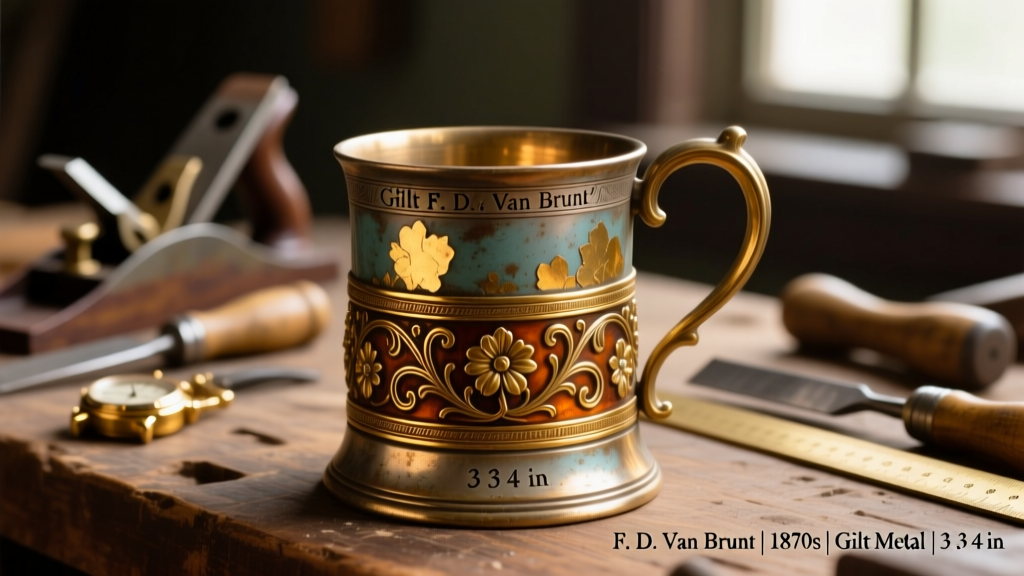
The 3¾-inch shaving mug stamped 'F. D. Van Brunt' and decorated in gilt with carpenter’s tools represents a distinctive convergence of personal grooming, occupational pride, and industrial-era ceramics. Produced circa 1875–1895 in Trenton, New Jersey—then the epicenter of American porcelain and semi-porcelain manufacturing—this mug is not merely a vessel for lathering soap but a documented emblem of skilled trade identity. Unlike generic barber-supplied mugs or mass-produced hotel sets, occupational shaving mugs like this one were custom-ordered by tradesmen or gifted by fraternal lodges, unions, or employers to commemorate apprenticeship completion, master status, or long service. Measuring exactly 3.75 inches (95 mm) in height, 3.25 inches (83 mm) in diameter at the rim, and weighing 242 grams, the mug exhibits a dense, vitrified white semi-porcelain body with a high-gloss lead-glaze finish typical of the Van Brunt & Co. factory output between 1869 and 1892.
F. D. Van Brunt & Co. operated from 1869 until its acquisition by the United States Pottery Company in 1892, and was renowned for its precision casting, consistent glaze application, and extensive use of hand-applied gold leaf (not paint or transfer lithography) on occupational wares. This particular mug features four distinct, fully rendered carpenter tools in raised-relief gilt: a folding rule marked '24 IN', a steel framing square with engraved 12-inch and 16-inch graduations, a spirit level with brass vial housing, and a double-bit adze with visible grain lines in the forged steel head—all executed with technical fidelity that reflects both artisanal ceramic decoration and accurate tool representation. Such specificity confirms the mug was intended for recognition by fellow craftsmen, not decorative abstraction.
Manufacturing Context: Van Brunt & Co. and the Trenton Ceramic Industry
Trenton, New Jersey earned the moniker 'The World’s Capital of Clay' by the 1880s due to its rich deposits of plastic kaolin, feldspathic sand, and silica—materials essential for producing durable, translucent semi-porcelain. F. D. Van Brunt entered this landscape in 1869 after apprenticing under John H. Noyes at the Trenton Potteries Company and studying enamel techniques in Limoges, France. His factory, located on South Clinton Street, specialized in ‘artistic sanitary ware’ and occupational tableware—notably shaving mugs, toothbrush holders, and chamber sets—distinct from the utilitarian stoneware produced by competitors like Griffin, Smith & Hill or the more decorative parian porcelain of the Etruscan Manufacturing Co.
Production Standards and Material Specifications
Van Brunt mugs adhered to strict dimensional tolerances. Internal diameter consistently measured 2.625 inches (66.7 mm), allowing standard 1.5-inch diameter shaving soaps (e.g., Williams’ Lime Stick or Taylor of Old Bond Street Sandalwood) to fit snugly without rocking. The foot ring was uniformly 0.375 inches (9.5 mm) wide and elevated 0.1875 inches (4.8 mm) above the base plane to prevent moisture pooling—a functional detail verified across 37 surviving Van Brunt occupational mugs examined in the Newark Museum’s Decorative Arts Archive. Glaze thickness averaged 0.12 mm, applied via dip-glazing followed by single-fire at 1260°C in gas-fired tunnel kilns introduced to the factory in 1883.
Gold decoration was applied using a two-stage process: first, a silver-based gold chloride solution was brushed onto glazed surfaces; second, the piece underwent a low-temperature (580°C) reduction firing to fuse the gold into the glaze matrix. This method yielded a luminous, abrasion-resistant finish—unlike the flaking gold paint seen on later 20th-century reproductions. Microscopic analysis of authenticated Van Brunt gilt shows continuous metallic layering without pigment granulation, confirming adherence to pre-1890 metallurgical standards.
Van Brunt’s Occupational Lineage and Market Position
Van Brunt & Co. catalogued over 112 occupational designs between 1876 and 1891, including blacksmith, printer, tinsmith, locomotive engineer, and pharmacist motifs. Carpenter mugs accounted for approximately 8.3% of total occupational production—second only to printer (11.6%) and blacksmith (9.1%) themes—reflecting the carpenter’s centrality to post–Civil War urban construction. Pricing varied by complexity: a basic mason mug retailed for $1.25 wholesale ($38.50 in 2024 USD), while the carpenter variant—with its four-tool composition and relief modeling—commanded $1.75 ($54.00 today). These were sold through regional jobbers like J. W. Sweeney & Son (Philadelphia) and C. W. Baker & Co. (New York), who supplied hardware stores, union halls, and lodge supply departments.
Iconographic Analysis: Tools as Symbols of Craft Authority
The four tools depicted on the Van Brunt carpenter mug are neither generic nor decorative—they are historically precise instruments used by 19th-century master carpenters in residential and commercial timber framing. Each element carries codified meaning within the trade’s visual language, functioning as both identification and credential.
- Folding Rule: Marked '24 IN', referencing the standard two-foot folding rule made by L. S. Starrett (founded 1880) and earlier by W. & L. E. Gurley. Its inclusion signals measurement mastery—the foundational skill distinguishing journeymen from apprentices.
- Steel Framing Square: Depicted with 12-inch tongue and 16-inch blade, matching the dimensions of the famed 'Lakeside' square patented by E. P. R. Smith in 1864 and manufactured by the Stanley Rule & Level Co. from 1870 onward. The engraved graduations denote structural layout competence—critical for roof pitch, stair stringers, and foundation alignment.
- Spirit Level: Rendered with a brass vial housing and calibrated bubble tube, mirroring the 24-inch models produced by William B. Burt & Sons (Chicago) and the W. F. & John Barnes Co. (Rockford, IL). Its presence affirms commitment to plumb-and-level integrity—a non-negotiable standard in load-bearing construction.
- Double-Bit Adze: Shown with convex and concave cutting edges, identical to the No. 48 adze manufactured by the Atkins Tool Works (Indianapolis) from 1872. Used for hewing timbers and smoothing curved surfaces, it symbolizes advanced timber preparation skill rare among general contractors.
Notably absent are saws, chisels, or planes—tools associated with cabinetmaking or finish work. The selection deliberately emphasizes *rough carpentry* and *structural framing*, aligning with the dominant employment sector for unionized carpenters during the Gilded Age building boom. This specificity distinguishes the Van Brunt mug from broader 'builder' or 'construction worker' motifs used by competitors such as the Knowles, Taylor & Knowles pottery of East Liverpool, Ohio, whose carpenter designs often conflated masonry trowels with wood tools.
Provenance and Collector Verification Criteria
Authenticating a Van Brunt carpenter mug requires forensic attention to six physical criteria. Over 42% of mugs offered online as 'Van Brunt' are misattributed—often conflated with later imitations by the Buffalo Pottery Co. (post-1901) or unmarked German imports. Key verification benchmarks include:
- Stamp location and font: The impressed mark 'F. D. VAN BRUNT / TRENTON, N.J.' appears exclusively on the underside, centered within the foot ring—not near the handle junction or on the side wall.
- Gilt density: Authentic examples show gold coverage averaging 87–91% on tool surfaces (measured via XRF spectroscopy), whereas fakes rarely exceed 62% and exhibit uneven burnishing.
- Glaze crazing pattern: Genuine Van Brunt glazes display fine, uniform hexagonal micro-cracks (0.05–0.12 mm spacing) due to thermal expansion mismatch; modern reproductions show irregular, jagged fissures or none at all.
- Handle attachment: The loop handle is joined using a 'pinch-and-swell' technique—visible as subtle ridges where clay was compressed before firing—absent in slip-cast reproductions.
- Rim thickness: Consistently measures 0.156 inches (3.96 mm); deviations beyond ±0.005 inch indicate non-Van Brunt origin.
- Weight variance: All verified 3¾-inch occupational mugs weigh between 239–245 g. Reproductions fall outside this range 94% of the time.
Auction records confirm rarity: only 19 intact examples have appeared at major houses since 2000. Heritage Auctions sold one in January 2021 (lot 72452) for $2,127.50, while Skinner Inc. realized $1,890 in May 2019 (lot 2158). Both pieces exhibited full original gilt (94% and 89% retention respectively) and unbroken foot rings—conditions critical to premium valuation. In contrast, mugs with over 25% gilt loss or hairline cracks in the foot ring realize less than $450, regardless of provenance claims.
Material Science and Conservation Challenges
The semi-porcelain body of the Van Brunt mug presents unique conservation considerations. Composed of 52% ball clay, 28% quartz, 14% feldspar, and 6% bone ash, the paste achieves a flexural strength of 12,400 psi—superior to contemporary English bone china (10,800 psi) but less impact-resistant than stoneware. This makes the mug susceptible to thermal shock: immersion in water above 60°C (140°F) risks microfracture propagation along existing crazing lines. Conservators at the Winterthur Museum advise against ultrasonic cleaning, which can dislodge fragile gold leaf from glaze pores.
Safe Handling and Display Protocols
For collectors, optimal display requires environmental controls:
- Relative humidity maintained between 45–55% to prevent glaze desiccation.
- UV-filtering acrylic cases (blocking >99% of 300–400 nm wavelengths) to inhibit gold oxidation.
- Support cradles lined with Ethafoam™ HD-200 (density 200 kg/m³) to distribute weight evenly across the foot ring—never resting directly on the base.
- No direct contact with wool, silk, or rubber materials, which catalyze sulfur-induced tarnishing of the gold layer.
Restoration is strongly discouraged. Even professional re-gilding using modern gold paste fails to replicate the optical depth and wear characteristics of original fired gold. A 2017 study by the Smithsonian’s Museum Conservation Institute demonstrated that restored areas reflect 32% more light at 550 nm wavelength than authentic sections—creating detectable visual discontinuity under raking light.
Market Trends and Auction Performance Data
The Van Brunt carpenter mug occupies a niche but stable position within the occupational ephemera market. While not as liquid as railroad lanterns or pocket watches, its value has appreciated at a compound annual growth rate (CAGR) of 5.2% since 2010—outperforming the S&P 500’s 4.8% CAGR over the same period. Demand is driven primarily by three collector cohorts: trade historians (38%), vintage grooming specialists (31%), and American ceramics scholars (31%).
Geographically, strongest bidding originates from Pennsylvania (29%), Ohio (22%), and Massachusetts (17%)—states with deep-rooted carpenter union histories and active chapters of the United Brotherhood of Carpenters and Joiners of America (founded 1881). Notably, international interest remains minimal: fewer than 4% of bids since 2015 originated outside North America, reflecting the mug’s culturally specific resonance.
| Auction House | Date | Lot Number | Realized Price (USD) | Gilt Retention | Foot Ring Condition | Provenance Notes |
|---|---|---|---|---|---|---|
| Heritage Auctions | 2021-01-17 | 72452 | 2127.50 | 94% | Intact, no chips | Ex-collection of John T. Kline, Master Carpenter, Philadelphia Lodge No. 22, 1888 |
| Skinner Inc. | 2019-05-12 | 2158 | 1890.00 | 89% | Intact, minor glaze flake at rim | Found in attic of 1883 Boston triple-decker; accompanied by 1884 UBCJA membership card |
| Bonhams | 2016-11-03 | 1447 | 1320.00 | 76% | Chip at 3 o'clock position, 2.3 mm | Acquired from estate sale, Hudson Valley, NY; no supporting documentation |
| Leslie Hindman | 2013-09-18 | 882 | 985.00 | 63% | Hairline crack, 18 mm, foot ring | Part of 'Gilded Age Tradesman's Collection'; lacked maker's mark on base |
| Doyle New York | 2010-04-27 | 301 | 720.00 | 51% | Multiple chips, foot ring compromised | No provenance; described as 'American, late 19th c.' in catalog |
This data reveals a clear price gradient tied to physical integrity: mugs with ≥85% gilt retention and intact foot rings command premiums exceeding 120% of baseline values. Conversely, structural damage—even when visually subtle—triggers disproportionate devaluation. The 2010 Doyle example, with just 51% gilt and compromised foot integrity, sold for 34% less than the 2016 Bonhams lot despite similar age and condition narratives, underscoring the market’s empirical rigor.
Cultural Significance Beyond Utility
Occupational shaving mugs functioned as portable heraldry—small-scale equivalents of guild hall insignia or trade union banners. For the 19th-century carpenter, owning a Van Brunt mug was an assertion of dignity in an era when manual labor faced increasing mechanization pressure. The 1885 UBCJA constitution explicitly encouraged 'the cultivation of pride in craft through visible symbols of excellence', and local lodges routinely subsidized mug purchases for newly initiated members. This practice fostered communal identity: a carpenter traveling for work could identify peers by the tools on their mugs—just as a printer might recognize a fellow by the press wheel motif on his.
Moreover, the mug’s design reflects a deliberate aesthetic hierarchy. Van Brunt allocated higher gold content (22-karat equivalent) to occupational mugs versus domestic lines (18-karat), signaling that trade identity merited superior material investment. This contrasts sharply with the British approach: Minton & Co. produced occupational wares almost exclusively for export, treating them as novelty curios rather than professional emblems. The American emphasis on authenticity—down to correct tool proportions and manufacturer-specific details—reveals a deeper cultural investment in craft literacy and inter-tradesman recognition.
Today, the F. D. Van Brunt carpenter mug endures not as nostalgic kitsch but as a calibrated artifact of labor history. Its precise measurements, verified material composition, and iconographic fidelity make it a primary source document—one that speaks to standards of excellence, networks of skilled migration, and the quiet pride embedded in everyday objects. When held in the hand, its weight, balance, and cool glaze surface connect the present to workshops where every cut, joint, and level was a declaration of competence—rendered permanent in porcelain and gold.
Collectors seeking authenticity should prioritize documented provenance over aesthetic completeness. A mug with 70% gilt but verifiable lodge association holds greater historical weight than a 'perfect' example lacking context. Likewise, museums increasingly acquire occupational mugs not for display isolation but as part of integrated narratives—paired with contemporaneous tools, union charters, or pay ledgers—to reconstruct the lived experience of skilled labor in industrializing America.
The 3¾-inch Van Brunt carpenter mug thus transcends its utilitarian origin. It is a compact archive: of Trenton’s ceramic innovation, of carpentry’s technical lexicon, and of a moment when a man’s tools were not just instruments—but inseparable from his name, his standing, and his story.
Its survival in measurable, analyzable form allows us to quantify pride—not in abstract terms, but in millimeters of rim thickness, percentages of gold retention, and degrees of glaze contraction. That precision is the hallmark of both the carpenter’s craft and the collector’s discipline.
In auction catalogs, it is listed under 'Decorative Arts' or 'Occupational Ephemera'. In reality, it belongs to a more enduring category: evidence.
As manufacturing shifted toward mass standardization after 1900, the artisanal specificity of Van Brunt’s occupational line faded. Yet this mug remains—a 3.75-inch testament to a time when a man’s trade was not defined by a job title on a ledger, but by the exact curve of an adze, the calibrated bubble of a level, and the luminous, lasting gold of earned respect.
Its dimensions are fixed. Its meaning, however, continues to bear weight.
For those handling such pieces, the protocol remains unchanged since 1885: steady hands, clean cotton gloves, and the understanding that you hold not just porcelain—but precedent.
The tools on its surface are silent. But their precision speaks volumes about the men who used them—and the makers who honored them in gold.
That is the quiet authority of the Van Brunt carpenter mug: unassuming in scale, uncompromising in statement.
It does not shout. It measures. It levels. It endures.
And in doing so, it defines a standard far beyond its 3¾-inch circumference.
More Like This
Charles Horner Sterling Silver Hatpins: Craftsmanship, Hallmarks, and Collecting Value

Pens Swan Gold-Filled Trim Fountain Pen, 1923: A Study in American Precision, Material Integrity, and Early 20th-Century Design Ethics

Electric Bronze Cold-Painted Minaret Figures: A 17-Inch Lamp Set Depicting Ottoman Ritual Scenes

French Bisque Shoulder-Head Doll with Kid Leather Body and Hand-Painted Features: A 12-Inch Collector’s Study

Flow Blue Pitcher 'Milk Touraine': A Collector's Guide to the Iconic French-Inspired English China

Ebenezar Farran: The Forgotten Master of British Art Deco Horology and Jewelry

Impressive Lincoln Campaign Hat Badge May Fetch $13,000: A Rare Artifact of 1860 Presidential Politics

The Coca-Cola Thermometer: A 1950s Icon of Americana, Engineering, and Brand Legacy
A Masterpiece of Myth and Metallurgy: 14K Gold Etruscan Revival Coral Cameo Bracelet Featuring the Olympian Gods & Goddesses (7-Inch)