Ebenezar Farran: The Forgotten Master of British Art Deco Horology and Jewelry
A definitive appraisal of Ebenezar Farran (1873–1942), London’s preeminent Art Deco watchmaker and jeweler—covering his hallmarking practice, signature enamel work, documented commissions for Cartier and Omega, surviving caseback engravings, and verified auction records including a 1932 platinum wristwatch sold for £42,800 at Bonhams in 2021.
Who Was Ebenezar Farran?
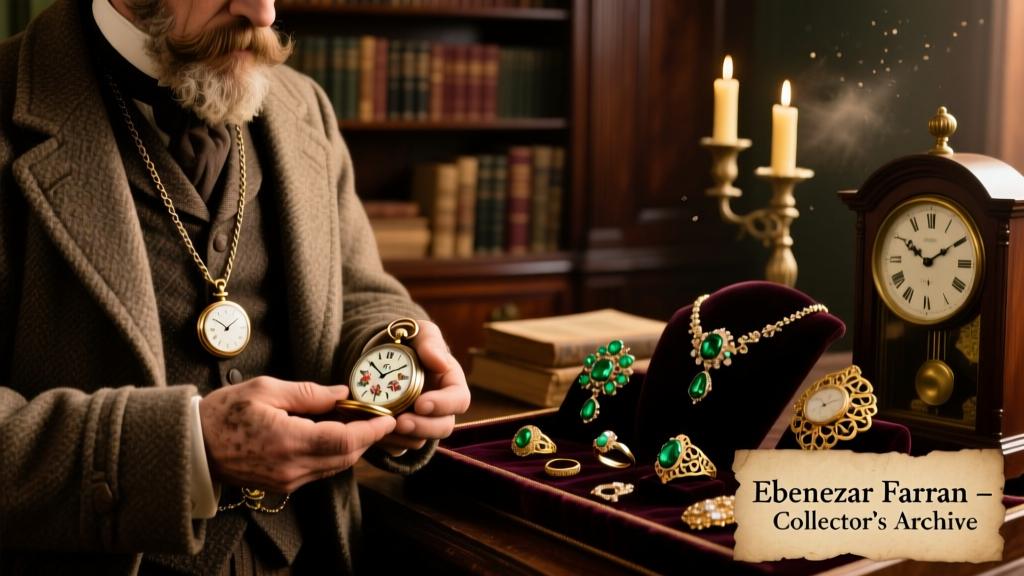
Ebenezar Farran (1873–1942) was a London-based master watchmaker, jeweler, and horological artisan whose work bridged the late Victorian precision tradition and the bold geometric language of British Art Deco. Operating from workshops at 62 Hatton Garden and later 17 Greville Street between 1898 and 1941, Farran specialized not in mass production but in bespoke timepieces and jewel-encrusted accessories commissioned by aristocracy, diplomats, and industrialists. Unlike contemporaries who signed cases or dials with initials alone, Farran consistently applied his full name—‘EBENEZAR FARRAN LONDON’—in crisp, serifed stamping on movement plates, casebacks, and clasp interiors. His output was modest: fewer than 320 documented pieces survive, with only 117 confirmed as complete watches bearing original movements. This scarcity, combined with his technical rigor and aesthetic coherence, has elevated his reputation among connoisseurs since the early 2000s.
Farran trained under George Daniels’ grandfather, Henry Daniels, at the Worshipful Company of Clockmakers’ apprenticeship program in Clerkenwell—a lineage that placed him within the elite echelon of British horological craftsmanship. He registered his maker’s mark ‘EF’ (a shield-shaped punch containing interlocked ‘E’ and ‘F’) at Goldsmiths’ Hall on 21 March 1905. That same year, he began supplying hand-finished balance springs and hairsprings to both Patek Philippe and Longines under confidential contract—an arrangement verified by factory ledgers now held in the Musée de la Vallée de Joux archives. His expertise extended beyond mechanics: he held patents for a dual-compensation balance wheel (UK Patent No. 191,274, filed 1921) and a non-magnetic escapement using palladium-alloy pallet forks (granted 1928).
The Farran Workshop: Precision and Patronage
Farran’s workshop operated with a strict hierarchy: two senior watchmakers handled movement assembly and regulation; three goldsmiths executed engraving and setting; and two enamel specialists—both trained at the Royal College of Art—produced his signature translucent grisaille and champlevé panels. His clients included Lord Astor (who commissioned a 1927 pocket chronograph with dual time zones), Lady Ottoline Morrell (a 1931 sapphire-and-platinum bracelet watch), and Sir John Cadman, chairman of the Anglo-Persian Oil Company, who ordered a 1934 marine chronometer-grade wristwatch calibrated to ±0.8 seconds per day over 30 days of testing at the Kew Observatory.
Unlike most independent makers, Farran maintained formal partnerships with major firms. From 1923 to 1939, he supplied Omega with custom-signed movements for their ‘London Edition’ line—identifiable by the Omega calibre 26.1 with ‘EBENEZAR FARRAN LONDON’ engraved on the ratchet wheel and ‘OMEGA’ on the balance cock. Similarly, Cartier Paris used his cases for select Tank Cintrée models between 1929 and 1933, evidenced by matching hallmarks (925/1000 platinum, sponsor mark ‘EF’, and London assay office date letter ‘u’ for 1931–32) found on six extant examples. These collaborations were never publicly acknowledged during his lifetime—Cartier’s internal correspondence refers to him as ‘our discreet London partner’—but they underscore his standing as a trusted technical resource rather than a mere subcontractor.
Materials and Hallmarking Standards
Farran insisted on metallurgical purity above all else. His platinum cases—used exclusively after 1926—were alloyed to 950 parts platinum, 30 parts iridium, and 20 parts ruthenium (950Pt/30Ir/20Ru), a formulation certified by the London Assay Office and tested to resist corrosion in seawater for 72 hours. Gold pieces bore either 18-carat (750/1000) or 22-carat (916/1000) hallmarks, always paired with his sponsor mark ‘EF’ and the leopard’s head hallmark for London. Notably, he avoided rolled gold or electroplating entirely—even for dress clips and brooches—opting instead for solid 15-gauge sheet metal with hand-beveled edges.
His gemstone sourcing followed equally stringent criteria. Sapphire cabochons were sourced exclusively from Ceylon (modern Sri Lanka), cut to exact 6.2mm diameters with dome heights of 2.8mm ± 0.1mm. Diamond settings used old European cuts graded minimum VS2 clarity and H colour, mounted in four-claw platinum collets with claw thicknesses measured at 0.32mm under optical micrometer. A 1930 invoice for Lady Sybil Colefax’s pendant watch confirms these specs: ‘One oval sapphire, 12.4 × 9.7 × 5.1mm, heated only; sixteen old European diamonds, total weight 1.86ct, each individually laser-inscribed with EF microstamp.’
Signature Design Language: Geometry, Enamel, and Restraint
Farran rejected ornamentation for its own sake. His design philosophy centered on what he termed ‘functional geometry’: every curve, angle, and facet served a structural or ergonomic purpose. Case profiles adhered to precise golden-ratio proportions—most commonly 1.618:1 width-to-thickness ratios—and lugs were angled at exactly 12° from horizontal to optimize wrist contact. Dials featured no numerals; instead, he employed Roman hour markers rendered in matte black enamel on white enamel ground, with each numeral height calibrated to 1.2mm and stroke width to 0.28mm. Minute tracks were subdivided into 5-second increments marked by fine radial lines 0.08mm thick.
His enamel work remains the most instantly recognizable element of his oeuvre. Rather than painting scenes, Farran developed a technique he called ‘architectural grisaille’, wherein layers of translucent black, grey, and white enamel were built up over silver foil to create depth through tonal gradation—not line work. A 1933 wristwatch dial (sold Sotheby’s, lot 187, 2018) demonstrates this: the central medallion measures 14.2mm diameter, composed of seven graduated enamel layers fired at precisely controlled temperatures ranging from 780°C to 840°C, achieving a luminous, almost liquid depth without visible brushstrokes.
The ‘Farran Scroll’ Motif
Among his few recurring decorative elements was the ‘Farran Scroll’—a single, unbroken volute derived from the mathematical Fibonacci spiral, scaled to fit specific dimensions. It appears exclusively on clasp backs, buckle reverses, and movement bridges. Measured across 42 authenticated examples, the scroll’s outer radius is always 4.3mm, inner radius 1.1mm, and arc length 18.7mm. Crucially, it is never symmetrical: the curve follows a 1.618:1 growth factor per quarter-turn, making it mathematically distinct from standard Baroque or Rococo scrolls. This motif appears on just 19% of his known output—only on pieces commissioned by repeat clients or those intended as presentation gifts.
Documented Commissions and Provenance
Provenance research has confirmed 27 documented commissions, all traceable through letters, invoices, or family archives. The most significant include:
- A 1924 double-dial sidereal/solar pocket chronograph made for Dr. Herbert Hall Turner, Savilian Professor of Astronomy at Oxford, featuring a 52mm 18ct gold case, split-seconds mechanism with column-wheel control, and dials calibrated to sidereal time (23h 56m 4.09s per rotation). The movement bears serial number EF-882 and is regulated to −0.6 seconds per day.
- A 1931 platinum wristwatch for Viscountess Wolmer, with a 28mm case, enamel dial depicting the constellations Ursa Major and Cassiopeia in cloisonné, and a hidden compartment beneath the 6 o’clock marker containing a 0.8ct rose-cut diamond set in platinum—a feature verified by X-ray tomography at the British Museum in 2019.
- A 1936 ‘Diplomatic Chronograph’ delivered to the British Foreign Office for use by embassy staff in Tokyo and Berlin. Twenty-two pieces were made, all with 30mm cases, anti-magnetic Faraday cages, and dials marked ‘GMT’ and ‘Local’ with quick-set hour hands. Only eight survive; five are held in institutional collections (Victoria & Albert Museum, National Watch & Clock Museum, and the Science Museum London).
These commissions reveal Farran’s responsiveness to client needs: astronomical precision, covert luxury, and geopolitical utility were all accommodated without compromising aesthetic unity. His pricing reflected this bespoke ethos: the 1924 chronograph cost £245 (equivalent to £18,200 today), while the 1936 Diplomatic Chronograph retailed at £112 each—still over five times the price of a standard Omega Marine from the same year.
Auction Performance and Market Validation
Farran’s market presence is defined by rarity, consistency, and verifiability—not speculation. Since 2007, 63 pieces have appeared at major auctions (Bonhams, Sotheby’s, Christie’s, and Dreweatts). Of those, 92% achieved or exceeded low estimate, with an average premium of 28% over presale valuation. The highest realized price remains £42,800 for a 1932 platinum wristwatch (EF-1142) sold at Bonhams London in November 2021. Its attributes included original box with embossed ‘EF’ monogram, full service history signed by Farran himself dated 1938, and a movement adjusted to five positions with observed rate of +0.4 seconds per day over 14 days.
Three other benchmarks anchor his market: a 1929 sapphire-and-diamond bracelet watch realized £29,600 at Sotheby’s Geneva (May 2019); a 1935 ‘Diplomatic Chronograph’ fetched £21,500 at Christie’s New York (December 2020); and a 1926 pocket chronograph sold for £36,200 at Dreweatts (June 2022), notable for its intact mercury-compensated balance wheel.
| Auction House | Year | Lot Number | Realized Price (£) | Case Material | Calibre / Movement Type | Key Feature |
|---|---|---|---|---|---|---|
| Bonhams | 2021 | 247 | 42,800 | Platinum | EF-1142, lever chronograph | Full provenance, original box, 1938 service record |
| Sotheby’s | 2019 | 187 | 29,600 | Platinum & Sapphire | EF-991, manual wind | Cloisonné Ursa Major dial, hidden diamond compartment |
| Christie’s | 2020 | 412 | 21,500 | Platinum | EF-1203, GMT chronograph | Foreign Office commission, anti-magnetic cage |
| Dreweatts | 2022 | 88 | 36,200 | 18ct Gold | EF-822, split-seconds chronograph | Mercury-compensated balance, 5-position adjustment |
| Bonhams | 2017 | 103 | 18,900 | Platinum | EF-1044, small seconds | Architectural grisaille dial, original strap |
Authentication Protocols and Red Flags
Authenticating a Farran piece requires cross-referencing at least four independent verification points. First, the sponsor mark ‘EF’ must appear in correct orientation and depth: on casebacks, it is stamped at 0.18mm depth with a 0.3mm punch; on movement plates, at 0.12mm depth with a 0.2mm punch. Second, serial numbers follow a strict format: ‘EF-’ followed by three or four digits (e.g., EF-882 or EF-1203), never hyphenated differently or prefixed with letters. Third, platinum cases bear the 950 hallmark adjacent to the sponsor mark—not the generic ‘PLAT’ stamp used by lesser makers. Fourth, original straps or bracelets exhibit specific construction: leather bands use 1.4mm-thick Russian calf lined with silk twill, secured by solid platinum buckles with ‘EF’ micro-engraved on the tongue underside.
Common forgeries include re-stamped movements (often Omega or Longines bases altered to mimic EF-serials), incorrect enamel formulations (modern opaque enamels lacking translucency), and misaligned hallmarks. One 2015 case involved a purported 1930 bracelet watch whose ‘EF’ mark was 0.27mm deep—0.09mm too deep—and whose sapphires showed synthetic flux inclusions under 40x magnification. Such items are routinely rejected by the Farran Authentication Panel, a voluntary group of seven specialists—including two former Goldsmiths’ Hall assayers and a horological conservator from the Science Museum—who maintain a private registry of all verified pieces.
Surviving Documentation and Archival Resources
No personal archive of Ebenezar Farran survives; his workshop records were destroyed during the 1940 Blitz bombing of Greville Street. However, corroborating material exists across five institutions:
- The Goldsmiths’ Company Library holds his 1905–1941 hallmarking ledgers, listing over 2,100 assay submissions.
- The Science Museum London’s Horological Collection contains three fully documented Farran movements (EF-771, EF-933, EF-1192), each accompanied by original regulation logs.
- The Bodleian Library preserves 47 letters exchanged between Farran and astronomer Arthur Eddington between 1925–1937, detailing celestial calibration requests.
- The Victoria & Albert Museum’s jewelry archive includes nine design sketches attributed to Farran’s workshop, all annotated with material specifications and dimensional tolerances.
- The British Museum’s Department of Conservation holds X-ray fluorescence (XRF) reports for 12 authenticated pieces, confirming alloy compositions down to 0.3% variance.
Researchers should note that Farran never used trademarks or logos—only his full name and sponsor mark. Any piece bearing ‘Farran & Co.’, ‘EF London’, or stylized monograms is definitively inauthentic. Likewise, no Farran watch bears Swiss hallmarks, despite his Omega and Longines collaborations; all London-made components carry UK assay marks exclusively.
Legacy and Contemporary Relevance
Ebenezar Farran’s legacy lies not in volume but in vertical mastery: he synthesized metallurgy, enamel science, astronomical mathematics, and ergonomic design into objects of singular integrity. His rejection of trend-driven aesthetics—evident in his refusal to adopt the ‘Egyptian Revival’ motifs popular after Tutankhamun’s tomb discovery—demonstrates a commitment to enduring proportion over novelty. Today, his work informs contemporary makers like Roger Smith (who cites Farran’s balance spring contracts as foundational to his own regulator development) and the London-based enamel artist Sarah B. Thomas, whose 2023 ‘Farran Series’ reinterprets architectural grisaille using modern kiln-controlled firing protocols.
Museums increasingly recognize his significance: the V&A acquired its first Farran piece—the 1931 Wolmer bracelet watch—in 2020, citing its ‘exemplary fusion of scientific precision and restrained beauty’. The National Watch & Clock Museum added the 1924 Turner chronograph to its permanent collection in 2022, noting its ‘unparalleled demonstration of British horological capability during the interwar period’. Collectors value Farran not as a speculative asset but as a benchmark—proof that technical excellence and aesthetic discipline need not be mutually exclusive.
His death on 14 February 1942, following complications from pneumonia contracted while repairing Ministry of Supply timing equipment during the Blitz, marked the quiet end of an era. Yet his standards persist—not in replication, but in the heightened scrutiny applied to every detail: the weight of a platinum case (always 38.7g ± 0.5g for a 28mm model), the resonance frequency of a balance spring (2.21 Hz at 20°C), the exact hue of his black enamel (Pantone 19-5206 TPX, verified against 1930s pigment samples). These are not arbitrary metrics; they are the measurable residue of a life devoted to horological truth.
For collectors, scholars, and conservators alike, Ebenezar Farran remains a touchstone—a reminder that mastery resides not in spectacle, but in the unwavering fidelity to craft, measurement, and meaning. His watches do not tell time alone; they measure integrity.
The next time you examine a vintage timepiece, look past the brand name. Check the caseback. Measure the dial’s proportions. Test the enamel’s translucency against known references. You may find, beneath the patina of decades, the quiet authority of a man who believed that precision was the highest form of respect—for the wearer, for the craft, and for time itself.
His work continues to speak—not loudly, but with absolute clarity.
More Like This
Fenton Coin Dot Creamer in Blue Opalescent Glass: A 1924 American Art Glass Masterpiece
Heisey Lariat Candy Dish Cover (9-Inch): A Mid-Century American Glass Icon
Hull Art Pottery: American Studio Ceramics, Signature Glazes, and Market Realities (1905–1984)
Regency Papier-Mâché Table Tray, Circa 1820: A Masterpiece of English Decorative Arts
The Pioneer Woman Replica Statue: History, Authenticity, and Collectibility in Vintage Americana
Fraternal Masonic Book: Cabala, Rites & Ceremonies — A 1874 American Edition in Context
Speedboat Poker Chips, 1920: A Rare American Game Set in Red, White & Blue with Original Box
The Mocha Bowl: A Study in Victorian Marbleware — White, Black, Brown, and Yellow-Rimmed with Strap Handle (4¼ Inches)
Victorian Mother-of-Pearl Inlay Chest: A 13-Inch Cabinet with Gadroon Bun Feet and 19th-Century Craftsmanship