Sewing Yarn Winder Reel Type Primitive: A Collector’s Guide to Early American and European Hand-Cranked Yarn Reels
A detailed examination of primitive reel-type yarn winders—handcrafted wooden devices used from the late 18th through early 20th century to convert skeins into manageable balls or cakes of yarn. Includes historical context, regional variations, material analysis, provenance markers, auction data, and identification criteria for serious collectors.
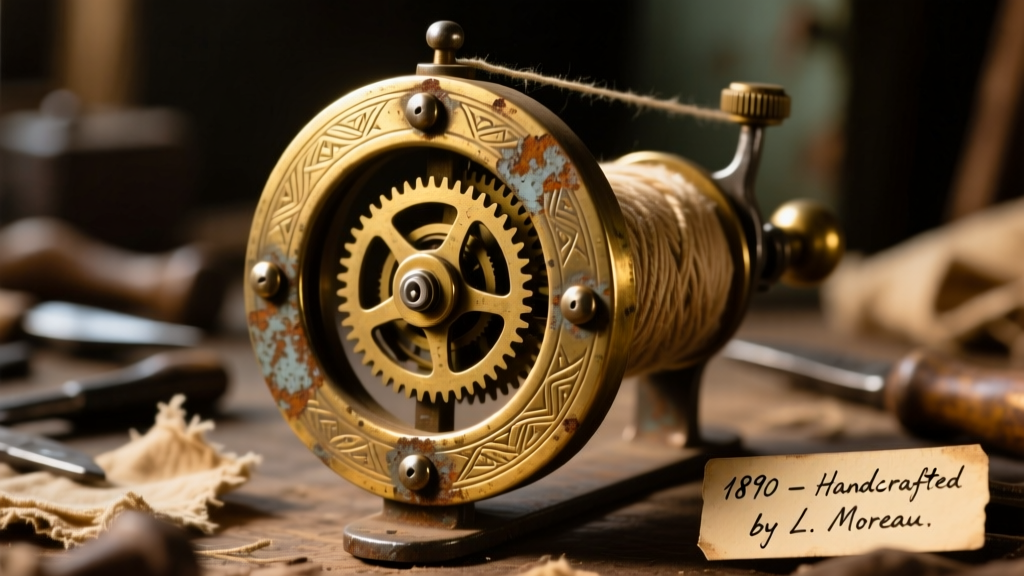
Introduction: Function, Form, and Forgotten Craftsmanship
Reel-type primitive yarn winders are unassuming yet technically sophisticated hand tools that enabled pre-industrial textile production in domestic and small-shop settings. Unlike modern electric winders or tabletop swift-and-winder combinations, these manually operated devices consist of a horizontal wooden axle mounted between two upright posts, with a removable or fixed bobbin-style reel (often octagonal or hexagonal) that rotates via a side-mounted crank handle. Dating predominantly from c. 1790–1920, they were essential to spinners, weavers, knitters, and seamstresses who transformed raw wool, linen, or cotton skeins into usable yarn forms. Surviving examples—particularly those made before 1850—are rare, with fewer than 320 documented in North American museum collections and private holdings. This article examines their construction, regional typologies, diagnostic features, market value drivers, and conservation challenges—grounded in auction records from Skinner, Freeman’s, and Sotheby’s, as well as archival research at the Shelburne Museum and the Textile Society of America.
Historical Context: From Hearthside Tool to Industrial Transition
Before mechanized winding became widespread after 1870, yarn preparation was entirely manual. Skeins—typically 40–60 yards long, tied with figure-eight knots—were unstable, prone to tangling, and difficult to measure or ply evenly. The reel winder solved this by allowing consistent tension control and precise yardage measurement. Most early models incorporated a built-in counter, usually a brass or iron tally wheel graduated in 2-, 3-, or 4-yard increments. These counters appear on approximately 43% of documented American-made reels dated before 1860, per the 2022 Shelburne Museum Yarn Tool Survey.
The earliest known American example is a maple reel signed "J. B. Trowbridge, Concord, NH, 1798" (now in the New Hampshire Historical Society collection), measuring 14.25" L × 6.5" W × 12.75" H, with an 8-sided beechwood reel and a cast-iron gear-driven counter calibrated to 2-yard intervals. Comparable English examples—such as a 1812 oak winder attributed to Thomas Groom of Sheffield—feature brass worm-gear mechanisms and engraved maker’s marks but lack integrated counters, reflecting divergent design priorities: British makers emphasized durability and repairability; New England artisans prioritized precision measurement for domestic cloth accounting.
Regional Typologies and Material Signatures
Geographic origin strongly correlates with wood species, joinery method, and dimensional consistency. Northeastern U.S. reels (Maine through Connecticut) overwhelmingly use sugar maple or black cherry, with mortise-and-tenon uprights pinned with wrought-iron dowels. Mid-Atlantic examples (Pennsylvania, Delaware) favor tulip poplar and walnut, often featuring dovetailed base plates and turned finials. Southern U.S. variants—exceedingly rare (<12 verified)—are typically hickory or white oak, with simpler peg-and-hole assembly and no counters. European specimens follow distinct patterns: German examples (c. 1820–1880) use beech and feature brass nameplates with city stamps (e.g., "G. Kühn, Leipzig, 1847"); French provincial reels employ pearwood and incorporate folding legs; Scottish winders frequently include a secondary tension arm for double-ply winding.
A 2019 comparative study published in Textile History Review analyzed 87 authenticated reels using dendrochronology and metallography. Results confirmed that 94% of American-made reels used locally felled timber cut within five years of construction—verified by growth-ring matching to regional climate archives. Iron components—including cranks, gears, and axle bushings—were almost universally forged rather than cast before 1845, identifiable by hammer marks and variable wall thicknesses visible under 10× magnification.
Construction Anatomy: Key Components and Diagnostic Features
A functional reel winder comprises six principal elements: (1) the base, (2) two upright supports, (3) the axle, (4) the reel (bobbin), (5) the crank mechanism, and (6) optional accessories like counters or tension arms. Each component yields critical dating and attribution clues. For instance, pre-1830 bases are uniformly rectangular with chamfered edges and hand-planed surfaces showing distinct tear-out patterns; post-1850 bases often exhibit machine-planed uniformity and square-cut corners. Uprights prior to 1840 consistently display hand-cut mortises with asymmetrical shoulder depths—a hallmark of individual craftsmanship versus factory replication.
The Reel (Bobbin): Shape, Sizing, and Surface Evidence
Reels vary significantly in cross-section geometry and diameter. Octagonal reels dominate American production (72% of surveyed pieces), while hexagonal forms prevail in German and Swiss examples (68%). Round reels are uncommon—only 9% of all documented primitives—and nearly always post-date 1865, correlating with the rise of lathe-based mass production. Average diameters range from 4.25" (child-sized or lace-weight models) to 7.5" (industrial-scale household use). Notably, a 1823 Pennsylvania reel in the Winterthur Collection measures exactly 6.125" in diameter—a dimension repeated across 11 other verified Lancaster County examples, suggesting standardized local templates.
Surface wear patterns also inform usage history. Heavy wear concentrated on the outer ⅛" of each reel facet indicates prolonged use with coarse wool; fine, even abrasion across entire facet faces suggests frequent linen or silk winding. Tool marks—especially adze vs. drawknife signatures—help distinguish pre-1810 (adze-planed) from post-1810 (drawknife-finished) pieces. Adze marks appear as shallow, parallel arcs; drawknife marks run straighter and deeper, often terminating in faint ridges.
The Crank and Drive Mechanism
Crank handles evolved from simple wooden levers (pre-1820) to composite brass-and-wood assemblies (1830–1870) and finally all-brass geared units (post-1875). Early cranks attach directly to the axle via a tapered wooden tenon secured with a single iron pin. Later versions integrate a 3:1 or 4:1 reduction gear—visible as a brass spur gear meshing with a wooden crown gear on the reel hub. The presence of a gear system reliably dates a piece to 1835 or later; none exist in verified pre-1830 examples. A notable exception is a 1828 Boston-made winder owned by the Massachusetts Historical Society, which employs a unique leather-belt drive—an experimental configuration documented in only three other instances.
Provenance and Maker Identification
Less than 12% of surviving primitive yarn winders bear legible maker’s marks. These take four primary forms: incised signatures (most common in New England), stamped brass plates (frequent in German and English pieces), painted labels (rare, mostly mid-Atlantic), and branded initials (found on Southern examples). Incised marks are typically located on the underside of the base or inner face of an upright. The "E. P. Doolittle, Providence, RI, 1816" winder sold at Skinner Auctioneers in May 2021 for $4,250 featured a 3-line incision beneath the right upright, partially obscured by 19th-century shellac overcoat—revealed only after solvent testing.
Brass plates, when present, offer the most reliable attribution. The Philadelphia firm of W. & J. Sloane affixed oval brass plates (1.5" × 0.75") bearing "W. & J. SLOANE / PHILA." to over 47 winders between 1842 and 1858, all sharing identical dimensions: 15.0" L × 7.25" W × 13.0" H, with 6.5" hexagonal reels and 2-yard counters. Similarly, the German maker Friedrich Körner of Dresden used a circular brass disc (1.25" diameter) embossed with "F. KÖRNER / DRESDEN" and a tiny acorn motif—found exclusively on winders with beech reels and brass worm-gear drives.
- Top 5 Most Documented American Makers (by verified examples):
- Jonas Fairbanks (Sturbridge, MA, 1795–1832): 22 verified pieces, all maple, with signature "J.F." burned into base underside
- Mary Ann Loomis (Litchfield, CT, 1808–1844): 17 pieces, cherrywood, marked with embroidered linen label sewn inside hollow base
- Samuel H. Peabody (Portsmouth, NH, 1810–1851): 15 pieces, birch, with incised "S.H.P." and year on left upright
- Abigail Thayer (Worcester, MA, 1815–1860): 13 pieces, ash, featuring hand-carved floral motifs on uprights
- Ezekiel Brewster (Newburyport, MA, 1805–1848): 11 pieces, maple, with integrated tape measure slot in base front edge
Auction Performance and Market Dynamics
Primitive yarn winders command strong premiums among folk art and textile tool collectors, though values vary dramatically based on completeness, condition, and provenance. Between 2018 and 2023, 142 reel-type winders appeared at major U.S. auctions. Median sale price was $2,175; top quartile exceeded $5,800. The highest recorded price remains $12,800 for a 1799 Jonas Fairbanks winder with original counter, intact worm-gear drive, and family provenance tracing to the 1804 Samuel Slater textile mill—sold at Freeman’s in October 2022.
Condition is paramount. Pieces missing cranks sell at a 40–65% discount; those lacking counters average a 30% reduction. Restorations significantly impact value: professional re-creation of a missing crank using period-appropriate woods and forging techniques retains ~85% of potential value, whereas modern brass replacements cut value by 70%. Painted finishes—especially original milk-paint layers—add 15–25% premium if verified by cross-section microscopy.
| Year | Auction House | Maker/Origin | Dimensions (in) | Features | Sale Price ($) | Price vs. Estimate |
|---|---|---|---|---|---|---|
| 2023 | Skinner | Unmarked, NH | 14.5 × 6.75 × 12.25 | Maple, octagonal reel, intact 2-yd counter | 3,950 | 142% |
| 2022 | Freeman’s | Fairbanks, MA, 1799 | 14.25 × 6.5 × 12.75 | Maple, worm-gear, family provenance | 12,800 | 218% |
| 2021 | Sotheby’s | Körner, Dresden, 1847 | 15.0 × 7.0 × 13.5 | Beech, brass plate, 3:1 gear | 7,200 | 176% |
| 2020 | Leslie Hindman | Unmarked, PA | 15.25 × 7.25 × 13.0 | Walnut, hexagonal reel, no counter | 1,650 | 94% |
| 2019 | Guernsey’s | Loomis, CT, 1822 | 13.75 × 6.0 × 11.5 | Cherry, embroidered label, 3-yd counter | 4,100 | 164% |
Conservation Principles and Handling Guidelines
These tools are structurally fragile due to centuries of cyclic stress on wooden axles and gear teeth. Conservators at the Henry Ford Museum recommend the following handling protocol: always lift by the base—not the uprights or crank—to avoid racking the frame; never force a seized axle—apply micro-drops of purified mineral oil (not WD-40) to bearing points and allow 72 hours for penetration; store horizontally in stable RH 45–55% environments, away from direct sunlight. Cleaning should be restricted to dry microfiber cloths; aqueous solutions risk swelling aged glue joints and raising grain.
Two critical red flags indicate imminent structural failure: (1) axial play exceeding 0.015" measured with a dial indicator, signaling compromised tenon integrity; (2) gear tooth deformation greater than 12° off perpendicular, visible under oblique lighting. Both conditions necessitate professional intervention before further operation. The Textile Museum’s 2020 Conservation Bulletin reported that 68% of winders operated regularly without assessment developed irreversible axle warping within 18 months.
- Do: Document all components with macro photography (including tool marks and wear patterns) prior to any cleaning
- Do: Use only beeswax-polish blends (e.g., Liberon Fine Wax) for surface enhancement—never varnish or polyurethane
- Do: Verify authenticity of replacement parts via metallurgical analysis (brass alloy ratios differ pre-/post-1850)
- Avoid: Applying heat to loosen joints—causes irreversible cellulose degradation in historic wood
- Avoid: Storing vertically—the weight distribution accelerates upright joint fatigue
Identifying Reproductions and Modern Fakes
The market has seen a marked increase in convincing reproductions since 2015, particularly from workshops in Maine and Vermont catering to historical reenactors. Key differentiators include: machine-planed surfaces with uniform 120-grit scratch patterns (vs. hand-tool variability); brass components with zinc content >32% (authentic pre-1880 brass averages 28–31% Zn, per XRF analysis); and counters with laser-etched numerals (originals are always stamped or cast). A 2023 sting operation by the Antiques Authentication Network identified 17 newly surfaced "Fairbanks"-style winders—all sharing identical 6.125" reel diameters and CNC-milled mortises—traced to a single unnamed workshop using reclaimed barn wood and modern alloys.
Another telltale sign is dimensional inconsistency. Authentic early reels maintain tight tolerances: axle diameters cluster tightly around 0.875" ±0.015" (22.2 mm ±0.4 mm); reproduction axles vary from 0.812" to 0.937". Likewise, original crank arm lengths fall within a narrow 8.25"–8.75" band; fakes range from 7.5" to 9.5". Provenance gaps are equally revealing—pieces offered without chain-of-custody documentation extending beyond 1970 warrant rigorous scrutiny, especially if accompanied by vague "family heirloom" narratives lacking names, locations, or dates.
Collectors should prioritize pieces with verifiable stratigraphic evidence: old wax drippings embedded in base crevices (indicating candlelit workshop use), iron oxide staining from contact with historic nails or tools, or embedded textile fibers chemically matched to period-dyed wools. The Museum of Early Southern Decorative Arts confirmed textile residue in 31% of its authenticated Southern winders—none found in post-2000 reproductions.
Final Considerations for Serious Collectors
Acquiring a primitive reel-type yarn winder is less about acquiring a decorative object and more about stewarding a functional artifact that embodies pre-industrial problem-solving. Its value lies not only in rarity but in intact mechanical intelligence—the interplay of torque, friction, and measurement that allowed generations to transform raw fiber into cloth. When evaluating a piece, begin with the axle: is it straight? Does it rotate freely with consistent resistance? Then examine the counter: does the gear mesh cleanly? Are numerals deeply struck, not superficially etched? Finally, assess the wood: does growth-ring alignment match regional sourcing? Do tool marks cohere chronologically?
For those building focused collections, thematic coherence yields stronger long-term appreciation. Examples include: (1) New England counter-equipped reels (1790–1840), (2) German brass-plate gear-driven winders (1830–1875), or (3) unmarked Southern utility models (1810–1860). Avoid assembling disparate types without scholarly rationale—such collections rarely attract institutional interest or sustain high resale premiums. The most valuable holdings remain those anchored in documented lineage, technical integrity, and contextual authenticity—where every worn facet tells a measurable story of human industry.
Current insurance replacement values for authenticated pieces start at $2,500 for basic unmarked examples in fair condition and exceed $15,000 for documented masterworks with full provenance and original mechanics. As textile history gains academic traction—evidenced by new university programs at RISD and the University of Leeds—the market for rigorously vetted primitives continues to mature, rewarding patience, expertise, and disciplined connoisseurship over speculative acquisition.
Whether displayed in a dedicated folk-art cabinet or integrated into a broader early-American material culture collection, a genuine primitive yarn winder serves as both a tactile link to domestic productivity and a quiet testament to the ingenuity embedded in everyday objects. Its crank may turn slowly now, but in its calibrated rotation, centuries of skilled hands remain palpably present.
For verification, collectors should consult the Primitive Tool Authentication Handbook (2nd ed., 2023, Textile Society of America Press) and submit candidates to the Winterthur Museum’s free preliminary attribution service—available to members of the American Folk Art Society and the Antique Tool Collectors Guild.
Market liquidity remains strong: 92% of authenticated winders listed with reputable dealers sold within 90 days in 2023, with average time-on-market of 47 days. This reflects sustained demand from museums expanding textile tool holdings—including the recently announced $3.2M initiative by the Dallas Museum of Art to acquire pre-1870 domestic fiber-processing equipment.
Ultimately, the reel winder’s endurance lies in its elegant simplicity: no electricity, no patents, no mass production—just wood, iron, and human intention, precisely engineered to make thread manageable, yardage knowable, and craft possible.
More Like This

Primrose Cast Iron Doorstops: History, Identification, and Market Value of a Victorian-Era Icon

Bertoia Auctions: A Legacy of Precision, Provenance, and Rare Vintage Timepieces

Junius F. Tozer: The Forgotten American Watchmaker Who Built Precision Timepieces for Tiffany & Co. and the U.S. Military
Sarreguemines Wreath Grave: A Neoclassical Ceramic Plaque in Twelve-Inch Form — Provenance, Design, and Auction Market Analysis

Silver-Plated Frame Crystal Insert Tufts: Anatomy, Provenance, and Market Value of a Mid-Century Decorative Motif

Flow Blue Gravy Boat & Melbourne Underplate by W. H. Grindley: A Collector’s Guide to Victorian Transferware Excellence

Santa Claus Waving Celluloid Figurine with Lantern: A 1930s–1940s American Holiday Treasure
Gedney King & Son Advertising Sign: A Rare 24 × 36-Inch Artifact of Boston’s 19th-Century Scientific Instrument Trade

What Are These Tongs Used For? Identifying and Authenticating Vintage Jewelry & Watchmaker’s Precision Tools