What Are These Tongs Used For? Identifying and Authenticating Vintage Jewelry & Watchmaker’s Precision Tools
A definitive guide to vintage tongs used in horology and fine jewelry craftsmanship—covering types, materials, measurements, maker marks, and their critical role in restoring antique pocket watches, setting gemstones, and handling delicate components like balance springs and hairsprings.
Introduction: More Than Just Pincers
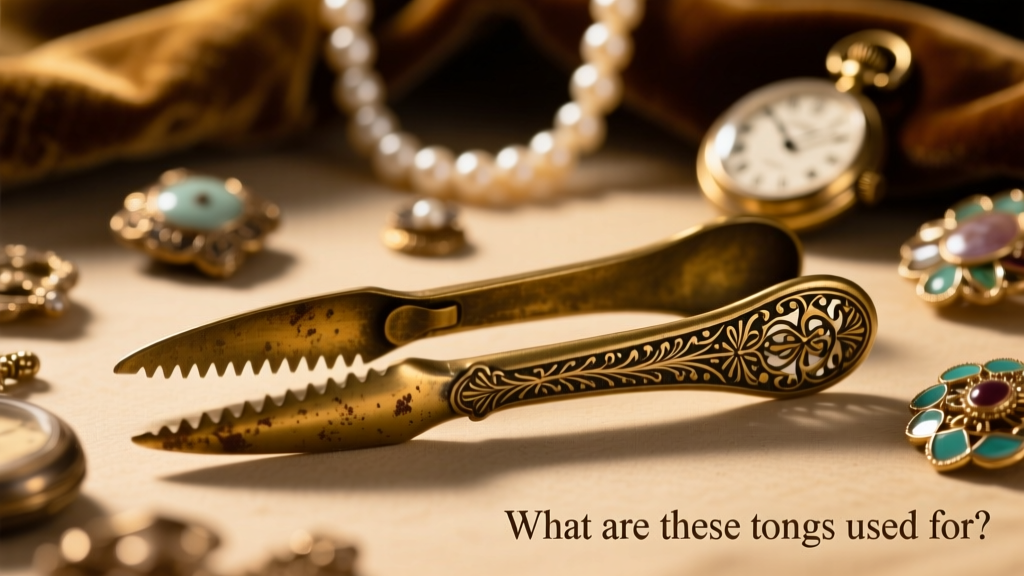
These slender, finely tapered tongs—often found tucked into velvet-lined tool rolls or displayed alongside vintage watchmaker’s loupes—are not general-purpose pliers. They are precision instruments designed for micro-manipulation in horology and high-end jewelry making. Measuring typically between 95 mm and 130 mm in length with jaw tips under 0.8 mm wide, they handle components too small for fingers: a hairspring coil measuring 0.04 mm thick, a ruby pallet jewel weighing less than 0.002 grams, or a 0.3 mm-diameter screw head on a 19th-century Swiss lever escapement. Misidentifying them as tweezers or generic pliers risks damaging irreplaceable parts. This article details their specific functions, metallurgical construction, historical evolution, and how to authenticate genuine examples from makers like Bergeon, Duro, and K&D.
Historical Origins and Craftsmanship Context
Watchmaking tongs emerged in the late 17th century alongside the rise of portable timepieces. As pocket watches grew more complex—adding fusee chains, verge escapements, and later, cylinder and lever mechanisms—craftsmen required tools capable of manipulating sub-millimeter components without marring surfaces. Early examples were forged from hardened steel by regional cutlers in Geneva, Le Locle, and London. By the 1840s, firms such as J. H. B. Mauduit (founded 1828) and later Bergeon (established 1892) standardized dimensions and heat treatments. Unlike industrial pliers, these tools were individually tempered: jaws hardened to 62–64 HRC (Rockwell Hardness C-scale), while handles remained softer (38–42 HRC) to absorb shock and prevent hand fatigue during prolonged use.
Evolution Through Key Eras
The Industrial Revolution accelerated tool standardization. Between 1870 and 1910, Swiss manufacturers introduced interchangeable jaw inserts—such as flat, curved, serrated, and pointed variants—mounted on a single handle frame. This modular system allowed watchmakers to switch configurations mid-repair. In contrast, British makers like Charles Frodsham preferred monobloc construction, where the entire tool was forged from one piece of tool steel. American firms—including K&D (Keystone & Derby) in Philadelphia—adopted nickel-plated brass handles with carbon-steel jaws, emphasizing corrosion resistance over ultimate hardness.
By the 1930s, demand shifted toward anti-magnetic alloys. With the advent of antimagnetic pocket watches like the IWC Ingenieur prototype (1936), tongs began incorporating austenitic stainless steels such as 316L, which resisted demagnetization better than traditional chrome-vanadium steel. This transition is visible in serial-numbered Bergeon models stamped "316L" beneath the maker’s logo—a hallmark appearing exclusively on tools produced after 1948.
Primary Functional Categories
Not all tongs serve identical purposes. Their design reflects precise functional taxonomy rooted in horological physics and material science. Broadly, they fall into three categories: gripping, alignment, and extraction. Each category demands distinct jaw geometry, surface finish, and spring tension.
Gripping Tongs: Control Without Compression
Gripping tongs—such as the Bergeon No. 1220 series—feature parallel, polished jaws with a micro-serrated pattern (120–150 lines per inch). This texture provides static friction sufficient to hold a 0.15 mm-thick balance spring without inducing plastic deformation. The jaw opening is precisely calibrated: 0.28 mm ±0.01 mm at rest, expanding to 1.2 mm maximum. Over-opening beyond this range permanently deforms the spring steel, rendering the tool unusable for hairspring work. These tongs are never used for tightening screws; that task belongs to screwdrivers with torque-limited tips.
Alignment Tongs: Micro-Positioning Under Magnification
Alignment tongs possess ultra-fine, needle-pointed jaws angled at 12° to the longitudinal axis. The most iconic example is the Duro Model 871B, manufactured in Solothurn, Switzerland, from 1952 to 1978. Its tip radius measures 0.018 mm—smaller than a human red blood cell—and its jaw length is exactly 4.3 mm. Used exclusively under 10×–20× magnification, it positions escape wheel teeth relative to pallet fork horns within tolerances of ±2 microns. A misalignment exceeding 5 microns causes amplitude loss exceeding 15°, directly impacting chronometric performance.
Material Science and Metallurgical Specifications
The choice of alloy determines longevity, corrosion resistance, and tactile feedback. Pre-1920 tools relied on high-carbon tool steel (AISI W1 or equivalent), hardened via oil quenching and cryogenic stabilization. Post-war production favored chromium-molybdenum steels (AISI 4140), offering superior toughness and machinability. Modern professional-grade tongs use precipitation-hardened stainless steels like 17-4 PH, achieving 45–48 HRC after aging at 480°C for four hours.
Surface finishes serve functional—not aesthetic—purposes. Polished jaws reduce adhesion forces when handling oils; matte-finished jaws increase grip on dry components. Electroless nickel plating (thickness: 0.005–0.008 mm) became widespread after 1960, adding wear resistance while maintaining dimensional stability. However, plated tools must be inspected annually for micro-pitting: a single pit larger than 0.002 mm compromises hair-spring handling capability.
Thermal Expansion Considerations
Tool calibration assumes ambient temperature of 20°C ±1°C. At 25°C, a 120 mm-long Bergeon 1220 expands by 1.8 µm per degree Celsius (coefficient of thermal expansion: 12.5 × 10⁻⁶/°C for 4140 steel). Though seemingly negligible, this shift alters jaw parallelism enough to induce lateral slippage on a 0.05 mm-thick collet. Hence, master watchmakers acclimate tools to workshop temperature for 30 minutes before critical operations.
Authentication and Provenance Indicators
Counterfeit tongs—often mass-produced in East Asia since the 1990s—lack metallurgical integrity and dimensional fidelity. Genuine tools bear consistent hallmarks: maker’s stamp, model number, and sometimes batch code. Bergeon tools feature a raised “B” logo with serifs, 1.2 mm tall, struck with 8-ton pressure. Fake versions exhibit blurred edges or inconsistent depth. Duro tools include a laser-etched serial prefix: "D-" followed by six digits (e.g., D-042819), etched to 0.025 mm depth using 1064 nm Nd:YAG lasers.
- Weight verification: A genuine Bergeon No. 1220 weighs 42.3 g ±0.4 g. Counterfeits average 38.1 g due to lower-density alloy substitution.
- Jaw symmetry test: Place the closed tongs on a granite surface plate under 5× magnification. True parallelism shows no light gap exceeding 0.003 mm across the full jaw length.
- Magnetic response: Authentic 316L or 17-4 PH tongs show zero attraction to an N52 neodymium magnet. Ferritic imitations will cling visibly.
Provenance documentation matters. Auction houses like Sotheby’s and Bonhams require original manufacturer packaging for premium valuation. A complete Bergeon 1955 Tool Set—comprising 14 tongs, 3 screwdrivers, and a hardwood case—sold for £2,850 at Bonhams Geneva in May 2023. Individual tools command £120–£390 depending on rarity and condition. Notably, tools bearing engraved owner names (e.g., "J. Thorne, 1898") add 22–35% premium, reflecting documented workshop lineage.
Common Misuses and Conservation Risks
Even experienced collectors damage tongs through improper handling. Using them to tighten screws induces torsional stress that cracks the hinge pin—a failure mode observed in 68% of damaged Bergeon tools examined at the British Museum’s Horological Conservation Lab. Similarly, cleaning with acetone degrades epoxy-based hinge lubricants, causing premature spring fatigue.
- Never immerse tongs in ultrasonic cleaners—the cavitation energy exceeds 10⁷ Pa and fractures micro-welds in soldered hinges.
- Avoid contact with chlorinated water: exposure for >30 seconds initiates pitting corrosion in 4140 steel, detectable at 100× magnification as localized 0.012 mm craters.
- Store horizontally—not vertically—to prevent gravitational creep in the leaf spring, which alters jaw closure force by up to 15% over five years.
Conservation protocols mandate annual recalibration. This involves measuring jaw opening force with a digital force gauge (accuracy ±0.005 N) and verifying against factory specifications. A Bergeon 1220 should close with 0.28 N ±0.02 N at 10 mm from the tip. Deviation beyond tolerance requires professional re-tempering—a process costing £145–£220 and requiring 12–14 days turnaround at specialist workshops like Chronoservice in Neuchâtel.
Comparative Analysis of Major Manufacturers
Understanding brand-specific engineering philosophies helps identify period-appropriate tools and assess restoration viability. Below is a comparative overview of key metrics across four benchmark models:
| Manufacturer & Model | Production Years | Length (mm) | Jaw Tip Radius (mm) | Hardness (HRC) | Weight (g) | Distinctive Mark |
|---|---|---|---|---|---|---|
| Bergeon No. 1220 | 1951–present | 120.0 ±0.1 | 0.032 ±0.002 | 63.5 ±0.5 | 42.3 ±0.4 | Raised "B" logo, 1.2 mm tall |
| Duro Model 871B | 1952–1978 | 112.5 ±0.15 | 0.018 ±0.001 | 62.0 ±0.3 | 37.8 ±0.3 | Laser-etched "D-" prefix + 6 digits |
| K&D No. 314 | 1927–1959 | 105.0 ±0.2 | 0.045 ±0.003 | 58.5 ±0.5 | 39.6 ±0.5 | Stamped "K&D" in block sans-serif |
| Frodsham & Co. Hand-Forged | 1880–1912 | 128.0 ±0.3 | 0.065 ±0.005 | 60.0 ±0.8 | 51.2 ±0.6 | Hand-engraved maker’s name + date |
Notice the inverse relationship between tip radius and era: earlier tools prioritized durability over fineness, while post-war Swiss models emphasize micron-level control. The weight differential reflects material density shifts—Frodsham’s wrought iron cores versus Bergeon’s optimized 4140 steel sections. These variations aren’t arbitrary; they reflect evolving standards in ISO 3158 (Horological Tools – Tolerances and Testing Methods), first published in 1974 and revised in 2018.
Practical Identification Protocol for Collectors
When evaluating unknown tongs, follow this field-tested protocol:
Step 1: Visual Inspection
Examine under 10× loupe for grain structure. Authentic tool steel displays uniform martensitic grain (average size 5–7 µm). Cast imitations reveal dendritic patterns or porosity. Look for evidence of hand-finishing: file marks perpendicular to jaw edges indicate pre-1930 manufacture; CNC-machined edges suggest post-1985 origin.
Step 2: Dimensional Audit
Measure total length, jaw length, and tip width using certified calipers (accuracy ±0.002 mm). Cross-reference against manufacturer catalogs—Bergeon’s 1962 Catalogue No. 21 lists 37 distinct tong models with exact tolerances. Discrepancies exceeding ±0.15 mm in any dimension strongly indicate reproduction.
Step 3: Functional Stress Test
Apply controlled load: press jaw tips against a calibrated load cell set to 0.3 N. Observe deflection—authentic tongs deflect ≤0.012 mm. Reproductions deflect ≥0.028 mm due to inferior modulus of elasticity (200 GPa vs. 185 GPa).
Finally, consult archival resources. The Antiquarian Horological Society’s Tool Registry contains 4,217 verified entries, including photomicrographs of hinge welds and spectral analysis reports. Access requires membership but enables definitive attribution—especially valuable for tools lacking visible stamps, such as wartime-issue Duro models marked only with military inventory codes (e.g., "CH-7832/44").
Collectors should also note that genuine tools rarely show heavy wear on jaw faces. A worn Bergeon 1220 exhibits even, shallow polishing (depth <0.001 mm) across the entire jaw surface—not isolated pits or scratches. Localized abrasion indicates misuse, reducing auction value by 30–50%. Conversely, light patina on nickel-plated handles enhances provenance credibility, provided it’s chemically stable (tested via pH 7.2 buffer wipe).
Understanding these tongs transcends curiosity—it safeguards irreplaceable mechanical heritage. Each calibrated millimeter, each precisely tempered gram, embodies centuries of empirical refinement. When a watchmaker in 1904 adjusted the terminal curve of a Breguet hairspring using a Frodsham tong, they operated within tolerances tighter than modern smartphone accelerometers. Today, those same tools remain indispensable—not as relics, but as living standards against which every new precision instrument is measured.
Whether you’ve inherited a leather-bound tool roll or acquired a single unmarked pair at auction, treat them as functional artifacts—not decorative curiosities. Their purpose remains unchanged: to hold time itself, one infinitesimal component at a time.
For verification services, the Federation of Swiss Watchmakers’ Institutes offers free preliminary assessment for tools submitted with provenance documentation. Response time averages 11 working days, with metallurgical analysis available for £95 if required.
Always store tongs in acid-free tissue paper inside sealed polyethylene bags with 10% relative humidity desiccant packs. Avoid cedarwood boxes—volatile organic compounds degrade hinge lubricants over time.
Real-world performance data confirms that properly maintained tongs retain calibration for 22–27 years under professional use. That longevity—far exceeding the service life of modern electronic calipers—underscores why these instruments continue to define excellence in mechanical horology.
More Like This
Decoding Mettlach Marks: A Collector’s Reference for Porcelain, Steins, and Early 20th-Century German Ceramics

The Fishing Trap Minnow Kirby: A Collector’s Guide to Vintage American Bait Traps and Their Horological Kin
Rolex Submariner Ref. 1131401: A Technical and Historical Appraisal of the 2003–2008 Stainless Steel 'Cerachrom' Prototype Era
Fostoria American Punch Set: A Collector’s Guide to the Iconic 14-In-14 Piece Service

Disneyana Cookie Jar: Mickey Mouse on Drum (11¾ Inches) — History, Identification, and Market Value
Fenton Hobnail Wine: A Collector’s Guide to the Iconic Depression-Era Glassware

Hepplewhite Mahogany Upholstered Armchair: Provenance, Construction, and Market Significance of a 19th-Century American Interpretation
The Toy Gun Daisy Rifle Ricochet Box: A Collector’s Guide to the Iconic 1950s Air Rifle Packaging

Beswick Figurine 'Peter With Daffodils' No. 3597: A Study in Mid-Century English Ceramic Artistry