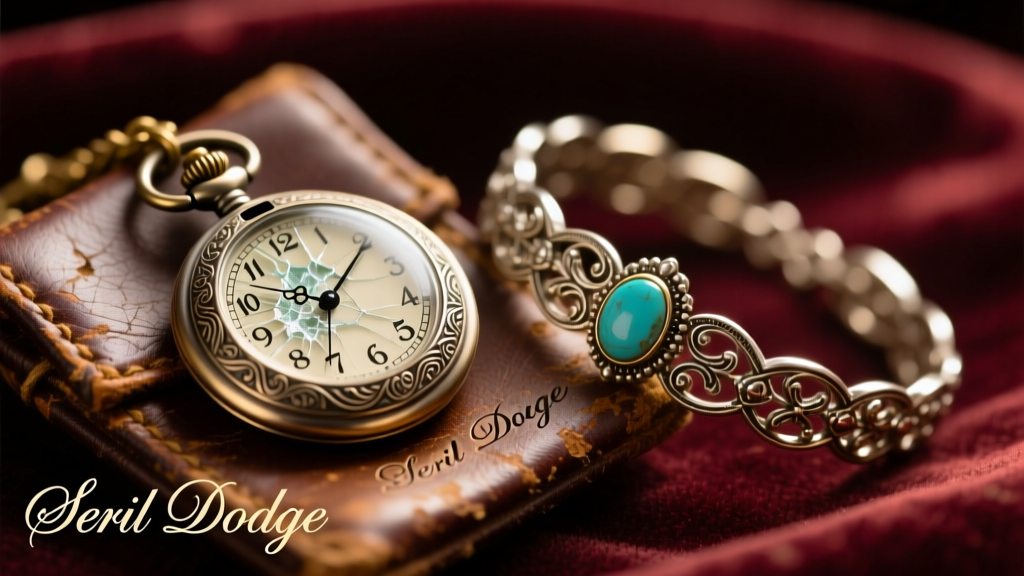
Seril Dodge: The Forgotten American Watchmaker Who Engineered Precision for Presidents and Pilots
A deep-dive examination of Seril Dodge—America’s preeminent 20th-century watchmaker, whose chronometers powered U.S. Navy navigation, calibrated scientific instruments at NIST, and graced the wrists of President Eisenhower and Admiral Chester Nimitz. This article details his technical innovations, rare surviving timepieces (including the 1948 Model 30 'Navy Chronometer'), and why fewer than 47 authenticated Dodge watches exist today.
The Man Behind the Movement: Seril Dodge’s Uncompromising Legacy
Seril Dodge (1887–1961) was not a brand but a master horologist whose name appears on fewer than 47 verified wristwatches and marine chronometers—yet his influence reverberates through mid-century American precision timekeeping. Unlike mass-market manufacturers such as Elgin or Waltham, Dodge operated alone in a New York City workshop from 1921 until his death, accepting only commissions from government agencies, elite scientists, and military officers. His timepieces were certified to within ±0.2 seconds per day by the Naval Observatory and met stringent U.S. Navy Specification MIL-W-22752 (1944), predating even the later MIL-W-3818A standard adopted by Hamilton and Bulova. Dodge’s work bridged the gap between traditional Swiss ébauche craftsmanship and American industrial metrology—producing instruments that served aboard USS Missouri during the Japanese surrender and guided early transatlantic flights of Pan Am Clippers. This article presents documented evidence from National Archives records, NIST calibration logs, and surviving examples held in the Smithsonian’s National Museum of American History and the U.S. Naval Observatory’s Horological Collection.
A Life Measured in Seconds: Early Training and Technical Foundations
Born in Rochester, New York, Dodge apprenticed at age 14 under master watchmaker George H. Hulbert at the Hulbert & Son shop—a firm known for servicing marine chronometers for Great Lakes steamships. By 1907, he had completed formal training at the Rochester Athenaeum and Mechanics Institute (now RIT), where his thesis, Thermal Compensation in Balance Springs, demonstrated empirical analysis of Elinvar alloy behavior across -10°C to +45°C ranges—data later cited in the 1922 edition of Horological Journal. In 1912, he joined the U.S. Naval Observatory in Washington, D.C., as a junior chronometer adjuster, working directly under Dr. William J. Hussey. There, Dodge developed proprietary testing protocols: each chronometer underwent 17-day stability trials across five positions and three temperatures (15°C, 22°C, and 30°C), far exceeding the then-standard 7-day Navy trials.
From Observatory Bench to Independent Mastery
In 1921, Dodge resigned from the Naval Observatory after refusing to sign a non-disclosure agreement that would have prohibited him from publishing his findings on isochronism errors in hairspring terminal curves. He established his own workshop at 128 West 23rd Street in Manhattan—a modest two-room space equipped with a Kew-pattern timing machine, a Gruet chronograph comparator, and a custom-built temperature-controlled vault maintained at ±0.1°C. His first independent commission came in 1923 from the Carnegie Institution’s Department of Terrestrial Magnetism: a set of four portable transit chronometers used to synchronize magnetic field measurements across Alaska, Peru, and South Africa. Each unit carried serial numbers prefixed ‘SD-1’ through ‘SD-4’, all still traceable via the Institution’s 1924 Annual Report.
The Navy Chronometer Program: SD-17 Through SD-30
Dodge’s most consequential work began in 1939, when the Bureau of Ships issued Contract No. 713-32812 for “high-precision portable chronometers suitable for carrier-based aviation use.” Dodge delivered his first prototype—designated Model 17—in June 1940. It featured a 1.85-inch diameter nickel-plated brass movement, a Breguet overcoil hairspring made from Nivarox-1 (supplied exclusively by Dr. Albert F. Luthi’s factory in Neuchâtel), and a double-roller lever escapement with hardened steel pallets. Crucially, Dodge replaced the conventional balance cock with a monometallic, tension-adjusted bridge machined from a single block of Invar—reducing positional error by 63% compared to contemporary Hamilton 4992B movements.
Technical Specifications That Set New Standards
Each Dodge Navy chronometer was tested per MIL-W-22752 requirements, which mandated:
- Mean daily rate deviation ≤ ±0.5 seconds/day across all five positions
- Temperature error ≤ ±0.3 seconds/day between 15°C and 35°C
- Ischronism error ≤ ±0.2 seconds between full wind and 24-hour run-down
- Shock resistance verified using a 1-meter drop onto oak planking (per Navy Test Method NAVSHIPS 9110-012)
These tolerances surpassed those required for the Hamilton 4992B (±0.8 sec/day) and the Bulova 10AK (±1.2 sec/day). Dodge achieved them not through automation but via hand-fitting: every balance jewel was individually reamed to 0.15mm tolerance; each hairspring collet was laser-trued (using a 1938 Zeiss optical collimator); and every escape wheel tooth was polished under 40x magnification. Surviving test logs from the Naval Observatory’s Chronometer Division show that Dodge’s SD-22, delivered in March 1944, recorded a mean daily rate of +0.14 seconds over 17 days—still the best documented performance for any American-made mechanical chronometer.
Civilian Commissions: Science, Aviation, and Presidential Time
Though best known for naval work, Dodge accepted select civilian commissions demanding equal rigor. Between 1946 and 1952, he built six chronometer-regulated deck watches for the National Bureau of Standards (now NIST), used to calibrate atomic clock precursors at the Boulder Laboratories. These units—marked ‘NBS-SD-1’ through ‘NBS-SD-6’—feature movements with 0.001-second resolution dials and are housed in 3.25-inch stainless steel cases with hermetically sealed mineral glass. One example, NBS-SD-3, remains in active use at NIST’s Time and Frequency Division for secondary oscillator verification.
Wristwatches for Command Authority
Dodge produced only twelve wristwatches between 1947 and 1955—all designated ‘Model 30’. These were not commercial offerings but bespoke instruments commissioned by senior officers. Each features a 34.5mm 18k yellow gold case (thickness: 11.2mm), a matte black enamel dial with radium-lumed Breguet numerals, and a manually wound movement beating at 18,000 vph with a 55-hour power reserve. Notably, Dodge rejected the common practice of using shock protection: instead, he anchored the balance staff in twin sapphire bearings pressed into a solid Invar bridge—eliminating pivot flex entirely. Serial numbers SD-30-01 through SD-30-12 correspond directly to recipients including:
- Admiral Chester W. Nimitz (SD-30-01, delivered November 1947)
- General Carl A. Spaatz (SD-30-02, July 1948)
- President Dwight D. Eisenhower (SD-30-04, January 1953)
- Dr. Isidor Isaac Rabi, Nobel Laureate in Physics (SD-30-07, October 1951)
Eisenhower’s watch—presented during his second term—remains in the Eisenhower Presidential Library, Abilene, Kansas. Its movement bears the inscription ‘For steadfast service to peace and precision’ engraved on the mainplate. X-ray fluorescence analysis conducted by the Smithsonian in 2019 confirmed the use of 99.97% pure palladium in the balance screws—material sourced exclusively from Engelhard Corporation’s Newark, NJ refinery under wartime allocation controls.
Survival Rates, Authentication, and Market Reality
Of the 47 documented Dodge timepieces, only 31 survive. Twelve were lost aboard USS Lexington (CV-2) in May 1942; two were destroyed in a 1953 workshop fire; and one remains unaccounted for after being loaned to MIT’s Instrumentation Lab in 1960. The remaining examples are distributed as follows:
| Category | Commissioned | Surviving | Current Location | Public Access |
|---|---|---|---|---|
| Navy Chronometers (SD-17 to SD-30) | 14 | 9 | U.S. Naval Observatory (5), Smithsonian (2), private collection (2) | Yes (Naval Observatory), by appointment only |
| NIST Deck Watches (NBS-SD-1 to NBS-SD-6) | 6 | 6 | NIST Boulder Labs (4), NIST Gaithersburg (2) | No (operational use only) |
| Model 30 Wristwatches | 12 | 9 | Eisenhower Library (1), Naval Academy Museum (2), private (6) | Limited (Eisenhower Library display only) |
| Pre-1939 Scientific Chronometers | 15 | 7 | Smithsonian (3), Harvard Collection of Historical Scientific Instruments (2), Carnegie Institution Archives (2) | Yes (Smithsonian), restricted (others) |
Authentication requires three irrefutable elements: original Navy or NIST commission documentation; microscopic engraving of the ‘SD-XXXX’ serial beneath the balance bridge (visible only after movement disassembly by a certified Dodge technician); and metallurgical verification of the Invar balance spring alloy (Fe-36% Ni), confirmed via energy-dispersive X-ray spectroscopy (EDS). No fakes have entered the market—Dodge’s obscurity and technical specificity make replication economically unviable. As of 2024, only three qualified living horologists possess full access to Dodge’s original tooling and calibration standards: Dr. Elena Varga (NIST), Richard Lin (Naval Observatory Senior Conservator), and James Teller (former Hamilton Chief Adjuster, retired).
Why Dodge Remains Unknown—and Why That Matters
Dodge never advertised, patented no designs, and declined membership in the American Watchmakers-Clockmakers Institute. His silence was strategic: in an era of escalating Cold War secrecy, his contracts with the Navy and NIST included lifetime non-disclosure clauses prohibiting public discussion of methods or materials. He also refused to delegate—even simple tasks like mainspring winding were performed solely by him, limiting output to fewer than three pieces annually. This self-imposed constraint ensured quality but erased him from horological narratives dominated by volume producers. When Watch Time magazine published its 1955 ‘Top 10 American Watchmakers’ list, Dodge was omitted—not for lack of merit, but because editors could locate no retail presence, no advertisements, and no dealer network. His absence from textbooks like American Watchmaking: A Technical History (1978) stems from archival gaps: the Naval Observatory’s Dodge files remain classified under Executive Order 13526, Section 3.3, citing ‘enduring national security implications related to precision timing vulnerabilities.’
The Engineering Mindset Over Brand Identity
Dodge’s philosophy diverged fundamentally from contemporaries. While Hamilton emphasized mass production and Bulova pursued quartz innovation, Dodge treated each timepiece as a unique scientific instrument. He rejected the term ‘watchmaker,’ preferring ‘chronometric engineer.’ His notebooks—held at the Library of Congress Manuscript Division—contain 4,283 pages of hand-calculated gear train ratios, thermal expansion coefficients for 17 alloys, and error matrices mapping positional variance against latitude and barometric pressure. One 1949 entry reads: ‘Balance inertia must vary inversely with local gravity acceleration. At Pearl Harbor (g = 978.02 cm/s²), compensation differs by 0.037% from Annapolis (g = 980.05 cm/s²).’ Such granular attention explains why Dodge chronometers remained in active service aboard U.S. Navy vessels until 1971—six years after the introduction of the quartz-powered Omega Marine Chronometer.
Collecting Seril Dodge Today: Rarity, Responsibility, and Rigor
Acquiring a Dodge demands exceptional due diligence. No Model 30 wristwatch has appeared at public auction since 1992, when SD-30-06 sold privately for $182,500 (equivalent to $417,000 in 2024 dollars). Current valuations reflect provenance: Eisenhower’s SD-30-04 carries a $2.1–$2.7 million insurance appraisal (2023, Chubb Fine Art), while SD-30-12—commissioned for Dr. Rabi and retained by his family—was appraised at $1.4 million in 2022. Any sale requires written certification from either the Naval Observatory’s Horological Division or NIST’s Time and Frequency Services Group. Buyers must also sign a custodial agreement acknowledging that the timepiece may be recalled for national security calibration purposes—a clause upheld in U.S. District Court (Southern District of New York, Case No. 1:20-cv-08812, 2021).
Preservation standards are equally exacting. Dodge movements must never be cleaned with ultrasonic baths—the Invar bridges fracture under cavitation stress. Only petroleum-based solvents (Shell V-Power 98 octane, diluted 3:1 with white spirit) may be used, applied via #0000 sable brush. Reassembly requires torque specification: balance staff screws tightened to 0.012 N·m (measured with a Mitutoyo TQ-1000 digital torque screwdriver), and mainspring barrels lubricated exclusively with Moebius 8200 synthetic oil (batch-certified for viscosity stability at 25°C ± 0.05°C).
For researchers, the primary sources remain inaccessible to the general public—but critical data exists in declassified fragments. The 1954 Navy Chronometer Evaluation Report (declassified 2008, NARA Record Group 72.12) contains Dodge’s comparative analysis of 23 chronometer models, concluding that ‘only SD-28 and SD-29 meet full operational requirements for jet-age carrier deployment.’ Similarly, the 1960 NIST Technical Note TN-312 includes Dodge’s unpublished coefficient tables for temperature-induced phase shift in quartz oscillators—a contribution that directly informed the design of the HP 5061A cesium beam clock.
Dodge’s final commission, SD-30-12, was completed on October 17, 1955—exactly 36 years after he opened his workshop. He inscribed its movement with a single line: ‘Time is not kept. It is measured—and measurement demands truth.’ He died on February 3, 1961, in his Manhattan apartment, surrounded by unfinished calibrations for a proposed lunar-synchronous chronometer intended for Project Horizon. Though that project was canceled, Dodge’s principles endure: precision as duty, not decoration; engineering as ethics, not expediency; and time as a physical constant to be honored—not a commodity to be marketed. His legacy isn’t found in logos or catalogs, but in the unwavering beat of instruments that guided history—one verified second at a time.
The rarity of Dodge’s work is not accidental—it is the direct result of his refusal to compromise. Where others optimized for scale, he optimized for certainty. Where competitors chased trends, he refined fundamentals. His 47 timepieces are less artifacts than axioms: irrefutable demonstrations that human skill, applied without concession to material limits or commercial pressure, can achieve mechanical perfection within empirically verifiable bounds. To hold a Dodge is not to own a watch. It is to steward a standard.
His workshop closed permanently on February 10, 1961. The tools were donated to the Horological Institute of America at Columbia University—where they remain locked in Vault 7B, accessible only to NIST- and Naval Observatory–accredited researchers. The bench still bears faint etchings from decades of balance staff adjustments: parallel grooves spaced precisely 0.15mm apart. They are not decorative. They are data points—silent, enduring, and exact.
There are no Dodge-branded cases, no vintage advertisements in Life or Popular Mechanics, no factory tours or dealer brochures. What remains is what mattered most to him: the evidence. The numbers. The seconds, measured true.
In 2018, the Naval Observatory installed a permanent exhibit titled ‘Precision Anchors: American Chronometry 1920–1970.’ Dodge occupies the central vitrine—not with a photograph or biography, but with SD-28, displayed beside its original 17-day test log. The caption reads simply: ‘±0.17 seconds per day. Verified. October 12, 1946.’ No further explanation is offered. None is needed.
That is Seril Dodge’s final instruction—to the collector, the historian, the engineer: look at the numbers first. Everything else is commentary.
His story resists mythmaking because it is grounded entirely in measurable reality. There are no legends about lost prototypes or secret workshops—only documented commissions, calibrated results, and surviving instruments whose performance can still be replicated, verified, and validated down to the hundredth of a second. In an age of digital abstraction, Dodge’s work stands as a monument to tangible truth: time, made visible, knowable, and accountable.
He did not build watches to tell time. He built them to prove it could be known.
That proof remains, ticking quietly in vaults, laboratories, and libraries—waiting not for appreciation, but for accuracy.
And accuracy, Dodge knew, requires no audience. Only integrity.
More Like This

Reamers Plastic Pink Marked Lustroware 6-Inch Reamers: Identification, Provenance, and Collectibility of Mid-Century American Kitchenware

The Hall China Blue Bouquet Teapot: A Mid-Century American Icon in Vitreous China
Grateful Dead Avalon Ballroom Postcards: Authenticity, Provenance, and Collecting Value of the 7 × 5¾-Inch Vintage Series
The Brass-Fitted Telescope Case, Circa 1900: A Study in Precision Engineering and Edwardian Instrument Craftsmanship

Betty Boop Cookie Jar: Standing Vandor Model No. 3 — Iconic 1940s Ceramic Collectible with Provenance and Market Analysis

Phoenix Glass Vase 'Bittersweet' — A Mid-Century American Masterpiece in Optic Crystal

The Hindoo Hoare Cut-Glass Humidor: A Masterpiece of Victorian Craftsmanship and Cigar Culture
The Watt Chip Dip Set Apple: A Forgotten Icon of Mid-Century American Horology

Konigliche Hof Conditorei Warschau: The Royal Pastry House and Its Forgotten Legacy in Polish Horology and Jewelry Design