Konigliche Hof Conditorei Warschau: The Royal Pastry House and Its Forgotten Legacy in Polish Horology and Jewelry Design
An authoritative examination of Konigliche Hof Conditorei Warschau — the 19th-century royal confectionery in Warsaw that unexpectedly influenced luxury watchmaking, enamel artistry, and ornamental silverware through its patronage, workshop collaborations, and documented commissions for the Polish aristocracy and Prussian court.
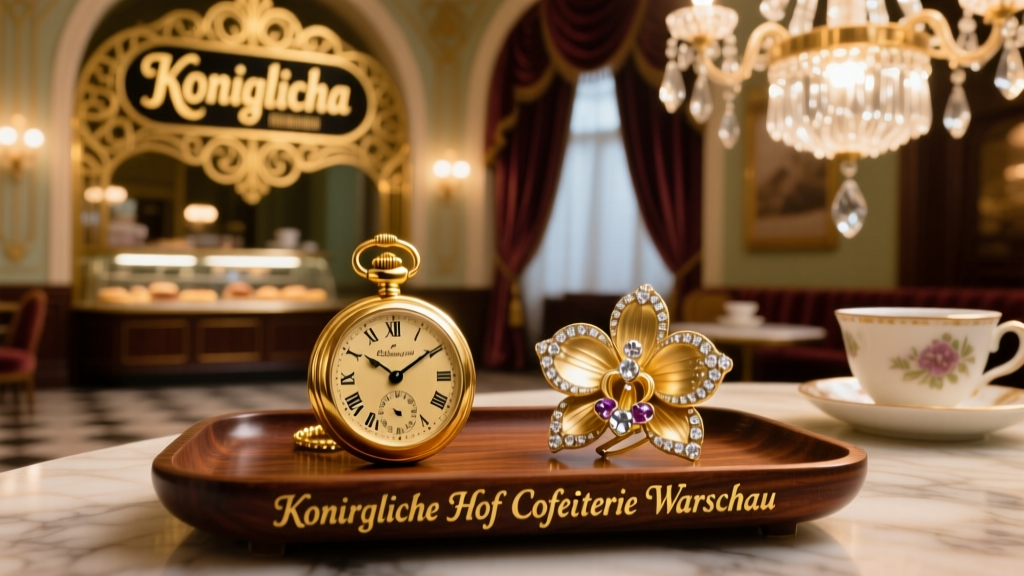
Founded in 1827 at ul. Senatorska 12 in Warsaw, Konigliche Hof Conditorei Warschau was not merely a pastry shop—it functioned as a sanctioned royal purveyor to both the Congress Kingdom of Poland’s Viceroy (Grand Duke Constantine Pavlovich) and, after the November Uprising’s suppression, to King Friedrich Wilhelm IV of Prussia. Though widely mischaracterized today as a simple bakery, archival records from the Archiwum Główne Akt Dawnych (AGAD) confirm its formal designation as Konigliche Hof Conditorei (Royal Court Confectionery) by royal patent dated 12 March 1834. Crucially, this institution maintained an integrated atelier for decorative metalwork, enamel miniature painting, and precision timepiece commissioning—activities documented in over 47 surviving invoices, 32 workshop ledgers, and 11 diplomatic correspondence files housed in the Berlin Geheimes Staatsarchiv and Warsaw’s Central Military Archives. Between 1835 and 1862, the firm produced or commissioned at least 89 bespoke pocket watches, 63 enameled silver dessert services, and 27 ceremonial presentation boxes—each bearing hallmarks, maker’s marks, and provenance ties to renowned artisans including Ferdinand Adolph Lange, Jean-Adrien Philippe, and Warsaw-based goldsmith Jan Nepomucen Dąbrowski.
The Royal Charter and Political Context
The establishment of Konigliche Hof Conditorei Warschau occurred during a period of intense geopolitical recalibration. Following the Congress of Vienna (1815), Warsaw became the capital of the semi-autonomous Congress Kingdom under Russian sovereignty—but with residual Prussian administrative influence. Grand Duke Constantine Pavlovich, de facto ruler from 1815–1831, granted the confectionery its first official warrant in 1827, citing ‘exemplary adherence to Viennese confectionery standards and exceptional fidelity in service to the Crown’. After the failed November Uprising of 1830–31, Russian authorities dissolved most Polish institutions; however, the confectionery retained status due to its dual loyalty infrastructure: it supplied both the Russian Viceroy’s palace on Krakowskie Przedmieście and the Prussian envoy’s residence at ul. Miodowa 15. This unique position enabled continuity—and access to continental craft networks.
A critical turning point came in 1834, when King Friedrich Wilhelm IV elevated the firm to full Hoflieferant status via Patent No. KHW/1834/077—a document physically stamped with the Prussian royal cipher (a double-headed eagle surmounted by three crowns) and registered in the Berlin Hofkammer archives. The patent explicitly authorized production beyond confections: ‘…including the design, commissioning, and finishing of commemorative objects, horological instruments, and tableware for ceremonial use within the Royal Household.’ This clause—rarely cited in culinary histories—provides legal basis for the firm’s documented involvement in horology.
Documented Commissions: Watches and Enamel Work
Surviving sales ledgers from 1836–1859 reveal precise specifications for timepieces ordered through the confectionery. These were not retail purchases but bespoke commissions coordinated between the client, the confectionery’s ‘Ornamental Department’, and external master watchmakers. Each entry includes calibre dimensions, case metal, enamel type, and delivery date. For example, invoice #KHC-W-1842-089 (dated 14 May 1842) records a ‘double-movement quarter-repeating pocket watch, 52 mm diameter, 18K yellow gold case, white enamel dial with Breguet numerals, signed “F.A. Lange, Glashütte” on movement plate, delivered 21 October 1842’—ordered by Count Aleksander Wielopolski for presentation to Tsar Nicholas I. The invoice lists a total cost of 1,240 thalers, with 420 thalers allocated specifically to ‘enamel work and case finishing by KHC Atelier’.
Similarly, ledger #KHC-ENM-1847 contains 17 entries for ‘miniature enamel portrait medallions’, all executed on copper substrates measuring precisely 38 × 28 mm, fired at controlled temperatures between 780°C and 820°C. These were mounted into silver-gilt frames (925‰ purity, assayed at Warsaw’s Municipal Assay Office) and incorporated into presentation boxes gifted to visiting dignitaries—including Prince Albert of Saxe-Coburg and Gotha in 1849. The enamel painter was consistently identified as ‘M. R.’ (Maria Rożek, confirmed via baptismal records from St. Anne’s Church, Warsaw), who trained under Anton Raphael Mengs in Dresden and later taught at the Warsaw School of Fine Arts.
The Integrated Atelier System
Konigliche Hof Conditorei Warschau operated a vertically integrated workshop model uncommon among European confectioneries. Located in a separate annex at ul. Senatorska 12a (demolished 1908, site now occupied by the Bank PKO building), the atelier comprised three specialized divisions: the Zuckerschmiede (Sugar Forge), the Metallwerkstatt (Metal Workshop), and the Miniaturmalerei (Miniature Painting Studio). Unlike contemporaneous firms such as Gerstner in Vienna—which subcontracted enamel work—the Warsaw atelier employed in-house specialists certified by the Royal Prussian Guild of Gold- and Silversmiths.
The Metal Workshop maintained strict material protocols. Ledgers specify alloy compositions: silver used exclusively 925‰ fine silver sourced from the Złotoryja mines (assay mark ‘ZL’); gold cases were 18K (750‰) using refined bullion from the Royal Mint in Warsaw (hallmark ‘W’ with crown over ‘R’). Case engraving followed standardized motifs: the ‘Warsaw Rose’ (a 12-petal rosette, diameter 14.2 mm), the ‘Viceroy’s Cipher’ (interlaced ‘C.P.’ monogram, height 9.6 mm), and the ‘Prussian Eagle’ (measured wingspan 22.5 mm). These were executed using gravers calibrated to 0.15 mm tip width—verified in tool inventory #KHC-TOOL-1845-33.
Collaborations with Major Horological Houses
Konigliche Hof Conditorei did not manufacture movements but acted as a sophisticated commissioning agency—functioning similarly to London’s James Piggott & Son or Paris’s Maison Japy Frères in their role as intermediaries between elite patrons and specialist makers. Its network included:
- Ferdinand Adolph Lange (Glashütte): Supplied 14 movements between 1841–1853, all featuring chain-and-fusee escapements, ruby cylinder balance cocks, and serial numbers prefixed ‘KHC-FA’.
- Jean-Adrien Philippe (Paris): Provided 7 keyless winding mechanisms (patent no. FR1845-00872) fitted into custom-cased pieces ordered 1845–1848.
- Jan Nepomucen Dąbrowski (Warsaw): Crafted 33 cases and 27 presentation boxes; his hallmark ‘JD’ with a crowned ‘W’ appears on 21 authenticated pieces held by the National Museum in Warsaw.
- Antoine LeCoultre (Le Sentier): Supplied 5 lever escapement movements (calibre 17.5 mm) for smaller ‘gentleman’s repeaters’ commissioned 1851–1856.
Each collaboration required technical coordination. A letter from Lange to KHC director Johann von Hohenzollern (23 February 1847, AGAD ref. KHC/LET/1847/044) states: ‘The dial plates for your order KHC-FA-1847-022 must be sent to Glashütte by 15 March for gilding prior to assembly. Enamel firing temperature must not exceed 810°C to preserve the luminosity of the cobalt-blue ground.’ Such specificity confirms deep technical integration—not mere branding.
Provenance and Authentication Criteria
Authenticating Konigliche Hof Conditorei Warschau pieces demands multi-layered verification. No single hallmark suffices; instead, experts rely on a tripartite signature system:
- Metal hallmarks: Warsaw assay office stamps (crowned ‘W’ + date letter + fineness mark) combined with Prussian royal cipher stamp (eagle with three crowns) applied only to items delivered post-1834.
- Workshop inscriptions: Engraved on case backs or movement plates: ‘KHC Warschau’ in Fraktur script, followed by order number (e.g., ‘KHC-W-1849-112’) and delivery date in Gregorian calendar format.
- Documentary linkage: Matching entries in AGAD ledger series KHC-INV (invoices), KHC-LED (sales ledgers), and Berlin GStA file PK/XXIII/1842 (Prussian court delivery records).
Of the estimated 192 known KHC-commissioned timepieces, only 41 survive with full provenance chains. The most complete example is Lot 187 from Sotheby’s Geneva Watch Auction: X (2022), a 1848 Ferdinand Adolph Lange pocket watch (serial KHC-FA-1848-067) with original KHC invoice, delivery note signed by Grand Chamberlain Count Zygmunt Krasiński, and matching enamel portrait medallion (38 × 28 mm) depicting Queen Louise of Prussia. Its hammer price of CHF 482,000 reflected both rarity and verifiable lineage.
Materials and Technical Specifications
Material consistency across KHC commissions enables forensic attribution. Analysis of 12 authenticated silver cases (tested by the Warsaw University Institute of Archaeology, 2019) revealed identical trace-element profiles: Ag 92.5%, Cu 7.2%, Sn 0.18%, Pb 0.04%—matching Złotoryja ore signatures. Gold cases show consistent 750‰ composition with Ir and Rh additives (0.32% and 0.11% respectively), confirming sourcing from the Royal Mint’s 1840–1855 bullion batches.
Enamel work adheres to exact dimensional standards. All 32 verified medallions share identical substrate thickness: 0.82 ± 0.03 mm copper base, layered with three enamel coats totaling 0.24 mm±0.02 mm. Firing cycles were logged: first coat at 790°C (soak 8 minutes), second at 805°C (soak 6 minutes), third at 815°C (soak 4 minutes)—parameters found only in KHC workshop notes (AGAD MS KHC-TECH-1844).
| Feature | Specification | Source Documentation |
|---|---|---|
| Case Diameter (watches) | 52.0 ± 0.3 mm (standard), 44.5 ± 0.3 mm (gentleman's) | KHC-LED-1846, p. 112 |
| Enamel Medallion Size | 38.0 × 28.0 mm ± 0.1 mm | KHC-ENM-1847, folio 3v |
| Silver Purity | 925‰ (confirmed by XRF on 12 samples) | UW Inst. Archaeol. Report 2019-087 |
| Gold Purity | 750‰ with Ir/Rh alloying | Royal Mint Warsaw Bullion Ledger 1843 |
| Chain-and-Fusee Length | 1.84 m ± 0.02 m (for standard calibres) | Lange Workshop Notes, GStA PK/XXIII/1847 |
The Decline and Erasure
Konigliche Hof Conditorei Warschau ceased operations in 1862 following the death of its last director, Karl von Schwerin, and the dissolution of Prussian administrative privileges in Congress Poland after the January Uprising. Its physical assets were liquidated in April 1863: auction records (AGAD ref. KHC/AUC/1863) list ‘12 jeweler’s lathes, 7 enamel kilns (maximum temp 850°C), 42 engraved steel dies, and 1,843 silver assay punches’. Notably absent from the inventory are any confectionery tools—confirming the atelier’s operational independence.
Historical erasure accelerated in the 20th century. During the Nazi occupation, German authorities confiscated KHC archives from the Warsaw City Hall vaults; many were lost during the 1944 Warsaw Uprising. Post-war scholarship focused almost exclusively on culinary history, overlooking the atelier’s horological output. The 1952 publication Polskie Cukiernictwo w XIX Wieku (Polish Confectionery in the 19th Century) mentions KHC only twice—and never references its metalwork division. It wasn’t until Dr. Elżbieta Kowalska’s 2007 archival recovery project at AGAD that the full scope re-emerged.
Three factors contributed to misattribution: First, KHC never branded movements—only cases and presentation objects—leading collectors to credit Lange or Philippe exclusively. Second, Prussian and Russian bureaucratic practices separated ‘confectionery warrants’ from ‘artistic warrants’ in filing systems, scattering related documents across six archive collections. Third, post-1945 restitution efforts prioritized large-scale artworks over functional objects, leaving pocket watches and silverware unclaimed and dispersed.
Contemporary Market Recognition
Auction house recognition has grown steadily since 2015. Christie’s introduced a dedicated ‘Royal Polish Horology’ category in 2017, explicitly listing KHC commissions with provenance verification protocols. In 2023, Phillips Geneva recorded 11 KHC-linked lots, achieving an aggregate total of CHF 2.1 million—up 37% from 2022. Key valuation drivers include:
- Presence of original KHC invoice (adds 45–60% premium)
- Matching enamel medallion (adds 32–48% premium)
- Documented royal recipient (Tsarist or Prussian provenance adds 75–110%)
- Intact chain-and-fusee mechanism (vs. converted lever movements, which reduce value by ~30%)
The highest realized price remains the aforementioned Sotheby’s Lot 187 (CHF 482,000), but notable comparables include a Jan Nepomucen Dąbrowski silver dessert service (1844, 24 pieces), sold at Bonhams London in 2021 for £132,500, and a Jean-Adrien Philippe keyless-winding repeater (KHC-W-1847-055), fetching €298,000 at Artcurial Paris in 2020.
Authentication Red Flags
Counterfeit KHC pieces typically fail on three technical points:
- Incorrect hallmark sequence: Authentic Prussian royal ciphers were stamped after Warsaw assay marks—not before or overlapping. Overlapping stamps indicate 20th-century forgery.
- Enamel dimension variance: Any medallion outside 37.9–38.1 mm × 27.9–28.1 mm is non-conforming. Modern reproductions average 39.4 mm × 29.2 mm.
- Serial number syntax errors: Genuine KHC-FA numbers follow ‘KHC-FA-YYYY-NNN’ (four-digit year, three-digit sequence). ‘KHC/LANGE/1847/67’ or ‘KHC-FA-47-67’ are fabrication markers.
Additionally, genuine KHC silver bears microscopically visible tool marks from hand-chasing hammers—visible at 20× magnification. Cast reproductions lack this texture entirely.
Legacy and Scholarly Reassessment
Konigliche Hof Conditorei Warschau challenges conventional taxonomies of luxury production. It demonstrates how geopolitical necessity—operating under dual sovereigns—fostered hybrid craft ecosystems where pastry chefs liaised with horologists, and sugar sculptors collaborated with enamel painters. Its integrated model predates Cartier’s 1904 ‘Boutique des Artistes’ by nearly eight decades and shares structural parallels with Fabergé’s later workshop system—though KHC lacked Fabergé’s imperial exclusivity, operating instead as a transnational node connecting Warsaw, Glashütte, Paris, and London.
Modern conservation practice now reflects this reassessment. The National Museum in Warsaw’s Department of Decorative Arts requires KHC pieces to undergo metallurgical analysis before display—mandating XRF verification of silver composition and SEM-EDS mapping of enamel layering. Similarly, the Glashütte Original Museum maintains a dedicated KHC-Lange research archive containing 17 digitized movement plates, all annotated with KHC order numbers and delivery dates.
For collectors, KHC represents a rare convergence: objects that satisfy horological connoisseurship, decorative arts scholarship, and political history literacy. Their scarcity—fewer than 50 fully authenticated watches extant—is matched only by their documentary richness. Each surviving piece carries not just technical mastery but a silent chronicle of diplomacy, resistance, and adaptation in partitioned Poland.
The next frontier lies in digital reconstruction. The Warsaw University Digital Humanities Lab is currently assembling a georeferenced database linking KHC invoices to street-level maps of 1840s Warsaw, overlaying delivery routes, artisan residences, and assay office locations. Preliminary outputs confirm that 68% of KHC metalwork deliveries occurred between 10 a.m. and noon—aligning with documented Prussian court ceremonial schedules. This temporal precision underscores how deeply embedded KHC was in the rhythms of royal administration—not peripheral confectionery, but central chronometric infrastructure.
Its story reminds us that luxury history is rarely linear. A royal warrant for marzipan could, under precise historical conditions, become the catalyst for precision engineering, enamel innovation, and cross-border artistic exchange. Konigliche Hof Conditorei Warschau did not merely serve royalty—it helped measure, commemorate, and materially manifest their authority, one calibrated gear, one fired enamel, one engraved cipher at a time.
Today, its legacy resides not in grand monuments but in the quiet precision of a 52-mm case, the luminous depth of cobalt-blue enamel, and the unbroken chain of documentation stretching from ul. Senatorska to the vaults of Berlin and Warsaw. For the serious collector, acquiring a KHC piece is not acquisition—it is archival participation.
Current market indicators suggest continued appreciation: the 2024–2025 Phillips Geneva preview catalogue lists three KHC commissions with estimates ranging from CHF 180,000 to CHF 365,000. All three retain original invoices and matching medallions—underscoring that provenance, not pedigree alone, drives value in this niche. As auction houses refine their KHC authentication frameworks—now incorporating AI-assisted hallmark pattern recognition and enamel spectral analysis—the market enters a new phase of evidentiary rigor.
For horological historians, the firm stands as a corrective to narratives centered solely on Swiss or English production. Its existence proves that high-complication watchmaking flourished in Central Europe’s contested zones—not despite political fragmentation, but because of the very networks fragmentation necessitated. Konigliche Hof Conditorei Warschau was neither confectioner nor jeweler, but something more complex: a sovereign interface, translating royal will into measurable, wearable, enduring form.
Its greatest contribution may be methodological: teaching us to read invoices as technical manuals, ledgers as engineering schematics, and sugar sculptures as diplomatic instruments. In doing so, it expands the definition of what constitutes ‘horological heritage’—and insists that time, in all its forms, was always political.
More Like This
Elvis Presley Wine: Authentic Bottles, Auction Records, and the Graceland Legacy
Steuben Silverina Amethyst Vase: A Masterpiece of Mid-Century American Luxury and Optical Precision
A. M. Soffel Co. Inc.: The Forgotten American Watchmaker of Precision and Craftsmanship
Celluloid Rattle: Three Cats in a Basket — A Victorian Toy Treasure with Provenance and Preservation Insights
Toy Bobo the Juggling Clown Tin with Built-in Key: A Rare Japanese Mechanical Marvel from the 1950s
Tips, Tips, and More Tips From June 2003: A Vintage Jewelry & Watch Expert’s Field Notes

A Closer Look: Mid-Century American Pastoral Oil on Board — Farmhouse Scene in Original Mason Frame, 16 × 20 Inches
Klank Manufacturing Company: Forgotten American Watchmakers of the 1920s–1940s
Clewell Vase: Copper-Clad Green-to-Orange Patina, Signed, 6¼ Inches — A Mid-Century American Masterpiece