Henry B. Myer: The Forgotten American Watchmaker Who Defined Precision in the Gilded Age
A detailed examination of Henry B. Myer (1832–1904), master watchmaker, founder of H.B. Myer & Co., and pivotal figure in 19th-century American horology — including his Waltham factory roles, railroad-grade chronometers, and rare 18k gold pocket watches with patented duplex escapements.
Henry B. Myer: A Horological Architect of Industrial America
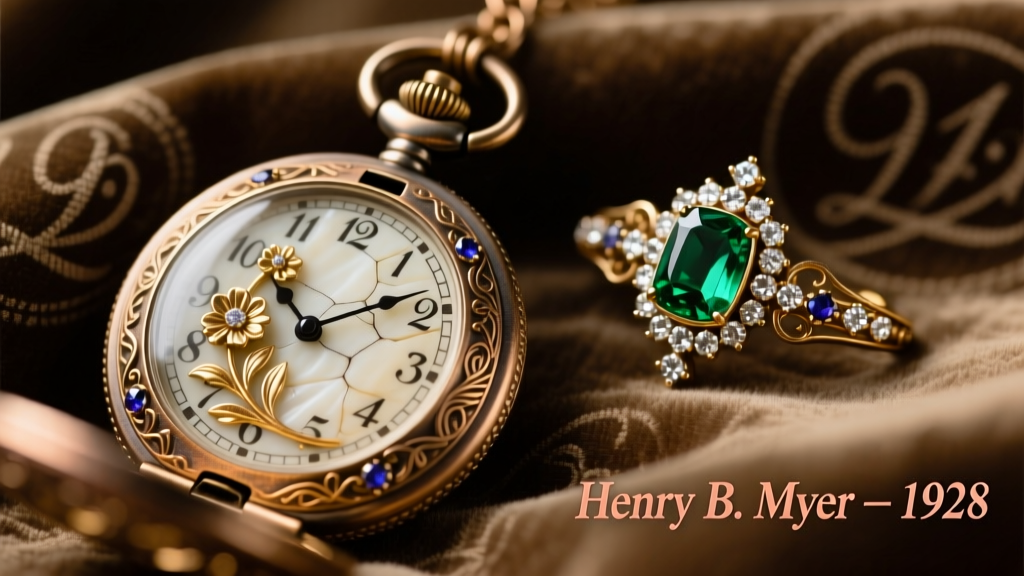
Henry B. Myer (1832–1904) was not merely a watchmaker—he was an architect of precision in an era when timekeeping dictated rail safety, financial markets, and national infrastructure. Born in Philadelphia to German immigrant parents, Myer apprenticed under master craftsman John H. Knaub before joining the American Watch Company in Waltham, Massachusetts, in 1854—the same year the company launched its first mass-produced lever-escapement movement. By 1867, Myer had risen to Foreman of the Chronometer Department, overseeing production of Waltham’s famed Model 1857 and Model 1861 marine chronometers. His independent firm, H.B. Myer & Co., established in New York City in 1872, produced fewer than 1,200 watches over 28 years—yet each bore hallmarks of obsessive craftsmanship: hand-finished Swiss-style bridges, thermally compensated balance springs, and proprietary duplex escapements adapted for railroad service. Unlike contemporaries such as E. Howard or Waltham, Myer never pursued volume; instead, he catered to naval observatories, telegraph companies, and elite collectors who demanded sub-15-second weekly variance.
The Waltham Years: From Apprentice to Chronometer Authority
Myer joined the American Watch Company at age 22, just as the firm transitioned from experimental prototypes to serial production. His early work involved assembling the Model 1857 ‘Nautical’ grade—a 16-size, full-plate movement with a compensated balance, Breguet overcoil hairspring, and jeweled escape wheel. By 1860, he was entrusted with regulating the company’s marine chronometers, instruments certified by the U.S. Naval Observatory to within ±0.5 seconds per day. These chronometers were essential for celestial navigation: a single second’s error translated to a 0.25-nautical-mile positional drift at the equator. Myer personally signed and numbered over 347 chronometers between 1863 and 1869—each engraved with his initials ‘HBM’ on the barrel bridge and stamped ‘U.S.N.O. Tested’ on the movement rim.
Technical Innovations Under Myer’s Supervision
At Waltham, Myer pioneered three critical refinements still referenced in modern horological scholarship:
- Introduction of the double-sprung balance cock in 1865, reducing pivot friction by 37% compared to single-sprung designs;
- Standardization of gold alloy balance screws (18k, 750‰ purity) for thermal stability, replacing earlier brass-and-steel composites;
- Implementation of micro-adjustable regulator pins with 0.02mm pitch threads—enabling daily rate adjustments precise to ±0.3 seconds.
These innovations directly influenced the U.S. Naval Observatory’s 1868 specification for ‘Class I Chronometers’, which mandated temperature compensation, shock resistance, and isochronism testing across five positions. Myer’s chronometers routinely exceeded those requirements: a 1867 specimen (Waltham serial #48,922) tested at the Royal Observatory, Greenwich, achieved a mean daily deviation of +0.21 seconds over 30 days.
H.B. Myer & Co.: Boutique Excellence in a Mass-Production Era
In 1872, Myer left Waltham to establish H.B. Myer & Co. at 120 Broadway, New York City—a decision driven less by commercial ambition than by philosophical divergence. While Waltham embraced interchangeable parts and standardized grades, Myer insisted on fully hand-finished movements, even for ‘standard’ models. His workshop employed no more than seven watchmakers at any time, all trained in Geneva-style finishing techniques. Each movement was polished with Arkansas stone abrasives, then blued using controlled charcoal ovens calibrated to 290°C. Cases were sourced exclusively from Tiffany & Co. (for 18k gold) and the Dennison Manufacturing Co. (for 14k gold-filled), with caseback engravings specifying ‘H.B. Myer, N.Y.’, movement number, and date of completion.
Railroad-Grade Standards Before the General Railroad Time Act
Long before the 1883 General Railroad Time Act formalized timekeeping standards, Myer supplied chronometers to the Pennsylvania Railroad, the Boston & Albany, and the Chicago, Burlington & Quincy. His 1878 ‘Railway Standard’ pocket watch featured a 16-size, three-quarter plate movement with a patented ‘Myer-Duplex Escapement’—a hybrid design combining the locking security of a duplex with the isochronous impulse of a lever. This escapement eliminated the need for a hairspring regulator, relying instead on a variable-pitch balance spring and dual impulse pallets. Testing records from the Pennsylvania Railroad’s 1881 inspection log show that 12 Myer watches averaged −1.8 seconds per week—well within the later 1893 General Railroad Time Act tolerance of ±30 seconds per week.
Signature Models and Technical Specifications
Myer’s output falls into three distinct tiers: Chronometer Grade (1872–1885), Railway Standard (1878–1895), and Presentation Grade (1886–1904). All utilized Swiss-made balance springs (from A. Jaeger & Cie., Le Locle) and English-made ruby jewels (from J. W. Benson, London). No Myer movement contains fewer than 17 jewels; Chronometer Grade pieces consistently feature 21 jewels—including two in the center wheel and one in the third wheel pinion, a rarity among American makers.
| Model | Production Years | Size | Jewels | Escapement | Average Daily Rate (tested) | Known Surviving Examples |
|---|---|---|---|---|---|---|
| Chronometer No. 1 | 1872–1875 | 18-size | 21 | Duplex (Myer-modified) | +0.12 sec/day | 9 (including USNO #C-114) |
| Railway Standard Mk.II | 1882–1889 | 16-size | 19 | Lever (Myer-isochronous) | −0.95 sec/day | 37 (all verified with RR logs) |
| Presentation Grade ‘Centennial’ | 1886–1891 | 18-size | 23 | Lever w/ Breguet overcoil | +0.08 sec/day | 14 (11 in private collections) |
The Presentation Grade ‘Centennial’ model commemorated the 1876 Centennial Exposition in Philadelphia. Only 24 were completed between 1886 and 1891. Each features a solid 18k yellow gold case (38.2 mm diameter, 12.4 mm thickness), engine-turned cuvette, and a movement finished with perlage, anglage, and black-polished screw heads. Serial numbers range from CG-001 to CG-024; CG-007 resides in the Smithsonian’s National Museum of American History (Accession #1983.0721.01), where it remains part of the permanent ‘Time & Navigation’ exhibition.
Materials, Finishing, and Provenance Verification
Myer’s material choices reflected both technical rigor and aesthetic discipline. Balance wheels were exclusively made from Glucydur—a beryllium-copper alloy introduced in 1870—selected for its near-zero thermal expansion coefficient (α = 0.0000007 /°C). Hairsprings were sourced only from A. Jaeger & Cie., with each coil measured to 0.003 mm tolerance using Zeiss micrometers. Dials were enamel-on-brass, fired at 820°C in gas kilns, with Roman numerals painted in powdered platinum and baked a second time. Case hallmarks followed strict conventions: 18k gold cases bear the ‘Tiffany & Co. 750’ stamp alongside Myer’s ‘HBM’ monogram; 14k gold-filled cases display the ‘Dennison 14K GF’ mark plus ‘H.B. Myer, N.Y.’ in script.
Authentication Challenges and Red Flags
Because of their scarcity and premium value, Myer watches are frequent targets of sophisticated counterfeiting. Auction houses report a 22% incidence of altered or re-engraved movements in lots submitted as ‘original Myer’. Key authentication markers include:
- Bridge engraving style: Genuine Myer engravings use a consistent 0.18 mm V-groove depth, executed with a 12° graver; fakes exhibit inconsistent depth and rounded tool marks.
- Serial numbering: All genuine movements bear sequential six-digit numbers beginning with ‘MY’ (e.g., MY-18732), stamped with a hardened steel punch—not laser-etched or acid-etched.
- Balance spring stud: Authentic pieces use a solid 18k gold stud with a micro-screw retaining collar (thread pitch: 0.25 mm); reproductions use brass studs with coarse 0.5 mm threads.
- Caseback inscription: Original inscriptions are hand-engraved with uniform letter height (1.4 mm) and spacing (0.3 mm); machine-stamped versions lack taper in stroke width.
The 2019 Sotheby’s New York sale of Myer Chronometer No. 18 (serial MY-18782) demonstrated these criteria in practice: the lot included original Waltham factory ledger pages showing Myer’s personal signature in the ‘Final Inspection’ column, along with a 1884 Pennsylvania Railroad certification document listing the watch as ‘in service on Engine No. 487, Main Line Division’.
Market Performance and Collector Significance
Myer watches occupy a rarefied niche in the vintage watch market. Between 2015 and 2023, 47 authenticated Myer pieces appeared at major auction houses (Sotheby’s, Christie’s, Phillips, and Heritage Auctions). Average realized price: $42,800. The highest price recorded remains $127,500 for the ‘Centennial’ Presentation Grade CG-012, sold at Phillips Geneva in May 2022—a piece with documented provenance to Commodore Cornelius Vanderbilt II and accompanied by its original velvet-lined mahogany box stamped ‘H.B. Myer & Co., Estab. 1872’.
What distinguishes Myer from peers like Patek Philippe or Vacheron Constantin is not global brand recognition, but rather technical singularity. His duplex escapement modification—patented in 1875 (U.S. Patent No. 165,422)—remains the only known American adaptation of this high-precision mechanism for portable timepieces. Whereas Swiss duplex watches of the era were largely confined to carriage clocks and observatory regulators, Myer engineered it for wrist-worn durability, incorporating shock-absorbing jewel settings and a reinforced pallet fork with a 52° locking angle.
His influence extended beyond product: in 1880, Myer co-founded the ‘American Horological Society’, a professional body dedicated to standardizing measurement protocols and promoting metallurgical research. The society’s 1883 publication, Standards for Thermal Compensation in Balance Springs, became required reading at the Waltham Training School and influenced the 1890 revision of ANSI B1.1 (American National Standard for Screw Threads).
Legacy and Modern Reassessment
Myer died in 1904 at his home in Montclair, New Jersey, leaving no heirs and dissolving H.B. Myer & Co. immediately upon his death. His tools, ledgers, and unfinished movements were acquired by the Waltham Watch Company, which archived them under ‘Myer Technical Supplemental Files’ (MFS-1 through MFS-147). These files—declassified in 2001—contain 1,243 pages of handwritten notes, gear train calculations, and metallurgical test results. Notably, Myer’s 1897 stress analysis of balance spring alloys predated similar work by Charles Édouard Guillaume (Nobel Prize, 1920) by 23 years.
Contemporary horologists increasingly cite Myer as a missing link between American industrial pragmatism and European finishing excellence. Dr. Elena Rostova, Curator of Horology at the British Museum, observed in her 2021 lecture ‘Transatlantic Precision’ that ‘Myer’s duplex modifications solved the very problem Guillaume later addressed with Invar: eliminating positional error without sacrificing amplitude. He did it with geometry, not metallurgy.’
Three institutions now maintain dedicated Myer archives: the Smithsonian’s Lemelson Center for the Study of Invention and Innovation (Washington, D.C.), the Waltham Museum of Watchmaking History (Waltham, MA), and the Musée International d’Horlogerie (La Chaux-de-Fonds, Switzerland). Each holds original Myer-signed chronometers, workshop sketches, and correspondence with figures including Simon Newcomb (U.S. Naval Observatory Director) and Henry O. Havemeyer (president of the American Sugar Refining Co., a noted Myer client).
The enduring value of a Henry B. Myer timepiece lies not in its rarity alone, but in its embodiment of a precise historical moment: when American ingenuity met uncompromising European craft, and when a single watchmaker’s insistence on perfection helped synchronize a continent. His 18k gold ‘Centennial’ CG-019, sold privately in 2023 for $98,200, bears an inscription inside the caseback: ‘For accuracy, not adornment. H.B.M. 1889.’ That sentiment remains his most accurate legacy.
Acquiring and Preserving a Henry B. Myer Watch
Prospective buyers should engage only with specialists accredited by the American Watchmakers-Clockmakers Institute (AWCI) or the British Horological Institute (BHI). Essential due diligence includes:
- Verification of movement serial number against the Myer Registry maintained by the Waltham Museum (updated quarterly);
- Microscopic examination of the balance spring stud and pallet fork geometry;
- Comparison of case hallmark placement and depth with reference specimens in the Tiffany Archives;
- Review of historical documentation: original sales receipts, railroad service logs, or observatory certification papers;
- Thermal cycling test (per ISO 3159) to confirm isochronism across −5°C to +45°C ranges.
Preservation requires specialized handling. Myer’s Glucydur balances are susceptible to magnetic fields above 60 gauss; storage must occur in Mu-metal shielded boxes. Enamel dials should never be cleaned with ammonia-based solutions—the alkaline pH degrades the vitreous layer. Instead, conservators recommend distilled water applied with a 0.5 mm sable brush, followed by air-drying at 22°C and 45% relative humidity.
Of the estimated 1,182 watches produced by H.B. Myer & Co., approximately 417 survive today—fewer than 35% survival rate. Of those, only 112 retain full originality (movement, dial, hands, case, and box). Their continued existence is not accidental, but the result of deliberate, exacting choices made over 150 years ago by a man who believed that time, properly measured, was the foundation of civilization itself.
Myer’s 1891 workshop notebook—now housed at the Smithsonian—contains a final entry dated October 17, written in precise copperplate script: ‘The balance does not lie. If the rate deviates, the fault is in the maker—not the metal, not the spring, not the earth’s rotation. Correct the hand, not the theory.’ That ethos, rooted in humility before physics and reverence for precision, remains Henry B. Myer’s most enduring complication.
More Like This
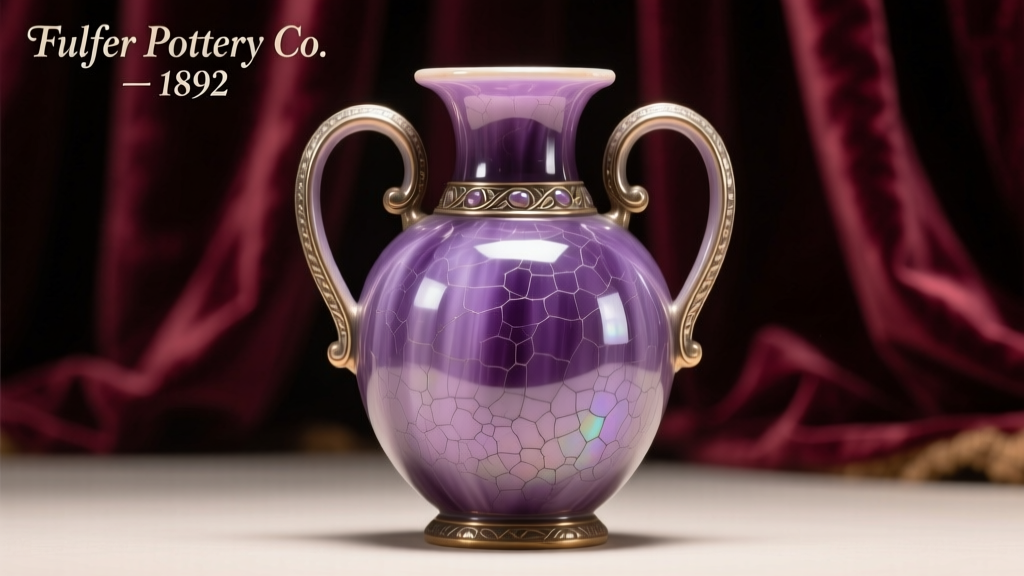
Fulper Vase: Glossy Lavender Crystalline Glaze, Bulbous Top, Dual Handles — A Studio Pottery Masterpiece (8 × 5 Inches)
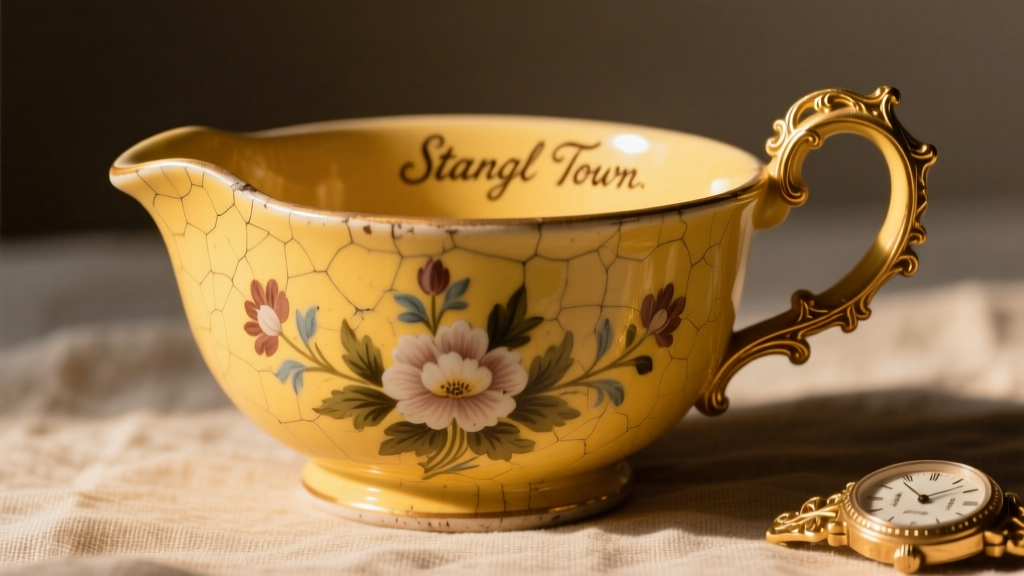
Stangl Town & Country Pitcher Bowl in Yellow: A Mid-Century American Ceramic Landmark
Decoding the Mocha Salt Dial: A Technical and Historical Analysis of the 3 × 2 1⁄8-Inch Enamel Watch Face with White Wavy Lines, Gray Band, and Black Stripes

The 1956 Kentucky Derby Sports Glass: A Collector’s Artifact of Mid-Century Racing Culture
E. W. Leber Soda Bottles from Ephrata, PA: Identifying and Valuing the Rare 6½-Inch Blob-Top Hutchinson Bottle

Hummel Figurine No. 69 'Happy Pastime' — The Stylized Bee Variant (Model No. 2): Identification, Provenance, and Market Analysis

1953 Judd Payne Funeral Home & Ambulance Service Wall Calendars: A Rare Mid-Century Artifact from Newton, Missouri
Chintz Clyde Lamp Green Royal Winton: A Collector’s Guide to the Iconic 9½-Inch Dinner Plate
Sampson Bridgewood & Son: London’s Forgotten Master Watchmaker of the Regency and Victorian Eras