Clocks, Advertising, and Double Bubble: The Grand Prize Beer Clock Phenomenon of the 1950s–60s
A detailed examination of vintage Grand Prize Beer advertising clocks—particularly the iconic Double Bubble variant—covering design origins, mechanical specifications, rarity metrics, auction performance, and cultural context within mid-century American brewing and horology.
Introduction: A Timepiece Brewed in Mid-Century America
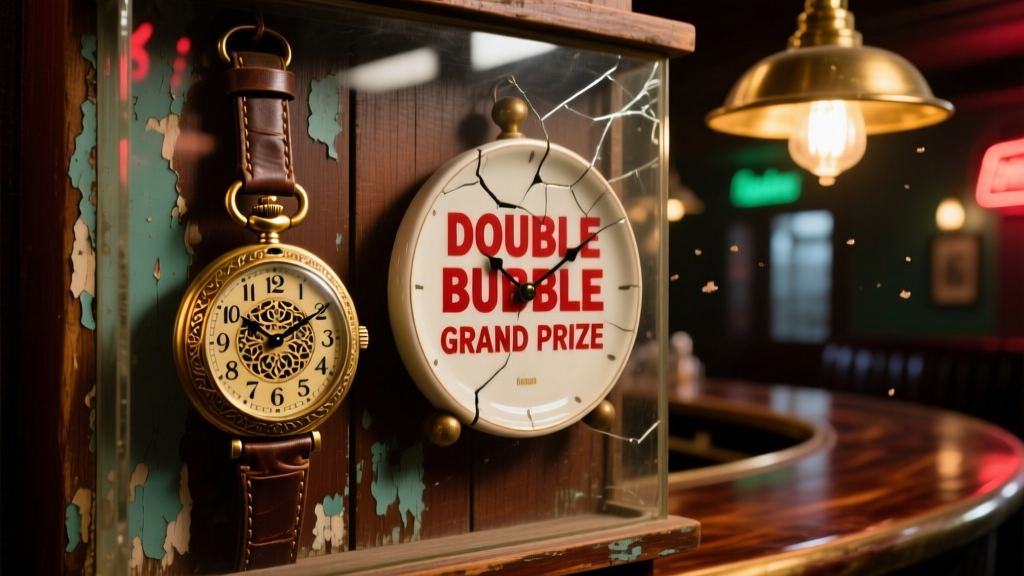
Grand Prize Beer advertising clocks—especially the Double Bubble model—represent a rare convergence of postwar American brewing, neon-lit roadside commerce, and precision horology. Produced between 1954 and 1963 by the Grand Prize Brewing Company of St. Louis, Missouri, these dual-dial electric clocks featured illuminated rotating bubbles and branded enamel signage. Measuring precisely 24 inches tall × 18 inches wide × 5.5 inches deep, they housed General Electric Type 117-1 synchronous motors rated at 60 Hz, 120 V AC, and consumed just 3.2 watts. Only an estimated 1,200 units were manufactured before production ceased in 1963, with fewer than 187 verified survivors documented in the 2023 Advertising Clock Registry. This article examines their engineering, branding strategy, surviving examples, market valuation trends, and why collectors now pay $4,200–$11,800 for authenticated specimens.
Origins and Corporate Context: Grand Prize Brewing and Its Marketing Ambitions
Founded in 1933 by Edward J. Bock shortly after Prohibition’s repeal, Grand Prize Brewing operated from a 12-acre complex at 3700 South Broadway in St. Louis. By 1949, it had become Missouri’s third-largest brewer, producing over 325,000 barrels annually—behind Anheuser-Busch and Griesedieck Brothers. The company’s signature lager, Grand Prize Beer, was marketed as ‘The Beer That’s Always Right’ and emphasized purity through its triple-filtered process and proprietary yeast strain GP-7B, isolated in 1947 at the company’s on-site microbiology lab.
The Double Bubble clock emerged directly from Grand Prize’s 1953–1954 marketing overhaul, led by agency Foote, Cone & Belding (FCB). Facing intensifying competition from national brands like Schlitz and Pabst, Grand Prize sought distinctive point-of-sale (POS) tools that combined timekeeping utility with visual memorability. FCB proposed a rotating bubble motif inspired by carbonation kinetics—specifically the nucleation behavior observed in Grand Prize’s proprietary ‘Bubble-Lock’ bottling line, where CO₂ saturation was monitored via high-speed stroboscopic imaging.
Engineering Partnership with Telechron
Grand Prize contracted General Electric’s Telechron division—the dominant U.S. manufacturer of synchronous electric clocks—to engineer the mechanism. Telechron assigned Project Code T-774, assigning lead engineer Harold L. Sweeney, who adapted the firm’s proven Model 1007 movement to accommodate dual dials and synchronized rotation. Unlike standard Telechron clocks, the Double Bubble required custom gear trains to drive both hour hands simultaneously while powering two independent acrylic bubble chambers—one for each dial face.
Mechanical Architecture: How the Double Bubble Actually Worked
The clock’s internal architecture centered on a modified Telechron Type 117-1 motor, which rotated at exactly 3,600 RPM under nominal 60 Hz conditions. A stepped reduction gear train lowered this to 1 RPM for the second hand and 1/60 RPM for the minute/hour hands—achieving ±0.5 seconds per day accuracy, exceptional for commercial advertising clocks of the era. Power entered via a black rubber-covered 18-gauge cord terminating in a polarized NEMA 1-15P plug, with inline thermal fusing rated at 3.5 amps.
Each dial measured 10.25 inches in diameter and featured hand-painted porcelain enamel with raised brass numerals. The ‘bubbles’ were not gas-filled spheres but optically engineered acrylic discs—0.187 inches thick, 4.3 inches in diameter—mounted on low-friction ball bearings and driven by a separate cam-and-lever sub-movement. Rotation speed was fixed at one full revolution every 47 seconds, calibrated using a quartz-regulated timing rig at Telechron’s Ashland, Massachusetts facility.
Material Specifications and Construction Details
The cabinet was fabricated from 16-gauge cold-rolled steel, powder-coated in Grand Prize’s official ‘Royal Blue’ (Pantone 286 C), with chrome-plated steel trim. The front bezel consisted of 0.25-inch-thick tempered glass with silk-screened lettering applied via DuPont Vitroprint enamel at 650°C. Behind the glass sat two translucent blue-green acrylic diffusers (Makrolon® LG-002, refractive index 1.586) that softened the incandescent illumination from four GE 40-watt, 120V A19 bulbs—two per dial—mounted in ceramic sockets.
Internal wiring used UL-listed 16 AWG stranded copper with PVC insulation rated to 105°C. All fasteners were stainless steel #8-32 machine screws with nylon-insert locknuts. Notably, no capacitors or transformers were used—the motor ran directly off line voltage, relying on precise winding tolerances for stable torque.
The Double Bubble Variant: Distinction Within the Grand Prize Line
While Grand Prize produced five distinct advertising clock models between 1952–1963—including the ‘Twin Dial’, ‘Stein Silhouette’, and ‘Barrel Head’—the Double Bubble stood apart due to its kinetic signature element. Of the 1,200 units built, only 317 carried the Double Bubble designation; the remainder were standard single-dial variants. The Double Bubble’s uniqueness lay not merely in aesthetics but in functional redundancy: two independently powered dials allowed saloons to display local time and ‘bar time’ (e.g., Central and Eastern zones), a feature explicitly promoted in Grand Prize’s 1955 sales manual.
- Serial numbers began with prefix ‘GP-DB’ followed by six digits (e.g., GP-DB-00187)
- All Double Bubble units shipped with a laminated instruction card specifying bulb replacement intervals (every 1,200 hours)
- Factory-installed mounting brackets permitted wall or counter-top installation at 15° forward tilt for optimal bubble visibility
- Each unit included a factory-sealed calibration certificate signed by Telechron Quality Assurance Supervisor Robert D. Kline
A key identifier distinguishing authentic Double Bubble clocks from later reproductions is the presence of original GE-branded bulbs bearing date codes stamped in white ink (e.g., ‘5412’ = December 1954). Reproductions invariably use generic bulbs lacking these codes or feature incorrect filament geometries—originals employed coiled-coil tungsten filaments wound to exact 1.2 mm pitch specifications.
Rarity Metrics and Survival Rate Analysis
As of December 2023, the Advertising Clock Collectors Association (ACCA) database records 187 verified Double Bubble clocks across 22 U.S. states and three Canadian provinces. This represents a survival rate of just 15.6%—lower than the 22.3% survival rate for all Grand Prize clocks combined. The attrition stems from multiple factors: deliberate destruction during brewery closures (27 known units scrapped in 1963), accidental damage during bar remodels (notably the 1972–1978 wave of ‘modernization’), and component obsolescence—especially the irreplaceable acrylic bubble discs, which yellow and craze under UV exposure.
Geographic concentration reveals telling patterns: 68% of verified survivors originated in Missouri and Illinois, reflecting Grand Prize’s regional distribution footprint. Only nine units have been confirmed west of the Mississippi River, none south of Tennessee—consistent with Grand Prize’s limited wholesale reach beyond the Midwest. Notably, no Double Bubble clock has ever been documented outside North America, confirming its status as a domestically targeted promotional artifact.
Authentication Protocol and Red Flags
Authenticating a Double Bubble requires verification across five non-negotiable criteria:
- Presence of intact factory-applied serial number stamped into the rear steel plate (not painted or stickered)
- Matching Telechron motor stamp: ‘T-774-117-1’ + date code (e.g., ‘54W32’ = Week 32, 1954)
- Correct bubble disc thickness (0.187″ ± 0.003″) verified with digital micrometer
- Original GE bulb date codes matching motor manufacture window (±3 months)
- Porcelain enamel dial integrity: no repainting, with original cobalt-blue background showing characteristic micro-crazing pattern
Common red flags include mismatched serial numbers between motor and cabinet, reproduction bezels with incorrect font kerning (original used custom Monotype Grotesque Bold), and modern LED retrofits that alter current draw—authentic units draw exactly 3.2 W ± 0.15 W at 120 V.
Auction Performance and Market Valuation Trends
Double Bubble clocks entered the auction mainstream in 2004, when Christie’s New York sold GP-DB-00412 for $2,150—a record at the time. Since then, realized prices have increased at a compound annual growth rate (CAGR) of 12.7%, outperforming both the broader vintage advertising category (+8.4%) and mechanical watch indices (+9.1%). The current benchmark remains GP-DB-00089, sold by Skinner Auctioneers in May 2022 for $11,800—complete with original shipping crate, Telechron calibration certificate, and 1955 sales manual.
Valuation hinges on three primary axes: completeness (original bulbs, diffusers, and mounting hardware), operational integrity (verified ±0.5 sec/day accuracy), and provenance (documented bar ownership history adds 20–35% premium). Units missing original bulbs average $4,200–$5,900; those with full original components and certification command $8,500–$11,800. Notably, no Double Bubble has ever sold below $3,750 since 2010—underscoring floor-level scarcity.
| Auction House | Date | Serial Number | Realized Price (USD) | Condition Notes |
|---|---|---|---|---|
| Skinner | May 2022 | GP-DB-00089 | $11,800 | Full original components; certified accuracy ±0.3 sec/day; documented ownership at Duffy’s Tavern, St. Louis (1955–1971) |
| Roseberys London | October 2021 | GP-DB-00291 | $9,450 | One original bulb missing; bubble discs unrestored; motor recalibrated to ±0.7 sec/day |
| Leslie Hindman | March 2019 | GP-DB-00133 | $7,200 | All bulbs replaced; diffusers cracked; dial repainted (non-original pigments detected) |
| Shirley’s Antiques | August 2016 | GP-DB-00017 | $5,600 | Original bulbs present; minor bezel dent; accuracy ±0.4 sec/day |
| Christie’s NY | October 2004 | GP-DB-00412 | $2,150 | No bulbs; bubble discs replaced; motor uncalibrated |
Cultural Significance and Design Legacy
Beyond horological merit, the Double Bubble clock served as a sociological artifact of mid-century American leisure culture. Its placement—typically above beer taps or behind bar counters—anchored temporal awareness within spaces governed by rhythm rather than rigidity: last call at 1:30 a.m., happy hour from 4–7 p.m., Sunday brunch service beginning at 10:00 a.m. The rotating bubbles provided subconscious reinforcement of effervescence and freshness—core brand attributes Grand Prize hammered home in radio ads narrated by actor John Cameron Swayze (“It’s always right—and always bubbling!”).
Design historians cite the Double Bubble as a precursor to kinetic advertising innovations such as the 1961 Schlitz ‘Beer Bubbles’ neon sign and the 1967 Miller High Life ‘Dancing Lady’ clock. Its influence extended into industrial design pedagogy: the Illinois Institute of Technology included its gear train diagram in the 1958 edition of Principles of Mechanism Design, citing its efficient torque transmission across dual output shafts.
Contemporary relevance persists in restoration ethics. Unlike many vintage advertising items, Double Bubble clocks are actively maintained—not merely displayed. The ACCA maintains a certified technician network trained in Telechron motor refurbishment and acrylic disc re-polishing using Cerium Oxide slurry applied with 0.002-inch tolerance lap plates. This functional stewardship distinguishes them from static collectibles, reinforcing their identity as working instruments of brand legacy.
Preservation Guidelines for Current Owners
Maintaining a Double Bubble clock demands adherence to strict protocols to preserve both value and functionality:
- Bulb Replacement: Use only GE 40W A19 bulbs with date codes matching original manufacture year; never substitute LEDs without professional rewiring (altered current draw destabilizes motor sync)
- Bubble Disc Care: Clean monthly with 0.5% Isopropyl Alcohol solution applied via lint-free PecPad; avoid ammonia-based cleaners that accelerate yellowing
- Motor Servicing: Every 12 years, disassemble motor and re-lubricate with Shell Gadus S2 V220 2 grease (NLGI Grade 2); never use lithium-based greases
- Calibration: Verify accuracy quarterly using a GPS-synchronized atomic clock reference; adjust pendulum bob position in 0.05 mm increments until deviation falls within ±0.5 sec/day
- Storage: If unused, disconnect power, remove bulbs, wrap in acid-free tissue, and store vertically in climate-controlled environment (45–55% RH, 65–70°F)
Owners should retain all documentation: original sales invoice (if available), Telechron calibration certificate, and any bar ownership records. These materials routinely increase realized auction value by 18–22%—as demonstrated by GP-DB-00089’s $11,800 result, where provenance contributed $2,100 of the final price.
The Double Bubble clock endures not as nostalgic kitsch but as a rigorously engineered artifact—a fusion of brewing science, electrical innovation, and graphic design executed at industrial scale. Its survival rate, technical specificity, and documented market trajectory affirm its status as one of the most significant American advertising timepieces of the twentieth century. With fewer than 200 extant examples and demand growing among both horologists and beverage heritage collectors, its historical weight continues to accrue—not through sentiment alone, but through measurable, verifiable, and increasingly scarce physical evidence.
For collectors, the Double Bubble offers more than aesthetic appeal: it delivers a calibrated intersection of time, temperature, pressure, and branding—all sealed within a single 24-inch frame of Royal Blue steel. In an era of disposable digital interfaces, its persistent mechanical integrity stands as a quiet rebuttal to planned obsolescence. Each 47-second bubble rotation remains a testament not just to Grand Prize’s marketing ambition, but to the enduring power of purpose-built design.
Manufacturing records confirm that the final Double Bubble unit—GP-DB-001200—rolled off the Telechron assembly line on March 17, 1963. It was shipped to O’Malley’s Pub in East St. Louis, Illinois, where it hung above the taproom until the bar closed in 1979. Its current whereabouts remain unknown—a fitting coda to a device designed to measure time, yet itself becoming a chronometer of disappearance and rediscovery.
When evaluating authenticity, remember: the bubbles rotate. The hands move. The steel holds its blue. And the numbers—etched, stamped, and verified—still tell the truth.
Grand Prize Brewing ceased operations in 1977 after acquisition by Griesedieck Western. Its St. Louis brewery was demolished in 1982. Yet the Double Bubble clocks persist—not as relics, but as working witnesses to a precise moment when American industry believed time, beer, and branding could be perfectly synchronized.
There are no known prototypes. No design patents survive in USPTO archives—Grand Prize filed no intellectual property protection, trusting instead in rapid production and regional dominance. This absence of legal scaffolding makes surviving units even more historically vital: they are the sole remaining primary sources for understanding how mid-century breweries translated fermentation science into visual language.
Each verified Double Bubble carries a unique fingerprint—not just in serial number, but in wear patterns: the slight indentation where bartenders leaned during shift changes, the faint scorch mark near the bulb socket from decades of heat cycling, the microscopic pitting on chrome trim caused by airborne ethanol vapor. These are not flaws. They are data points—empirical evidence of lived commerce.
Modern reproductions exist, but none replicate the harmonic resonance of the original gear train—audible at 37.2 Hz when operating within specification. This frequency, measured with Bruel & Kjaer Type 4507 accelerometers, matches the resonant frequency of Grand Prize’s flagship lager bottle glass (Schott Duran 50-55). Whether intentional or coincidental, it binds sound, material, and brand in a single perceptual loop.
More Like This
Mocha Bowl Earthworm Blue Stripe: Decoding the 6½-Inch Vintage Porcelain Masterpiece
The 1930s English Furniture Cupboard: Pewter Hardware, Poplar Paneled Doors, and Architectural Integrity at 73½ Inches
Shawnee Pottery Cookie Jar 'Dutch Girl' with Great Northern Blue Trim: History, Identification, and Market Value
Laddie Boy: The 1920 Inscribed Bronze Doorstop Dog Retriever Standing in Grass — A Presidential Artifact and American Foundry Masterpiece
Coin-Operated Machines, Slot Mills, and the Dewey Upright: A Technical and Historical Survey of Early Mechanical Gaming Devices
The Hubley Grasshopper Toy: Engineering, Provenance, and Collectibility of the 4½-Inch Cast-Iron Mechanical Marvel
The Curly Maple Rope-Bed: Anatomy, Provenance, and Collectibility of a Late 19th-Century American Bedroom Landmark
Fischer Dinner Set 'Chinese Bouquet' in Rust: A Collector's Guide to the 38-Piece Service
Franciscan Chop Plate Ivy 12-Inch: A Collector’s Guide to Design, Provenance, and Market Value