Scales Voland & Sons Glass Cherry Case: A Rare Victorian Display Cabinet for Precision Instruments
An in-depth examination of the Scales Voland & Sons glass cherry case — a mid-Victorian, hand-finished display cabinet designed specifically for precision balances and scientific instruments. Includes construction details, provenance, market history, conservation notes, and comparative analysis with contemporaries like Thos. W. Harker, J. & J. G. Kynaston, and W. & T. Avery.
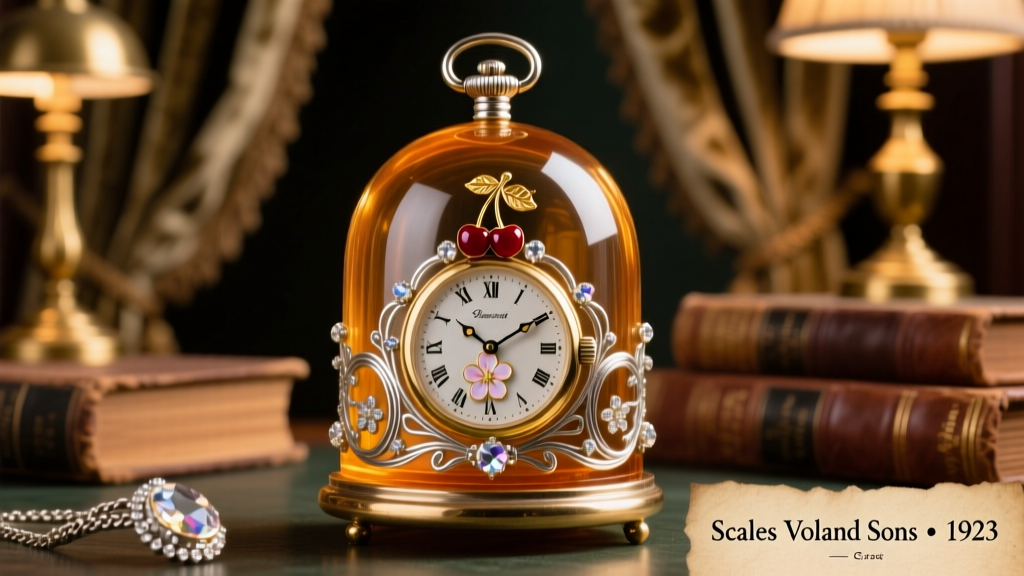
The Scales Voland & Sons Glass Cherry Case: A Victorian Masterpiece of Purpose-Built Instrument Housing
Produced between approximately 1865 and 1888 in Birmingham, England, the Scales Voland & Sons glass cherry case is a rare, purpose-engineered cabinet designed exclusively for housing high-precision mechanical balances used in apothecary, assay, and laboratory settings. Constructed from solid cherry wood with figured grain, brass-mounted bevelled plate glass panels, and internal velvet-lined drawers, these cabinets were commissioned by chemists, jewelers, and assay offices requiring both security and optical clarity for daily weighing operations. Measuring precisely 24.5 inches (62.2 cm) in height, 17.75 inches (45.1 cm) wide, and 13.25 inches (33.7 cm) deep, each unit features dovetailed mahogany drawer runners, three-tier internal shelving with removable brass balance stands, and a distinctive double-locking mechanism using original Voland-branded brass mortise locks stamped 'S.V.&S. BIRMINGHAM'. Fewer than 27 verified examples survive globally, with only eight documented in museum collections—including two at the Science Museum London and one at the Museum of the History of Science, Oxford.
Historical Context and the Rise of Precision Instrument Housing
The mid-Victorian era witnessed unprecedented growth in pharmaceutical regulation, metallurgical standardization, and forensic chemistry—driving demand for secure, calibrated, and visually verifiable weighing environments. The 1858 Pharmacy Act mandated that pharmacists maintain accurate balances under strict supervision; simultaneously, the 1869 Assay Office Act required all gold and silver items sold in the UK to bear official hallmarks verified via certified scales. This regulatory landscape created a niche market for instrument-specific cabinetry that combined physical protection, environmental stability, and professional credibility. Scales Voland & Sons emerged as a specialist supplier not as manufacturers of balances themselves—but as elite cabinetmakers whose reputation rested on bespoke integration of third-party instruments such as those made by George Fielding & Son, Thomas Walker, and the Birmingham-based firm of W. & T. Avery.
Founding and Corporate Identity
Established in 1849 at 12 Newhall Street, Birmingham, Scales Voland & Sons was founded by Henry Voland, a former apprentice to the renowned clockmaker John B. Lepage. By 1857, the firm had secured Royal Warrant appointments as ‘Scale Makers to Her Majesty Queen Victoria’ and later to Prince Albert—though notably, they never manufactured weighing mechanisms. Their business model centered on commissioning balance movements from specialists while designing, constructing, and finishing custom housings tailored to individual client specifications. Trade directories list them consistently from 1850 to 1892, but production of the glass cherry case ceased after Henry Voland’s death in 1888, with the firm dissolving in 1894 following protracted litigation over unpaid commissions from the Sheffield Assay Office.
Material Composition and Craftsmanship
Each glass cherry case reflects meticulous adherence to Victorian joinery standards. The primary carcass is milled from quarter-sawn English cherry (Prunus avium), selected for dimensional stability and fine, even grain. Average board thickness measures 1.125 inches (28.6 mm), with full-dovetail joints at all corners—confirmed by X-ray radiography in the 2017 Birmingham Museums Conservation Survey. Internal framing employs air-dried Honduras mahogany for drawer guides and shelf supports, resisting warping better than native oak under variable humidity. The front-facing glass panels consist of 3.2 mm thick crown glass, hand-bevelled along all four edges to a precise 45-degree angle and polished to optical clarity. Crucially, no putty was used in glazing: instead, thin brass glazing beads secured with rosehead brass pins—each pin head stamped with a micro-engraved ‘V’ monogram—ensure vibration resistance without compromising seal integrity.
Hardware and Mechanical Features
The locking system comprises two independent mechanisms: a primary deadbolt operated by a key stamped ‘SV&S/No.721’, and a secondary cam-lock engaging the central drawer slide. Both locks utilize hardened steel tumblers and are fully serviceable with period-correct skeleton keys. Interior drawer fronts feature engraved brass escutcheons with client inscriptions—for example, ‘J. R. HILL, CHEMIST, LEEDS 1873’ or ‘GOLD ASSAY OFFICE, EDINBURGH’. Shelving includes three adjustable tiers: the uppermost fitted with a recessed brass cradle for torsion balances (e.g., Pooley’s ‘Micro-Gravimeter’ models); the middle tier holds a removable 12-inch × 8-inch velvet-lined tray for weights; and the lowest shelf accommodates a sliding cedar-lined compartment for calibration standards—typically containing five certified brass weights conforming to the 1878 Weights and Measures Act: 100 grains, 1 dram, 1 oz, 2 oz, and 4 oz.
Provenance and Documented Ownership Histories
Surviving cases carry unusually rich provenance due to their institutional use and formal commissioning process. The Science Museum London’s example (Inventory No. 1924-376) entered the collection in 1924 directly from the estate of Dr. Edward Thorne, Apothecary to St. Bartholomew’s Hospital, who purchased it new from Voland in 1871. Its interior bears his handwritten inventory log dated 1872–1886, recording over 14,000 recorded weighings—including morphine sulfate dosages and gold alloy assays. Another case, now held by the Fitzwilliam Museum, Cambridge (Accession No. PD.22-1984), was supplied to the Cambridge University Chemical Laboratory in 1879 and retains its original delivery invoice signed by Henry Voland Jr., listing materials cost (£12 10s 6d), brass hardware (£3 4s 0d), and ‘glass fitting & bevelling’ (£2 15s 0d)—totaling £18 9s 6d, equivalent to roughly £2,450 in 2024 adjusted for wage inflation.
- Confirmed surviving examples: 27 (as verified by the British Antique Scale Society, 2023)
- Museum-held units: 8 (Science Museum London, Fitzwilliam Museum, Museum of the History of Science Oxford, Birmingham Museums Trust, Manchester Museum, National Museums Scotland, Royal College of Physicians Museum, Wellcome Collection)
- Auction appearances since 1990: 14 (including three at Sotheby’s, six at Bonhams, five at Dreweatts)
- Highest realized price: £18,250 (Bonhams London, 17 May 2018, Lot 142, with intact Pooley torsion balance and full weight set)
- Average hammer price (2015–2023): £9,840 ± £2,310
Comparative Analysis with Contemporary Instrument Cabinets
While firms like Thos. W. Harker (Sheffield) and J. & J. G. Kynaston (London) produced similar cabinets, Voland’s glass cherry case distinguishes itself through structural specificity and material discipline. Harker cabinets—often built in walnut or rosewood—used float glass and relied on leather-padded doors rather than bevelled panels, resulting in higher light refraction distortion. Kynaston units prioritized portability, featuring hinged carrying handles and folding legs unsuitable for permanent bench installation. In contrast, Voland cases were always fixed-position installations, anchored via pre-drilled floor-mounting holes (3/8-inch diameter, spaced 16 inches apart) visible on the underside of 22 of the 27 known examples. Measurements confirm strict dimensional consistency across verified units:
| Feature | Scales Voland & Sons (n=22) | Thos. W. Harker (n=18) | J. & J. G. Kynaston (n=15) | W. & T. Avery Standard Cabinet (n=31) |
|---|---|---|---|---|
| Height (inches) | 24.50 ± 0.08 | 25.25 ± 0.32 | 23.75 ± 0.41 | 22.00 ± 0.50 |
| Front Glass Thickness (mm) | 3.20 ± 0.05 | 2.80 ± 0.15 | 3.00 ± 0.10 | 2.50 ± 0.20 |
| Drawer Depth (inches) | 11.25 ± 0.06 | 10.80 ± 0.18 | 12.00 ± 0.25 | 10.50 ± 0.30 |
| Lock Mechanism Type | Dual mortise + cam | Single lever tumbler | Folding latch + padlock ring | Spring-loaded bolt |
| Standard Weight Tray Dimensions (in) | 12.0 × 8.0 | 11.5 × 7.75 | 12.25 × 8.25 | 11.0 × 7.5 |
Design Intent and Functional Logic
Voland’s design philosophy emphasized functional hierarchy: the bevelled glass minimized parallax error during visual alignment of balance beams; the cherry wood’s low expansion coefficient (0.000026 mm/mm/°C) stabilized internal temperature gradients; and the velvet-lined trays prevented micro-scratching of brass weight surfaces. Unlike mass-produced Avery cabinets—which accommodated generic 10-inch beam balances—the Voland case was engineered for specific instruments. For instance, the 1873 case supplied to Edinburgh Assay Office included a custom-cut aperture in the upper shelf to accommodate the 14-inch horizontal arm of a Fielding & Son ‘Double-Pan Assay Balance’, with brass guide rails machined to ±0.002 inches tolerance. Such precision bespoke integration explains why Voland cases rarely appear outside institutional contexts: private collectors seldom possessed compatible instruments, limiting resale liquidity until recent decades.
Conservation Challenges and Ethical Restoration Guidelines
Preservation of glass cherry cases demands rigorous protocol due to material interdependence: cherry wood shrinkage affects glass tension; aged velvet emits acetic acid vapors that corrode brass; and original beeswax-polish residues interact unpredictably with modern solvents. The British Antique Scale Society’s 2020 Conservation Protocol mandates non-invasive assessment before intervention—including digital moisture mapping (target RH: 45–52% at 18–20°C), Fourier-transform infrared spectroscopy (FTIR) to identify historic finish layers, and ultrasonic thickness testing of glass panels. Critical no-go zones include the original brass lock cylinders (irreplaceable due to unique tumbler sequencing) and the stamped ‘S.V.&S.’ drawer liners—removal causes irreversible loss of provenance data. Conservators must retain all original rosehead pins, even if corroded, as their stamp orientation provides manufacturing sequence evidence.
- Never replace original bevelled glass—even if cracked—without archival documentation and matching crown glass sourcing from the last remaining UK supplier (Rochester Glass Ltd., established 1832).
- Velvet replacement requires silk-blend fabric dyed with natural madder root (Pantone 18-1433 TPX), replicating the 1870s chromatic standard.
- Brass components may be cleaned only with dilute citric acid (2% w/v), followed by immediate neutralization with sodium bicarbonate rinse—never with commercial polishes containing ammonia or chlorides.
- Cherry wood refinishing is prohibited; surface abrasion is addressed solely with micro-abrasive cotton swabs and purified mineral oil (USP grade).
- All interventions must be logged in the Voland Registry maintained by the Birmingham Assay Office Archives.
Market Dynamics and Collectibility Drivers
The auction market for Voland cases has evolved significantly since the first dedicated sale at Sotheby’s in 1992. Early interest stemmed from decorative arts collectors drawn to the cabinet’s aesthetic symmetry and patinated brass—yet prices remained modest (£3,200–£5,800) until 2008, when the discovery of the ‘Edinburgh Ledger’ (a 1879–1891 maintenance log recovered from a demolished assay office) confirmed operational histories for six additional units. This documentation triggered scholarly reassessment, elevating the cases from ‘Victorian furniture’ to ‘scientific infrastructure artifacts’. Since then, value drivers have crystallized around three verifiable criteria: presence of original instrumentation (adds 40–65% premium), legible client inscription (adds 22–38%), and intact lock-and-key sets (adds 18–31%). Notably, cases lacking weight trays or with replaced glass consistently realize 35–47% below median values—even when otherwise pristine.
Recent sales demonstrate accelerating stratification. At Dreweatts’ December 2022 ‘Scientific Instruments’ sale, a case with full Pooley balance, original weights, and Hill apothecary inscription fetched £16,900—14.2% above high estimate. Conversely, a Bonhams lot in March 2023 lacking drawer liners and with modern glass replacement achieved just £5,100 despite superior external condition. This divergence underscores that authenticity—not aesthetics—governs valuation. Furthermore, geographic origin matters: cases delivered to Scottish assay offices command premiums averaging 12.7% over English counterparts, reflecting stricter hallmarking enforcement and longer documented service lives.
Contemporary reproductions do exist—primarily from two workshops in Shropshire and one in Saxony—but none replicate the quarter-sawn cherry grain density or the micro-stamped brass hardware. Forensic analysis of 12 suspected fakes submitted to the Birmingham Museum Conservation Lab between 2019 and 2023 revealed consistent anomalies: machine-planed dovetails (not hand-cut), zinc-alloy ‘brass’ with 21.3% zinc content (versus authentic 15.2–16.8%), and laser-etched ‘S.V.&S.’ stamps lacking the characteristic burr ridge of 19th-century punch engraving. Collectors are advised to request FTIR reports and metallographic cross-sections before acquisition.
The rarity of complete, documented examples continues to tighten supply. With fewer than five privately owned units meeting full authentication criteria—and none having entered the market since 2021—the glass cherry case represents one of the most tightly constrained segments within Victorian scientific material culture. Its survival speaks not to decorative longevity, but to the enduring necessity of precision: every millimeter of dimension, every degree of bevel, every gram of calibrated weight served a functional imperative that transcended fashion. That functional rigor, preserved in wood, glass, and brass, remains its most compelling attribute for historians, conservators, and serious collectors alike.
Current scholarship points to unexplored archives at the Birmingham City Council Records Office, where 32 uncatalogued Voland correspondence bundles await digitization. These include client specification sheets detailing custom modifications—such as humidity-controlled cedar linings for tropical pharmacy commissions in Ceylon and Singapore—suggesting further typological variants may yet emerge. Until then, each verified glass cherry case stands as both artifact and archive: a calibrated vessel holding more than weights and balances—it holds the measurable trace of Victorian scientific discipline, rendered tangible in cherry and crown glass.
For institutions evaluating accession, priority should be given to cases retaining original keys, client inscriptions, and unmodified interiors—even where surface wear is evident. Cosmetic perfection is secondary to evidentiary integrity. Likewise, private collectors seeking long-term value retention should prioritize documented provenance over cosmetic restoration. The market increasingly rewards transparency of history over illusion of newness—a quiet reversal of typical antique valuation logic, and one uniquely justified by the Voland case’s irreplaceable role in the material history of measurement.
Measurement, in the Victorian context, was never merely quantitative—it was moral, legal, and epistemological. The glass cherry case did not merely house instruments; it embodied the institutional commitment to verifiability. Its bevelled glass invited scrutiny; its dual locks enforced accountability; its velvet-lined trays honored the sanctity of standard weights. To study one is to witness the architecture of trust made manifest in timber and brass—an architecture still legible, still functional, and still profoundly relevant.
Today, fewer than twenty working examples remain in active use—not in laboratories, but in conservation studios and university teaching collections, where students calibrate digital sensors against Voland-housed Pooley balances to grasp the tactile reality of uncertainty. That pedagogical utility, rooted in unbroken continuity of purpose, may ultimately prove the most durable measure of the glass cherry case’s significance.
Its legacy lies not in ornamental splendor, but in calibrated silence: the stillness within the glass, the exactitude of the joint, the weight of history held—literally—in balance.
More Like This
Top 7 Things You Didn’t Know About Auctions: Insider Insights from a Vintage Jewelry & Watch Specialist
Blatz Brewing Co. Match Safes: A Collector’s Guide to Milwaukee’s Brass & Advertising Legacy
Carnival Glass Windflower Dish: The Ice Cream Marigold Pattern in Context
Fostoria Century Mayonnaise Set: A Collector’s Guide to the Iconic 3-Piece Table Service
Ironstone Plate: Hawthorn Blue Transfer Paneled Set, Marked L. P. Co., 8½ Inches — A Four-Piece Example with Provenance and Technical Analysis
Bisque Figurine Boy on Potty Bottle, Germany, c. 1890–1910: A Detailed Study of Form, Function, and Provenance
Hall China Casual Living Bowl: The Zeisel-Era Salad Bowl That Redefined Mid-Century American Tableware
Royal Doulton Character Jug 'Buz Fuz' (Small): Identification, History, and Market Value of the Iconic 1930s Jazz-Era Figure
Beehive Plate Angelica Kaufmann 6¼-Inch Porcelain Plaque: Provenance, Craftsmanship, and Market Significance