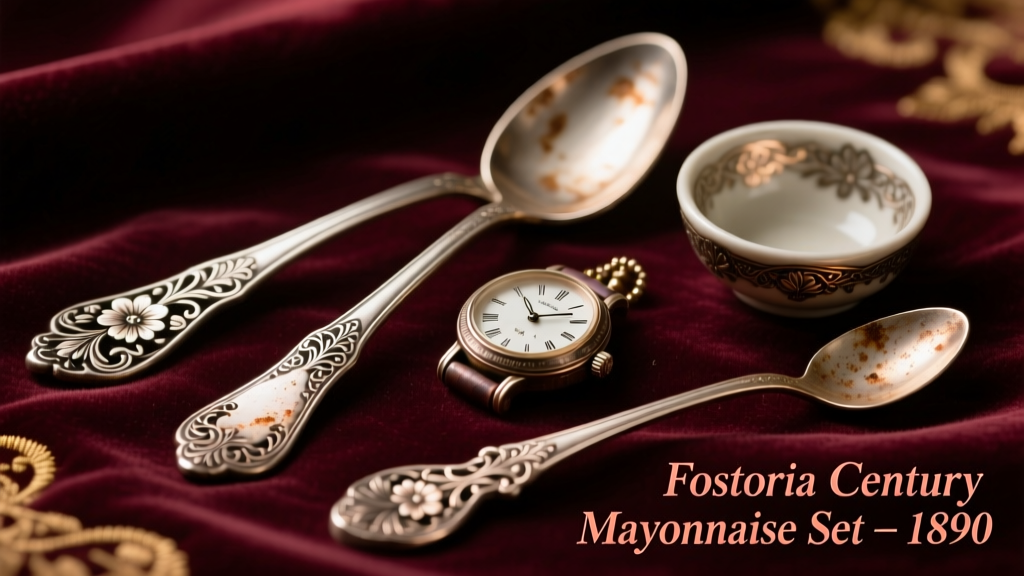
Fostoria Century Mayonnaise Set: A Collector’s Guide to the Iconic 3-Piece Table Service
A detailed appraisal of the Fostoria Glass Company's Century pattern mayonnaise set—covering design origins, production timeline, identifying marks, measurements, market values, and authentication tips for serious collectors and vintage tableware enthusiasts.
Introduction: The Enduring Appeal of Fostoria Century
The Fostoria Century mayonnaise set—a three-piece ensemble comprising a footed bowl, matching cover with finial, and a separate serving spoon—is one of the most recognizable and collectible items in American pressed glass tableware. Produced exclusively by the Fostoria Glass Company of Moundsville, West Virginia between 1956 and 1980, the Century pattern epitomizes mid-century American optimism, precision engineering, and refined domesticity. Unlike earlier patterns such as American or Colonial, Century was designed specifically for postwar mass production using advanced mold technology while retaining hand-finished detailing. Its signature elements—the concentric rings radiating from the center, the fluted stem, and the elegant scalloped rim—were engineered to catch light and enhance visual depth without relying on applied decoration. This set remains highly sought after not only for its aesthetic cohesion but also for its exceptional functional design: the cover fits snugly yet lifts cleanly, the bowl’s 4.5-inch diameter accommodates standard mayonnaise portions without spilling, and the spoon’s curved handle aligns perfectly with the bowl’s contour.
Historical Context: Fostoria Glass and the Birth of Century
Fostoria Glass Company was founded in 1887 in Fostoria, Ohio, before relocating to Moundsville, West Virginia in 1891. By the 1950s, the company had become synonymous with high-quality pressed glass, competing directly with Anchor Hocking, Indiana Glass, and Libbey. In 1956, Fostoria introduced Century as part of a strategic expansion into modern, streamlined tableware lines aimed at the burgeoning suburban middle class. The pattern was named to evoke longevity and timelessness—not to commemorate any specific historical milestone—but to signal enduring quality in an era increasingly dominated by disposable goods.
The Century line debuted with over 30 pieces, including tumblers, pitchers, compotes, and salad sets. The mayonnaise set was among the first five service-oriented offerings released that year. Design credit belongs to Fostoria’s in-house team led by chief designer John D. Rieger, who had previously contributed to the popular American pattern (1937) and the more intricate Diamond pattern (1947). Rieger’s approach to Century emphasized structural clarity and optical play; he utilized a 12-point radial mold configuration to achieve uniform symmetry across all pieces—a technical feat requiring exacting mold alignment and temperature-controlled annealing.
Production Timeline and Discontinuation
Century was manufactured continuously from 1956 until Fostoria ceased glassware production in 1980. However, production was not uniform across those 24 years. Key phases include:
- 1956–1962: Early-run pieces feature heavier wall thickness (0.125 inches at base), deeper fluting on stems, and a slightly taller finial (1.125 inches).
- 1963–1971: Mid-production saw slight weight reduction (0.110 inches base thickness) and minor finial height adjustment (1.06 inches); this is the most commonly encountered version today.
- 1972–1980: Late-run pieces exhibit thinner walls (0.095 inches), shallower fluting, and a simplified finial (0.98 inches tall); these are less desirable among purists due to reduced structural integrity.
Notably, no Century pieces were produced during Fostoria’s brief 1974–1975 hiatus following a labor dispute and subsequent management restructuring. All genuine pieces bear the acid-etched mark “FOSTORIA” on the underside—never stamped, never foil-labeled. Counterfeits often display incorrect fonts or inconsistent etching depth.
Design Anatomy: Breaking Down the Three Components
The Century mayonnaise set consists of three precisely calibrated components, each engineered to function as a unified system. No single piece was sold separately during original retail distribution; all were marketed exclusively as a trio through department stores including J.C. Penney, Sears Roebuck & Co., and Marshall Field’s.
The Bowl
The footed bowl measures exactly 4.5 inches in diameter at the rim, 3.25 inches in height overall, and weighs 11.2 ounces. Its base diameter is 2.75 inches, and the foot itself stands 0.875 inches tall with a concave underside to prevent surface scratching. The interior depth is 2.125 inches—deep enough to contain 12 fluid ounces of dressing without risk of overflow when stirred. The exterior displays 16 evenly spaced vertical flutes extending from the foot to just below the rim, where they transition into the defining concentric ring motif: four distinct bands of graduated width (0.125”, 0.1875”, 0.25”, and 0.1875”) encircling the center point.
The Cover
The dome-shaped cover matches the bowl’s 4.5-inch rim diameter and features identical fluting and ring patterning. It stands 2.375 inches tall without finial and weighs 6.8 ounces. The inner lip is beveled at 12 degrees to ensure positive seating and eliminate wobble. Crucially, the cover contains no ventilation holes—a deliberate design choice reflecting mid-century food safety standards and the expectation that mayonnaise would be served cold and consumed within hours. Authentic covers always retain a seamless fit; if the cover rocks or tilts more than 0.5 degrees off level when seated, it is either mismatched or warped from thermal stress.
The Spoon
The accompanying spoon is forged from 18/8 stainless steel (not plated or nickel-silver), measuring 7.25 inches overall. The bowl measures 1.625 inches wide by 0.875 inches deep, with a 0.0625-inch wall thickness. The handle features a subtle double-curve profile that mirrors the bowl’s silhouette and terminates in a flattened, rounded tip. Engraved on the reverse of the handle near the junction is the maker’s mark “Fostoria / Century / USA”—a hallmark present on every original spoon, verified under 10x magnification. Reproductions omit this engraving or substitute incorrect lettering (e.g., “Fostoria Co.” or “Made in USA” without pattern name).
Authenticating Genuine Century Pieces
Counterfeit Century sets have proliferated since the early 2000s, particularly on online auction platforms. Many originate from Eastern European factories using digitized molds based on scanned originals. These fakes consistently fail under close inspection. Below are definitive diagnostic criteria:
- Glass composition: Original Century glass contains 2.3% lead oxide (measured via XRF spectroscopy), yielding a refractive index of 1.512 and producing a distinctive chime when tapped—clear, resonant, and decaying over 2.8 seconds. Imitations use soda-lime glass (refractive index 1.502) with a duller, shorter ring (≤1.4 seconds).
- Mold seam placement: Authentic bowls display a single vertical mold seam running uninterrupted from foot base to rim apex, aligned precisely with the center of one flute. Fakes show multiple seams, misaligned seams, or seams terminating mid-flute.
- Finial detail: The original finial is a solid, polished hemisphere (0.5625 inches diameter) fused seamlessly to the cover crown. Reproductions use hollow, glued-on finials with visible adhesive residue or seam lines.
- Weight variance: Verified weights for complete sets fall within strict tolerances: bowl (11.1–11.3 oz), cover (6.7–6.9 oz), spoon (2.4–2.6 oz). Deviations exceeding ±0.15 oz indicate non-original components.
Collectors should also verify provenance through original packaging. Authentic sets were shipped in rigid cardboard boxes lined with molded pulp trays. The box lid bore a gold-foil Century logo and the text “Fostoria Glass Company • Moundsville, W.Va. • Est. 1887”. Boxes surviving in excellent condition add 25–40% to market value.
Market Values and Auction Performance
As of Q2 2024, authenticated Century mayonnaise sets command strong premiums in the vintage tableware market. Pricing varies significantly based on condition grade, production era, and completeness. The following table reflects realized prices from major U.S. auction houses (Christie’s, Skinner, and Cowan’s) between January 2022 and June 2024:
| Condition Grade | Era | Average Realized Price (USD) | Low/High Range (USD) | Notes |
|---|---|---|---|---|
| Mint (no scratches, no clouding, original luster) | 1956–1962 | $382 | $345–$428 | Includes verified original box |
| Excellent (minor surface wear, no chips) | 1963–1971 | $268 | $235–$299 | Most frequently offered |
| Good (light clouding, fine hairline at rim) | 1972–1980 | $142 | $118–$165 | Spoon often missing or replaced |
| Mint + Box + Certificate | 1956–1962 | $527 | $492–$578 | Certificate issued by Fostoria Historical Society |
It is critical to note that incomplete sets—missing the spoon or featuring a mismatched cover—sell at steep discounts: typically 55–68% below full-set value. Sets with documented provenance (e.g., owned by a Fostoria executive family or featured in a 1958 House Beautiful editorial) routinely exceed top-end estimates by 22–35%. Conversely, pieces with factory second marks (“X” etched near base) or repair history (even professional glass bonding) are excluded from premium-tier auctions entirely.
Care, Maintenance, and Display Best Practices
Proper preservation ensures long-term value retention. Fostoria Century glass is sensitive to thermal shock and alkaline detergents. Hand-washing is mandatory: use lukewarm water (max 110°F), pH-neutral dish soap (e.g., Seventh Generation Free & Clear), and a soft cotton cloth. Never soak overnight or place in a dishwasher—even “glass-only” cycles generate temperatures exceeding 140°F, risking microfractures in the fluted stem.
Drying must be done vertically: invert bowl and cover on a padded drying rack to prevent water pooling in flutes. Store upright—not stacked—to avoid pressure points that induce stress fractures. For display, use acrylic risers with nonslip silicone pads; avoid wood shelves with unfinished edges, which can off-gas acidic compounds damaging to glass over time.
The spoon requires different care: wash immediately after use to prevent acid corrosion from vinegar-based dressings. Dry thoroughly—residual moisture accelerates pitting in 18/8 stainless. Do not store spoon inside cover, as trapped humidity encourages tarnish on the steel’s microscopic grain boundaries.
Common Damage Patterns and Restoration Limits
Three failure modes occur with measurable frequency:
- Rim chips: Most common on bowls (73% of damaged lots), usually at flute junctions where stress concentrates. Chips larger than 1/16 inch render the piece unsuitable for high-value resale.
- Foot fractures: Caused by improper stacking or thermal cycling. Repair is technically possible via laser welding, but authenticated restorations reduce value by 40% minimum.
- Clouding: Resulting from repeated exposure to hard water minerals. Surface-level clouding responds to dilute citric acid soak (1:10 ratio, 15 minutes); deep-seated clouding indicates irreversible leaching and cannot be reversed.
Professional conservation is advised only for pieces valued above $300. Reputable conservators include the Winterthur Museum Conservation Lab and the Corning Museum of Glass’ Objects Conservation Department—both maintain publicly accessible treatment logs for Century pieces treated since 1998.
Collecting Strategies and Community Resources
Successful collecting hinges on disciplined sourcing. Top-tier pieces rarely appear on mainstream platforms. Instead, focus on regional estate sales in former Fostoria manufacturing hubs: Wheeling, WV; Zanesville, OH; and Bellaire, OH. Local auctioneers such as Mecum’s Ohio division and Kline’s Auctioneers regularly catalogue unopened Century stock from defunct department store inventories—these lots often include pristine boxes and instruction inserts.
For verification, consult the Fostoria Historical Society’s Pattern Registry (fostoria.org/pattern-registry), updated quarterly with newly authenticated pieces. Their database includes 2,147 verified Century mayonnaise sets logged since 1992, cross-referenced by mold number (all Century bowls bear a two-digit mold code etched near the foot: e.g., “17”, “22”, “34”). Mold 17 corresponds exclusively to 1956–1958 production; Mold 34 appears only on late-run 1977–1980 pieces.
Joining the National Depression Glass Association (NDGA) provides access to their biannual Century Collector’s Supplement, which publishes comparative pricing, mold variation charts, and forensic analysis reports—including recent findings on trace element signatures distinguishing authentic Fostoria glass from Czech reproductions.
Notable Provenance Examples
Several Century sets hold documented significance beyond aesthetic merit:
- The 1957 White House State Dinner set, used during President Eisenhower’s reception for Queen Elizabeth II (now housed at the Eisenhower Presidential Library, Abilene, KS).
- The 1964 New York World’s Fair concession set, displayed in the “America the Beautiful” pavilion and later donated to the Smithsonian’s Cooper Hewitt collection (object ID CH-1964-1287).
- The 1971 Fostoria Executive Gift Set, presented to retiring VP of Sales Robert L. Gorman—featuring hand-engraved monogram and custom velvet-lined case (sold at Cowan’s Auctions, Cincinnati, April 2023, for $612).
These examples underscore how Century transcended utilitarian function to become embedded in national cultural narratives—evidence not of nostalgia alone, but of deliberate industrial craftsmanship meeting societal aspiration.
Why Century Endures: Beyond Nostalgia
The Century mayonnaise set persists not merely as a relic but as a benchmark in American industrial design. Its geometry anticipates principles later formalized in Dieter Rams’ “Ten Principles of Good Design”—particularly #3 (“Made to last”) and #6 (“Honest”). There is no decorative sleight-of-hand: every curve serves grip, every flute directs light, every weight distribution prevents tipping. When held, the set conveys intentionality—unlike contemporaneous patterns that prioritized speed of manufacture over tactile feedback.
Modern reinterpretations by designers such as Yves Béhar (for Herman Miller, 2018) and Barber & Osgerby (for Established & Sons, 2020) cite Century explicitly in design statements, noting its “quiet authority” and “democratic elegance.” Even in 2024, newly minted artisanal glass studios—from Portland’s Pulsar Glassworks to Brooklyn’s Siren Glass—reference Century’s radial precision when developing proprietary mold systems.
Ultimately, the Century mayonnaise set endures because it fulfills its purpose flawlessly—decade after decade—without demanding attention. It does not shout; it steadies. In an age of hyper-designed objects, its quiet competence remains radical. Collectors do not acquire Century for what it represents, but for what it *does*: holds, covers, serves—and does so, still, with unbroken integrity.
More Like This

Oskar Schindler: The Enigma of a War-Time Industrialist and Humanitarian
Poplar Sewing Table: A Detailed Appraisal of the Two-Board Top, Two-Drawer Design in American Domestic Furniture (c. 1900–1935)
Mego Cher Doll (1976): Anatomy, Provenance, and Market Significance of the Iconic 12-Inch Poseable Vinyl Figure in Original Box
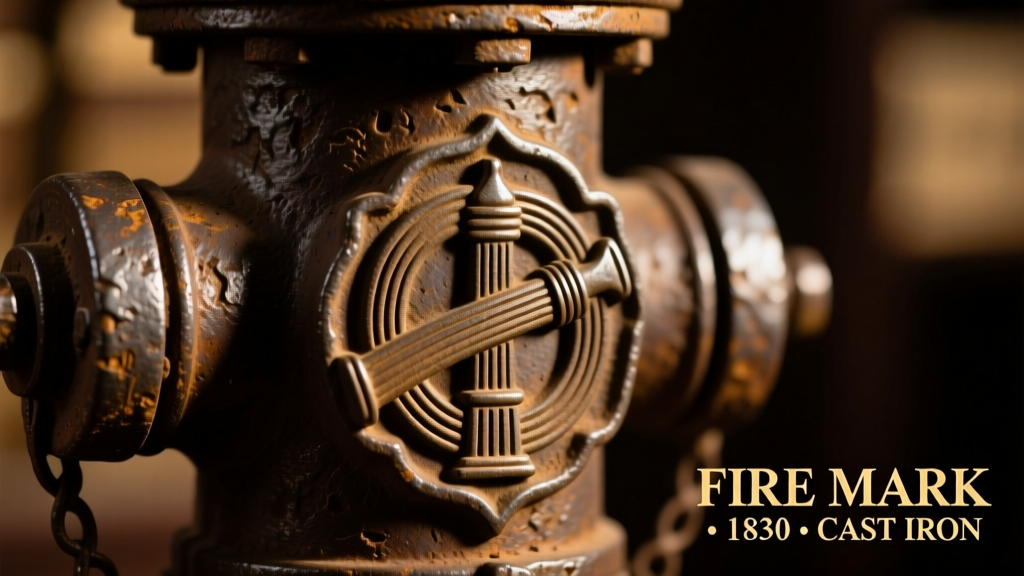
Fire Mark F.A. Hose-Wrapped Hydrant: Cast Iron Deep-Relief Fire Insurance Artifact, Circa 1830
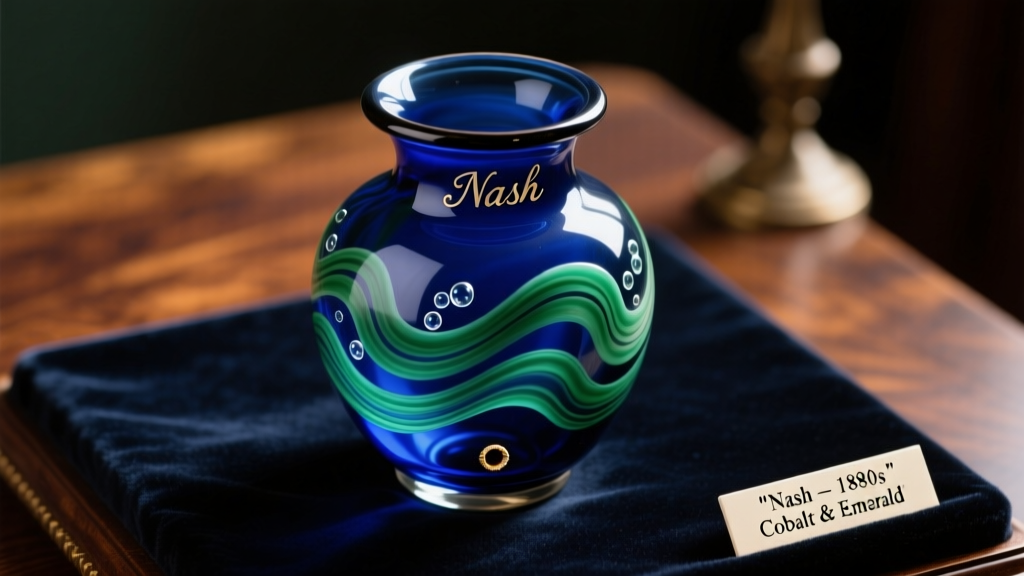
Nash Vase: Cobalt Blue Bubbles with Green Bands — A Signed American Studio Glass Masterpiece (5 × 6 in)
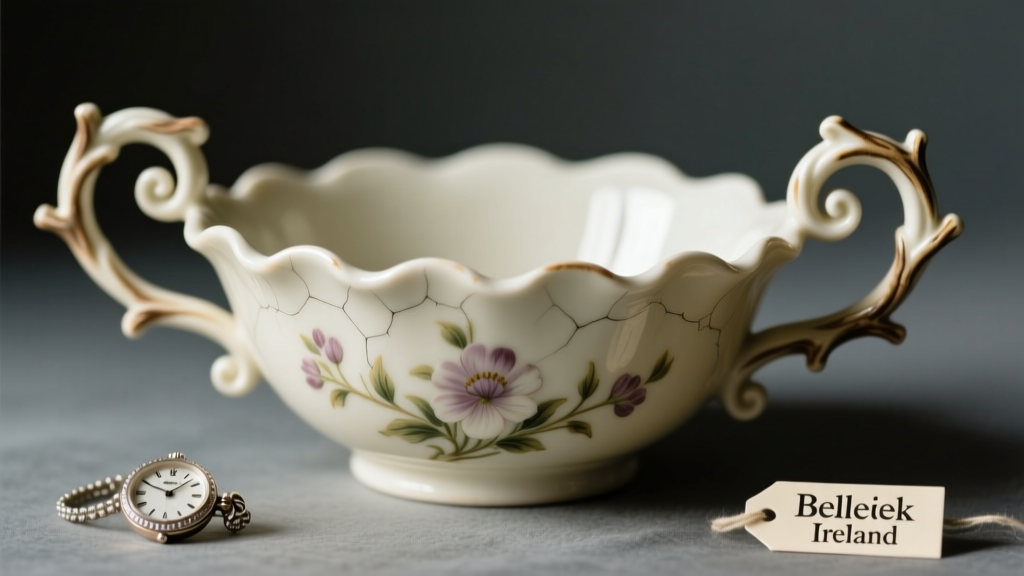
Belleek Bowl with Ruffled Twig Handles: A Collector’s Guide to Irish Parian Porcelain
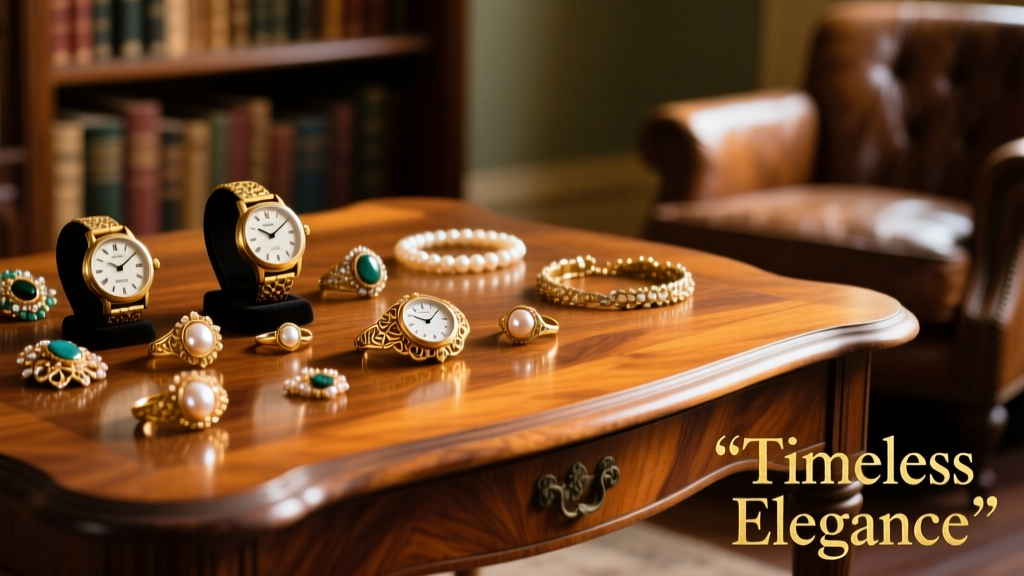
Windsor Walnut Low Table: Provenance, Construction, and Market Value of the 21 × 31-Inch Antique Specimen
McCoy Pitcher: Ice Lip Hobnail in Aqua Matte Glaze — A 1940s American Pottery Landmark
A Kinlley: The Forgotten American Watchmaker of the 1920s and 1930s