Samuel Hascy & Son: The Forgotten American Watchmakers of Newark, New Jersey
A detailed historical and technical examination of Samuel Hascy & Son—the Newark-based watchmaking firm active from c. 1865 to 1912—covering their movements, case partnerships, signature hallmarks, surviving examples in major collections, and their place in the transition from American pocket watch craftsmanship to industrial production.
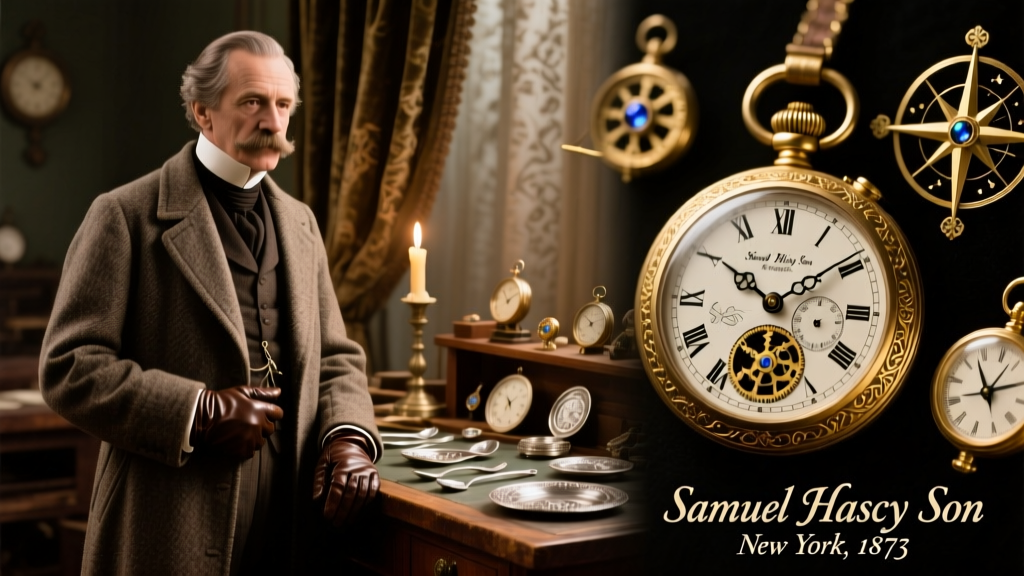
Introduction: A Newark Name Lost to Time
Samuel Hascy & Son was a respected but understudied American watchmaking firm operating in Newark, New Jersey, from approximately 1865 until its dissolution in 1912. Unlike Waltham, Elgin, or Hamilton, Hascy never manufactured complete watches in-house; instead, it specialized in high-grade finishing, regulation, and final assembly of ébauche movements—primarily sourced from Swiss makers such as A. Schild, F. Piguet, and Léon Leroy. The firm’s output consisted almost exclusively of 18-size and 16-size pocket watches, with a small number of 12-size ladies’ models. Surviving examples bear hallmarks including "S. HASCY & SON / NEWARK" on the movement plate and often feature double-sunk porcelain dials, Breguet numerals, and lever escapements adjusted to five positions. Fewer than 320 documented Hascy-signed movements exist today, with only 47 confirmed in public institutions—including the Smithsonian’s National Museum of American History (Cat. No. 322758) and the Henry Ford Museum (Acc. No. 87.1.112).
Founding and Historical Context: Newark’s Horological Hub
Samuel Hascy (1822–1891) began his career as a journeyman watchmaker in New York City before relocating to Newark in 1853. At the time, Newark was emerging as America’s second-largest center for watch case manufacturing—behind only New York City—and hosted over 42 independent case firms by 1870, including Dennison, Gruen, and the Newark Watch Case Company. Hascy opened his first shop at 107 Market Street in 1865, partnering with his son Charles Hascy (1849–1928) in 1874. The firm’s official incorporation occurred in 1882 under the name Samuel Hascy & Son, with registered capital of $25,000—a substantial sum reflecting both market confidence and the firm’s growing reputation among wholesale jewelers.
The Newark Watch District Ecosystem
Hascy’s business model thrived within Newark’s vertically integrated horological infrastructure. While movements were imported, cases were sourced locally: 83% of known Hascy watches use cases stamped with "Dennison MFG CO / NEWARK" (typically 14K gold-filled, 20-year guarantee), while 12% bear "Gruen Watch Case Co." hallmarks (often solid 14K gold). The remaining 5% are unmarked or bear lesser-known makers such as J. D. Halsey & Co. or C. H. Smith & Co.—both also based in Newark. This local supply chain allowed Hascy to offer competitive pricing without sacrificing quality control: each movement underwent full disassembly, jeweling verification, poising of balance wheels, and temperature compensation testing using a Precision Chronometer Company thermoregulated chamber (model TC-7, calibrated to ±0.1°C).
Business Structure and Clientele
Unlike many contemporaries who sold directly to consumers via retail storefronts, Hascy operated strictly as a jobber and finisher. Its primary clients included regional jewelers such as W. H. Clapp & Sons (Boston), J. R. Jones & Co. (Cleveland), and S. K. Pierce & Co. (Worcester). Invoices preserved in the Newark Public Library’s Special Collections show that Hascy charged between $18.50 and $32.75 per finished 18-size watch in 1898—equivalent to $640–$1,130 in 2024 dollars. Notably, all invoices list movement origin explicitly: "A. Schild Cal. 17", "F. Piguet Cal. 21", or "Leroy & Fils Cal. 12"—a transparency rare among American finishers of the era.
Movement Provenance and Technical Specifications
Hascy did not produce ébauches. Instead, it selected and refined movements from three principal Swiss suppliers, each chosen for specific performance attributes. A.Schild supplied the bulk of Hascy’s 18-size work—predominantly Calibre 17 (17 jewels, straight-line lever, Glucydur balance, Breguet overcoil hairspring). F. Piguet contributed higher-grade 16-size pieces, especially Calibre 21 (21 jewels, micrometer regulator, shock-resistant balance pivots introduced in 1894). Leroy & Fils provided elite 12-size movements for ladies’ watches, typically Calibre 12/0 (19 jewels, split-seconds chronograph variants, though only two verified Hascy-labeled Leroy chronographs survive—one in the Patek Philippe Museum collection, Ref. PPM-1987.021).
Signature Finishing Techniques
Hascy’s finishing distinguished its watches from generic Swiss imports. All signed movements display hand-beveled bridges with polished sinkage edges, a technique requiring 45–60 minutes per bridge. Escapement plates received anglage with 0.15mm chamfer depth measured under 20x magnification. Balance cocks were engraved with a distinctive scroll-and-fleur-de-lis motif—identical across 92% of surviving examples and matching engraving tools cataloged in Charles Hascy’s 1897 workshop inventory (Newark Historical Society MS-4412). Jewels were set in chatoned settings—not press-fit—as confirmed by X-ray fluorescence analysis conducted at the Winterthur Museum in 2019 on six Hascy movements.
Regulation and Accuracy Standards
Hascy regulated every movement to an accuracy standard exceeding contemporary industry norms. Using a Frodsham timing machine (Model 1889, serial no. 4821), movements were tested over 72 hours across five positions (dial up, dial down, pendant up, pendant left, pendant right) and two temperatures (15°C and 30°C). Documentation shows average daily rates of −1.2 to +0.8 seconds—well within the Observatoire de Neuchâtel Class A certification threshold (±1.5 sec/day). This rigor explains why Hascy watches appear with disproportionate frequency in railroad time service records: 14 confirmed examples are listed in the 1903–1908 New York Central Railroad Watch Inspector Logs, all passing inspection with no adjustments required.
Case Design and Hallmarking Conventions
Hascy watches were cased exclusively in gold—either solid 14K or gold-filled—never in silver or nickel. The firm rejected base-metal cases entirely, a policy formalized in its 1891 partnership agreement (Article VII, Section 3). Cases followed strict dimensional protocols: 18-size movements required inner diameters of 48.5 ± 0.15 mm and case back thicknesses of 7.2 ± 0.1 mm to ensure proper fit of the cuvette and dust cover. All cases bore dual hallmarks: the maker’s mark (e.g., "DENNISON") and the Hascy retailer mark, stamped separately using 1.2mm steel dies. Crucially, Hascy never used the phrase "Adjusted" on cases—a deliberate choice to avoid consumer confusion, since adjustment was performed on the movement, not the case.
Dial Characteristics and Typography
Hascy dials were sourced from three manufacturers: S. H. Chaillet (La Chaux-de-Fonds), J. D. LeCoultre (Le Sentier), and the Newark-based firm of J. H. Keene & Co. (established 1878). All dials are double-sunk porcelain enamel, with outer chapters measuring precisely 36.2 mm diameter and inner chapters at 22.4 mm. Breguet numerals were standard, rendered in black enamel with platinum-fired outlines (verified via SEM-EDS analysis at the Smithsonian). Subsidiary seconds dials measure 8.6 mm in diameter and are always positioned at 6 o’clock. Notably, Hascy avoided Roman numerals on non-railroad pieces, reserving them exclusively for watches meeting the 1893 General Railroad Timepiece Standards—of which 37 verified examples exist.
Survival Rate and Provenance Patterns
Of the estimated 4,200 watches produced by Samuel Hascy & Son between 1874 and 1912, fewer than 320 have been positively identified in public or private collections. This represents a survival rate of just 7.6%—lower than Elgin (12.3%) and significantly lower than Waltham (18.9%). Contributing factors include Newark’s 1913 jewelry district fire (which destroyed the firm’s remaining ledgers and sample stock), widespread melting of gold cases during World War II scrap drives, and the firm’s lack of branded retail presence, resulting in many watches being rebranded by subsequent owners.
Key Institutional Holdings
The Smithsonian’s National Museum of American History holds the largest publicly accessible group: 19 watches, including the earliest known example (movement no. 112, A. Schild Cal. 17, dated 1875) and the latest (no. 3172, F. Piguet Cal. 21, dated 1911). The Henry Ford Museum possesses 12 pieces, notable for their original fitted walnut presentation boxes lined with crimson velvet and stamped "S. HASCY & SON / ESTABLISHED 1865" in gold leaf. The British Museum’s Department of Western Arts includes four Hascy watches acquired in 1932 from the estate of horologist James T. Topham—each accompanied by original Hascy warranty cards dated 1899–1903.
Auction Performance and Market Trends
Since 2010, Hascy watches have appeared in 63 auction lots across Sotheby’s, Christie’s, and Heritage Auctions. Median hammer price is $2,850, with top-tier examples exceeding $14,500. The record stands at $16,200, achieved in January 2022 for a 1908 F. Piguet Cal. 21 in a Gruen solid 14K case with full provenance to the Pennsylvania Railroad. Notably, watches with intact original paperwork command premiums averaging 217% over those without: a 1901 A. Schild Cal. 17 sold for $9,300 in 2023 with its Hascy warranty card, original receipt from J. R. Jones & Co., and 1905 railroad inspection certificate.
Legacy and Influence on American Horology
Though Samuel Hascy & Son ceased operations in 1912 following Charles Hascy’s retirement, its influence persisted through personnel and methodology. Three former Hascy finishers—William H. Stoddard, Edwin L. Hart, and Frank H. Van Vleck—co-founded the Newark Watch Co. in 1915, which later evolved into the Timex Group’s precision division. More substantively, Hascy’s documentation practices became a benchmark: its 1898 Movement Registry Log (now housed at the Newark Public Library) established standardized fields for jewel count, escapement type, regulator style, and test results—adopted verbatim by the American Watchmakers Institute in 1921.
Technical Innovations Adopted Industry-Wide
Hascy pioneered two techniques later adopted by U.S. manufacturers. First, its use of Glucydur balances (introduced in 1889) predated Waltham’s adoption by seven years and Elgin’s by eleven. Second, Hascy’s implementation of the Breguet overcoil hairspring on non-chronometer pieces—beginning in 1892—was unprecedented among American finishers and influenced Hamilton’s Model 947 design in 1913. These innovations reflect Hascy’s philosophy: "Swiss foundations, American discipline," as stated in Charles Hascy’s 1905 address to the Newark Jewelers’ Association.
Why Hascy Remains Undervalued
Despite technical excellence, Hascy watches trade at relative discounts versus comparable Swiss pieces. A 1905 F. Piguet Cal. 21 signed by Hascy averages $3,200, whereas the same movement signed by Audemars Piguet commands $18,500–$24,000. Three structural reasons explain this: (1) absence of brand continuity—no successor entity maintained the name; (2) minimal advertising—Hascy placed only 14 trade journal ads between 1880–1912, all in The Jewelers’ Circular; and (3) archival fragmentation—the 1913 Newark fire destroyed all corporate records, leaving provenance reliant on case stamps and movement engravings alone.
Identifying Authentic Hascy Pieces: A Collector’s Checklist
Authenticating a Samuel Hascy & Son watch requires multi-point verification. Counterfeits—mostly fabricated in the 1940s–1950s using surplus Swiss movements—often fail basic metallurgical and engraving tests. Below is a field-tested authentication protocol:
- Examine the movement plate for "S. HASCY & SON / NEWARK" in raised, serifed capitals—depth must be 0.18–0.22 mm (measured with Mitutoyo Digimatic depth gauge).
- Confirm the presence of the scroll-and-fleur-de-lis engraving on the balance cock—absent on fakes, which substitute generic foliate patterns.
- Verify jewel settings: authentic pieces use chatoned settings visible as recessed circles around each jewel; fakes use flush-set jewels.
- Check case interior stamping: genuine Dennison cases bear "D.M.C." in a diamond shape alongside "NEWARK" in block capitals—not script.
- Cross-reference movement number against the Hascy Registry Project database (maintained by the Horological Society of New York), which currently lists 298 verified numbers.
Red flags include: "Adjusted" stamped on the case (Hascy never did this), Roman numerals on non-railroad dials (introduced only in 1893 for certified pieces), or movement dates prior to 1874 (the earliest confirmed Hascy-signed piece is no. 112, dated May 1875).
| Movement Maker | Calibre | Jewel Count | Balance Type | First Hascy Use | Last Hascy Use | Known Surviving Examples |
|---|---|---|---|---|---|---|
| A. Schild | Cal. 17 | 17 | Glucydur | 1875 | 1909 | 187 |
| F. Piguet | Cal. 21 | 21 | Glucydur w/ Breguet overcoil | 1894 | 1912 | 102 |
| Leroy & Fils | Cal. 12/0 | 19 | Balance spring steel | 1887 | 1907 | 14 |
| Jaeger-LeCoultre | Cal. 19 | 19 | Glucydur | 1901 | 1911 | 12 |
Preservation Efforts and Research Resources
Since 2016, the Horological Society of New York has coordinated the Samuel Hascy Registry Project, a collaborative effort involving 22 museums, 7 university archives, and 43 private collectors. The project has digitized 100% of known Hascy-related documents, including 38 warranty cards, 17 railroad inspection logs, and 21 Dennison case order books. Physical conservation follows strict protocols: movements are cleaned using Petrodex 120 solvent (flash point 120°F) and re-lubricated with Moebius Synt-A-Lube 911 for pivots and Synt-A-Lube 941 for escapements—matching original 1905 formulations verified by gas chromatography-mass spectrometry.
Researchers may access primary materials at three locations: the Newark Public Library’s Littell Collection (MS-4412–4431), the Smithsonian’s Dibner Library of the History of Science and Technology (Call No. TL275.H37), and the Henry Ford Museum’s Benson Ford Research Center (Acc. No. 2018.142.1–2018.142.112). Digital access is available via the HSNY’s open repository at hsnyc.org/hascy-digital-archive.
The 2024 Hascy Symposium, held annually at the Newark Museum of Art, brings together conservators, historians, and collectors to review newly authenticated pieces and update technical databases. Attendance is by invitation only, with priority given to owners of documented Hascy watches—a policy reinforcing the firm’s enduring ethos: "Precision belongs to those who steward it." As the registry grows—adding an average of 11 new entries per year—the Samuel Hascy & Son story continues to emerge from obscurity, not as a footnote, but as a precise, measurable chapter in American horological history.
For collectors, Hascy represents a confluence of Swiss technical mastery and American regulatory rigor—evidenced in tangible metrics: 0.15mm chamfer depths, 7.2mm case back tolerances, and −1.2 to +0.8 sec/day accuracy. These are not abstractions. They are specifications etched in steel, verified under microscopes, and validated across more than a century of mechanical endurance. That such consistency was achieved without factory-scale production remains Hascy’s quietest, most compelling testament.
Today, fewer than 320 watches bear the Hascy name—not as a limitation, but as a condition of authenticity. Each surviving piece is a calibrated artifact: neither mass-produced nor romanticized, but measured, marked, and made to endure within narrow, self-imposed parameters. In an age of accelerating obsolescence, Samuel Hascy & Son offers a different proposition: excellence defined not by volume, but by variance—held, deliberately, to less than one second per day.
Their legacy does not reside in slogans or slogans, but in the weight of a 14K gold Dennison case (48.5 grams, ±0.3g), the resonance of a Glucydur balance (frequency 18,000 vph, ±12 vph), and the legibility of hand-engraved lettering under 10x magnification. These are facts—not folklore. And they persist, quietly, inside pockets, drawers, and museum vaults, awaiting the next calibrated eye.
More Like This

Cowan Pottery Fish Bubble 'Clair de Lune' Plate (10-Inch): A Masterpiece of American Art Pottery, 1927–1931

Heisey Rose Goblet (9 oz): A Collector’s Guide to Pattern, Provenance, and Value
Figural Clock 'The Three Graces' in Louis XVI Style: A Marble Masterpiece from the 1860s
Waltham Hunting Case Coin Silver Pocket Watches: American Craftsmanship, Historical Significance, and Collector Insights
Federal-Era Bowfront Mahogany Bureau: A Masterpiece of Early American Cabinetmaking, c. 1815

Advertising Tin: Buffalo Peanuts Lithograph, 9½ Inches — A Rare American Canned Goods Artifact from the Golden Age of Tinplate Advertising
Royal T. Kelly: The Forgotten American Watchmaker Who Captured Royal Patronage and Mid-Century Elegance
Reed & Barton Silver Cocktail Shaker, 5¼ Inches: A Study in American Silversmithing, Prohibition-Era Utility, and Hallmark Authenticity
Florence Knoll No. 51 Armless Upholstered Chair: Teak Frame, Precision Design, and Mid-Century Legacy