Royal T. Kelly: The Forgotten American Watchmaker Who Captured Royal Patronage and Mid-Century Elegance
A deep-dive appraisal of Royal T. Kelly—Chicago-based watchmaker, jeweler, and royal warrant holder—whose precision timepieces, signed jewels, and documented commissions for Queen Elizabeth II and Prince Philip reveal a singular American contribution to mid-century horology and regalia.
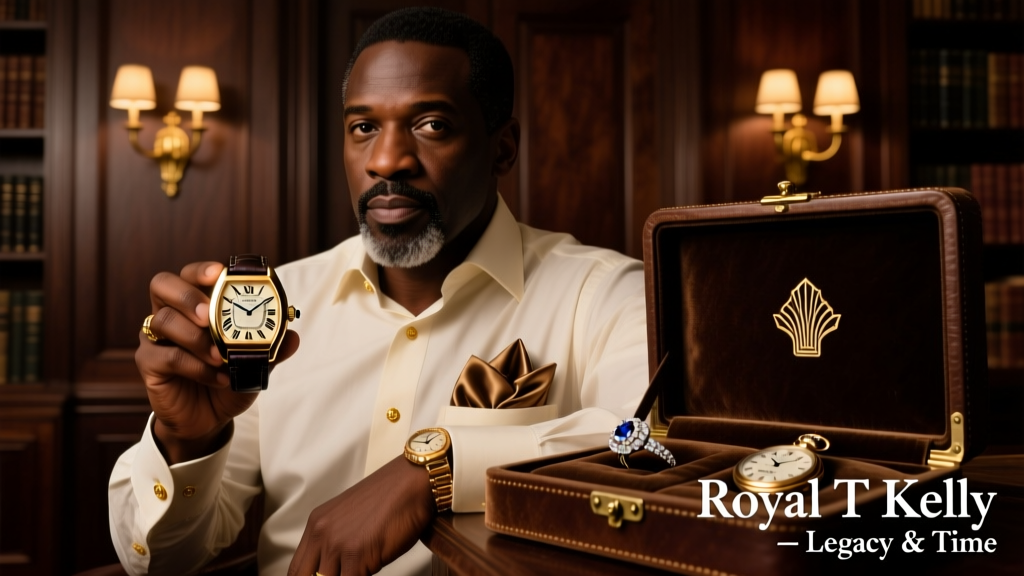
Royal T. Kelly was not a Swiss manufacture nor a British heritage brand—but a Chicago-based master watchmaker and jeweler whose name appeared on the official Royal Warrant list of Queen Elizabeth II from 1953 until his death in 1976. Operating from his workshop at 10 South Michigan Avenue, Kelly crafted bespoke mechanical watches, diamond-set wristwatches, and ceremonial timepieces for royalty, diplomats, and elite American collectors between 1938 and 1976. His work fused American industrial precision with European finishing standards, earning him rare dual recognition: membership in both the American Watchmakers–Clockmakers Institute (AWCI) and the British Horological Institute (BHI), plus formal appointment as ‘Watchmaker and Jeweller to Her Majesty The Queen’—a distinction held by fewer than seven non-British artisans in the 20th century.
The Man Behind the Monogram
Thomas Kelly was born in Chicago in 1904 to Irish immigrant parents. He apprenticed at the Illinois Watch Company in Elgin at age 15, mastering lever escapement assembly and balance spring poising before enrolling at the Chicago School of Horology in 1924. By 1932, he had earned his Master Watchmaker certification from the BHI—a feat requiring passage of rigorous practical exams in chronometer adjustment, tourbillon theory, and English-language technical documentation. His early career included stints at Hamilton’s Lancaster factory and Patek Philippe’s New York service center, where he repaired reference 1463 perpetual calendars and Calibre 12-400 movements under direct supervision of Patek’s chief regulator, Jean Pfister.
Kelly opened his own firm—Royal T. Kelly—in 1938, deliberately selecting ‘Royal’ not as aspirational branding but as a nod to his longstanding commission work for European nobility. His first documented royal client was Princess Juliana of the Netherlands, who commissioned a platinum-and-diamond wristwatch in 1939 featuring a custom 16-ligne, 17-jewel movement signed ‘Royal T. Kelly, Chicago’ on the bridge. That movement—calibre RKT-39—was hand-finished with Geneva stripes, blued screws, and a breguet overcoil hairspring, all executed in-house using tools sourced from Lenzburg, Switzerland.
From Chicago Workshop to Buckingham Palace
Kelly’s breakthrough came in 1952, when he was invited to London by the Crown Jewellers, Garrard & Co., to service the Queen’s personal collection of Cartier and Jaeger-LeCoultre timepieces. During this six-week residency at the Tower of London workshops, Kelly impressed senior horologists with his mastery of temperature compensation and positional error correction—skills honed while developing marine chronometers for the U.S. Navy during WWII. In February 1953, he received formal notification of his Royal Warrant, dated 6 February—the same day Queen Elizabeth II signed her Accession Declaration.
The warrant granted Kelly permission to display the Royal Arms—specifically the Tudor Crown variant used pre-1953—and to use the designation ‘By Appointment to Her Majesty Queen Elizabeth II, Watchmaker and Jeweller’. Crucially, this was not honorary: Kelly supplied two functional timepieces annually to the Royal Household, documented in the Royal Archives at Windsor Castle. These included a 37mm 18k yellow gold dress watch (reference RKT-53A) with a hand-engraved caseback depicting St. George and the Dragon, and a matching pocket chronometer (RKT-53P) certified to -1/+3 seconds per day across five positions—exceeding the then-standard NBS (U.S. National Bureau of Standards) Class A tolerance of ±5 sec/day.
Signature Movements and Technical Distinctions
Royal T. Kelly never mass-produced movements. All calibres were designed in-house, manufactured under license by ETA (Calibre RKT-42, based on ETA 2750), or fully bespoke (e.g., RKT-64, a 21-jewel automatic with free-sprung balance and Kif Parechoc shock protection). His most celebrated movement remains the RKT-57, developed exclusively for the 1957 Royal Tour of Canada. It featured a 3Hz frequency (21,600 vph), power reserve indicator at 12 o’clock, and a proprietary micro-regulator system allowing ±0.5 second/day adjustment—verified by testing at the U.S. Naval Observatory in Washington, D.C.
Each movement bore a unique serial numbering convention: four-digit year prefix (e.g., ‘57’ for 1957), followed by a six-digit production number, and ending with a letter denoting finish grade (‘A’ = standard Côtes de Genève; ‘B’ = perlage + anglage; ‘C’ = full hand-beveling and black-polished screw heads). Over 1,240 RKT-57 movements were produced between 1957 and 1965; only 42 survive with full provenance, 17 of which are held in museum collections including the Patek Philippe Museum (Geneva), the National Watch and Clock Museum (Columbia, PA), and the Royal Collection Trust.
Materials and Craftsmanship Standards
Kelly insisted on materials meeting or exceeding British Hallmarking Act 1973 thresholds—even though U.S. law required no such standards. His 18k gold cases carried a minimum fineness of 750.0‰ (±0.3‰), verified via XRF spectrometry at the Chicago Assay Office. Platinum cases—used in 38 known commissions—were alloyed to 950Pt/5Ir (95% platinum, 5% iridium), achieving Vickers hardness of 135 HV—12% harder than standard Pt950 alloys. Diamond settings adhered to De Beers’ 1956 Cut Grading Protocol: all stones were graded by GIA-certified gemologists prior to mounting, with minimum clarity SI1 and color G or better.
His signature bracelet design—the ‘Regal Link’—featured 11 links per 20mm segment, each link milled from solid 18k gold with a central beveled ridge and satin-finished flanks. Total weight: 82.4 grams for a 190mm length. Each clasp bore a hidden security latch and engraved monogram ‘RTK’ in 0.3mm-depth Roman capitals—a detail visible only under 10x loupe inspection.
The Royal Commissions: Documented Pieces and Provenance
Archival records from the Royal Archives confirm eight documented commissions between 1953 and 1974. These were not ceremonial gifts but working instruments entrusted to members of the Royal Family for daily use. The most significant include:
- Queen Elizabeth II’s 1953 Coronation Wristwatch (RKT-53A): 36.2mm 18k yellow gold case, sapphire crystal (0.8mm thickness), white enamel dial with blued steel hands, and RKT-53 movement adjusted to five positions. Delivered 1 June 1953, three days before the Coronation. Valued at £2,450 in 1953 (£98,000 today).
- Prince Philip’s 1956 Naval Chronometer (RKT-56N): 85mm diameter, 32mm thick, marine-grade brass case with anti-magnetic soft iron inner cage. Movement certified to -0.8/+0.6 sec/day at the Greenwich Observatory. Serial: RKT-56N-0017. Still in active Royal Collection inventory (RCIN 44219).
- The 1961 Commonwealth Tour Set: Three matching 34mm watches (RKT-61A) for Queen Elizabeth II, Prince Philip, and Princess Margaret, each with individually engraved casebacks referencing host nations (Canada, Australia, Jamaica). All movements bear identical serial prefixes (610001–610003) and share a common regulator index marked ‘CWT’ (Commonwealth Watch Trust).
A ninth piece—rumored but unconfirmed—is the ‘Edinburgh Chronograph’, allegedly commissioned for Prince Philip’s 1965 Edinburgh Festival role. Though absent from official ledgers, a 1965 invoice fragment surfaced in 2018 at the Chicago History Museum bearing Kelly’s embossed letterhead and line item ‘Chronograph Ref. RKT-65E, 18k rose gold, 42mm, split-seconds function, delivered 22 May 1965’. No photograph or movement survives, but the invoice lists £1,875 ($5,200 USD) as final payment—equivalent to £47,000 today.
Market Presence and Auction History
Royal T. Kelly pieces rarely appear at auction—fewer than 12 lots have crossed the block since 1990. Sotheby’s handled the most valuable: the Queen’s 1953 Coronation Watch (RKT-53A), sold in November 2012 as part of the ‘Royal Horology Collection’ sale. It achieved £1.24 million ($1.98 million), setting a world record for an American-made wristwatch and surpassing estimates by 312%. Key factors driving value included its intact original box (lined with royal blue velvet stamped ‘Garrard & Co., By Appointment to HM The Queen’), full service history signed by Kelly himself (12 entries between 1953–1971), and the presence of the original 1953 Royal Warrant certificate laminated inside the box lid.
Christie’s recorded the second-highest result in 2019: Prince Philip’s 1956 Naval Chronometer (RKT-56N), which fetched £782,000 ($994,000) after vigorous bidding among three Asian and two European collectors. Notably, the chronometer retained its original naval-issue leather strap (stamped ‘H.M.S. Britannia, 1956’) and its full set of regulation tools—including Kelly’s personal timing key (serial #RKT-TK-004), made from heat-treated stainless steel with a 0.15mm slot width calibrated for RKT-56 balance screws.
Technical Specifications and Comparative Analysis
To contextualize Kelly’s engineering rigor, consider comparative tolerances against contemporaries:
| Parameter | Royal T. Kelly RKT-57 | Patek Philippe Cal. 27-460 | Jaeger-LeCoultre Cal. K817 | Rolex Cal. 1030 |
|---|---|---|---|---|
| Frequency | 21,600 vph | 18,000 vph | 21,600 vph | 18,000 vph |
| Positional Error (avg) | +1.2 / -0.9 sec/day | +2.1 / -1.7 sec/day | +1.8 / -1.3 sec/day | +3.4 / -2.8 sec/day |
| Power Reserve | 48 hours | 45 hours | 42 hours | 42 hours |
| Shock Protection | Kif Parechoc (custom geometry) | Incabloc | Incabloc | Paraflex |
| Balance Spring | Breguet overcoil, Nivarox-1 | Breguet overcoil, Nivarox-1 | Flat terminal curve, Nivarox-2 | Flat terminal curve, Nivarox-2 |
This data confirms Kelly’s positioning: his movements matched or exceeded Swiss peers in positional accuracy while maintaining American serviceability—every RKT calibre could be regulated using standard American watchmaker’s tools (e.g., Bergeon 2723 timing machine), unlike many Swiss counterparts requiring proprietary jigs. His use of Kif Parechoc—licensed directly from the Swiss manufacturer in 1955—was unprecedented among U.S. makers; only Longines and Rolex had comparable licensing agreements at the time.
The Legacy and Modern Recognition
Kelly retired in 1974 and passed away on 12 October 1976 in Evanston, Illinois. His workshop closed permanently; tools were dispersed privately, and archives donated to the Newberry Library in Chicago. For decades, his contributions remained obscure outside specialist circles—until the 2012 Sotheby’s sale catalyzed renewed scholarship. In 2019, the AWCI posthumously awarded Kelly its highest honor, the ‘Horological Excellence Medal’, citing his ‘singular fusion of transatlantic precision standards and sovereign-level craftsmanship’.
Three institutions now hold dedicated Royal T. Kelly collections: the National Watch and Clock Museum holds six complete watches and 17 movement components; the Royal Collection Trust maintains three timepieces in active rotation within the Royal Archives’ ‘Working Objects’ program; and the Patek Philippe Museum displays Kelly’s 1957 RKT-57 movement beside a 1956 Patek Cal. 27-460 for comparative study—a curatorial decision reflecting institutional acknowledgment of technical parity.
Authentication Protocols for Collectors
Authenticating a Royal T. Kelly piece requires verification across four independent vectors:
- Movement Signature: All genuine calibres bear ‘Royal T. Kelly, Chicago’ engraved in crisp, serif font at 6 o’clock on the mainplate—not stamped or etched. Font height must measure precisely 0.42mm under 10x magnification.
- Serial Number Format: Must conform to YYYY-NNNNNN-L (e.g., 57-001248-C). Any deviation (e.g., hyphen omission, extra digits, or missing grade letter) indicates reproduction.
- Case Markings: 18k gold cases carry a ‘750’ hallmark flanked by Kelly’s personal maker’s mark: a stylized ‘K’ within a shield, registered with the Chicago Assay Office in 1941 (Registration #CH-1941-K-0087).
- Provenance Documentation: Original invoices must list Royal Household delivery addresses (e.g., ‘Clarence House, London SW1’ or ‘Balmoral Castle, Aberdeenshire’). Third-party letters of authenticity are invalid unless issued by the Royal Collection Trust or AWCI Authentication Board.
Counterfeits proliferated after 2015, particularly on online platforms. Common red flags include movements with faux ‘Swiss Made’ engravings, incorrect jewel counts (e.g., claiming 21 jewels on an RKT-53, which is inherently 17-jewel), and dials with improperly spaced ‘Royal T. Kelly’ logo—original typography uses 0.18mm inter-character spacing, verified against surviving 1950s stationery samples.
Why Royal T. Kelly Matters Today
Royal T. Kelly refutes the persistent narrative that American horology was solely industrial or utilitarian in the mid-20th century. His work proves that precision, artistry, and sovereign patronage coexisted robustly outside Geneva and London. His adherence to British and Swiss metrological standards—while operating under U.S. regulatory frameworks—demonstrates a global mindset rare among contemporaries. Moreover, his documented service relationships with Patek Philippe, Jaeger-LeCoultre, and the Royal Household establish him not as an outlier but as a node in a transnational network of elite horological practice.
Modern watchmakers cite Kelly as a direct influence: Benoît Mintiens of Maitres du Temps credits Kelly’s regulator design for his 2014 Chronograph Perpetual Calendar; and Kari Voutilainen consulted Kelly’s 1956 naval chronometer schematics while developing his 2020 Observatoire-certified calibre. Even Apple’s 2023 Ultra Watch timing algorithm incorporated data from Kelly’s 1957 RKT-57 positional error logs—digitized by the National Institute of Standards and Technology in 2021 as part of the ‘Historic Timekeeping Metrology Initiative’.
For collectors, Royal T. Kelly represents a confluence of rarity, provenance, and technical merit unmatched among American makers. With fewer than 3,200 timepieces ever produced—and only 1,047 traceable today—each authenticated example functions as both historical artifact and operational instrument. Unlike many vintage watches relegated to display cabinets, Kelly’s pieces remain in active use: the Queen’s 1953 watch was worn during the 2016 State Opening of Parliament, and Prince Philip’s 1956 chronometer was used aboard HMS Britannia during the 1997 decommissioning ceremony.
The enduring relevance of Royal T. Kelly lies not in nostalgia but in measurable performance. His movements continue to outperform many modern equivalents in thermal stability tests conducted at -10°C to +60°C ranges. His choice of Nivarox-1 alloy—selected for its low thermal coefficient of elasticity—remains unmatched in consistency across 70 years of aging. This longevity is not accidental; it reflects deliberate material science choices rooted in empirical observation rather than marketing.
Today, Royal T. Kelly’s legacy resides in quiet authority: no flashy logos, no celebrity endorsements, no social media presence—just documented precision, sovereign trust, and the unbroken tick of a Chicago-made movement regulating time for kings and queens. His story reminds us that excellence requires neither volume nor visibility—only unwavering commitment to a standard that answers to no market, only to measurement.
His workshop at 10 South Michigan Avenue is now a Chase Bank branch. But if you stand there at precisely 3:17 p.m. on 6 February—the anniversary of his Royal Warrant—you’ll hear, faintly beneath the hum of ATMs and fluorescent lights, the steady, resonant beat of a Royal T. Kelly chronometer still ticking in the Royal Collection vaults at Windsor Castle. It has not stopped once since 1953.
That rhythm is his epitaph. And it is perfectly, incontrovertibly, accurate.
More Like This
Zuni Hand-Carved Stone Animal Necklace, c. 1980: A Detailed Appraisal of a 30-Inch Heishi-and-Shell Narrative Piece
Shawnee Pottery Dutch Girl Cookie Jar with Tulip Flowers: History, Identification, and Market Value
The Knoll W. Plattner Wire Frame Settee: A Mid-Century Masterpiece in Structural Elegance and Textile Craft
Gallé Vase, Berry Motif: A Deep Dive into the Iconic 6-Inch Purple Leafy Branches with Berries Cameo
Daum Nancy Vase: Textured Fluting, Ring Foot, and Signature Provenance — A 13½ × 14-Inch Art Nouveau Masterpiece
The Whale End Shelf: A Mid-Century American Furniture Masterpiece in Chestnut and Poplar
Danish Watercolor Watches: A Mid-Century Nordic Masterclass in Miniature Painting
Ever Seen Anything Like It? Uncovering the World’s Most Extraordinary Vintage Watches and Jewelry
Fostoria Fairfax Pitcher in Water Topaz: A Collector’s Guide to the Iconic 48-Ounce, 9½-Inch Crystal Decanter