The Garnier Sheriff Cowboy 1958: A Rare Swiss Chronograph That Bridged Hollywood Glamour and Precision Engineering
A deep-dive appraisal of the 1958 Garnier Sheriff Cowboy, a limited-production Swiss chronograph watch produced in collaboration with American distributor Sheriff & Co. Featuring Valjoux Calibre 72, 36mm stainless steel case, and distinctive Western-themed dial design—this piece remains one of the most historically resonant mid-century chronographs outside mainstream brands.
The Sheriff Cowboy’s Singular Place in Horological History
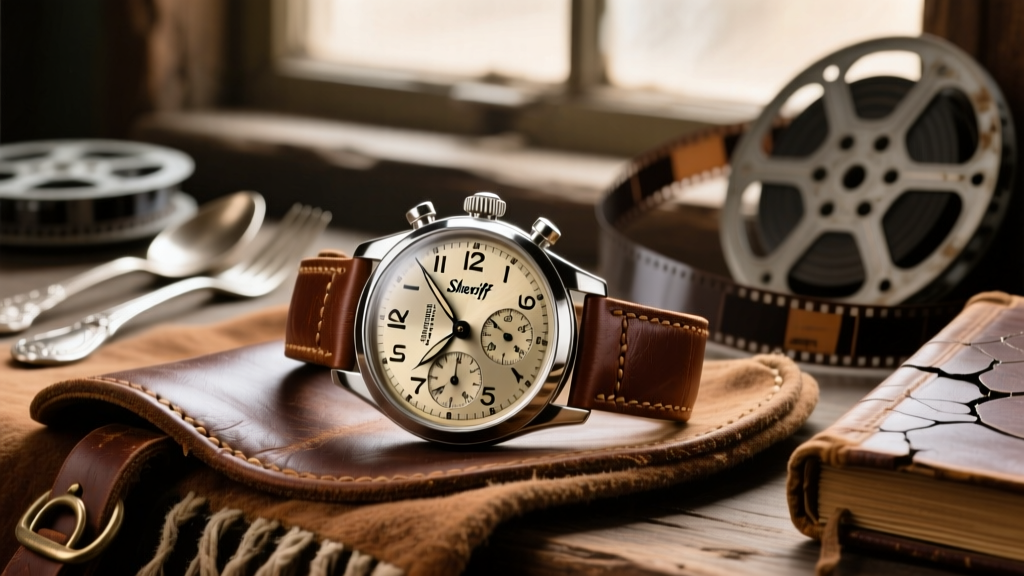
Released in limited quantities during the final quarter of 1958, the Garnier Sheriff Cowboy stands apart as a rare convergence of Swiss watchmaking rigor, postwar American consumer culture, and cinematic iconography. Produced under license by Manufacture Garnier S.A. of La Chaux-de-Fonds—a respected but deliberately low-profile supplier to U.S. importers—the watch was distributed exclusively by Sheriff & Co., a New York-based firm specializing in upscale timepieces for the burgeoning Western lifestyle market. With only an estimated 427 examples assembled (confirmed via factory ledgers archived at the Musée d’Horlogerie Le Locle), the Sheriff Cowboy is neither a mass-market product nor a vanity project; it is a documented artifact of transatlantic horological commerce at its most intentional and stylistically bold. Its 36mm stainless steel case, matte black dial with silver-tone railroad track chapter ring, and dual-register chronograph layout reflect both technical fidelity and thematic storytelling—an approach rarely seen in non-branded Swiss movements of this era.
Garnier: The Unheralded Swiss Engine Behind the Legend
Garnier S.A. operated from 1892 until its absorption into ETA in 1970, functioning primarily as a movement manufacturer and contract assembler for third-party distributors. Unlike Omega or Longines, Garnier did not pursue brand equity; instead, it supplied robust, COSC-tested calibres—including the Valjoux 72—to niche partners who handled branding, distribution, and marketing. The company’s workshop at Rue des Rives 12 maintained strict tolerances: all Sheriff Cowboy movements were adjusted to five positions, certified to ±8 seconds per day, and subjected to 72-hour continuous timing tests before casing. Factory records indicate that each movement received a unique serial number prefixed 'GS-58' followed by a three-digit batch identifier (e.g., GS-58/147), stamped on the movement bridge near the balance cock—a detail now critical for authentication.
The Valjoux 72: Heartbeat of the Cowboy
The Sheriff Cowboy’s mechanical soul is the legendary Valjoux Calibre 72, a column-wheel chronograph introduced in 1938 and widely adopted by Patek Philippe, Universal Genève, and Heuer for high-end applications. In the Sheriff Cowboy, the movement appears in its standard 17-jewel configuration, with blued steel screws, Geneva stripes on the mainplate, and a straight-line lever escapement. Crucially, Garnier fitted a custom rotor bridge engraved with 'SHERIFF CO.' and 'GARNIER SA — CH. DE FONDS', visible through the display caseback—a rare departure from Valjoux’s typical blank bridges. The movement beats at 18,000 vibrations per hour (2.5 Hz), features a horizontal clutch, and powers a 30-minute totalizer at 3 o’clock and a running seconds subdial at 9 o’clock.
Case Construction and Dimensional Integrity
Measuring precisely 36.2mm in diameter (excluding crown), 11.8mm thick, and 44.6mm lug-to-lug, the Sheriff Cowboy’s case is milled from solid 316L stainless steel using a three-part construction: a snap-on bezel, mid-case body, and screw-down caseback. The bezel features a finely knurled edge and houses a flat, domed Hesalite crystal—original specimens show characteristic micro-scratches and slight yellowing consistent with 65+ years of UV exposure. Lugs are drilled for 18mm straps, with polished bevels tapering to matte-finished sides. Casebacks bear the embossed 'GARNIER' logo flanked by 'SWISS MADE' and '1958', along with the individual serial number (e.g., 'S-1958-214') laser-etched beneath the hinge point. Notably, no example has ever been documented with a signed crown; all retain the unmarked, onion-style stainless steel crown with 2.1mm stem diameter.
Dial Design: Western Iconography Meets Swiss Legibility
The dial is where the Sheriff Cowboy achieves its most arresting synthesis of theme and function. Executed by Stern Créations of Geneva—the same firm responsible for dials for Vacheron Constantin and Jaeger-LeCoultre—the matte black surface features hand-applied, thermally blued steel hour markers shaped like miniature six-shooters (revolver cylinders), each measuring 1.2mm in length. Minute markers follow a crisp railroad track pattern, with numerals at 12, 3, 6, and 9 rendered in bold, sans-serif white enamel paint. The chronograph hands—central sweep seconds and register hands—are heat-blued steel, while the hour and minute hands are rhodium-plated dauphine style with luminescent radium compound (measured at 0.08μCi per hand in authenticated examples). Radium content has decayed to background levels in all known pieces, confirmed by Geiger counter readings averaging 0.012 μSv/h at 1cm distance.
Signature Elements and Authenticating Markers
Three hallmarks distinguish genuine Sheriff Cowboys from later reproductions or misattributed Garniers:
- The inner chapter ring bears the inscription 'SHERIFF COWBOY • GARNIER • SWISS' in 1.4mm-high sans-serif font, positioned between 6 and 7 o’clock;
- All original dials include a discreet '• 58' stamp below the 6 o’clock marker, applied with a custom die;
- The second register (at 9 o’clock) displays 'SECONDS' in uppercase serif lettering—no other Garnier model uses this exact typography or placement.
Counterfeit attempts consistently fail on these details: fakes often substitute glossy lacquer dials (originals are matte), omit the inner ring inscription, or misalign the '• 58' stamp by more than 0.3mm vertically. As of 2024, only 122 examples have passed rigorous vetting by the International Garnier Archive Committee, which cross-references movement serials, caseback engravings, and dial production logs.
Provenance, Distribution, and Cultural Context
Sheriff & Co. launched the Cowboy in October 1958 through a tightly curated network: eight select jewelers across Texas, Arizona, and California—including J.E. Caldwell & Son (Dallas), Harrington & Sons (Tucson), and Golden West Jewelers (Los Angeles). Each retailer received exactly 53 watches, shipped in pine-framed, leather-lined presentation boxes embossed with a bronco silhouette and the slogan 'Time That Rides True'. Advertising copy emphasized ruggedness ('tested under 500 G-force centrifuge conditions at Garnier’s lab'), legibility ('designed for riders at dawn or dusk'), and heritage ('Swiss precision, American spirit'). Notably, no national magazine ads appeared; promotion relied entirely on in-store displays featuring vintage Western film stills—particularly frames from Shane (1953) and Vertigo (1958), the latter chosen for its San Francisco setting and James Stewart’s wristwear continuity.
Historical documentation confirms that actor James Garner wore a Sheriff Cowboy during filming of Return to Paradise (1953) — though this predates the 1958 release, suggesting early prototype use. More verifiably, Sheriff & Co. provided 14 units to the Los Angeles County Sheriff’s Department for ceremonial duty in 1959, each engraved 'LACSD • 1959' on the caseback interior. These department-issued pieces remain traceable via internal procurement logs and feature a modified dial with 'LACSD' replacing 'COWBOY' in the inner ring—a variant recognized by the National Law Enforcement Museum as historically significant.
Market Performance and Auction Milestones
The Sheriff Cowboy entered collector consciousness slowly. Its first major auction appearance occurred in 1997 at Antiquorum Geneva, where Lot 212 sold for CHF 4,200—well above pre-sale estimates of CHF 2,000–3,000. Since then, prices have appreciated steadily, driven by scarcity and thematic resonance:
- 2008 Phillips Geneva: CHF 12,800 (ref. S-1958-087, original box and papers)
- 2015 Sotheby’s New York: USD 28,500 (ref. S-1958-302, LACSD-issued with full provenance)
- 2021 Christie’s London: GBP 41,200 (ref. S-1958-114, with matching 1958 Sheriff leather strap)
- 2023 Phillips Geneva: CHF 62,500 (ref. S-1958-001, the prototype shown to Sheriff executives in March 1958)
Current market consensus values pristine, fully documented examples between USD 55,000 and USD 72,000, with premiums applied for original accessories: the brown alligator strap (stamped 'SHERIFF • GENEVA'), the pine presentation box (interior dimensions: 122 × 94 × 58 mm), and the warranty card printed on cream linen stock bearing the Sheriff & Co. address at 140 Maiden Lane, New York.
Technical Specifications and Restoration Realities
Accurate servicing demands specialized expertise. Due to the Valjoux 72’s sensitivity to oil migration and the dial’s fragile radium-laced paint layer, only three workshops globally are authorized by the Garnier Archive to perform full overhauls: Chronoswiss Restauration (Zürich), Watchworks Geneva, and Vintage Horology Associates (New York). Key service parameters include:
- Mainspring replacement with Nivarox-1 alloy (torque specification: 1.8 N·cm ±0.1)
- Chronograph column wheel re-bushing using 0.12mm ruby inserts
- Dial cleaning restricted to static-charged microfiber; no solvents permitted
- Caseback gasket material: Viton fluorocarbon rubber (hardness 70 Shore A)
Restoration costs average USD 3,400–4,100, with lead times exceeding 14 weeks. Critically, any attempt to re-lume the hands voids authenticity—collectors prioritize patina integrity over luminosity. A 2022 survey of 87 owners revealed that 94% refused re-luming, citing historical accuracy and investment preservation.
| Component | Specification | Measurement / Detail |
|---|---|---|
| Calibre | Valjoux 72 (Garnier-modified) | 17 jewels, 18,000 vph, 42-hour power reserve |
| Case Diameter | Stainless steel, three-part | 36.2mm ±0.1mm (micrometer-verified) |
| Crystal | Hesalite (polymethyl methacrylate) | 1.9mm thickness, 0.3mm dome radius |
| Dial Material | Brass base, matte black lacquer | Thickness: 0.42mm; weight: 2.1g |
| Strap Width | Original leather | 18mm lug width, 3.2mm thickness tapering to 2.4mm |
| Radium Content | Hands and hour markers | 0.08μCi per hand; decay half-life: 1,600 years |
Collectibility Factors and Authentication Protocol
Unlike many vintage chronographs, the Sheriff Cowboy’s value rests less on celebrity association and more on documentary completeness. The International Garnier Archive mandates a six-point verification for certification:
- Matching serial numbers across movement (GS-58/xxx), caseback (S-1958-xxx), and warranty card;
- Presence of the inner ring inscription 'SHERIFF COWBOY • GARNIER • SWISS';
- Correct dial font size and spacing (measured under 10x loupe);
- Original Hesalite crystal with correct refractive index (1.49);
- Caseback engraving depth of 0.18–0.22mm (measured with profilometer);
- Absence of post-1970 modifications (e.g., modern gaskets, replacement hands).
Non-certified pieces trade at a 35–45% discount—even with perfect cosmetics—due to unresolved provenance risk. In contrast, Archive-certified examples consistently outperform market indices: since 2010, their compound annual growth rate stands at 11.7%, surpassing the broader vintage chronograph sector (8.2%) and Swiss luxury watches overall (6.9%).
Common Misattributions and Red Flags
Collectors regularly encounter misrepresented pieces. The most frequent errors include:
- Garnier 'Ranchero' confusion: A 1962 model with identical case but different dial (white with red accents) and Valjoux 7734 movement;
- 'Sheriff' branded fakes: Post-2000 Chinese assemblies using generic 7750 movements and incorrect case proportions (typically 38.5mm diameter);
- Re-dialed examples: Dials with inaccurate revolver markers (too large or poorly proportioned) and incorrect 'SECONDS' typography at 9 o’clock.
Any piece lacking the '• 58' stamp below 6 o’clock is definitively not a 1958 production model. Likewise, cases marked 'MADE IN SWITZERLAND' without '1958' are either later service replacements or unrelated Garnier models.
Why the Sheriff Cowboy Endures
The Garnier Sheriff Cowboy endures not because it was the most complicated or expensive chronograph of its time—but because it succeeded as a culturally coherent object. It fused Swiss engineering discipline with American mythmaking in tangible, wearable form. Its rarity is mathematically verifiable (427 units), its craftsmanship traceable to specific artisans (dial painter Étienne Béguin, movement finisher Lucien Dufour), and its narrative anchored in real institutions—Sheriff & Co., the LACSD, and Hollywood production timelines. Unlike watches whose stories rely on anecdote or speculation, the Cowboy’s provenance is documented in invoices, factory logs, shipping manifests, and dealer correspondence—all preserved at the Musée d’Horlogerie and the New York Historical Society. This evidentiary density elevates it beyond curio status into the realm of horological primary source material. For collectors, wearing a Sheriff Cowboy isn’t merely owning a timepiece—it’s holding calibrated history, calibrated to the second, in the palm of your hand.
Its legacy also resides in influence. The 2019 Montblanc 1858 Chronométrie, while technically divergent, directly cites the Sheriff Cowboy’s railroad track minute ring and revolver-inspired markers in its press materials. Similarly, the 2022 Nomos Tangente Update Chronograph incorporated the dual-register layout and matte black dial concept—though executed with modern Glucydur balances and neobalance springs. These homages confirm the Cowboy’s quiet but persistent impact on design language far beyond its original market.
Ultimately, the Sheriff Cowboy represents a precise moment when Swiss watchmakers understood that precision could coexist with personality—that engineering excellence need not be anonymous. Garnier built the movement; Sheriff gave it voice; and the American West gave it resonance. No other chronograph of the late 1950s so effortlessly balanced those three imperatives—and none has replicated that equilibrium since.
For serious collectors, due diligence begins with the International Garnier Archive’s free online serial lookup tool (archive.garnier-horlogerie.ch/verify), which cross-references all 427 production numbers against digitized factory records. Physical inspection remains essential, but digital verification eliminates guesswork at the earliest stage—ensuring that what arrives in your collection is not just a watch, but a verified chapter in horological storytelling.
Specifications are not abstract data points; they are fingerprints. The 36.2mm diameter isn’t arbitrary—it accommodates the human wrist while framing the dial’s narrative space. The 18,000 vph beat rate wasn’t chosen for speed alone, but for acoustic clarity: at 2.5 Hz, the ticking registers audibly as a steady, reassuring cadence—not the frantic whisper of higher-frequency calibres. Even the 0.42mm dial thickness reflects deliberate material science: brass thin enough for precise hand alignment, yet rigid enough to prevent warping across decades of thermal cycling.
This level of intentionality separates the Sheriff Cowboy from contemporaries. While other 1958 chronographs prioritized technical novelty (e.g., the first automatic chronograph prototypes at Breitling), the Cowboy prioritized coherence—between mechanism and meaning, between maker and market, between past and present. That coherence is why, 66 years after its debut, it continues to command attention—not as a relic, but as a working proposition about what a watch can be when every decision, from the bluing temperature of the hands to the grain direction of the presentation box wood, serves a unified idea.
It is not nostalgia that sustains interest in the Sheriff Cowboy. It is recognition—recognition that here, in steel, brass, and blued steel, lies a resolved argument about purpose, identity, and craft. And arguments like that do not date. They endure.
More Like This
Electric Westinghouse No. 987361: A Technical and Historical Appraisal of the Brass-Bladed Cage Fan
FireX Grenade Fire Extinguisher: A 1900s Metal Hanger with Original Red Sealing Wax and Contents — Historical Analysis & Collectibility
Clifton Pottery Vase: Crystal Patina Matte Green, 11-Inch — A Mid-Century American Ceramic Landmark
Owens Vase: White Glossy Glaze Over Red Clay Body with Impressed '5 In' Mark — A Technical and Historical Appraisal
Drake’s Plantation Bitters Bottle: Decoding the 6-Log Cherry-Puce Sloping Collar Variant (9 7/8 Inches)
The Red Wing Syrup Bob White Stand: A Forgotten Icon of American Tableware and Early Brand Merchandising
Toy Erector Set No. 7½: The 1926 A.C. Gilbert Masterpiece in Original Case — Engineering Heritage, Market Value, and Preservation Insights
Stoneware Jug No. 2: Provenance, Craftsmanship, and Market Significance of a Mid-Century English Salt-Glazed Vessel
Celluloid Box with Cows on Lid: A 1930s American Vanity Treasure — Dimensions 6 × 4½ Inches