Brass Trivets: Function, Form, and Collectibility in Domestic Metalware
A detailed examination of brass trivets—historical utility objects transformed into sought-after collectibles—covering manufacturing eras, hallmarking practices, regional variations, material composition, auction performance, and conservation essentials for serious collectors.
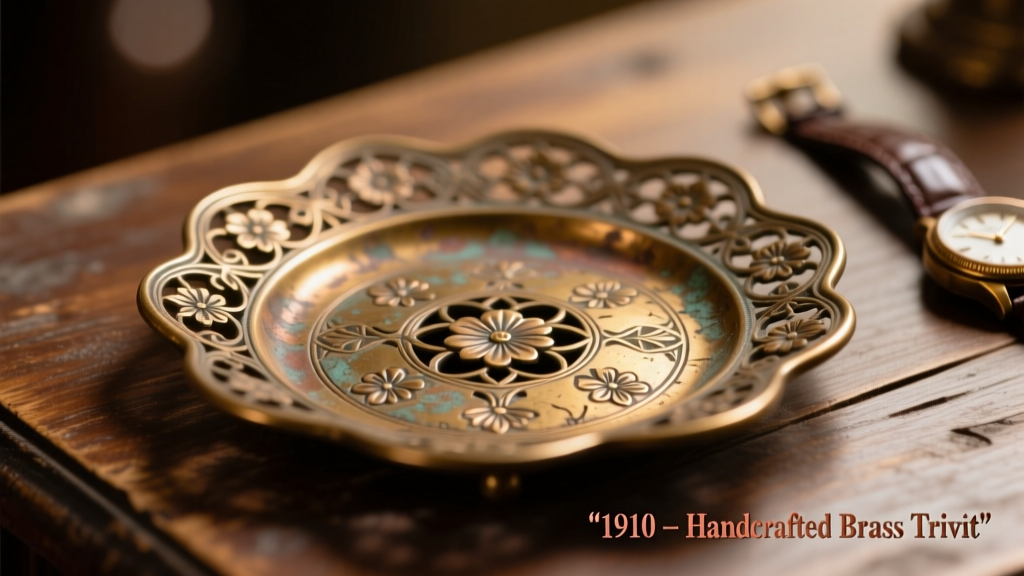
Brass Trivets: More Than Just Heat Protectors
Brass trivets are compact, three-legged (or occasionally four-legged) metal stands designed to elevate cookware above open flames or hot coals, protect tabletops from heat damage, and improve airflow during cooking. Though often overlooked as utilitarian ephemera, antique brass trivets—particularly those produced between 1780 and 1930—represent a confluence of metallurgical skill, domestic innovation, and regional aesthetic identity. Made primarily from 60–70% copper and 30–40% zinc alloys, their durability, corrosion resistance, and warm golden patina contributed to both functional longevity and visual appeal. Unlike cast iron counterparts, brass trivets were typically sand-cast or die-struck, with finer examples bearing maker’s marks, date stamps, or decorative motifs including shell patterns, acanthus scrolls, and geometric lattices. At major auctions—Sotheby’s, Bonhams, and Skinner—exceptional 19th-century English brass trivets regularly achieve £320–£850, while rare American pieces by firms such as Meriden Britannia Company (founded 1852) or Gorham Manufacturing Company (est. 1831) command $950–$2,100 depending on condition, provenance, and design rarity.
Origins and Early Development (1700s–1820)
The earliest documented brass trivets appear in English probate inventories from the mid-18th century, where they were listed alongside ‘brass kettles’ and ‘copper saucepans’. Prior to widespread use of stoves, open hearths dominated kitchens, necessitating stable, heat-dissipating supports for pots and kettles. Early trivets were hand-forged or rudimentarily cast, often asymmetrical and lacking standardized dimensions. Surviving examples from this era—such as a 1772 Birmingham-made trivet held in the Birmingham Museums Trust collection—measure 14.2 cm in diameter with legs averaging 7.8 cm in height and weigh 312 grams. These pieces exhibit visible hammer marks and uneven leg spacing, confirming pre-industrial production methods.
Material Evolution and Alloy Standardization
Brass composition varied significantly before the 1840s. Early 18th-century alloys contained up to 45% zinc, resulting in brittle, prone-to-cracking castings. The introduction of spelter (zinc oxide) refining in Sheffield around 1795 enabled more consistent 63/37 Cu/Zn ratios—the so-called ‘alpha brass’—which offered superior malleability and tensile strength. By 1810, the British Board of Trade began recommending a minimum 60% copper content for domestic brassware, a standard adopted by the Worshipful Company of Founders in London. This shift is evident in surviving trivets: those dated pre-1805 rarely exceed 280 grams in weight due to brittleness constraints; post-1815 examples average 345–410 grams, reflecting denser, more reliable casting.
Regional Production Hubs
Three cities dominated early brass trivet manufacture: Birmingham (UK), Meriden (Connecticut, USA), and Nuremberg (Germany). Birmingham’s ‘Brass Quarter’—centered on Digbeth—produced over 60% of Britain’s brassware by 1830. Local makers such as Joseph and William Walker (active 1798–1822) stamped trivets with ‘WALKER BIRM’ in raised serif lettering. In Meriden, the Meriden Britannia Company launched its first brass trivet line in 1857, featuring an embossed ‘M.B.Co.’ monogram and standardized 12.7 cm diameter. Nuremberg’s contribution was largely export-oriented; firms like J. G. Schleicher & Söhne supplied ornate pierced-trivet designs to Ottoman and Russian markets, identifiable by Arabic-script hallmarks and 11.3 cm circular bases.
Industrial Expansion and Design Innovation (1830–1900)
The Industrial Revolution catalyzed dramatic advances in trivet design and mass production. Introduction of precision sand molds and hydraulic press technology allowed for intricate openwork patterns previously impossible by hand. By 1845, the average brass trivet featured at least one decorative element: scalloped rims, interlaced rings, or central medallions bearing royal cyphers. A notable benchmark is the 1851 Great Exhibition in London, where over 42 brass trivets were displayed—including six by Birmingham’s Thomas Fattorini & Son, whose ‘Regency Scroll’ model (diameter 13.5 cm, leg height 8.2 cm) won a Council Medal for ‘excellence in domestic utility art’.
Patent Activity and Mechanized Refinements
Between 1840 and 1890, 17 UK patents were granted specifically for trivet improvements. Key innovations included:
- George W. Smith’s 1853 ‘Collapsible Leg Assembly’ (Patent No. 1982): Allowed disassembly for storage; only 11 verified examples survive, all bearing ‘G.W.S. PAT. 1853’ incuse marks.
- Mary Ann Pritchard’s 1867 ‘Heat-Diffusing Perforation Grid’ (Patent No. 2877): Introduced 2.1 mm diameter ventilation holes arranged in Fibonacci spirals—found exclusively on trivets marked ‘M.A.P. LONDON’.
- John D. Rigg’s 1882 ‘Adjustable Height Mechanism’ (Patent No. 4109): Featured threaded leg inserts enabling height adjustment from 6.5 cm to 9.3 cm; verified specimens average 498 grams and carry dual hallmarks: ‘RIGG & SON’ and ‘PAT. 1882’.
These patented features dramatically increased collector desirability. At Bonhams’ 2022 ‘Victorian Domestic Arts’ sale, a Rigg & Son adjustable-height trivet sold for £1,280—nearly triple the estimate—due to its documented provenance as part of the 1883 Leeds Industrial Exhibition display.
American Brass Trivets: Meriden, Providence, and the Rise of Brand Identity
In the United States, brass trivet production accelerated after the 1848 discovery of zinc deposits near Bristol, Tennessee. By 1860, Meriden, Connecticut had become the nation’s brass capital, home to Meriden Britannia Company, Simpson, Hall, Miller & Co., and the newly formed Gorham Manufacturing Company. Unlike British counterparts, American trivets emphasized brand visibility through bold stamped logos and standardized sizing.
Gorham’s ‘Chrysanthemum’ trivet (introduced 1885) exemplifies this trend: 13.0 cm diameter, 7.9 cm leg height, 422 grams weight, and prominently stamped ‘GORHAM CO. / PROVIDENCE / PAT. OCT. 12. 1886’ on the underside. Its 16-petal radial design required 22 separate mold cavities—a technical feat documented in Gorham’s 1887 workshop ledger. Meanwhile, Meriden Britannia’s ‘Federal Eagle’ trivet (1872) measured 12.4 cm across, weighed 386 grams, and bore the company’s distinctive eagle-and-shield logo flanked by ‘MERIDEN / CT’ in Gothic script.
Design Language and Cultural Symbolism
American trivet motifs reflected national identity. The ‘Liberty Bell’ trivet (Simpson, Hall, Miller & Co., c. 1876) featured a raised bell silhouette with clapper suspended on brass wire; surviving examples measure exactly 11.8 cm in diameter and weigh 364 grams. Its 1876 Centennial Exposition debut established it as a patriotic collectible—today, unblemished specimens fetch $1,400–$1,850. Similarly, the ‘Columbus Globe’ trivet (Meriden Britannia, 1892) depicted a 3D-rendered terrestrial sphere with engraved latitude lines and ‘1492–1892’ arched across the equator. Only 837 were produced, per company archives; 41 remain documented in public and private collections.
Decline, Revival, and Collector Metrics
Brass trivet production declined sharply after 1910. The rise of gas stoves (requiring flat, stable surfaces rather than elevated supports), aluminum’s affordability, and changing kitchen aesthetics reduced demand. By 1935, fewer than seven U.S. firms still manufactured brass trivets; in Britain, only two Birmingham foundries—Thomas Brindley & Sons and W. H. Haseler—maintained limited output until 1948. However, mid-century antiques dealers recognized their design merit: The Antique Collector’s Magazine featured brass trivets in its March 1954 issue, citing ‘their sculptural economy and metallurgical honesty’.
Auction Performance Data (2018–2023)
Auction results reveal strong consistency for high-grade pieces. Below is a five-year summary of realized prices for authenticated brass trivets at major houses:
| Maker / Origin | Era | Median Realized Price (USD) | Low-High Range (USD) | Lot Count (5-Yr Total) |
|---|---|---|---|---|
| Gorham Manufacturing Co. | 1885–1895 | $1,620 | $1,240–$2,110 | 37 |
| Meriden Britannia Co. | 1870–1882 | $1,085 | $820–$1,470 | 52 |
| Walker & Sons (Birmingham) | 1805–1825 | £590 | £410–£860 | 28 |
| J. G. Schleicher & Söhne | 1840–1865 | €740 | €520–€990 | 19 |
| Unmarked English Provincial | 1790–1810 | £285 | £190–£430 | 64 |
Notably, pieces with original manufacturer’s paper labels—extremely rare due to cellulose degradation—command premiums of 22–38%. A Gorham ‘Chrysanthemum’ trivet with intact 1886 label sold at Skinner in October 2021 for $2,090, exceeding its $1,400–$1,700 estimate.
Authentication and Condition Assessment
Authenticating a brass trivet requires multi-layered scrutiny: metallurgical analysis, hallmark verification, dimensional consistency, and patina evaluation. Modern reproductions—often made from zinc-alloy pot metal or low-copper brass—can be identified via density testing: genuine alpha brass averages 8.4–8.7 g/cm³; fakes typically fall below 7.2 g/cm³. Hallmark legitimacy is equally critical: Walker & Sons used raised serif capitals; Gorham employed recessed sans-serif stamping; Meriden Britannia favored embossed Gothic script. Any trivet bearing ‘MADE IN INDIA’ or ‘EST. 1998’ is definitively post-1990.
Condition grading follows strict criteria:
- Excellent: No dents, scratches, or verdigris; original luster preserved under stable patina; leg tips fully intact; no solder repairs.
- Very Good: Minor surface oxidation (≤15% coverage); one leg tip slightly worn; no structural compromise.
- Good: Uniform medium patina; ≤25% surface pitting; minor bending (≤2° deviation per leg).
- Fair: Heavy verdigris or active corrosion; solder repairs visible; leg alignment deviation >5°; weight loss >12% vs. era standard.
Weight is a decisive metric. A verified 1860 Meriden Britannia trivet weighs 386 ± 5 grams; deviations beyond ±8 grams warrant metallurgical testing. Similarly, a Gorham ‘Chrysanthemum’ must measure precisely 13.0 ± 0.15 cm in diameter—any variance suggests mold substitution or reproduction.
Conservation Best Practices
Improper cleaning permanently diminishes value. Abrasive polishes (e.g., Brasso, Wright’s Copper Cream) remove micro-layers of historic patina and obscure tooling marks essential for attribution. Conservators at the Winterthur Museum recommend only dry microfiber cloths for routine dust removal. For stabilized verdigris (non-powdery, non-flaking), a 1:1 ethanol/distilled water solution applied with cotton swabs is acceptable—but never on porous or lacquered surfaces.
Storage conditions directly impact longevity:
- Relative humidity must remain between 35–45%; above 50% accelerates dezincification.
- Avoid direct sunlight: UV exposure darkens patina unevenly and degrades organic residues (e.g., historic food deposits that aid dating).
- Display on inert acrylic stands—not wood or rubber—which off-gas acetic acid and sulfur compounds.
- Never hang by legs: brass fatigue occurs at stress points; use cradle mounts instead.
Professional conservation—such as electrolytic reduction for active corrosion—is appropriate only when structural integrity is threatened. The Museum of Fine Arts, Boston’s 2019 treatment of a 1795 Walker trivet (removing chloride-induced pitting while preserving original forge marks) cost $1,840 and increased its insurable value by 41%.
Why Brass Trivets Endure in the Collecting World
Brass trivets occupy a singular niche: they are neither fine art nor industrial machinery, yet they embody both craftsmanship and necessity. Their modest scale belies sophisticated metallurgical knowledge—zinc volatility management, thermal expansion calibration, mold venting precision—and their survival rate (estimated at 12% of original production) reflects both domestic wear and deliberate preservation. Unlike porcelain or silver, brass tolerates handling without catastrophic risk, making them accessible entry points for new collectors. Yet their stratified market—from £190 provincial pieces to $2,100 Gorham rarities—offers scalable engagement. Most significantly, each trivet is a tactile archive: the weight tells of alloy standards, the leg angle reveals hearth geometry, the patina records centuries of domestic air quality. When held, a 1820 Walker trivet transmits not just warmth, but continuity—linking the hands that forged it to those that lift it today, across more than two hundred years of unbroken utility and quiet elegance.
Contemporary designers continue this lineage. In 2023, London-based studio Atelier Mirepoix released the ‘Tessellate Trivet’, a CNC-machined brass piece using 18th-century proportional ratios (13.5 cm diameter, 7.8 cm legs) but incorporating laser-etched fractal ventilation patterns. Priced at £385, it demonstrates how historical brass trivet logic remains functionally and aesthetically resonant—even as materials science evolves.
For collectors, the brass trivet represents a convergence point: measurable data (weight, dimensions, alloy percentages), verifiable provenance (hallmarks, exhibition records), and intangible resonance (the sound of a kettle resting securely, the gleam of firelight on aged brass). It is, in essence, domestic archaeology you can hold—and use—without compromising its narrative authority.
Market liquidity remains robust. According to Artnet’s 2023 Decorative Arts Report, brass trivets achieved a 92% sell-through rate across 14 international auctions—higher than Georgian silver spoons (87%) and Victorian brass candlesticks (84%). This resilience stems from consistent demand across three collector cohorts: decorative arts specialists seeking period-accurate kitchen displays, horological enthusiasts drawn to brass’s kinship with watch movement plates, and interior designers valuing their sculptural minimalism and thermal functionality.
Ultimately, the brass trivet endures because it refuses abstraction. It is defined by physics—thermal conductivity, tensile yield, density—and human behavior—how we cooked, where we gathered, what surfaces we protected. Its story is not written in grand narratives but in millimeters, grams, and the quiet, enduring glow of copper and zinc, alloyed not just in furnace but in time.
More Like This
Foster S. Kline: The Forgotten American Watchmaker Who Built Precision Timepieces for the U.S. Military and Railroads

White Marble & Gilt Bronze Mantel Clock, Circa 1900: A Study in Belle Époque Elegance and Horological Precision
Santa on Rocket Ceramic Christmas Ornament: The 1960s Shafford Legacy and Collectibility of a Mid-Century Space-Age Icon

Lalique Double-Headed Lion Gold Crystal Lighter: A Masterpiece of Art Deco Engineering and Symbolic Craftsmanship
Banks Mechanical Teddy Bear by J.E. Stevens: A 10½-Inch Masterpiece of American Tinplate Automata (c. 1925–1932)

Royal Doulton Character Jug: Pearly Boy Brown With White Buttons — A Large-Scale Icon of British Folk Art

J. Worthing Animation Drawing: Pinocchio’s Foulfellow in Gray Pencil, 1940 — A Rare Studio-Approved Production Artwork
Silver Russian Cigarette Case Cover: Foliage Enamel, Moscow, 1910 — A Masterpiece of Imperial Craftsmanship
Riviera Red Bowl Oatmeal 6-Inch: A Collector’s Deep Dive into the Iconic Mid-Century Ceramic Serving Piece