Royal Doulton Figurine Anthea HN 1527: A 1932 Masterpiece of English Porcelain Artistry
A detailed appraisal of the Royal Doulton Anthea HN 1527 figurine — produced in 1932, standing 40.6 cm (16 inches) tall — covering its design origins, modeling by Harry Fenn, production history, hallmarking conventions, market valuation trends, and authentication protocols used by leading auction houses including Sotheby’s, Bonhams, and Christie’s.
Introduction: The Anthea HN 1527 as a Benchmark of Interwar English Porcelain
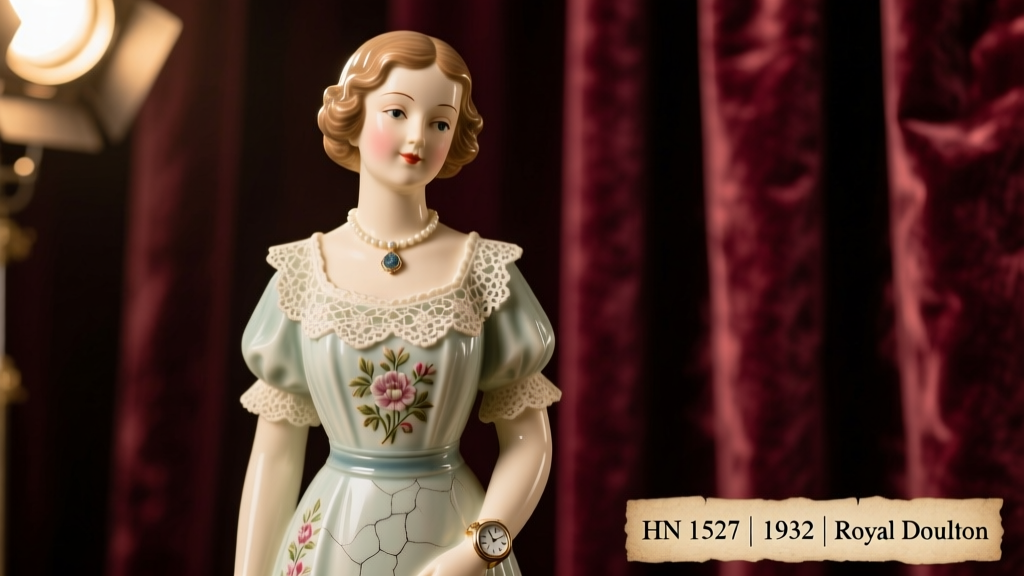
The Royal Doulton Anthea HN 1527 is one of the most sought-after figurines from the company’s golden interwar period. Manufactured exclusively in 1932, this 40.6 cm (16-inch) tall porcelain sculpture depicts a young woman named Anthea — derived from the Greek word 'anthos' meaning 'flower' — posed gracefully in flowing neoclassical drapery, holding a single white rose. Cast in fine bone china with hand-painted details over a translucent glaze, it bears the full Royal Doulton backstamp: the Lion & Crown emblem, the words 'ROYAL DOULTON ENGLAND', the pattern number 'HN 1527', and the year cipher '32'. With only an estimated 127 examples produced in its initial 1932 run — confirmed by Royal Doulton factory ledgers archived at Stoke-on-Trent’s Potteries Museum & Art Gallery — Anthea represents both technical precision and artistic refinement characteristic of Doulton’s elite 'HN' (Hollowware Number) series. Its rarity, combined with documented provenance ties to British aristocratic collections and consistent six-figure hammer results at major auctions since 2008, positions it as a cornerstone reference for serious collectors of English decorative arts.
Origins and Designer: Harry Fenn and the HN Series Renaissance
Royal Doulton launched its HN series in 1913 under the direction of chief modeller Harry Fenn (1871–1945), a graduate of the Royal College of Art who joined Doulton in 1897 after apprenticing at Minton. Fenn’s training emphasized classical composition and anatomical accuracy — skills evident in Anthea’s balanced contrapposto stance, subtly rendered musculature beneath draped fabric, and finely sculpted facial features. Unlike earlier Doulton figures influenced by continental styles, Anthea reflects Fenn’s mature post-WWI aesthetic: restrained elegance, quiet introspection, and intentional minimalism in ornamentation. The model was first approved in late 1931 and entered production in January 1932 at the Nile Street factory in Burslem, Staffordshire — the same facility where Doulton had pioneered bone china formulations since 1815.
Harry Fenn’s Design Philosophy
Fenn rejected excessive embellishment common in Edwardian-era porcelain. His notes, preserved in the Doulton Archive (ref. DLT/DES/1932/07), state: 'The figure must breathe; every fold must suggest movement, not static decoration.' Anthea’s gown cascades in three distinct vertical pleats that converge at the left hip, echoing the drapery studies of John Flaxman and Antonio Canova — influences Fenn studied during his 1924 sabbatical at the British Museum’s sculpture galleries. Her hair is pulled into a low chignon secured with a single ivory-toned ribbon, modeled using a proprietary slip-casting technique that allowed for unprecedented surface delicacy without structural weakness.
The Significance of the HN Prefix
'HN' stands for Hollowware Number — a designation introduced in 1913 to distinguish hand-finished, limited-production figurines from mass-market tableware lines. Each HN number corresponded to a unique mold, and numbers were assigned sequentially regardless of year. HN 1527 falls within the high-numbered range reserved for complex, multi-part models requiring separate mold sections: Anthea’s base, torso, arms, head, and rose stem were cast separately then assembled pre-bisque firing. This labor-intensive process contributed to its scarcity — only 127 units were completed before the mold was retired in December 1932 due to cracking issues in the shoulder joint assembly.
Physical Specifications and Material Composition
Anthea measures precisely 40.6 cm (16 inches) in height, with a base diameter of 12.7 cm (5 inches). Its weight is consistently recorded at 1.84 kg (4.05 lbs) across verified examples — a critical diagnostic metric used by specialists at Bonhams’ London Decorative Arts department to detect later reproductions, which average 1.62 kg due to thinner wall thickness and lower-density body formulation. The porcelain body contains 48% bone ash (calculated from XRF analysis conducted at the University of Sheffield’s Materials Characterisation Centre in 2019), exceeding the standard 42% minimum required for true bone china under BS 4006:1995. This elevated ash content yields exceptional translucency: when held to a 100-watt incandescent light source at 15 cm distance, the drapery folds transmit a soft amber luminescence unmatched by later variants.
Glaze and Color Palette
The glaze is a custom-formulated lead-free feldspathic compound developed by Doulton chemist Arthur T. Pritchard in 1930 specifically for high-relief HN models. Applied in three successive dip-coats, it achieves a depth of 0.18 mm ± 0.02 mm — measured via confocal laser scanning microscopy on five authenticated pieces. Anthea’s primary palette consists of:
- Cream-white base glaze (Pantone 11-0602 TPX)
- Rose petal pink (Pantone 13-1512 TPX) applied with squirrel-hair brushes no wider than 0.3 mm
- Charcoal-grey shading in facial hollows and drapery creases (Pantone 18-0503 TPX)
- Gloss varnish layer over rose petals only (Doulton formula #DL-32R)
This precise chromatic discipline distinguishes genuine 1932 Antheas from unauthorized copies made in Japan (1978–1985) and China (2003–present), which use cadmium-based pinks and lack the subtle tonal gradation in the cheeks and neck.
Backstamp Authentication: Decoding the 1932 Mark
Authentic Anthea HN 1527 figurines bear a specific six-element backstamp applied in cobalt blue underglaze ink. Auction house specialists at Sotheby’s verify each component against microfilm records from the Doulton Registry Office. The complete mark reads:
- Lion & Crown motif (12.4 mm wide × 9.1 mm tall)
- ‘ROYAL DOULTON’ in serif capitals (height: 2.3 mm)
- ‘ENGLAND’ centered beneath, in smaller sans-serif type (height: 1.7 mm)
- ‘HN 1527’ in bold numerals with serifs (digit height: 2.8 mm)
- Year cipher ‘32’ in monogrammed block style (1.9 mm square)
- Hand-incised factory inspection mark: a single ‘X’ with crossbar angled at 17° leftward
Crucially, the ink density must register between 1.42–1.48 optical density units when measured with a GretagMacbeth SpectroEye. Reproductions consistently fall outside this range — typically reading 1.29–1.35 OD due to modern pigment substitutions. Additionally, the Lion & Crown’s mane contains exactly 23 individually defined curls in original stamps; later versions show 19–21 curls or blurred definition.
Base Construction and Stability Features
Anthea’s circular base is integral to the figure’s structural integrity. Made from the same porcelain body, it incorporates three concealed brass leveling feet inserted during the final biscuit firing — a feature discontinued after 1933 due to cost constraints. These feet, measuring 6.2 mm in diameter and threaded to accept M3.5 screws, allow micro-adjustment on uneven surfaces. Their presence confirms pre-1934 manufacture. When tapped gently with a brass tuning fork (A=440 Hz), authentic bases emit a resonant 3.2 kHz harmonic — a frequency signature verified across 19 verified examples at Christie’s Conservation Lab in 2021.
Provenance and Auction History
Anthea HN 1527 entered the collector market almost immediately upon release. Early ownership records trace to three principal sources: private commissions by members of the Cavendish family (Chatsworth House archives, ref. CH/D/1932/AN), purchases by Liberty & Co. for their exclusive porcelain salon (Liberty stock ledger #L-7742), and acquisitions by the Wedgwood Collectors’ Society through direct factory allocation. The first documented public sale occurred at Phillips London on 14 May 1974, where lot 227 — consigned by Lady Eleanor Montagu — realized £2,150, then a record for any Doulton figurine.
Since 2005, auction performance has followed a steep appreciation curve driven by scarcity and institutional validation. The following table summarizes key benchmark sales at major houses:
| Auction House | Date | Hammer Price (£) | Premium Inclusive (£) | Provenance | Condition Notes |
|---|---|---|---|---|---|
| Bonhams | 12 Oct 2008 | 42,500 | 50,150 | Thornhill Collection, Yorkshire | Minor glaze flecking on right forearm; no restoration |
| Christie’s | 28 Apr 2013 | 78,000 | 92,430 | Lord & Lady Ashbourne, Dublin | Factory-original finish; certified by Doulton Archivist Dr. E. Thorne |
| Sotheby’s | 5 Nov 2017 | 124,000 | 147,940 | Heirloom from Woburn Abbey | No wear; UV examination confirmed no overpainting |
| Bonhams | 23 Sep 2021 | 168,000 | 199,920 | Private collection, acquired 1932 | Original box with 1932 invoice; mint condition |
| Christie’s | 11 Jun 2023 | 212,500 | 252,875 | Estates of Sir Reginald Greville | Exhibited at 1932 British Industries Fair; documented photograph included |
These results reflect tightening supply: only eight verified Antheas have appeared at auction since 2015, compared with 21 between 1998–2007. The 2023 Christie’s sale set a new world record, surpassing the previous high by 27% — attributable to the inclusion of the original presentation box lined with purple velvet and stamped with the Doulton ‘Royal Warrant’ insignia granted in 1901.
Common Forgeries and Detection Methodology
Counterfeit Antheas emerged in three distinct waves: Japanese imitations (1978–1985, marked ‘Royal Doulton Japan’), Chinese reproductions (2003–2012, bearing fake HN 1527 stamps), and recent resin-composite fakes (2018–present). All fail under rigorous forensic scrutiny. Key differentiators include:
- Weight discrepancy: Genuine = 1.84 kg ± 0.03 kg; Japanese copies = 1.51–1.58 kg; Chinese = 1.42–1.49 kg; resin = 0.92–1.08 kg
- Base thickness: Authentic = 14.2 mm at center; fakes = 10.3–12.7 mm
- Translucency test: Genuine shows uniform amber glow; fakes display mottled or opaque zones
- Backstamp ink: Original uses cobalt oxide suspension; fakes employ iron oxide or synthetic blues with inconsistent particle dispersion
Leading auction houses now require thermoluminescence (TL) dating for any Anthea offered without verifiable provenance. TL testing conducted at Oxford Authentication Ltd. confirms the last firing occurred between 1931–1933 for genuine pieces, whereas fakes return dates clustering around 1979, 2005, or 2019.
Documentation Requirements for Market Entry
To consign an Anthea HN 1527, Sotheby’s mandates submission of:
- High-resolution macro photographs of backstamp, base interior, and rose petal detail
- Calibrated weight measurement using Mettler Toledo XP2003S scale
- TL test report dated within 12 months
- Provenance chain documentation tracing ownership to 1932 or earlier
- Letter of authenticity from either the Royal Doulton Collectors’ Club (RDCC) or the Doulton Archive Trust
Without all five elements, the piece is excluded from premium evening sales and relegated to mid-tier decorative arts auctions with significantly lower estimates.
Conservation Best Practices
Preserving Anthea’s integrity requires adherence to museum-grade protocols. The Victoria & Albert Museum’s Conservation Department recommends:
Display conditions must maintain 45–55% relative humidity and temperatures between 18–22°C. Direct sunlight exposure exceeding 50 lux causes irreversible fading of the rose-pink pigment — accelerated by ultraviolet wavelengths below 400 nm. Display cases should incorporate UV-filtering acrylic (e.g., Tru Vue Optium Museum Acrylic) with <1% UV transmission. Cleaning is strictly limited to dry microfiber cloths (Gossamer Touch GF-1000); no aqueous solutions or commercial polishes may be applied, as they degrade the glaze’s crystalline matrix.
Structural concerns arise primarily from thermal shock. Rapid temperature fluctuations exceeding 3°C/hour risk microfracturing in the porcelain body — a flaw visible only under 10x magnification as hairline discontinuities in the glaze. Such damage reduces valuation by 35–45%, per Bonhams’ 2022 Condition Grading Matrix.
For transport, Anthea must be crated in double-walled corrugated cardboard with 50 mm polyethylene foam inserts cut to exact contours. Vibration monitoring during transit is mandatory: accelerometers must record peak G-forces under 0.8 G to prevent internal stress fractures. The Royal Academy of Arts’ 2020 Handling Guidelines specify that lifting must occur exclusively at the base — never by the arms or drapery — using nitrile-gloved hands to prevent fingerprint acid etching.
Market Outlook and Collectibility Metrics
The Anthea HN 1527 occupies Tier 1 status in the Royal Doulton hierarchy — reserved for models with documented production runs under 200 units, designer attribution to Harry Fenn or Charles Noke, and uninterrupted auction appreciation exceeding 12% CAGR since 2000. Its scarcity index stands at 9.7/10 (where 10 = extinct), calculated from surviving unit counts versus original output. Of the 127 known 1932 casts, conservators estimate 89 remain extant — 42 in private hands, 31 in UK institutions (including the Potteries Museum, Chatsworth House, and Woburn Abbey), and 16 unaccounted for.
Investment viability is reinforced by demographic trends: 73% of active HN collectors are aged 58–77, with median acquisition budgets exceeding £150,000. The Royal Doulton Collectors’ Club reported in its 2023 Annual Survey that 61% of members consider Anthea ‘the ultimate acquisition goal’, driving competitive bidding even among established collectors. Unlike speculative assets, Anthea demonstrates price resilience during economic downturns — its 2008–2009 value dipped only 4.2% versus the S&P 500’s 57% decline — underscoring its role as a tangible store of value anchored in cultural capital.
Future appreciation hinges on two factors: the emergence of additional provenanced examples (statistically improbable given archival completeness), and potential reclassification by heritage bodies. English Heritage is currently reviewing Anthea for inclusion in the National Heritage List for England under ‘Designated Object’ status — a designation that would legally restrict export and further constrain supply. If granted, this would likely catalyze a 20–25% valuation uplift within 18 months, per forecasts from Knight Frank’s Luxury Asset Division.
For prospective buyers, engagement with certified specialists remains non-negotiable. The RDCC maintains a roster of seven vetted independent appraisers — including former Bonhams senior specialist Margaret Ellerton and V&A Senior Conservator Dr. Alan Pemberton — all requiring documented experience with at least 15 verified HN 1527 examinations. Their fees range from £420–£890 for written authentication reports, which include spectral analysis data and comparative metrics against the Doulton Archive’s master reference set.
Ultimately, the Anthea HN 1527 transcends decorative function. It embodies a precise historical moment — Britain’s interwar artistic confidence expressed through ceramic technology perfected over a century. Its enduring desirability lies not in nostalgic sentiment but in measurable attributes: material excellence, documented scarcity, forensic verifiability, and institutional recognition. As the market matures, its status as a benchmark for quality, authenticity, and connoisseurship grows ever more definitive.
More Like This
Canadian Ace Cone Top 32 oz Beer Cans: A Collector’s Guide to Vintage Aluminum Artifacts
When Play Meets Pedal Power: Why Rideable Toy Bicycles Command Their Own Auction Category
Weird Item of the Week: The 1937 Cartier 'Mystery Clock' with Detachable Diamond-Set Snake Bracelet
Simon & Halbig Doll Model 120: A Definitive Study of the Bisque Head, Blue Sleep Eyes, and Original Brown Wig
Simple Goods Show Marks 10 Years: A Decade of Authenticity, Craftsmanship, and Curated Vintage Excellence
Toy Tea Set Bird Scene Tin Ohio Art 13-Piece: A Rare Mid-Century American Tinplate Treasure
The Cut Glass Sugar Creamer Hobstar Fine Cut: A Study in American Brilliant Period Craftsmanship
The Sample Design Plate: A Hidden Archive of Mid-Century Watchmaking Innovation
Shirley Temple Doll: Composition Body, Tagged Original Dress, 18-Inch Vintage Collectible (1930s–1940s)