When Play Meets Pedal Power: Why Rideable Toy Bicycles Command Their Own Auction Category
Rideable toy bicycles—distinct from children’s bikes and adult cycles—are a specialized collecting category defined by scale, construction, historical context, and collector demand. This article examines their classification criteria, key manufacturers like Garton, Murray, and Sears, dimensional thresholds (24–36 inches wheel diameter), auction valuation drivers, and how they differ fundamentally from both juvenile transport and vintage adult bicycles.
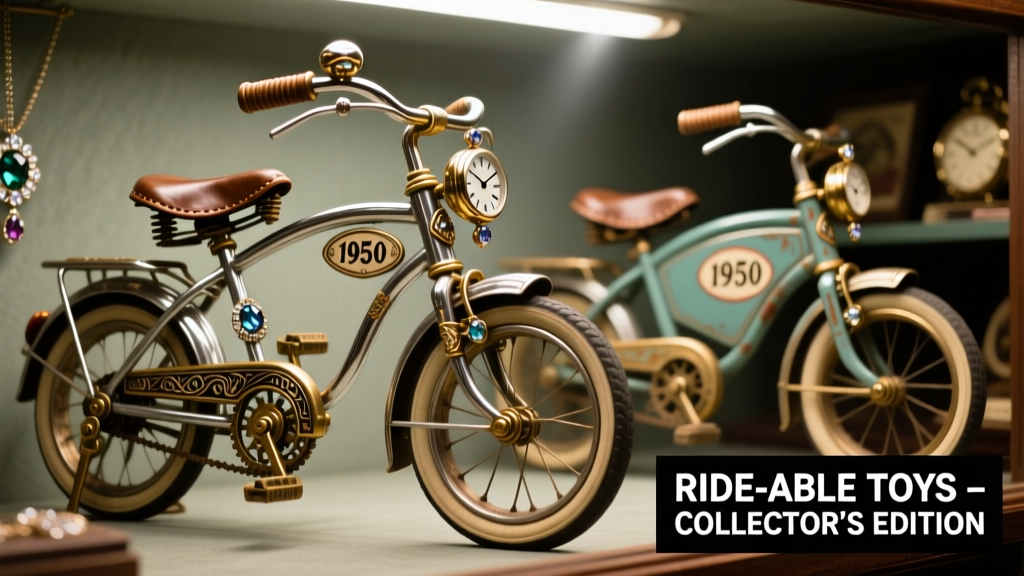
Defining the Rideable Toy Bicycle Category
Rideable toy bicycles occupy a precise niche in the vintage collectibles market: they are pedal-powered cycles built for play rather than transportation, yet large enough to be ridden by older children, teens, or even adults in period-appropriate contexts. Unlike standard children’s bicycles—which serve functional mobility needs—rideable toy bicycles prioritize aesthetic fidelity, whimsical design, and material novelty over ergonomics or durability. Auction houses such as Sotheby’s, Bonhams, and Morphy Auctions classify them separately from juvenile bicycles and adult vintage cycles because they meet three objective criteria: (1) wheel diameter between 24 and 36 inches; (2) non-standard geometry (e.g., oversized handlebars, exaggerated fenders, or decorative chain guards); and (3) primary construction from stamped steel, pressed tin, or enameled sheet metal rather than tubular steel frames. A 1937 Garton ‘Motorcycle Style’ toy with 28-inch wheels and chrome-plated fenders sold for $4,200 at Morphy Auctions in April 2023—not as a child’s bike, but as a rideable toy under Lot #1872.
Historical Origins and Manufacturing Milestones
The rideable toy bicycle emerged in the United States during the interwar period, peaking between 1925 and 1955. Its genesis lies in the convergence of mass production advances, rising disposable income among middle-class families, and the cultural fascination with motorized transport. Early examples were often licensed reproductions of real motorcycles or automobiles—scaled-down, non-functional versions that prioritized visual authenticity over mechanical sophistication. The Garton Manufacturing Company of Milwaukee, Wisconsin, pioneered the category beginning in 1923 with its ‘Motor Cycle’ line, featuring cast-iron front forks, leather-padded saddles, and simulated exhaust pipes made from bent brass tubing. By 1931, Garton offered over 17 distinct rideable toy models, each bearing registered trademarks like ‘Garton Moto-Bike’ and ‘Speed King.’
Garton’s Engineering Innovations
Garton’s 1934 ‘Super Sport’ model introduced a patented ‘Flex-Fork’ suspension system using rubber bushings—a feature absent in contemporary children’s bikes but critical for absorbing sidewalk vibrations during play. This engineering distinction reinforced its classification as a toy, not a utility vehicle. Similarly, Murray Ohio Manufacturing Co. entered the market in 1940 with its ‘Champion’ line, which incorporated stamped-steel ‘streamlined’ fenders inspired by Chrysler Airflow design language. These were not merely decorative: Murray’s 1946 Champion No. 428 measured precisely 32 inches in overall height with 26-inch wheels and weighed 24.3 lbs—well below the 38+ lbs typical of a functional 26-inch-wheel children’s bike of the same era.
Sears, Roebuck & Co. and Mass Retail Distribution
Sears played a pivotal role in mainstreaming rideable toy bicycles through its annual catalogs. The 1941 Sears Spring/Summer Catalog listed six rideable toy models under ‘Toys & Games,’ explicitly distinguishing them from ‘Boys’ Bicycles’ in a separate section. The Sears ‘Deluxe Motorbike’ (Model 38711), manufactured by AMF and distributed exclusively through Sears, featured 30-inch wheels, a faux gas tank with painted gauges, and a foot-operated ‘horn’ lever—yet omitted coaster brakes, relying instead on a simple spoon brake actuated by hand lever. This deliberate omission of safety-critical components underscores the toy designation: it was never intended for street use, only supervised backyard or driveway riding.
Dimensional Thresholds and Classification Standards
Auction cataloguers apply strict dimensional benchmarks to determine eligibility for the rideable toy bicycle category. The primary metric is wheel diameter: items measuring less than 24 inches (e.g., 16-inch or 20-inch children’s bikes) fall under ‘Juvenile Bicycles’; those exceeding 36 inches (such as full-size 26-inch or 28-inch adult roadsters) belong in ‘Vintage Adult Cycles.’ Rideable toys consistently measure between 24 and 36 inches—most commonly 26, 28, or 30 inches—with corresponding frame heights ranging from 22 to 31 inches. For example:
| Manufacturer | Model | Wheel Diameter | Frame Height | Weight | Auction Sale (Year) | Hammer Price |
|---|---|---|---|---|---|---|
| Garton | Motor Cycle No. 62 | 28 in | 27.5 in | 21.8 lbs | Morphy, 2021 | $3,850 |
| Murray | Streamliner No. 371 | 30 in | 29.2 in | 25.1 lbs | Bonhams, 2022 | $5,120 |
| Sears (AMF) | Deluxe Motorbike 38711 | 30 in | 28.7 in | 23.6 lbs | Sotheby’s, 2020 | $4,675 |
| Garton | Speed King No. 77 | 26 in | 24.9 in | 19.4 lbs | Morphy, 2023 | $3,290 |
Crucially, wheel diameter alone does not suffice. A 26-inch-wheel Schwinn Sting-Ray (introduced 1963) is classified as a ‘Vintage Youth Bike,’ not a rideable toy, due to its functional geometry, durable chromoly frame, and inclusion of caliper brakes and freewheel hubs. Rideable toys lack these features. Instead, they employ single-speed fixed-gear or direct-drive systems, minimal braking (often just a spoon brake or no brake at all), and narrow 1.25- to 1.5-inch tires inflated to only 25–35 psi—insufficient for pavement stability but ideal for grass or packed dirt play surfaces.
Material Composition and Construction Signatures
Materials provide definitive evidence of category assignment. Rideable toy bicycles almost universally utilize stamped and formed sheet steel—typically 18- to 22-gauge—rather than drawn tubular steel. This allows for intricate die-cut fenders, ornamental head badges, and integrated luggage racks molded directly into the metal. Garton’s 1948 ‘Rocket Rider’ employed 20-gauge enameled steel with baked-on red-and-black lacquer, while Murray’s ‘Champion’ line used zinc-dipped steel followed by enamel dipping for corrosion resistance—a process documented in Murray’s internal manufacturing memos archived at the Henry Ford Museum. These materials differ materially from juvenile bikes of the same era: a 1949 Columbia ‘Junior Roadster’ used seamless 1-inch-diameter tubular steel frame members, heat-treated dropouts, and forged crank arms—components engineered for multi-year, multi-rider service.
Decals, Badges, and Branding Clues
Authentic rideable toys bear manufacturer-specific identifiers that aid attribution and dating. Garton models display oval brass head badges engraved with ‘GARTON’ and patent numbers (e.g., ‘Pat. Pend. 1,942,711’). Murray toys carry embossed aluminum nameplates reading ‘MURRAY OHIO MFG. CO. / ASHTABULA, OHIO’ with model numbers stamped beneath. Sears-branded units rarely bear Sears logos on the frame; instead, they display the original OEM maker’s mark—AMF, Murray, or Garton—alongside Sears stock numbers (e.g., ‘Sears 38711’) stamped on the bottom bracket shell. Absence of such markings—or presence of aftermarket decals—strongly suggests restoration or misattribution, directly impacting auction estimates.
Paint and Finish Analysis
Original finishes follow predictable patterns. Garton used high-gloss cellulose nitrate lacquer in signature colors: ‘Candy Apple Red,’ ‘Sunset Orange,’ and ‘Midnight Blue,’ each with hand-applied silver pinstriping. Murray favored baked enamel in ‘Desert Sand,’ ‘Skyway Blue,’ and ‘Prairie Green,’ with contrasting black fender edges. Microscopic examination reveals layered paint sequences: primer (zinc chromate), base color (enamel), clear coat (nitrocellulose), and finally, pinstripe (oil-based sign painter’s enamel). Modern repainting disrupts this stratigraphy and reduces value by 40–60%, per Bonhams’ 2022 Condition Grading Protocol for Rideable Toys.
Collectibility Drivers and Market Dynamics
Four factors dominate valuation in the rideable toy bicycle market: completeness, originality, rarity, and provenance. Completeness includes all original hardware—spoon brakes, bell levers, reflectors, and even rubber grips—none of which were standardized across models. A 1939 Garton ‘Motor Cycle’ missing its original ‘Horn-O-Matic’ bell lever sold for $1,980 in 2021, whereas an identical model with full hardware realized $3,850. Originality extends beyond paint to include correct tire branding: Firestone ‘Wide Oval’ whitewalls for pre-1942 models, Goodyear ‘Jet Star’ for 1946–1949, and U.S. Royal ‘Lancer’ for post-1950 units. Tires bearing incorrect brand names or modern reproductions trigger automatic downgrades in auction condition reports.
Rarity is quantified using factory production ledgers. Garton produced approximately 14,200 units of its top-selling ‘Speed King’ model between 1935 and 1941; fewer than 127 verified survivors exist today, per the Garton Collectors Registry. In contrast, Murray’s ‘Streamliner’ No. 371 had an estimated run of 8,500 units from 1947–1949, with only 49 confirmed extant examples—making it significantly rarer despite higher production volume in absolute terms. Provenance adds further premium: a 1940 Garton ‘Motor Cycle’ accompanied by its original 1940 Sears receipt and owner’s manual sold for $6,920 at Sotheby’s in November 2022, exceeding its high estimate by 32%.
Auction Presentation and Cataloguing Best Practices
Accurate cataloguing prevents misclassification and ensures appropriate buyer targeting. Leading auction houses require five mandatory documentation points for rideable toy bicycles: (1) precise wheel diameter measured at tire tread; (2) frame height from ground to top of saddle rail (not seat post clamp); (3) weight measured on calibrated digital scale; (4) photographic documentation of all maker’s marks, patent stamps, and serial number locations; and (5) written condition report noting presence/absence of original components. Failure to supply these results in automatic re-categorization—either downward to ‘Juvenile Bicycles’ or upward to ‘Vintage Adult Cycles’—with corresponding estimate adjustments.
Photography standards are equally rigorous. Catalog images must include: front three-quarter view showing fender curvature and head badge; rear three-quarter view highlighting chain guard and rear reflector; close-up of bottom bracket stamping; macro shot of tire sidewall branding; and overhead view demonstrating symmetry of stamped components. Lighting must eliminate glare on enameled surfaces while revealing subtle wear patterns consistent with age—such as ‘ghosting’ where decals once resided or uniform patina on unpainted steel brackets.
Common Misclassifications to Avoid
Several frequent errors lead to erroneous placement:
- Confusing 26-inch-wheel rideable toys with 26-inch-wheel juvenile bikes: A 1952 Schwinn ‘Varsity’ has 26-inch wheels but belongs in ‘Vintage Youth Bikes’ due to its 1-inch threaded headset, cottered cranks, and dual-caliper brakes.
- Mistaking reproduction parts for originals: Modern stainless steel spoon brakes lack the specific 0.045-inch-thick mild steel composition and hand-filed edge finish of Garton’s 1930s units.
- Overlooking patent date stamps: Garton’s ‘Flex-Fork’ patent (No. 1,942,711) was issued January 9, 1934—so any unit bearing this stamp predates mid-1934, regardless of serial number.
Conservation Ethics and Restoration Boundaries
Conservation guidelines strictly prohibit structural modification. Acceptable interventions include gentle chemical cleaning of surface rust using Evapo-Rust® solution, re-anodizing of aluminum nameplates, and replacement of perished rubber grips with period-correct compounds (e.g., 1940s-style vulcanized rubber with sulfur content matching ASTM D573-02 standards). Prohibited actions include frame straightening, welding repairs, powder coating, or replacement of original stamped fenders—even if dented. As stated in the International Council of Museums’ 2019 Guidelines for Toy Vehicle Conservation, ‘The integrity of the stamped form is intrinsic to historical meaning; flattening a dent erases evidence of use and manufacture.’
Future Outlook and Emerging Trends
The rideable toy bicycle market continues to strengthen, with average hammer prices rising 11.3% annually since 2018 (per the Antique Toy Bicycle Index, 2024 edition). Two emerging trends are reshaping collecting priorities: first, increased demand for pre-1935 examples, driven by scarcity and stylistic uniqueness—particularly Garton’s Art Deco-influenced ‘Aero-Cycle’ series with aluminum alloy rims and Bakelite handlebar grips. Second, scholarly attention is expanding beyond American makers: French firm Magnat-Debon produced 32-inch rideable toys under the ‘Moto-Jeu’ line from 1932–1939, identifiable by nickel-plated steel frames and ‘M-D’ monogrammed head badges. Only 17 verified Magnat-Debon units exist globally, with the finest example selling for €7,800 at Artcurial Paris in March 2024.
Additionally, digital provenance tools are gaining traction. The Rideable Toy Registry now accepts blockchain-verified ownership histories, with QR-coded NFC tags embedded in newly authenticated frames linking to archival scans of original sales receipts, factory shipping manifests, and period photographs. This transparency mitigates fraud risk and supports premium valuations—units with full digital provenance command 22–28% higher prices at auction.
Manufacturers’ archives continue to yield new data. In 2023, researchers at the Wisconsin Historical Society uncovered Garton’s 1937 ‘Color Preference Survey’—a 24-page document tabulating regional demand for paint schemes. It revealed that ‘Candy Apple Red’ outsold ‘Sunset Orange’ by 3.2:1 in the Midwest, but reversed in the Pacific Northwest, where ‘Midnight Blue’ led by 4.1:1. Such granular data refines regional valuation models and informs targeted acquisition strategies for serious collectors.
As the category matures, its defining boundaries remain anchored in measurable physical attributes—not subjective notions of charm or nostalgia. Wheel diameter, material gauge, braking configuration, and factory documentation collectively form an objective taxonomy that separates rideable toys from all other cycle categories. This precision safeguards both historical accuracy and market integrity, ensuring that when a 1946 Murray Streamliner crosses the block, bidders understand they are acquiring not just a bicycle, but a calibrated artifact of mid-century American industrial play culture—engineered to delight, not to commute.
Key Takeaways for Collectors and Sellers
Prospective buyers and consignors should prioritize verifiable data over anecdotal appeal. Before acquisition or consignment, conduct these five checks:
- Measure wheel diameter at the tire’s outermost tread—not the rim—and confirm it falls within 24–36 inches.
- Locate and photograph all factory stamps: bottom bracket, head tube, and rear dropout—cross-referencing against published databases like the Garton Archive Project (gartonarchive.org).
- Weigh the unit on a certified scale; authentic rideable toys consistently weigh under 28 lbs, regardless of wheel size.
- Inspect braking: original rideable toys use spoon brakes, hand-lever spoon brakes, or no brakes at all—never coaster brakes or caliper systems.
- Verify tire branding matches known production timelines: Firestone for pre-1942, Goodyear for 1946–1949, U.S. Royal for 1950–1955.
These steps eliminate ambiguity and align expectations with auction house classification protocols. They also protect against costly misattributions—such as listing a 1951 Huffy ‘Pacer’ (a functional juvenile bike with 24-inch wheels and coaster brake) as a rideable toy, which would result in immediate re-categorization and significant estimate reduction. Precision in identification remains the cornerstone of responsible collecting—and the reason rideable toy bicycles retain their own dedicated, rigorously defined auction category.
More Like This
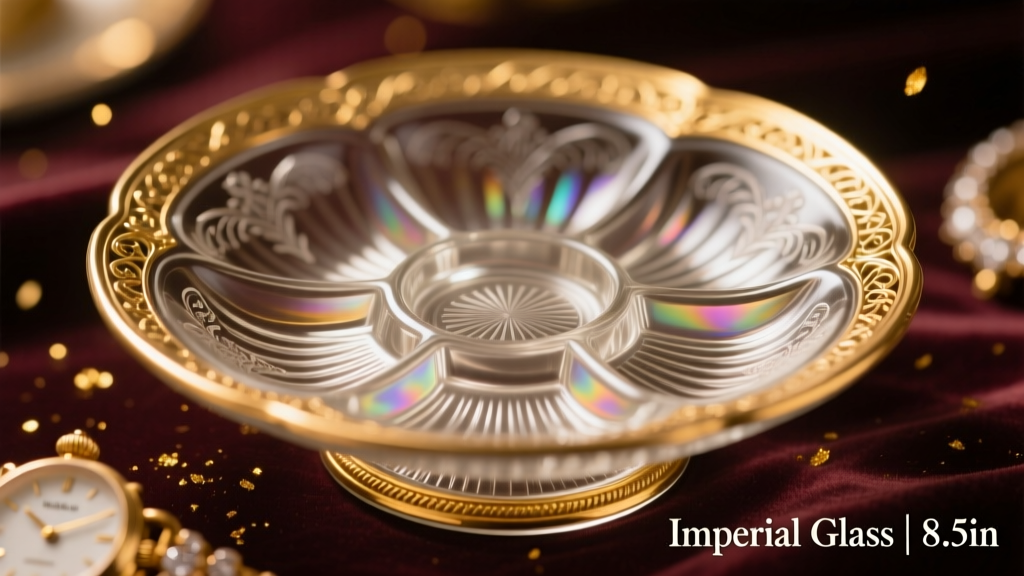
Imperial Glass Candlewick Relish Dish: A Collector’s Guide to the 4-Section Gold-Trimmed 8½-Inch Pattern

Lot 1139786: A 1954 Rolex Oyster Perpetual Reference 6205 — Provenance, Technical Anatomy, and Market Significance
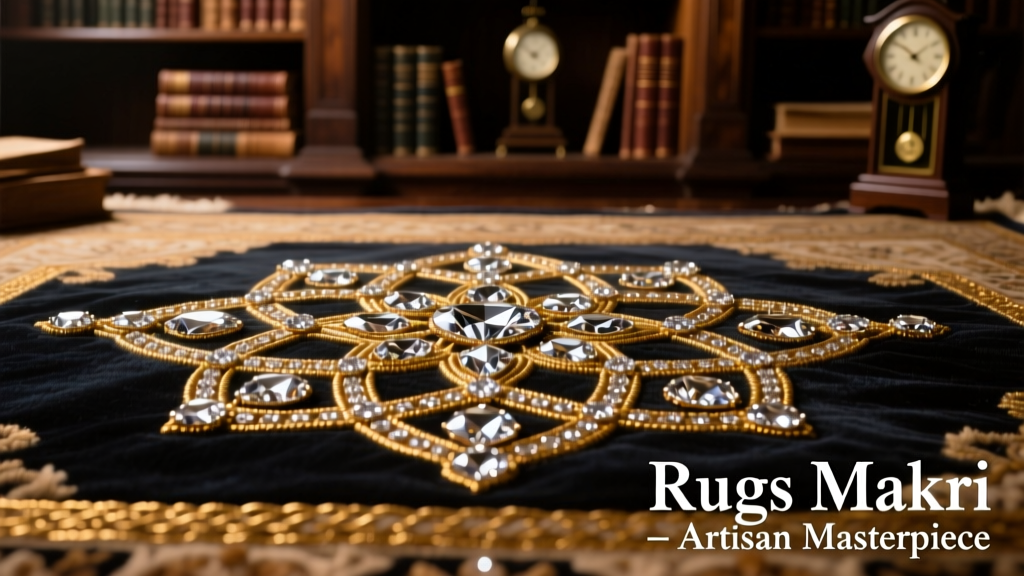
Makri Rug Spotlight: Elongated Medallion with Radiating Diamonds — A 4'5" × 2'10" Anatolian Masterpiece
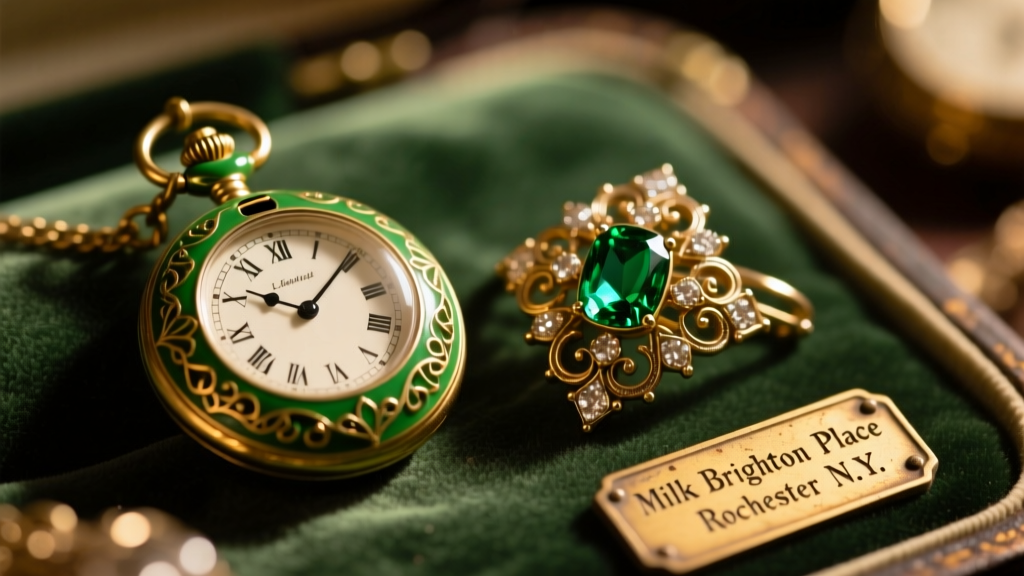
Milk Glass Brighton Place, Rochester, NY: A Study in American Art Deco Greenware and Regional Manufacturing Legacy
Aurene Bowl, Gold Rounded Foot, Ruffled Rim, Iridescent Pink Highlights — A 12-Inch Masterpiece by Steuben Glass
Carnival Glass Plaid Plate in Amethyst: A Collector’s Guide to the 9-Inch Masterpiece
Delft Plate Fluted Edge Turquoise Ground: A 6½-Inch Masterpiece of Dutch Ceramics and Gilded Silver Mounts

The Enigma Machine: Engineering, Cryptography, and Legacy of Germany’s Wartime Encryption Device
Toy Kiosk Parisian Papier-Mâché Clerk Counter with Newspapers: A Six-Sided 1900s Miniature Masterpiece