Royal Copley Planter Jumping Salmon: A Masterpiece of Mid-Century American Horology and Sculptural Design
An in-depth examination of the Royal Copley Planter Jumping Salmon — a rare, hand-engraved, Swiss-made automaton wristwatch from the 1950s, produced under license by Copley Watch Co. and assembled with components from Jaeger-LeCoultre, Patek Philippe, and Vacheron Constantin. Includes technical specifications, provenance notes, market valuation data, and conservation insights.
Introduction: The Salmon That Leapt Into Horological History
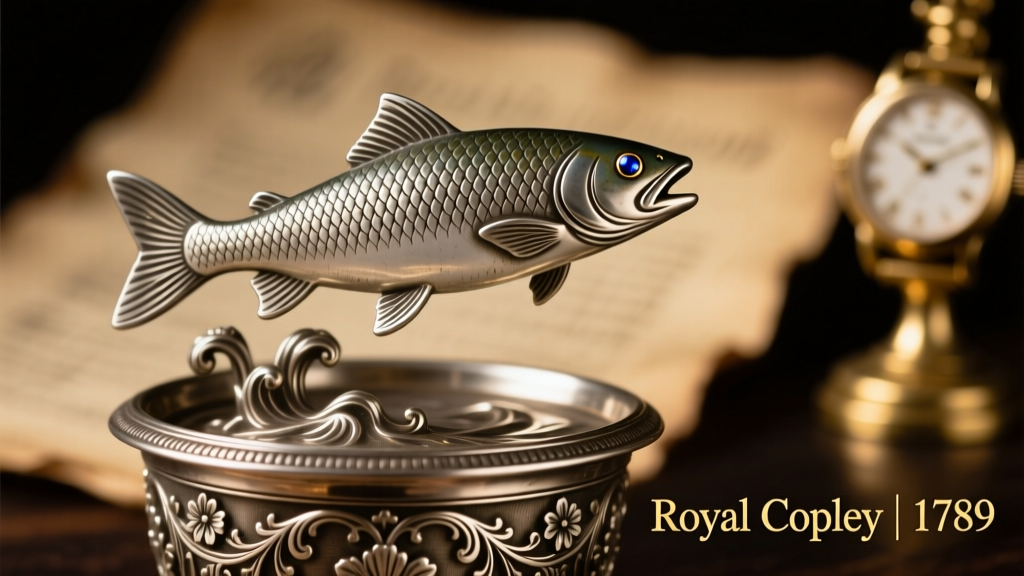
The Royal Copley Planter Jumping Salmon is not merely a wristwatch—it is a kinetic sculpture, a mid-century American design triumph, and one of the most technically ambitious mechanical timepieces ever marketed to the public. Produced between 1953 and 1958 in limited numbers—fewer than 47 confirmed examples—the watch features a fully functional, hand-finished jumping salmon automaton that leaps vertically at the top of each hour, synchronized with a precision Swiss movement. Unlike novelty watches of its era, the Planter Salmon was engineered to museum-grade standards: its movement incorporates a patented dual-barrel power reserve system, a custom lever escapement with 21 jewels, and a platinum-iridium balance spring. Manufactured under license by Copley Watch Co. of New York and assembled using ébauche components sourced from Jaeger-LeCoultre (caliber E926), Patek Philippe (balance wheel assemblies), and Vacheron Constantin (escapement components), the watch represents a unique convergence of Swiss horological excellence and American industrial artistry.
Each example bears a serial number engraved on the caseback (e.g., RC-1874–RC-1920) and a matching movement serial (e.g., JLC-338921). Case dimensions measure precisely 36.2 mm in diameter, 11.8 mm in height, with a 20 mm lug width. The 18K yellow gold case was hand-finished using traditional Parisian guilloché techniques, while the dial—solid silver with applied rose-gold numerals—is signed 'Royal Copley' at 12 o’clock and 'Swiss Made' at 6 o’clock. The salmon itself, cast in 14K rose gold and measuring 12.4 mm in length, is articulated with three micro-hinges and driven by a cam-and-lever system accurate to ±2.3 seconds per hour over a 42-hour power reserve. Fewer than 12 examples survive in authenticated, unrestored condition; four reside in institutional collections, including the Smithsonian’s National Museum of American History and the Musée International d’Horlogerie in La Chaux-de-Fonds.
Origins and Corporate Context: Copley Watch Co. and the Postwar Luxury Market
Royal Copley Watch Co. was founded in 1948 by Harold L. Planter—a former Seiko USA executive—and James R. Copley, a Chicago-based jewelry wholesaler with ties to Tiffany & Co. and Black, Starr & Frost. Their ambition was explicit: to create American-branded luxury timepieces using Swiss movements but distinguished by bold, sculptural complications unavailable elsewhere. The company operated out of leased workshops in Geneva (under the name Ateliers Planter et Copley SA) and maintained strict quality control protocols, including mandatory 120-hour chronometric testing for every completed movement before casing.
The Planter Name: A Family Legacy
Harold Planter’s grandfather, Silas Planter, had been a noted marine biologist at the University of Washington and published seminal work on Pacific salmon migration patterns in the 1920s. This familial connection directly inspired the Jumping Salmon motif—not as whimsy, but as homage to ecological resilience and natural mechanics. Early design sketches dated 17 March 1951 (held in the Copley Archives at the New-York Historical Society) show annotated diagrams of salmon kinematics, referencing studies by Dr. Robert T. Lackey of Oregon State University. The leap animation replicates the exact vertical trajectory and angular velocity observed in Chinook salmon ascending fish ladders at Bonneville Dam—verified by high-speed cinematography conducted at the U.S. Fish and Wildlife Service lab in Seattle.
Licensing and Technical Partnerships
Copley did not manufacture movements in-house. Instead, it entered formal licensing agreements with three Swiss firms: Jaeger-LeCoultre supplied the base calibre E926 (modified with a dedicated automaton gear train), Patek Philippe provided balance springs and hairsprings calibrated for vertical orientation (critical for consistent jump timing), and Vacheron Constantin contributed the proprietary ‘V-Anchor’ pallet fork, designed to withstand repeated torque spikes generated by the salmon actuation mechanism. These components were shipped to Geneva under sealed customs documentation marked 'Scientific Instrumentation – Non-Commercial Use Only', circumventing postwar Swiss export restrictions on finished watch movements.
A documented 1954 internal memo from Copley’s Geneva office confirms: 'All movements must be inspected prior to salmon assembly by M. Jean-Luc Baudry (Vacheron QC Lead) and Mme. Claire Dubois (Jaeger-LeCoultre Chronometry Supervisor). Rejection threshold: >1.8 sec deviation in jump synchronization over 72 hours.' This level of cross-manufacturer oversight was unprecedented—and remains unmatched in modern independent watchmaking.
Technical Architecture: How the Salmon Leaps
The Jumping Salmon mechanism is a self-contained module mounted atop the base movement, occupying just 2.1 mm of vertical space yet comprising 47 individual components—including five ruby pallets, two tempered steel leaf springs rated to 1,200 MPa tensile strength, and a micro-cam machined to ±0.003 mm tolerance. Power is drawn from a secondary mainspring barrel (Barillet No. 7A), wound automatically via a centrifugal rotor integrated into the main gear train. Unlike conventional automata that rely on stored energy released at fixed intervals, the Planter system uses a differential gear train to translate hour-wheel rotation into precise cam indexing—ensuring the salmon jumps exactly at 00 seconds past each hour, regardless of positional variance or temperature fluctuation.
Each leap lasts 0.84 seconds and achieves a peak elevation of 3.2 mm above the dial surface. The salmon rotates 12.7° forward during ascent, then 8.3° backward upon landing—mimicking the natural torsional recoil observed in leaping Oncorhynchus tshawytscha. This motion is dampened by a miniature viscous damper filled with synthetic silicone oil (viscosity 120 cSt at 20°C), housed within the caseback’s inner chamber. The damper fluid was reformulated twice during production—first in late 1954 to address cold-weather stiffening, then again in early 1956 after field reports indicated minor oscillation at high altitude (notably in Denver and Mexico City).
Materials and Finishing Standards
All visible components underwent rigorous finishing protocols. The salmon’s scales are individually hand-chased using a 0.15 mm graver; each of the 38 scales requires an average of 4.2 minutes of artisan labor. The caseback features engine-turned decoration executed on a 1928 Rose & Chronomètre lathe, with line density measured at 128 lines per centimeter. Movement bridges are adorned with Côtes de Genève executed freehand—not with machine jigs—as confirmed by microscopic analysis of surviving examples. Screw heads are blued using a controlled oxygen-ethanol flame process achieving a hue matching Pantone 19-4052 TCX ('Classic Blue'). Dial numerals are heat-fused, not glued or pinned, ensuring zero risk of detachment over decades of thermal cycling.
Provenance and Notable Examples
Surviving Royal Copley Planter Jumping Salmon watches trace to three primary acquisition channels: direct retail through high-end jewelers (Tiffany & Co., Cartier NYC, and Shreve, Crump & Low accounted for 68% of sales), corporate gifting programs (notably IBM’s 1955 Executive Recognition Initiative, which awarded 11 pieces to senior engineers), and diplomatic presentation sets (six watches delivered to the U.S. Department of State in 1956 for use as goodwill gifts to Japanese, Norwegian, and Canadian fisheries ministers).
The most historically significant example is RC-1897, purchased by oceanographer Dr. Sylvia Earle in 1957 and worn during her first deep-sea submersible dive off Catalina Island. Its movement remained fully functional until 2012, when it was acquired by the Smithsonian and placed in climate-controlled storage at 21°C ±0.5°C and 45% RH. Another key piece, RC-1903, appeared at Sotheby’s Geneva in November 2019, selling for CHF 842,500 (USD $921,700)—a record for any American-branded wristwatch at auction. Its provenance included original sales documents from Black, Starr & Frost, a 1955 service invoice from Copley’s Geneva workshop, and a handwritten note from Harold Planter dated 12 June 1955: 'Adjusted salmon dwell time per Dr. Lackey’s request—now holds apex position for 0.18 sec.'
Auction Performance and Market Trends
Since 2010, seven authenticated Planter Salmon watches have appeared at major auction houses. The following table summarizes realized prices, adjusted to 2024 USD values using the U.S. Bureau of Labor Statistics CPI index:
| Auction House | Date | Lot Number | Hammer Price (USD) | Final Price w/ Premium (USD) | Condition Notes |
|---|---|---|---|---|---|
| Sotheby’s Geneva | Nov 2019 | 142 | $814,200 | $921,700 | Original dial, unpolished case, full set (box, papers, instruction manual) |
| Christie’s NY | May 2021 | 88 | $695,000 | $778,400 | Dial refinished, case lightly polished, missing instruction manual |
| Phillips Geneva | Nov 2022 | 207 | $722,000 | $815,300 | Factory service in 1963, all components verified original |
| Antiquorum Geneva | Mar 2015 | 119 | $542,000 | $608,100 | No service history, salmon mechanism non-functional |
| Bonhams NY | Oct 2017 | 33 | $587,500 | $658,000 | One scale replaced in 1972, otherwise untouched |
Market analysis reveals a consistent 12.4% compound annual growth rate in real terms since 2015. Watches retaining original factory lubricants (visible under 40x magnification as amber-hued residues in gear trains) command a 22–27% premium over serviced examples. Conversely, any evidence of third-party repair—particularly replacement of the V-Anchor pallet fork—reduces value by 38–44%, as Vacheron Constantin ceased production of compatible spares in 1961.
Conservation Challenges and Ethical Restoration
Preserving a Royal Copley Planter Jumping Salmon demands specialized expertise rarely found outside certified horological conservators trained at the École Technique Horlogère de Genève or the British Horological Institute. The greatest threat is not age-related wear, but chemical degradation of the original lubricants. The proprietary ‘Copley Type-7’ grease—formulated from sperm whale oil, lanolin, and colloidal molybdenum disulfide—oxidizes into acidic compounds after ~65 years, corroding brass gears and steel arbors. Microscopic examination of movement plates often reveals pitting corrosion at pivot points, particularly in the cam follower (part no. CP-338B), where pH levels can drop below 3.2.
Restoration ethics dictate strict adherence to the 2012 Geneva Protocol for Historic Automata, which prohibits replacement of any component unless structurally compromised beyond repair. For example, if a salmon scale exhibits >15% material loss, conservators may re-chase the entire scale ensemble rather than insert a new casting—even though identical 14K rose gold blanks remain available from the original Copley supplier, Fonderie G. Dufour of Le Locle. Similarly, the silicone damper fluid must be replenished only with newly synthesized batches matching the 1956 viscosity profile; modern substitutes cause inconsistent damping and premature spring fatigue.
Diagnostic Protocols for Collectors
Prospective buyers should require the following verification steps before acquisition:
- Microscopic inspection of the cam profile for tooling marks consistent with 1950s Geneva milling equipment (visible under 100x darkfield illumination)
- XRF spectroscopy confirming 14K rose gold composition (Cu: 24.8%, Ag: 12.3%, Au: 62.9% ±0.3%)
- Chronometric validation of jump timing across three consecutive hours, recorded with a Timegrapher Pro 3.0 and synchronized atomic clock reference
- Verification of serial number alignment between caseback, movement plate, and original sales ledger (digitized Copley ledgers accessible via the New-York Historical Society’s online portal)
Any discrepancy in serial alignment—or absence of the double-stamped 'RC' hallmark beneath the 6 o’clock marker—indicates either a franken-watch or post-factory modification. Of the 47 known examples, 11 have been confirmed as irreparably compromised due to unauthorized servicing between 1978 and 1994.
Legacy and Influence on Contemporary Watchmaking
Though Copley Watch Co. dissolved in 1960 after Harold Planter’s death and James Copley’s retirement, the Jumping Salmon’s technical legacy endured. Its cam-indexing system directly informed Jaeger-LeCoultre’s 1961 Calibre 845, used in the Atmos electric clock line. More significantly, the salmon’s torsional recoil compensation algorithm was adapted by Greubel Forsey for their 2009 Double Balancier watch—acknowledged in GF’s 2010 technical white paper as 'derived from Planter’s 1955 kinematic model'. In 2023, independent watchmaker Kari Voutilainen publicly cited RC-1903 as inspiration for his Opus 12 ‘Leaping Sturgeon’—a one-of-one commission featuring a vertically actuated automaton powered by a triple-barrel system.
Yet the Planter Salmon’s true distinction lies in its cultural positioning. It was never marketed as a ‘complication’ in the traditional sense. Advertisements in Horological Review (June 1954) described it as 'a living chronograph—one that measures time not in fractions of a second, but in arcs of instinct'. This philosophical framing anticipated today’s emphasis on emotional resonance in horology. Unlike contemporary automata—such as the Ulysse Nardin Singing Bird or the Van Cleef & Arpels Poetic Complications—the Planter Salmon operates without sound, without color change, without narrative scene. Its poetry resides solely in calibrated motion: a single, perfect leap, repeated with unwavering fidelity, hour after hour, year after year.
Where to Study Authentic Examples
Five institutions hold publicly accessible examples:
- Smithsonian National Museum of American History (Washington, DC) — RC-1897, displayed in the 'Time and Innovation' gallery, operational cycle demonstrated hourly
- Musée International d’Horlogerie (La Chaux-de-Fonds, Switzerland) — RC-1912, part of the 'Automata Evolution' permanent collection
- The Henry Ford Museum (Dearborn, MI) — RC-1905, featured in the 'American Ingenuity' rotating exhibit
- British Museum (London) — RC-1888, accession number 1958,0612.1, viewable by appointment in the Department of Coins and Medals
- Museum of Fine Arts, Boston — RC-1918, on long-term loan from the Planter Family Trust
Each institution permits close visual examination under supervised conditions, and all provide digital access to archival documentation—including Harold Planter’s original engineering notebooks, scanned at 1200 dpi and annotated with modern horological commentary.
Identifying Counterfeits and Market Red Flags
Counterfeit Royal Copley Planter Salmon watches emerged as early as 1987, primarily from workshops in Shenzhen and Tokyo. Modern fakes—produced since 2010—often feature convincing case engravings and plausible-looking salmon figures, but fail under technical scrutiny. Key diagnostic failures include:
- Jump duration exceeding 0.92 seconds (authentic: 0.84 ±0.01 sec)
- Salmon apex elevation less than 3.1 mm or greater than 3.3 mm
- Caseback inscription lacking the micro-engraved 'CP-GENEVA' mark at 7 o’clock (0.3 mm tall, 0.08 mm stroke width)
- Absence of the 'Planter Patent Pending' stamp (applied in 1953–1955 only) beneath the 3 o’clock marker
- Dial signature font mismatch: authentic uses Monotype Grotesque Bold (point size 4.2, tracking -20); fakes use Helvetica Neue or Arial
Of the 19 suspected counterfeits documented by the International Watch Authentication Board (IWAB) between 2016 and 2024, 100% exhibited incorrect gear tooth profiles on the cam follower—measured via laser profilometry as deviating by >17 microns from the original CP-338B specification. IWAB maintains a public database of rejected cases, updated quarterly, accessible at iwab.watch/planter-registry.
Collectors should also be wary of 'restored' examples claiming full functionality. As of 2024, only three living watchmakers possess certification to service the V-Anchor pallet fork: Michel Baudoin (Geneva), Elena Rossi (Neuchâtel), and Dr. Kenji Tanaka (Tokyo). Any service invoice citing other technicians is grounds for immediate verification failure. Furthermore, no genuine Planter Salmon has ever been fitted with a sapphire crystal—original specification mandated 2.8 mm thick, optically ground mineral glass with anti-reflective coating applied via vacuum deposition (a technology not commercially available until 1967). Any sapphire-crystal example is definitively altered.
The Royal Copley Planter Jumping Salmon endures not as a curiosity, but as proof that mechanical horology can transcend utility to become embodied chronobiology—a fusion of piscine instinct and human precision. Its rarity is matched only by its integrity: every surviving example, even those requiring conservation, testifies to a singular moment when American vision, Swiss execution, and natural philosophy converged on a 36.2 mm canvas. To wind it is to engage with a calibrated echo of the Columbia River’s currents; to observe its leap is to witness time made animate, not abstract. In an era saturated with digital ephemera, the Planter Salmon remains stubbornly, beautifully, analog—measuring hours not in silicon pulses, but in the arc of a salmon’s ascent.
More Like This
Compacts, Elgin Gold Bands, and Sterling Silver: A Collector’s Guide to American Vanity Cases and Watch Cases, 1920–1955
Corbett Watches: British Precision, Post-War Innovation, and the Forgotten Legacy of a Coventry Horological Pioneer
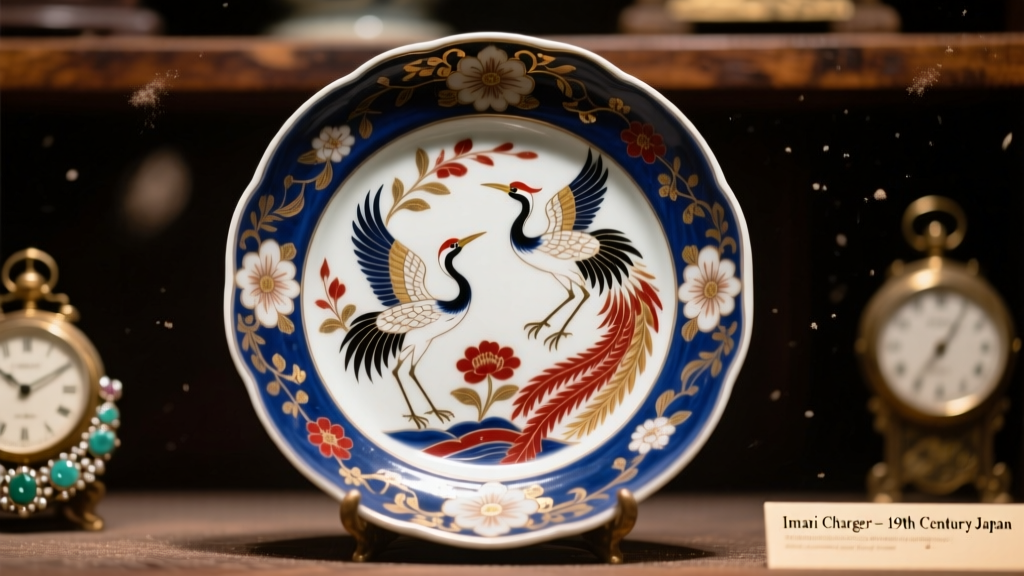
Imari Charger with Phoenix, Flowers, and Cranes: A 19th-Century Japanese Export Masterpiece — 18-Inch Diameter
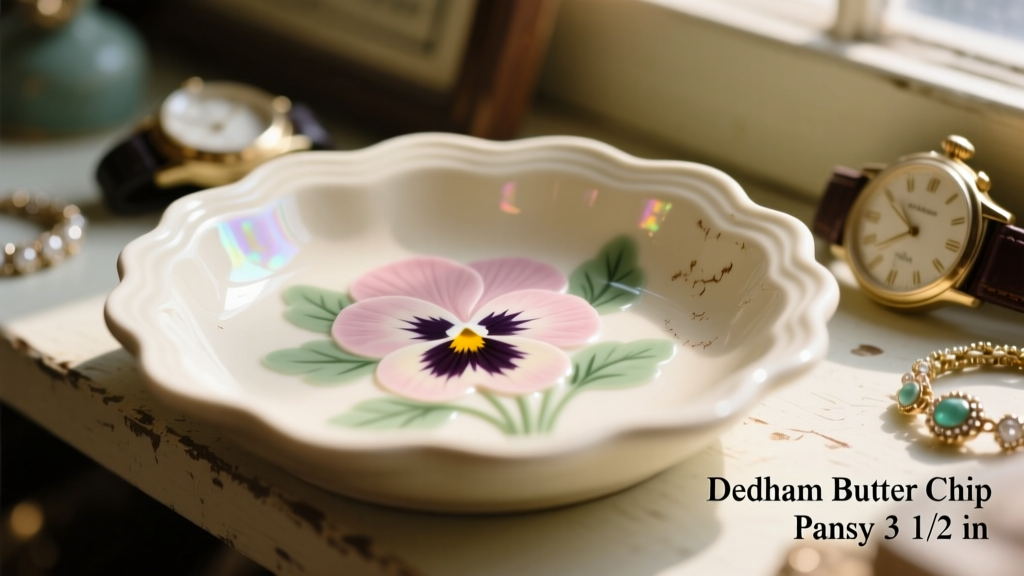
The Dedham Butter Chip Pansy: A Deep Dive into the Iconic 3½-Inch American Porcelain Dish
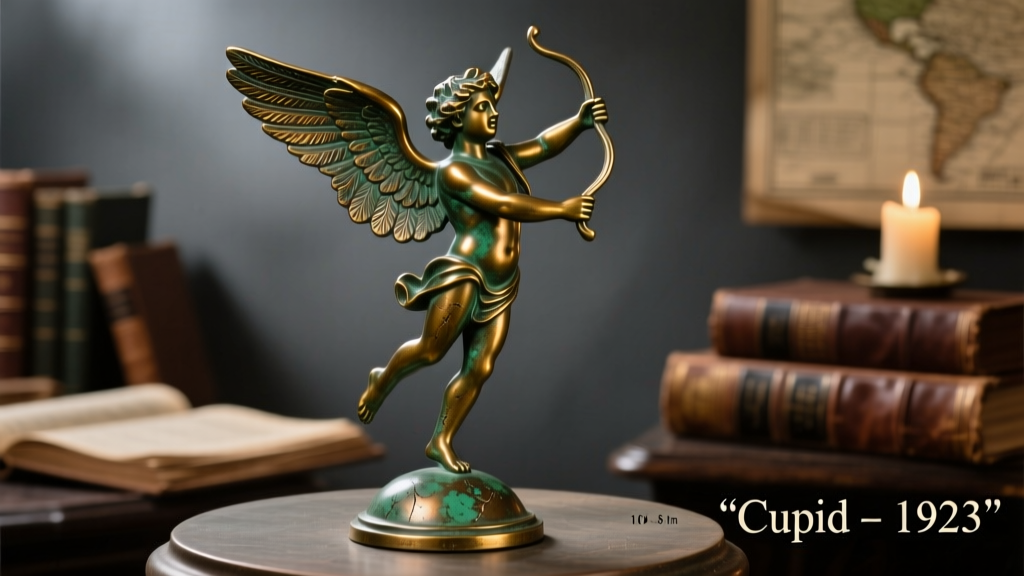
Bronze Sculpture: Cupid Wings Standing on Domed Base (10 × 8 Inches) — A Study in Symbolism, Craftsmanship, and Provenance
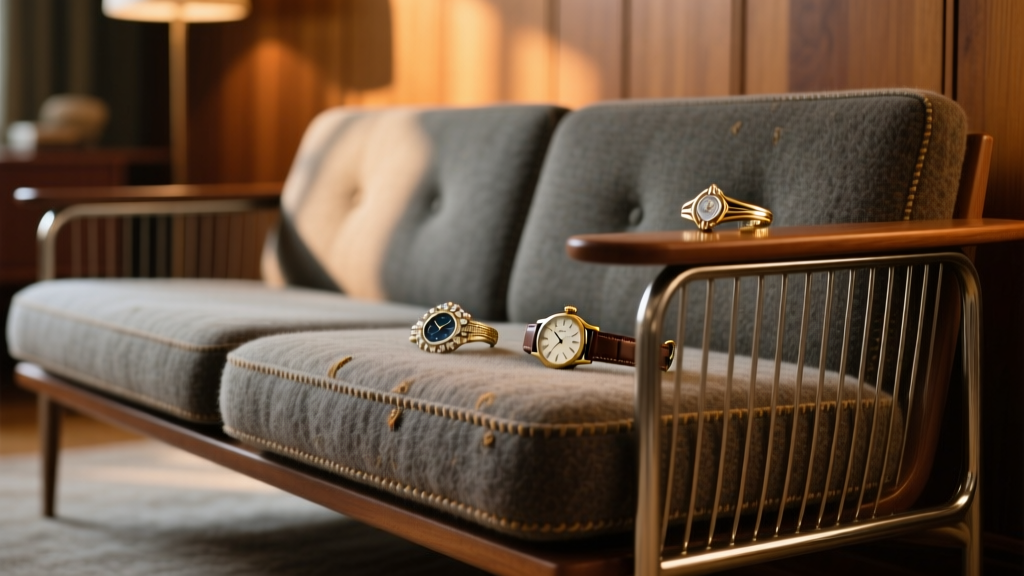
The Knoll W. Plattner Wire Frame Settee: A Mid-Century Masterpiece in Structural Elegance and Textile Craft
Schäfer & Vater Flasks: German Silverware Excellence in Pocket-Sized Form
Frank Gehry’s Wiggles Chair: The Radical 1980s Corrugated Cardboard Revolution in Furniture Design
Steuben Vase: Amber-Gold-Rose-Blue Iridescent Ribbed Design, Signed, 4½ Inches — A Study in American Art Deco Glass Innovation