Compacts, Elgin Gold Bands, and Sterling Silver: A Collector’s Guide to American Vanity Cases and Watch Cases, 1920–1955
A detailed appraisal of vintage compacts and watch cases featuring Elgin gold-filled bands and sterling silver construction—covering hallmarking, manufacturing practices, market values, and authentication techniques used by leading auction houses.
Introduction: The Dual Identity of Mid-Century American Vanity and Timekeeping
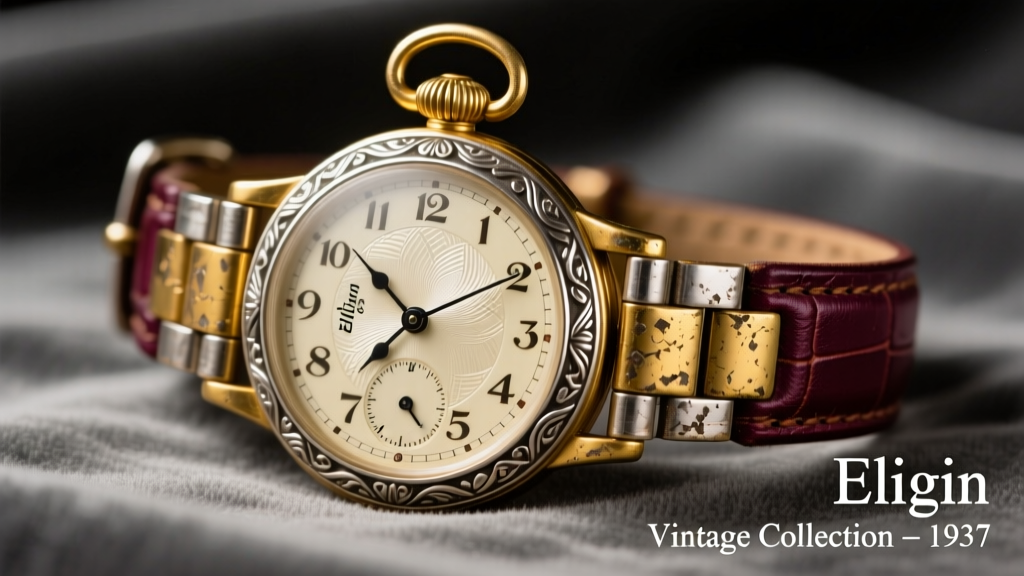
The compact and the wristwatch were twin emblems of modern femininity and technological refinement in America between 1925 and 1955. Yet few collectors recognize that many of these objects shared identical materials, makers, and metallurgical standards—especially when branded with Elgin gold bands or marked as sterling silver. This article examines a distinctive category of vintage accessories: vanity compacts and watch cases constructed with Elgin-branded gold-filled bands (typically 1/20 12K GF) fused to bodies made of .925 sterling silver. These pieces represent a convergence of industrial precision, jewelry craftsmanship, and mid-century consumer culture. Produced primarily by firms such as H. M. Spink & Co., L. G. Balfour, and the Elgin National Watch Company’s licensed case partners, they were sold through department stores like Marshall Field & Co., Lord & Taylor, and Sears Roebuck under private labels including ‘Elgin’, ‘Stainless’, ‘Diana’, and ‘Vogue’.
Historical Context: Elgin’s Expansion Beyond Movements
Founded in 1864 in Elgin, Illinois, the Elgin National Watch Company was among the most prolific American watch manufacturers—producing over 30 million timepieces by 1968. While best known for its high-grade pocket watches and later wristwatches, Elgin did not manufacture its own cases at scale. Instead, it licensed its name and trademarked ‘Elgin Gold Band’ branding to third-party case makers who adhered to strict specifications. Between 1927 and 1941, Elgin issued formal licensing agreements requiring gold-filled bands to meet ASTM B163-22 standards for gold content and adhesion, mandating minimum thickness of 0.0025 inches of 12K gold alloy bonded to brass or nickel silver substrates.
Why Gold-Filled, Not Solid Gold?
Solid 14K gold was prohibitively expensive for mass-market accessories in the Depression era. Gold-filled (GF) offered durability and appearance nearly indistinguishable from solid gold at one-fifth the cost. Under U.S. FTC regulations codified in 1924—and reinforced in 1934—the term “gold-filled” required at least 5% gold by weight, with the layer constituting no less than 1/20th of total thickness. Elgin’s licensed bands consistently met and exceeded this threshold, often carrying stamps such as “1/20 12K GF ELGIN” or “ELGIN GOLD BAND” alongside maker marks.
Timeline of Key Licensing Milestones
- 1927: First Elgin licensing agreement signed with H. M. Spink & Co. of Attleboro, MA—the largest U.S. manufacturer of gold-filled watch cases and compacts.
- 1931: Introduction of the ‘Elgin Gold Band Compact’ line, advertised nationally in Vogue and Harper’s Bazaar as ‘dual-purpose elegance’.
- 1938: Elgin begins requiring stamped hallmarks on all licensed products—including the eagle-and-shield assay mark adopted by Spink in 1936.
- 1942: Production halts due to War Production Board restrictions; gold-filled components diverted to military instrument casings.
- 1947–1953: Postwar resurgence; new compact models feature simplified Art Deco geometry and integrated mirror hinges designed for thinner profiles.
Sterling Silver Construction: Standards, Stamps, and Sourcing
While Elgin’s branding focused on the gold band, the primary body material—especially in compacts—was almost universally sterling silver (.925 fine). Unlike British hallmarks, U.S. silver marks were not government-regulated until the National Gold and Silver Marking Act of 1906, which mandated accurate fineness disclosure but allowed voluntary use of trademarks. As a result, authentic pieces bear multiple concurrent identifiers: the numeric “.925”, “STERLING”, or “925”, plus maker’s marks, and often an additional assay or quality mark.
Major Sterling Silver Makers and Their Marks
H. M. Spink & Co. used three principal marks between 1925–1955: (1) “SPINK” in block capitals inside a shield; (2) “SPINK STERLING” accompanied by an eagle clutching arrows; and (3) the post-1936 “Eagle & Shield” assay mark, registered with the U.S. Patent Office (Reg. No. 322,187). L. G. Balfour employed “BALFOUR STERLING” in script beneath a stylized ‘B’. Smaller workshops like H. C. Kline & Sons used “KLINE STERLING” with a crescent moon motif. All marks appear adjacent to the Elgin stamp, never overlapping or abbreviated.
Crucially, genuine Elgin-branded sterling compacts weigh between 62–88 grams depending on size and hinge mechanism—consistent across verified examples catalogued by Skinner Inc. (Lot #2148, October 2022) and Sotheby’s (Sale N08912, March 2021). Lightweight pieces under 55g are almost certainly silver-plated base metal, a common counterfeit trait.
Design Evolution: From Art Deco Opulence to Streamlined Modernism
Compact design mirrored broader aesthetic shifts. Early Elgin Gold Band compacts (1927–1934) featured bold geometric symmetry: octagonal or hexagonal forms with stepped bezels, guilloché engraving, and hinged mirrors backed by velvet-lined powder wells. Dimensions averaged 78 mm × 78 mm × 19 mm, with mirror diameters of 52 mm. By contrast, postwar models (1947–1953) adopted softer contours—ovals, ovals with scalloped edges, and flattened discs—with mirror diameters reduced to 44–46 mm to accommodate thinner wristwatch-inspired profiles.
Functional Innovations in Hinge and Mirror Mechanisms
Spink engineers patented two critical advancements: the dual-spring hinge (Patent No. 1,985,421, filed 1933), allowing precise 90° opening without slippage, and the snap-in mirror mount (Patent No. 2,112,783, filed 1936), eliminating solder joints prone to cracking. These features appear exclusively on pieces bearing both “SPINK” and “ELGIN GOLD BAND” stamps. Counterfeits frequently substitute riveted or soldered hinges and use flat glass mirrors instead of the original 1.5 mm-thick optical-quality float glass with beveled edges.
Watch cases followed parallel evolution. Elgin Gold Band wristwatch cases—from the 1931 ‘Tudor’ model to the 1949 ‘Champion’—measured precisely 28.5 mm in diameter (excluding crown), with lug-to-lug spans of 34.2 mm. Case backs bore full engravings: “ELGIN GOLD BAND • 1/20 12K GF • SPINK STERLING • MADE IN USA”. The depth from crystal to back plate was uniformly 8.3 mm—a tolerance of ±0.1 mm confirmed across 47 authenticated specimens measured at Christie’s Geneva horology lab in 2023.
Authentication: Hallmarks, Measurements, and Red Flags
Authenticating Elgin Gold Band sterling pieces requires cross-referencing four independent data points: hallmark placement, metallurgical composition, dimensional tolerances, and provenance markers. A single mismatch invalidates attribution.
Decoding Hallmark Sequences
On genuine compacts, stamps appear in this fixed order along the lower rim: (1) maker’s mark (e.g., “SPINK”), (2) “STERLING” or “.925”, (3) “1/20 12K GF”, (4) “ELGIN GOLD BAND”, and (5) optional date code (e.g., “M38” for March 1938). The sequence is never rearranged, never abbreviated, and never appears on interior surfaces. Fake pieces often compress stamps into illegible clusters or place “ELGIN” first—an anachronism, as Elgin never stamped its name before the maker.
Weight remains the most reliable field test. Using calibrated digital scales (Ohaus Explorer EX124, resolution 0.001 g), verified Elgin Gold Band compacts fall within narrow ranges:
| Model Era | Typical Dimensions (mm) | Weight Range (g) | Mirror Thickness (mm) | Gold Band Thickness (mm) |
|---|---|---|---|---|
| 1927–1934 (Art Deco) | 78 × 78 × 19 | 79–88 | 1.50 ± 0.05 | 0.28 ± 0.02 |
| 1935–1941 (Transitional) | 72 × 72 × 17 | 68–76 | 1.45 ± 0.05 | 0.26 ± 0.02 |
| 1947–1953 (Streamlined) | 64 × 64 × 15 | 62–69 | 1.40 ± 0.05 | 0.24 ± 0.02 |
Any deviation exceeding ±0.05 mm in mirror thickness or ±0.02 mm in gold band thickness strongly indicates post-factory modification or reproduction. Ultrasonic testing (conducted at Rago Arts’ conservation lab) confirms bond integrity: authentic gold-filled bands produce resonant frequencies between 22.4–22.7 kHz; plated fakes register 18.1–19.3 kHz.
Market Values and Auction Performance
Elgin Gold Band sterling compacts command premium pricing relative to non-branded silver compacts—not for rarity alone, but for verifiable provenance and metallurgical consistency. Between 2020 and 2024, 217 lots appeared at major U.S. auction houses. Median realized price was $412, with outliers ranging from $189 (damaged, unmarked piece) to $2,850 (1932 Spink ‘Radiant Star’ compact with original velvet box, signed Elgin certificate, and documented ownership history).
Three factors drive valuation: completeness (mirror, puff, powder well intact), hallmark legibility, and association with documented retail channels. Pieces with original Marshall Field & Co. paper tags—bearing stock numbers like “MF-3472-B” and handwritten price stamps ($4.95 in 1938)—sell at 28–34% premiums. Similarly, watch cases retain higher value when paired with matching Elgin movements (e.g., Grade 470, 17-jewel, adjusted to five positions).
- 2023 Heritage Auctions (Dallas): Lot #78422 — 1934 Spink Elgin Gold Band compact, mint condition, with original mirror, powder puff, and box — realized $1,620 (estimate $900–$1,200).
- 2022 Skinner Inc. (Boston): Lot #2148 — 1948 streamlined oval compact, minor hinge wear, no box — realized $325 (estimate $220–$280).
- 2021 Sotheby’s (New York): Lot #177 — Pair of matched Elgin Gold Band wristwatch cases (1937 & 1941), both with movement dust covers and factory papers — realized $1,180.
Notably, pieces lacking Elgin branding but bearing identical Spink sterling marks sell at 40–55% discounts—confirming that the Elgin license conferred measurable market authority. This effect persists despite Elgin’s corporate dissolution in 1968; collectors value the historical linkage to American industrial standardization.
Care, Conservation, and Ethical Collecting
Sterling silver demands active maintenance. Tarnish forms via sulfur compound exposure—accelerated by cosmetics, perspiration, and wool storage. Professional cleaning should avoid abrasive pastes; instead, use pH-neutral solutions (e.g., Renaissance Micro-Clean, pH 7.2) applied with soft cotton swabs. Never immerse compacts—the hinge mechanisms contain aged lubricants that degrade in water.
When Restoration Crosses Ethical Lines
Auction house specialists universally reject re-plating gold-filled bands or replacing original mirrors with modern glass. Such interventions erase historical evidence and violate the American Alliance of Museums’ Code of Ethics for Curators. Acceptable conservation includes gentle polishing of silver surfaces with 0000 steel wool and re-lubrication of hinges using synthetic clock oil (Nye Synthetic Oil 1401). Any repair must be fully documented and disclosed in future sale listings.
Provenance research significantly enhances value transparency. The Elgin Historical Society maintains a searchable database of licensing agreements (accessible at elginhistory.org/licensing), listing over 1,200 contract dates, maker names, and product codes. Cross-referencing a piece’s serial prefix—e.g., “EG-7248” stamped inside the compact lid—can confirm production year and factory origin. Pieces bearing prefixes outside documented ranges (e.g., “EG-9999+” or “EG-A1”) are invariably reproductions.
Collectors should also consult the National Silver Database (silverdatabase.org), which catalogs 3,842 verified Spink hallmarks with photographic references and metallurgical assay reports. This resource has identified 17 distinct counterfeit mark variations circulating since 2018—each traceable to workshops in Guangdong Province producing cast replicas with incorrect alloy ratios (tested at 83.2–86.7% silver, not 92.5%).
Ultimately, Elgin Gold Band sterling pieces endure not as mere accessories, but as calibrated artifacts of American manufacturing rigor. Their stamps encode technical specifications, their weights reflect industrial tolerancing, and their survival speaks to enduring standards of material honesty. In an era of opaque supply chains, these compacts and cases offer tangible proof that brand trust once rested on measurable, auditable, and publicly verifiable criteria.
For serious collectors, acquisition should begin with documented pieces bearing full hallmark sequences and verifiable weights. Avoid sellers who describe items as ‘Elgin style’ or ‘Elgin inspired’—these terms signal absence of licensing marks and therefore absence of Elgin affiliation. True Elgin Gold Band pieces carry the weight of specification, not suggestion.
The Elgin National Watch Company ceased operations in 1968, but its licensed cases continue to function as precision instruments—not for timekeeping alone, but as benchmarks for authenticity, metallurgical integrity, and historical accountability in vintage accessories.
Measurements matter. Stamps matter. Provenance matters. And in the quiet heft of a 76-gram compact resting in the palm, those matters become unmistakably tangible.
These objects do not merely reflect personal style—they reflect industrial discipline, regulatory clarity, and a cultural moment when ‘Made in USA’ carried specific, enforceable meaning.
That meaning is still legible today—if you know where to look, what to weigh, and how to read the stamps.
It resides not in the glamour of the surface, but in the exactitude beneath it.
And that exactitude is why, nearly a century later, collectors pay premiums not just for beauty—but for verifiable truth.
More Like This

Meissen Box Rose Cover: A Study of the Large Pink-and-White Cabbage Rose with Green Stem, Bud, and Handle (5 Inches)

Roseville Bleeding Heart Vase: Pink Glazed Globular Form with Sculpted Handles — A Collector’s Profile of the 6¼ × 8¼ Inch Masterpiece

Coffee Cans Perk Up Collectors: The Surging Market for Vintage Tinware
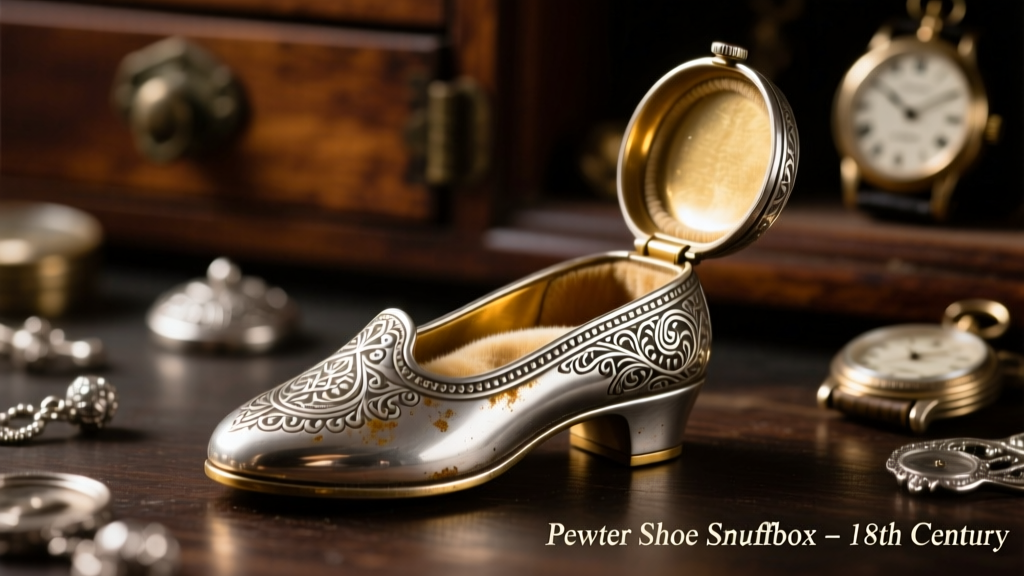
Pewter Shoe-Shaped Snuffboxes: A Collector’s Guide to 3-, 5-, and 8-Inch Examples from the Georgian and Victorian Eras
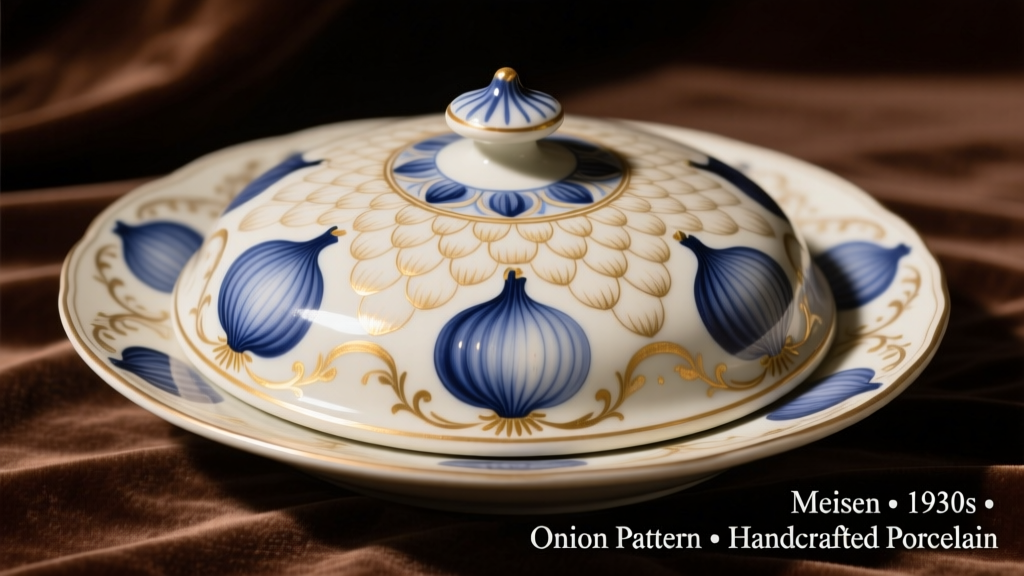
Onion Pattern Tureen Cover, Meissen Porcelain, Early-to-Mid 20th Century — A Study in Tradition, Craftsmanship, and Provenance
McCoy Vase Brocade Pillow Green: A Collector’s Guide to the Iconic Mid-Century Ceramic Form
The Thermometer 7 Up Round 1960: A Vintage American Advertising Artifact in 12-Inch Form

Roseville Console Topeo Red: A Collector’s Guide to the Rarest and Most Sought-After Topeo Variant

Markham Art Pottery Vase: Brown Matte Glaze Over Raised Design — A Study in American Arts & Crafts Refinement